Tag: disaster

  • Queensland’s Ten Worst Maritime Disasters

    The wreck of the Steamer Gothenburg. Source: Australasian Sketcher, 20 Mar 1875, p. 13.

    TEN: SOVEREIGN, 1847.
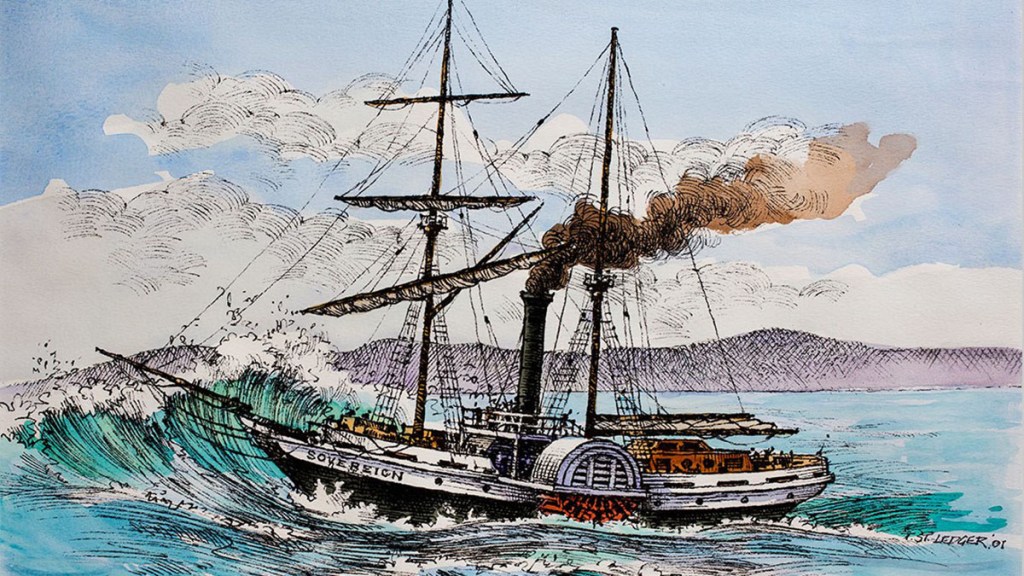
    The Sovereign. Image courtesy Stradbroke Island Heritage Museum.

    The paddle steamer Sovereign, with 54 persons on board, sailed from Moreton Bay via the southern channel on 11 March 1847.   As she ploughed through the large swells funnelled into the passage between Moreton and Stradbroke Islands, her engines failed at a critical moment.      The force of the breaking waves quickly drove her onto a sand spit projecting from the southern point of Moreton Island, where she broke up.    Forty-four people lost their lives.   The owners of the vessel would later claim the engines had been working fine and blamed the captain for the loss.     

    NINE: MERSEY, 1804.

    On 24 May 1804, the 350-ton merchant ship Mersey sailed from Sydney bound for Bengal, India, via Torres Strait.     In mid-June she was wrecked while trying to negotiate the dangerous waters of Torres Strait.   Neither the location or the circumstances of the tragedy are known, other than the captain and either 12 or 17 of the crew took to the longboat and made it safely to Timor Island to report the loss.   She reportedly sailed with 73 hands which means 56 or 61 people lost their lives.

    EIGHT: PERI, 1871.
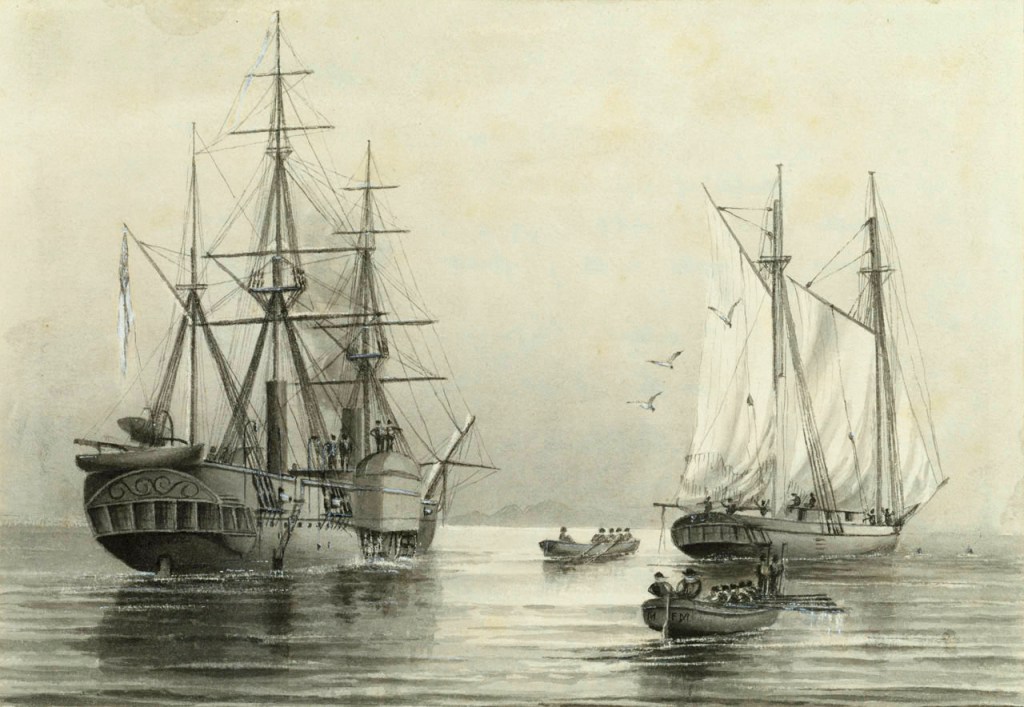
    HMS Basilisk and the Peri. Image Courtesy the British National Maritime Museum, Greenwich.

    In early February 1871 HMS Basilisk discovered a schooner, later identified as the Peri, adrift and seemingly abandoned a short distance off the Queensland near Cardwell.   When a boat was sent across to investigate, they discovered 14 emaciated Solomon Islanders, three corpses, no food or fresh water and five feet of putrid seawater in the hold. The Peri had last been seen about six weeks earlier in Fiji carrying around 80 or 90 blackbirded Islanders bound for Fijian cotton plantations.   It seems that the Islanders had overpowered their kidnappers and taken control of the schooner.   They then sailed or drifted west across almost 3,000 km of open ocean, withstood at least one severe tropical storm, and passed through a gap in the Great Barrier Reef before being found.      As many as 75 people likely died during the ordeal.

    Map showing 10 worst maritime disasters off Queensland. Courtesy Google Maps

    SEVEN: SYBIL, 1902.

    The labour schooner Sybil disappeared sometime after leaving the Solomon Islands on 19 April 1902 bound for Townsville with a fresh batch of South Seas labourers.    By August, grave fears were held for the Sybil, for the voyage should not have taken more than two or three weeks.    Searches were made of the islands along the outer Great Barrier Reef and in the Coral Sea but no trace of the vessel or any of those on board were found.   She had a crew of 12 and on the previous two voyages, she had carried 90 and 98 labour recruits, so it is thought no less than 100 lives were lost.

    SIX: GOTHENBURG, 1875

    Gothenburg. Photo Courtesy SLQ

    The steamer Gothenburg sailed from Darwin on 17 February 1875 bound for Adelaide via Australia’s east coast.   On 24 February the Gothenburg was steaming down the coast in the vicinity of Cape Bowling Green.   Bad weather meant they could not see the regular landmarks to aid their navigation. The captain was unaware strong currents were pushing the ship towards the Great Barrier Reef until it was too late. The Gothenburg ran aground on Old Reef.   The ship and all aboard her would likely have been saved but for a powerful cyclone bearing down on them.   As the storm worsened, the captain ordered the evacuation of the passengers, but as the women and children were being loaded into the lifeboats a succession of huge waves swept over the ship.    Only 22 people survived.  As many as 112 passengers and crew lost their lives.  

    FIVE: YONGALA, 1911
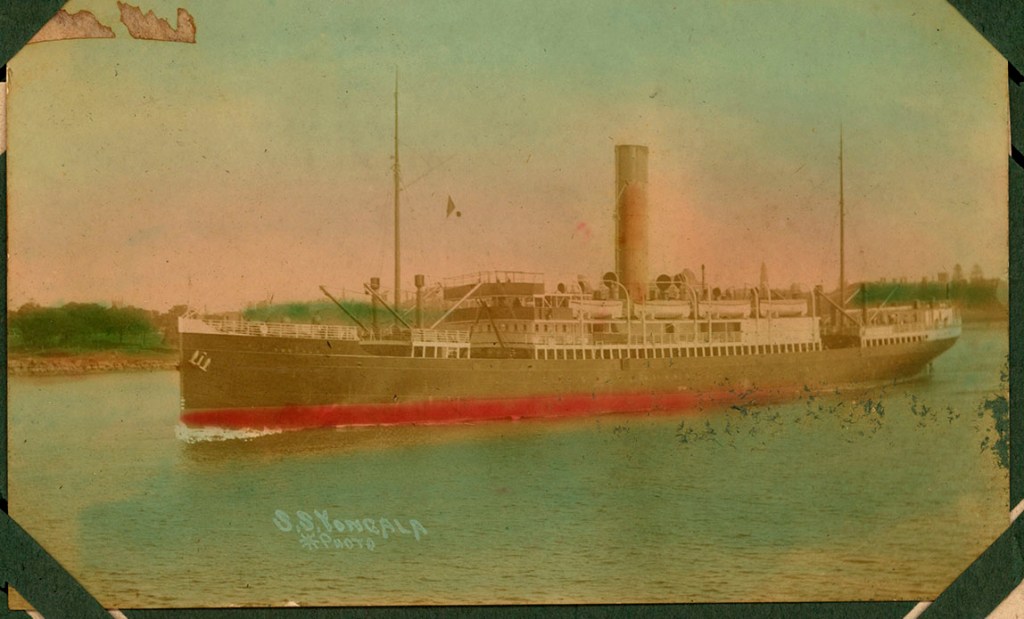
    S.S. Yongala. Photo Courtesy SLQ.

    The Yongala sank during a tropical cyclone near Cape Bowling Green on 11 March 1911 with the loss of all 122 people on board.    When the ship failed to arrive in Townsville as scheduled, concerns were raised.   Then, wreckage began washing ashore along the coast as far away as Hinchinbrook Island.   However, there was no sign of the ship or any hint as to where she might have sunk.   Nearly half a century would pass before the final resting place of the Yongala was conclusively located. 

    FOUR: QUETTA, 1890

    RMS Quetta. Photo courtesy SLQ

    While the Mail Steamer Quetta was steaming through Torres Strait on the night of 28 February 1890, it struck an uncharted rock pinnacle as it passed Adolphus Island.   The Quetta had departed from Brisbane bound for London carrying nearly 300 people comprising the passengers and crew when disaster struck.   The collision tore a gaping hole in the hull from bow to amidship, and the ship sank in just three minutes.    One hundred people made it safely to Little Adolphus Island where they were later rescued.   Dozens more were pulled from the water the following day.    133 people lost their lives in the tragedy.

    THREE: AHS CENTAUR, 1943

    AHS Centaur. Photo Courtesy State Library of Queensland

    At 4 am on 14 May 1943, the Australian Hospital Ship (AHS) Centaur was torpedoed and sunk by a Japanese submarine.    The Centaur was about 35km off Moreton Island having departed Sydney with medical staff from the Army’s 2/12 Field Ambulance bound for Port Moresby.   In all, there were 332 people on board.   268 lost their lives.   64 survived by clinging to debris and two damaged lifeboats until they were rescued 36 hours later.

    TWO: CYCLONE MAHINA, 1899

    Cyclone tracks for Cyclone Mahina.

    On the night of 4/5 March 1899, a powerful cyclone crossed the coast at Bathurst Bay on Cape York Peninsula. Lying directly in its path was the North Queensland pearling fleet which had sought shelter there.     Nearly 60 vessels – from large schooners to pearling luggers – were sunk or driven ashore with horrendous loss of life.    Between 300-400 people died in what is no doubt Queensland’s worst natural disaster.    The loss was most keenly felt on Thursday Island where the pearling fleet was based.

    ONE: GRIMENEZA, 1854

    Artists impression of the Grimeneza . Image Courtesy SLQ

    The worst shipwreck off the Queensland coast occurred on 3 July 1854.   The Peruvian ship Grimeneza was sailing from China with some 600 Chinese labourers bound for the Callao guano mines in Peru.   When they struck a reef at Bampton Shoals in the Coral Sea, the captain and six others immediately abandoned the ship leaving the rest of the crew and the passengers to their fate.  The rest of the crew tried to back the ship off, but when that failed, they too took to the lifeboats and were picked up 12 days later.   Miraculously, the Grimeneza floated off with the next high tide.   The labourers sailed the damaged ship west towards the Queensland coast with the pumps being worked around the clock.   But after three days of exhausting work, she foundered.   Six men were found clinging to a piece of wreckage 300 km off the coast a few days later.   The rest had all drowned or been taken by sharks.
    © Copyright, C.J. Ison / Tales from the Quarterdeck, 2024.

    If you would like to be notified of future blog posts, please enter your email address below.

  • The Banshee’s Terrible Loss, 1876.

    Australian Illustrated News, 15 May 1876.

       The Banshee steamed out of Townsville at 6 o’clock on the morning of Tuesday, 21 March 1876, bound for Cooktown, some 240 nautical miles (450 km) up the Queensland coast. Captain Daniel Owen had command of the 58-ton steamer and its crew of 10 men.   On this trip, the Banshee was carrying 30 paying passengers, and 12 stowaways.   Almost everyone was on their way to the Palmer River, where gold had recently been discovered.   But disaster would strike long before they reached their destination.

       A moderate breeze blew from the southeast, accompanied by some drizzling rain, as they left Townsville.   But nothing about the dismal weather hinted at the violent storm that would engulf them seven hours later.   At 1.30 p.m., when a few kilometres off the southern end of Hinchinbrook Island, they were lashed by hurricane-force winds, high seas, and torrential rain. Visibility was reduced almost to zero.

       Captain Owen did not see land again for over an hour as he steered a north-north-westerly course along Hinchinbrook’s east coast. In his 35 years at sea, he had never experienced such ferocious weather. So, he decided to exercise caution and seek shelter at Sandwich Bay. Once some normality had returned to the world, he would continue on to Cooktown. Captain Owen ordered the engines slowed to half speed and he placed a lookout forward to warn of any dangers.   

    Then, a little after 3 o’clock, the lookout sighted land dead ahead. The rocky cliffs of Cape Sandwich loomed out of the pelting rain before them. Captain Owen ordered the helmsman to steer “hard a port” and for the engines to increase to full speed. The bow started to come around, but it was too little, too late. The Banshee struck aft and was slammed broadside onto the rocks. Had they cleared that promontory, they would have made it safely into the sheltered waters beyond. But that was not to be.

    Map showing Banshee wreck site. Courtesy Google Maps.

       The ship almost immediately started breaking up. The saloon house gave way under Captain Owen’s feet. “I jumped from the saloon to the top of the steam chest, and from there to the top of the house aft,” Owen later recalled, “and stuck to the mizzen rigging.”

       Around the same time one of the passengers, Charles Price, grabbed hold of the boom as the ship ran aground, but when the funnel came crashing down, it knocked him onto the deck. From there, he climbed up on the side rail and leapt onto the rocks. Not all the passengers were so lucky. Many jumped into the sea in panic and drowned before they could scramble to safety. Price went to the aid of one female passenger clinging to the rocks as the waves crashed about her. He reached down but only got a handful of hair before she was swept away.

       The ship’s stewardess had a lucky escape. She was seen clinging to a piece of wreckage in that dangerous space between the ship and the rocks. Before anyone could get to her, she was dragged under the vessel before coming back up again. This time, she caught hold of a rope and was pulled to safety. Price tried to save another passenger who he saw struggling to get clear of the waves. But before he could reach the man, he was washed from the rocks and crushed by the ship.

       Another pair to have a lucky escape were the Banshee’s cook and a stowaway. They had remained with the ship until it was washed high on the rocks and then stepped off through a rent in the hull.

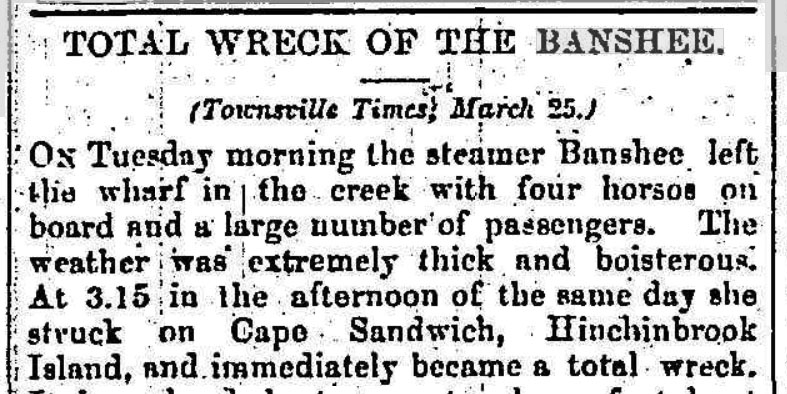
    Total Wreck of the Banshee. Mackay Mercury, 1 Apr 1876, p. 3.

       Captain Owen lost his perch in the mizzen rigging and found himself fighting for his life in the water. Twice he reached the rocks and twice he was washed back out into the cauldron. But on the third attempt, he got a firm hold and was able to clamber to safety above the pull of the waves.

       A passenger named Elliot Mullens was reading in the saloon when he heard someone call, “We are going aground.” He rushed onto the main deck just as the Banshee struck. Mullens climbed onto the bridge and, from there, launched himself across to a rock but was immediately washed off by a giant wave. Fortunately, he latched onto another rock, and despite being pummelled by successive waves, he scrambled out of the danger zone somewhat unscathed.

       “I turned, and just then the saloon … was smashed to atoms, burying beneath it four women and four children, whom we never saw again,” he later recalled. “Five minutes from the time of striking, all was over – all were saved or hopelessly gone from our sight forever.”

    In all, 17 people lost their lives, including all the children and women on board, except the stewardess. The survivors, most nursing deep cuts, bruises or broken bones, spent a cold, wet and miserable night on land. The next morning, two bodies were found washed ashore. Captain Owen held a brief service over them as they were buried where they lay.   

    By now, the storm had blown itself out, leaving a dead calm in its place. Six men volunteered to cross Hinchinbrook’s thickly forested and mountainous interior so they could signal the small settlement of Cardwell for help. Meanwhile, Captain Owen and everyone else remained where they were, but they did not have long to wait to be rescued.

    Hinchinbrook Passage circa 1880s. Source: Picturesque atlas of Australasia 1886.

       Around 6 p.m., someone cried out, “Sail Ho.” And, sure enough, there was a sailing vessel out to sea heading south. A large red flannel blanket was hastily hoisted on a makeshift mast, and everyone waited, praying that they would be seen.

       Five minutes later, the schooner The Spunkie turned towards land to investigate. But it was only by chance that the survivors had been spotted. The Spunkie’s mate had recently purchased a new telescope and was want to look through it at any opportunity. Luckily, when he brought it to his eye this day, he spotted the red flag and the bedraggled survivors lining the shore. By 10 o’clock that night, everyone had been transferred to the schooner, and they continued on their way to Townsville. The six men who crossed the island were picked up by the steamer Leichhardt as it was passing through the Hinchinbrook Passage.   

    A Marine Board Inquiry concluded the Banshee was lost due to the stress of the weather. Although they believed that Captain Owen had erred in not heading further offshore than he did, they found that “he acted as he believed for the best under very trying circumstances.”

    © Copyright C.J. Ison / Tales from the Quarterdeck, 2024.

    Please enter your email address below to be notified of future blogs.