Sixty bite-sized stories from Australia’s maritime past
The melancholy loss of H.M.S Sirius off Norfolk Island by George. Raper. Source National Library of Australia 136507434-1
I have just launched a new book titled Tales from the Quarterdeck: Sixty bite-sized stories from Australia’s maritime past. Sixty of the most popular posts have been reedited. In some cases, I’ve rewritten a couple and updated a few where new information has come to light since first writing them.
For those who would value ready access to the stories in their bookcase, Tales from the Quarterdeck is available in Kindle ebook and paperback formats through Amazon.
The stories are organised in chronological order, starting with the Tryall shipwreck off the Western Australian coast in 1622, and finishing with the Second World War exploits of the Krait. See below for a full list of the stories covered in the book.
Sydney Gazette 22 May 1808, p. 2.
1622 – The Tryall: Australia’s earliest shipwreck
1629 – The Batavia Tragedy
1688 – William Dampier: Navigator, naturalist, writer, pirate
1770 – The Endeavour’s Crappy Repair
1788 – Loss of La Astrolabe and La Boussole, a 40-Year Mystery
1789 – Bligh’s Epic Voyage to Timor
1789 – HMS Guardian: All Hands to the Pumps
1790 – The Loss of HMS Sirius
1790 – Sydney’s First Desperate Escape
1791 – HMS Pandora: Queensland’s earliest recorded Shipwreck
1791 – William Bryant’s Great Escape
1797 – The Loss of the Sydney Cove
1803 – Loss of HMS Porpoise
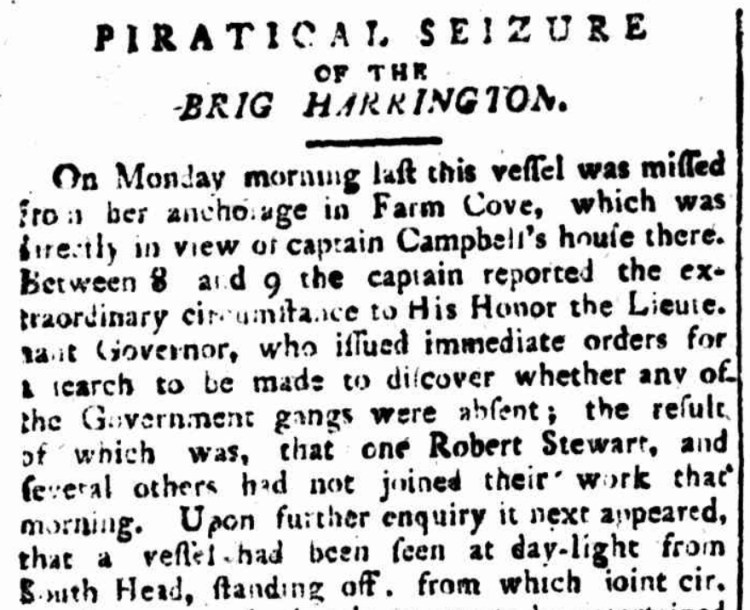
1808 – Robert Stewart and the Seizure of the Harrington
1814 – Wreck of the Morning Star
1816 – The Life and Loss of HMSC Mermaid
1824 – The Brig Amity’s Amazing Career
1829 – The Cyprus mutiny
1831 – The Caledonia’s perilous last voyage
1833 – The Badger’s Textbook Escape
1835 – The Loss of the Convict Ship Neva
1835 – The Post Office in the middle of nowhere
1835 – The Tragic Loss of George III
1845 – The Cataraqui: Australia’s worst shipwreck
1846 – The Peruvian’s Lone Survivor
1847 – The Foundering of the Sovereign
1850 – The Loss of the Enchantress: A first-hand account
1851 – The Countess of Minto’s brush with Disaster
1852 – The Bourneuf’s Tragic Last Voyage
1852 – The Nelson Gold Heist
Woodbury, Walter B. (Walter Bentley), 1834-1885. Hamlet’s Ghost, Sourabaya [Surabaya], Java [Boat with Passengers and Crew], ca. 1865. Walter B. Woodbury Photograph Collection (PH 003). Special Collections and University Archives, University of Massachusetts Amherst Libraries
1854 – Bato to the Rescue
1854 – HMS Torch and the rescue of the Ningpo
1856 – The Loss of the Duroc and the Rise of La Deliverance
1858 – The Loss of the Saint Paul and its Horrific Aftermath
1858 – Narcisse Pelletier, An Extraordinary Tale of Survival
1859 – The Indian Queen’s Icy Encounter
1859 – The Sapphire and Marina
1863 – The loss of the Grafton: Marooned for twenty months
1864 – The Invercauld shipwreck
1865 – The CSS Shenandoah: Victoria’s link to the American Civil War
1866 – The Loss of the SS Cawarra: Bad luck or an avoidable tragedy?
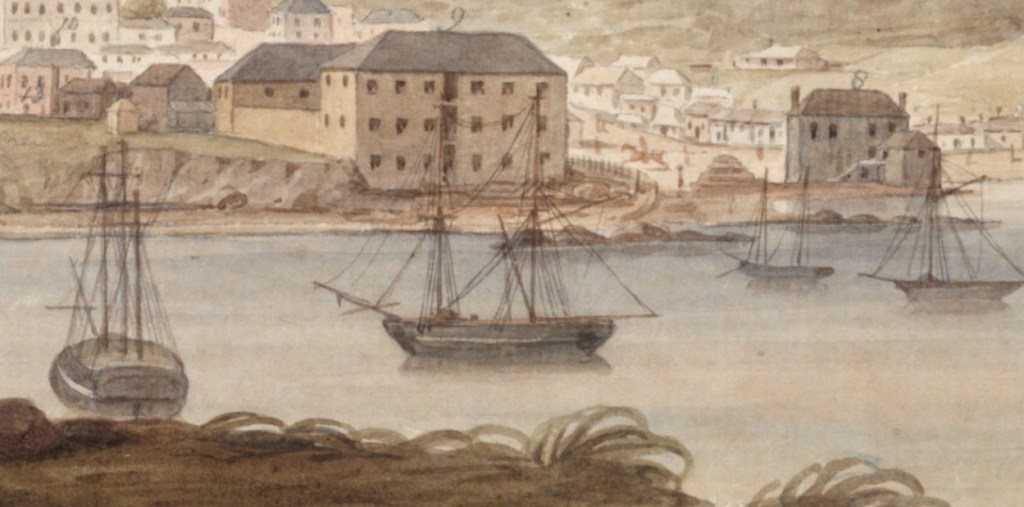
Detail reputedly showing the brig Cyprus (centre) from a panorama of Hobart 1828 – watercolour drawings by Augustus Earle, Courtesy State Library of NSW.
In August 1829, the brig Cyprus sailed from Hobart bound for Macquarie Harbour with provisions and 31 convicts sentenced to serve hard labour at that infamous penal settlement. However, while windbound at Recherche Bay in Tasmania’s south, the prisoners rose up, overpowered their guards and seized control of the ship. Thus began one of the most extraordinary escapes of Australia’s convict era.
Their leader was a 37-year-old convict named William Swallow. He was likely the only man among the prisoners who had any seagoing experience, so in true pirate tradition, the men voted for him to be their captain. Swallow had once earned a living as a seaman on colliers plying England’s coastal waters. That was until he tired of the seagoing life and found it was more lucrative to break into portside houses or ships moored in harbour. He finally came undone when the police suspected him of being involved in several recent burglaries and raided his house. A large haul of stolen property was found in the house, and Swallow was whisked off to gaol. This took place in 1821 when Swallow was going by the name William Walker. He was found guilty of housebreaking and sentenced to be transported to Van Diemen’s Land (Tasmania) for seven years.
William Swallow, however, had no intention of going quietly, leaving his wife and three children to fend for themselves. His first attempt to escape took place even before he had left England. He and a fellow prisoner jumped from the ship carrying them to the prison hulks to await the next Australia-bound convict transport. His mate drowned in the attempt, but Swallow survived and returned to his hometown. However, he was quickly recaptured and charged with returning from transportation. This time, he was loaded on a ship and sent to Van Diemen’s Land.
Swallow made a second attempt to escape eight months after arriving in Hobart. He and three other convicts seized a small schooner, crossed Bass Strait and made it to within 80 kilometres of Sydney before they ran aground and were taken back into custody. Swallow received 150 lashes and was sentenced to serve hard labour at Macquarie Harbour Penal Settlement. But he escaped again before ever setting foot in that much-feared hellhole. This time, he escaped from gaol and stowed away on a merchant ship bound for England. There, he lived free until being discovered in 1828. This time, he was sent to Van Diemen’s Land for life. But Swallow was still not ready to give up and accept his fate. Shortly after arriving back in Hobart, he stowed away on the very ship that had so recently brought him from England. By now, guards were masters at finding stowaways, and Swallow was taken off before it left port. He was flogged again and was on his way to Macquarie Harbour on the Cyprus when, in 1829, he and the other convicts seized the ship.
A tranquil Recherche Bay in southern Tasmania in 2019. Photo CJ Ison.
On 13 August, while the Cyprus was windbound in Recherche Bay, the convicts pounced, catching their guards by surprise and wresting control of the ship. They put the soldiers, captain and crew ashore and the following morning, hauled up the anchor, unfurled the sails and gave three hearty cheers as they got underway. The castaways would remain stranded in that remote and inhospitable corner of Tasmania for two weeks before they were discovered. That gave Swallow and his men ample time to get far away from Van Diemen’s Land before the alarm was raised.
It was supposed by the authorities that the runaways would try to make their way across the Pacific, where they would scuttle the Cyprus and pass themselves off as shipwrecked sailors at some unsuspecting South American port. But Swallow and the others had another idea in mind as Van Diemen’s Land disappeared over the horizon behind them.
The Cyprus was well stocked with food, for it carried sufficient supplies to see the Macquarie Harbour Penal Settlement through the coming winter months when it was all but cut off from the outside world. Swallow set a course to take them to New Zealand, where the men painted the vessel’s hull black and renamed her the Friends of Boston. Passing themselves off as an American-flagged ship, they then sailed north towards the Friendly Islands, known today as Tonga.
However, this leg of their voyage was far from smooth sailing. One man was lost overboard during a powerful storm, and the common purpose that had seen the convicts unite to capture the brig had begun to dissipate. After they reached the island of Tongatapu, present-day Nukualofa, seven men chose to remain there when the Cyprus set sail. Swallow continued north across the equator and eventually reached southern Japan after an impressive voyage of nearly 12,500 km. They pulled into a sheltered bay on the island of Shikoku in January 1830, hoping to resupply with firewood and fresh water. However, at the time, Japan was unwelcoming of foreigners. Despite the language barriers, the Japanese made it clear that the Cyprus had to be gone by sunset; otherwise, it would be fired upon.
Swallow heeded the warning, hoping to resupply somewhere more friendly, but as the sun dipped towards the horizon, the wind dropped and the ship was becalmed. The Japanese coastal battery opened fire as they warned they would, and one of the cannonballs struck the vessel on the waterline. But before any more damage could be inflicted, a breeze sprang up, and Swallow wasted no time getting the ship underway. They followed the Ryukyu Island chain south before crossing the East China Sea, all the time taking on water.
In February 1830, the Cyprus was off the coast of China, near the estuary of the Pearl River (Zhu Jiang River). By now, the leak had worsened, and the pumps had to be manned constantly to keep the ship afloat. Several of the runaways had had enough and wanted to abandon the ship. However, Swallow wasn’t ready to give up on the Cyprus just yet, despite the risk of being discovered by British naval vessels in the area. He hoped they might repair the ship and soon be on their way. However, those wishing to go ashore went below and punched a hole in the hull. They then boarded a lifeboat and left the Cyprus to sink. Swallow and his few remaining loyalists could not stem the steady inflow of water and were forced to abandon the ship a few hours later in the remaining lifeboat and make their way to Canton (Guangzhou).
View of the Canton factories by William Daniell, circa early 1800s. Courtesy British National Maritime Museum via Wikipedia.
The unexpected arrival of British subjects in the trading enclave raised the interest of the local East India Company officials. William Swallow was asked to visit their offices, where he was questioned at length.
As news of the seizure of Cyprus had yet to reach that port, Swallow passed himself off as Captain William Waldon and late master of the 200-ton English brig Edward. His story was a mixture of fact and fiction. He said that they had left London on 14 December 1828, bound for Rio de Janeiro and had then rounded Cape Horn and crossed the Pacific to Japan, where they were fired upon. The Edward, he said, had steadily taken on water as he tried to make for Manila, but his ship had finally foundered near Formosa (Taiwan).
He told the East India Company officials that he and his crew had boarded two lifeboats and headed for the Chinese mainland, but on the way, he lost contact with the second boat. On the strength that Swallow, AKA Waldon, had a sextant engraved with the ship’s name in his possession, and he had arrived in a longboat bearing the name “Edward of London,” his story was accepted. The East India Company officials gave Swallow and his men free passage to London on a merchant ship about to depart from Canton. The escaped convicts might just have got away with the subterfuge but for a stroke of bad luck.
A second boat arrived at the docks just days after they left. The men on that boat also claimed to be survivors from the Edward. But their version of the story was at odds with the one provided by Swallow. One of the new arrivals was immediately detained, but the rest fled Canton on an outbound ship one step ahead of the law. Then, two more men from the Cyprus turned up in Canton. They had been found on one of the Ryukyu islands and taken to Canton for questioning. When news of the seizure of the Cyprus finally reached the British enclave, the men in custody were questioned more closely, and they eventually confessed to who they were.
A letter was dispatched to London on the next ship to leave, warning the police to be on the lookout for Swallow and the others. That ship arrived in London before Swallow, and the police were waiting. However, by pure luck, he had disembarked at Margate rather than travel up the River Thames to London. The rest of Swallow’s travelling companions were arrested at the dock, and a couple of weeks later, Swallow was tracked down to a Lambeth boarding house, living under an assumed name.
In October 1830, Swallow and four others stood trial for piracy. The jury found the others guilty as charged, but acquitted William Swallow after he convincingly pleaded that he had been forced to take part in the mutiny against his will. Although Swallow escaped punishment for piracy, there was still the matter of his returning to England illegally. He was once again sent to Van Diemen’s Land, where he died at Port Arthur Penal Settlement on 12 May 1834.
Convict crewed boats crossing the bar to unload ships at Norfolk Island. Courtesy National Library of Australia.
More than 160,000 of Britain’s most unwanted souls were banished to Australia between 1788 and 1868. These convicts ranged from petty thieves to hardened criminals. Fraudsters, burglars and pickpockets rubbed shoulders with highway robbers, rapists and murderers in the fetid prison cells of transport ships bound for Australia. Political prisoners, social reformers and ordinary men and women struggling to feed their families also found themselves trapped in a brutal judicial system determined to rid Britain of its undesirables.
The vast majority of these men and women made the best of the hand fate had dealt them. They earned their freedom and took up land and farmed it, started businesses, married, raised children, and helped found the country we know today. But this book is not about them. Library shelves are lined with volumes praising the accomplishments of those worthy and not-so-worthy folk. Rather, Bolters tells the stories of those unruly malcontents who stepped ashore and thought, “This place is not for me,” and began plotting their escape.
Those who tried to abscond and failed, or flout any of the many other rules and regulations governing their lives were often sent to places of “secondary transportation.” These isolated penal settlements established at Newcastle, Port Macquarie, Moreton Bay and Macquarie Harbour were intentionally harsh. They were places where floggings were frequent, work was backbreaking, living conditions were wretched and life expectancy was short. Norfolk Island would later surpass them all for its brutality.
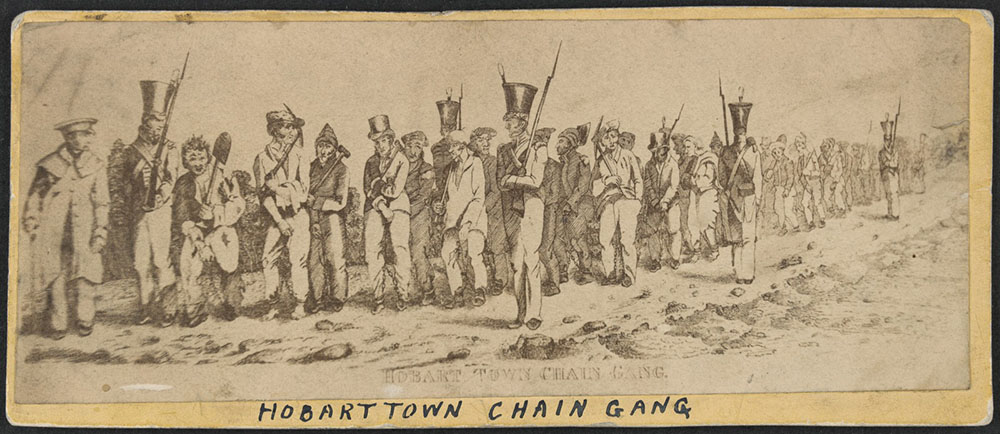
Hobart Town convict chain gang. Photo courtesy State Library of Victoria.
Australia’s penal settlements were gaols without bars. There was often very little to prevent anyone from taking their leave and hiding out in the bush. But what could they do then? The countryside was wildly unfamiliar, and the already dispossessed Aboriginal peoples were often hostile towards anyone encroaching further onto their land. Despite this, there were several bolters who lived for many years in Aboriginal communities. Alternatively, runaways could hole up on the outskirts of settlements, preying on whoever presented themselves as easy targets. These “bushrangers” were the scourge of early administrators in New South Wales and Van Diemen’s Land. The authorities went to great lengths to hunt them down and bring them to justice, often at the end of a rope. Eking out an existence on society’s fringes was not a viable long-term proposition. Those truly serious about escaping had to look not towards the country’s interior, but out to sea. Where townsfolk, farmhands, labourers and the like viewed the expansive ocean with justifiable trepidation, it was seen in a very different light by the many seamen and mariners in the convict ranks.
A flogging as Illustrated in The Fell Tyrant published in 1836. Courtesy Mitchell Library, State Library of NSW
Ships had brought them out to the colonies. They could whisk them away. Stowing away was the most frequent method of absconding, especially for those without seafaring skills. A cat-and-mouse game soon developed, with stowaways finding ever more inventive places to hide while the authorities devised new ways of flushing them out. Rarely did a ship leave Australia during the convict era without someone trying to stow away.
For men of a more ruthless and violent temperament, seizing control of a ship and sailing to some far-flung port proved an irresistible temptation. Ships transporting prisoners between settlements were always on alert for trouble, but that did not stop some desperate characters from trying their luck. Captains of vessels, complacent of port regulations, risked their ships being taken by convicts ever vigilant for lapses in security. A few enterprising convicts even built their own craft to make their escape. Few of these endeavours ended well, for the distances to be traversed were vast and the ocean unforgiving to frail and unseaworthy watercraft.
Detail from an 1828 watercolour of Hobart by Augustus Earle showing the brig Cyprus (centre), which was seized by convicts en route to Macquarie Harbour. Courtesy State Library of NSW.
Bolters tells the stories of many of those convicts who chanced their luck to regain their liberty. The narratives draw heavily on the personal accounts left behind by those determined to escape and official reports written by the men whose job it was to stop them. In 1791 William and Mary Bryant and a band of runaways made off with Governor Phillip’s cutter and sailed it to Timor in the Dutch East Indies (Indonesia). To this day it is still recognised as an outstanding feat of seamanship and survival. It was unfortunate for them that their luck ran out shortly after. However, Mary and a handful of others reached England and were later pardoned. They proved escape was possible, inspiring many others to follow their lead. In 1803, William Buckley fled from a short-lived settlement on the shores of Port Phillip Bay. He was taken in by the local Aboriginal people and remained with them for the next 32 years. Macquarie Harbour saw many inmates try to escape that god-forsaken place. No story is more chilling than that of the infamous cannibal Alexander Pearce and the men who fled into the wilderness with him.
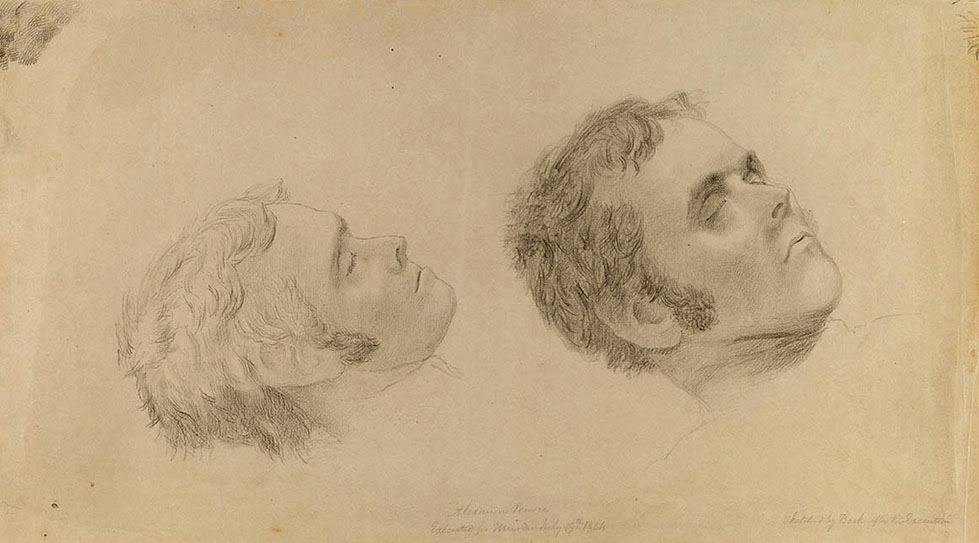
Sketches of Alexander Pearce made shortly after he was hanged. Artist: Thomas Bock. Courtesy State Library of NSW.
When a group of determined prisoners captured the Cyprus in 1829, few could have imagined that they would sail the vessel to Japan before scuttling it off the coast of China. Several men made it back to England before being arrested. Then, five years later, the prisoners entrusted with completing the Frederick at Macquarie Harbour took off for South America rather than deliver her to Port Arthur as supposed. The book ends with the liberation of six Irish rebels from Fremantle Prison by the American whaler Catalpa in 1876. This was arguably the most carefully planned and executed escape during the convict era. Along the way, the book delves into many lesser-known but no less desperate and dramatic attempts to flee Australian shores.










 Tales from the Quarterdeck