Tag: Cyclone

  • Cyclone Mahina & the loss of the North Queensland Pearling Fleet, 1899.

    Pearling luggers at Thursday Island. Courtesy State Library of Queensland.

       On 2 March 1899, Cyclone Mahina formed near the Solomon Islands and began tracking south-west towards the Queensland coast. On the same day, a second weather system formed in the Arafura Sea northwest of Darwin. This “monsoonal disturbance” was named Nachon and began moving towards the southwest. Unbeknown to the Thursday Island pearling fleet anchored in Bathurst Bay, 400 kilometres down the Queensland coast, both of these powerful weather systems were bearing down on them. Mahina and Nachon would collide over Bathurst Bay, wreaking havoc on the fleet, resulting in the loss of as many as 400 lives.

    Cyclone tracks for Cyclone Mahina which devastated the Thursday Island Pearling fleet at Cape Melville on 5 March 1899

       The pearling fleet was based at Thursday Island in Torres Strait, but the pearlers regularly ventured across Queensland’s warm tropical waters in search of shells. Pearling schooners served as floating processing stations for their fleet of ten to 15 luggers and diving boats. It was those smaller vessels that ranged out over nearby reefs, collecting the lucrative shells from the sea floor.

       March 4 was a Saturday and, for the pearlers, the much-anticipated start to the weekend. After they had delivered their pearl shells to their respective station schooner, tending to any repairs and restocking with provisions for the next week, it was time to relax and catch up with friends and family whom they had not seen all week.

       The schooners Sagitta, Silvery Wave, and Crest of the Wave were anchored near Cape Melville just inside Bathurst Bay. As the prevailing winds had been blowing from the southeast for the previous three weeks, everyone was anchored close to shore where the mountains extending inland protected them from the worst of the wind.
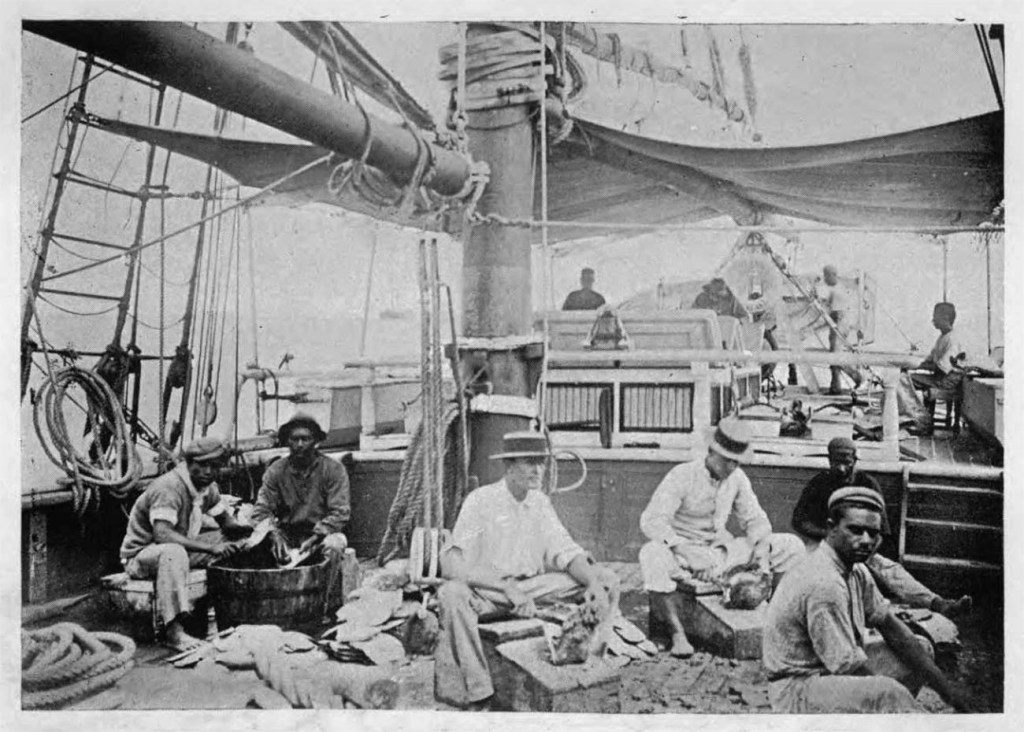
    Opening and cleaning shell on the schooner Olive. Source: The Pearling Disaster, 1899.

       The schooners Tarawa, Meg Merrilees, Olive and Aladin were anchored about 75 kilometres away near Pelican Island on the northwestern end of Princess Charlotte Bay. The manned Channel Rock lightship and several other pearling vessels were scattered along the Great Barrier Reef in the path of the approaching storm. No one, including the local Aboriginal people, could imagine the violent mayhem about to be unleashed upon them.

       At 7 o’clock on Saturday evening, only a moderate breeze was blowing from the southeast. However, just four hours later, the wind had increased to hurricane strength. It had also begun shifting direction from the southeast to the southwest. As Cyclone Mahina tore towards Bathurst Bay, the wind continued shifting further to the west, and eventually it blew from the northwest. For much of the early hours of Sunday, 5 March, the pearling fleet was exposed to the cyclone’s full fury. Torrential rain lashed the vessels. Streaks of angry lightning arced across the night sky while peals of thunder, howling wind and crashing waves competed to drown each other out. The hundreds of men and women trapped on their boats could do nothing but pray that they survived the ordeal.   

    Then, around 4 a.m., a massive storm surge swept through the bay. By 10 o’clock on Sunday morning, the tempest had moved inland, and some sanity returned to the world. It was only then that the few survivors would learn the full devastating impact of the storm.
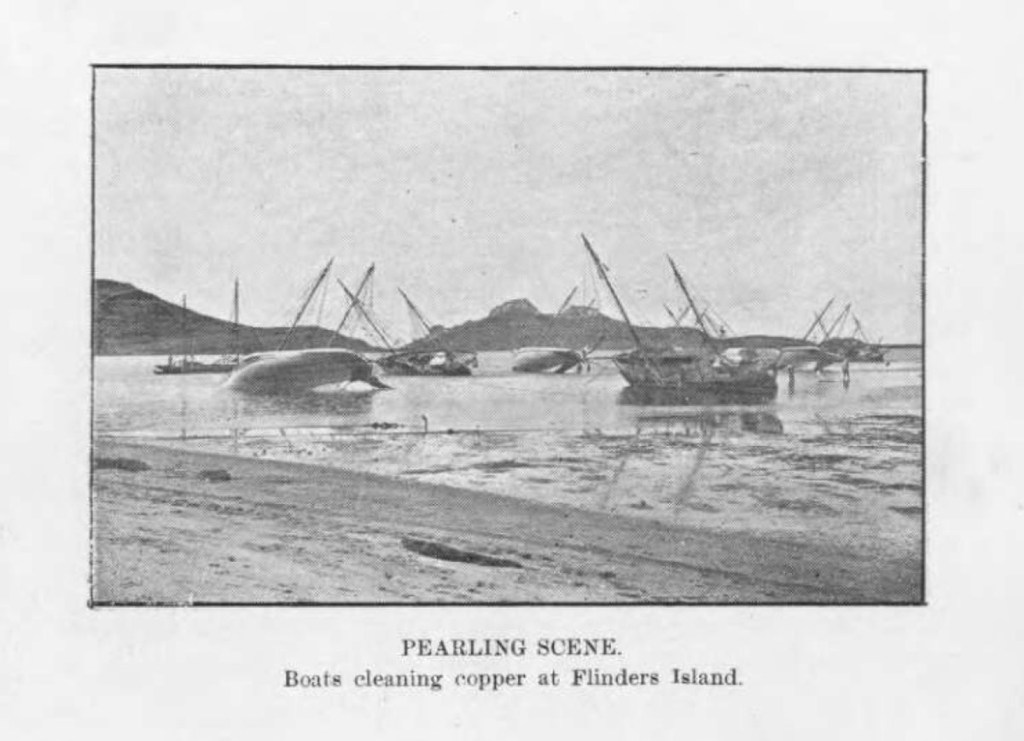
    Boats cleaning copper at Flinders Island. Source: The Pearling Disaster 1899.

       The Tarawa’s anchor cables had parted around 3 a.m., and she was swept onto Pelican Island. However, she was lucky for the damage would be easily patched, and she would limp back to Thursday Island. The Meg Merrilees dragged her anchors and ran onto a coral reef. All hands survived the wild night, but attempts to refloat the schooner were unsuccessful. The tender Weiwera was also lost. Of the 30 or so luggers anchored nearby, one-third sank with the loss of nine lives. The schooners Olive and the Aladin were more fortunate. Their anchors held, and they survived the night.

       The vessels lying off Cape Melville fared far worse. The 25-ton tender Admiral had only arrived in Bathurst Bay on the morning of the cyclone. She foundered at the storm’s height with the loss of her five crew and an unknown number of passengers brought down from Thursday Island to join the fleet. The Silvery Wave likewise was lost. Only a Japanese crew member named Sugimoto survived. The Sagitta was thought to have collided with the Silvery Wave and went to the bottom of Bathurst Bay with nearly 20 hands.   

    Captain W. Field Porter survived to give a harrowing account of that terrible night.  He recounted that his schooner, Crest of the Wave, was anchored near the other vessels off Cape Melville while about 40 luggers were in shallower water close to the beach. As the storm intensified, his anchors began dragging. Fortunately, the wind and current pushed the schooner into deeper water. “The intense darkness and driving rain prevented anything [from] being seen of the other boats or the land. The sea by this time was very rough, and enormous waves broke time after time on board,” Porter later wrote of his experience.

    “Mr Outridge, preparing for deep sea diving and assisted by Captain Porter of the Crest of the Wave.” Source: The Pearling disaster of 1899.

       The eye of the cyclone passed over his ship around 4.30 in the morning. After ten or fifteen minutes of dead calm, Captain Porter recalled, the wind suddenly came from the north-west, “with such terrific force that the schooner was thrown on her beam ends and [was] almost buried in the raging sea.” With much difficulty, the masts were cut away, and the ship righted itself. But by then, she had taken on a lot of water. The bilge pump was manned, and every spare hand bailed with buckets to keep the ship from sinking. Eventually, it was discovered that the water was entering through the rudder trunk. The leak was plugged with blankets and bags of flour, and the ship was saved. However, for 12 long and terrifying hours, the crew battled the elements, not knowing if each moment would be their last. Finally, the wind and seas started to ease, and Captain Porter and his men began to think they might just survive. As for the luggers, they either foundered at their anchorage or were driven ashore, where most were smashed to pieces. Some wreckage was found almost half a kilometre from the beach, taken there by the massive storm surge which swept several kilometres inland in places. Only a handful of the luggers were able to be refloated.

       The Channel Rock Lightship, moored between Cape Melville and Pipon Island, was nowhere to be seen after the storm passed and was believed to have sunk at her moorings with the loss of four lives. The bodies of Captain Gustaf Fuhrman and the mate Douglass Lee were later found near Cape Melville amongst debris from the lightship.

    Wreck of the Zanoni at Cape Melville, Source: The Pearling Disaster, 1899.

       It is estimated that some 300 pearlers lost their lives that night in Queensland’s most deadly natural disaster. While a dozen Europeans perished, most of the casualties were men and women from Torres Strait, the South Pacific, Japan and Malaya. Most were buried where their bodies were found with simple timber markers noting their final resting place. It was thought that as many as 100 local Aborigines were also killed during the storm and its massive tidal surge.

       On Flinders Island, several dolphins were found washed up on rocks almost five metres above the high tide mark. One witness painted a vivid picture of the destruction at Bathurst Bay. “There is quite a forest of mastheads and floating wreckage, the boats having evidently sunk at the anchorage. There are tons of dead fish, fowl, and reptiles of all descriptions, and the place presents the appearance of a large cemetery. All the trees have been stripped of their leaves.”

       Four schooners and 54 luggers were wrecked beyond repair, which devastated Thursday Island’s pearling industry. The human cost was even higher. With so many casualties, barely a family on Thursday Island escaped losing a loved one.
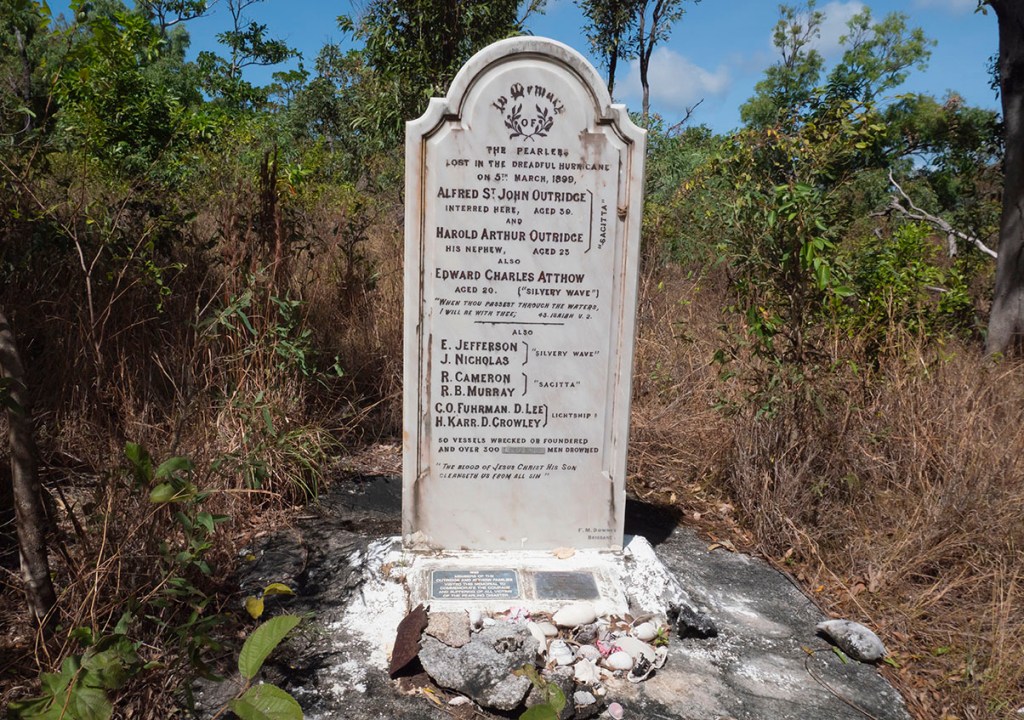
    Cyclone Mahina memorial at Cape Melville which marks the loss of 300 people during the storm. Photo: CJ Ison.

    © Copyright C.J. Ison / Tales from the Quarterdeck, 2024.

    Please enter your email address below to be notified of future blogs.
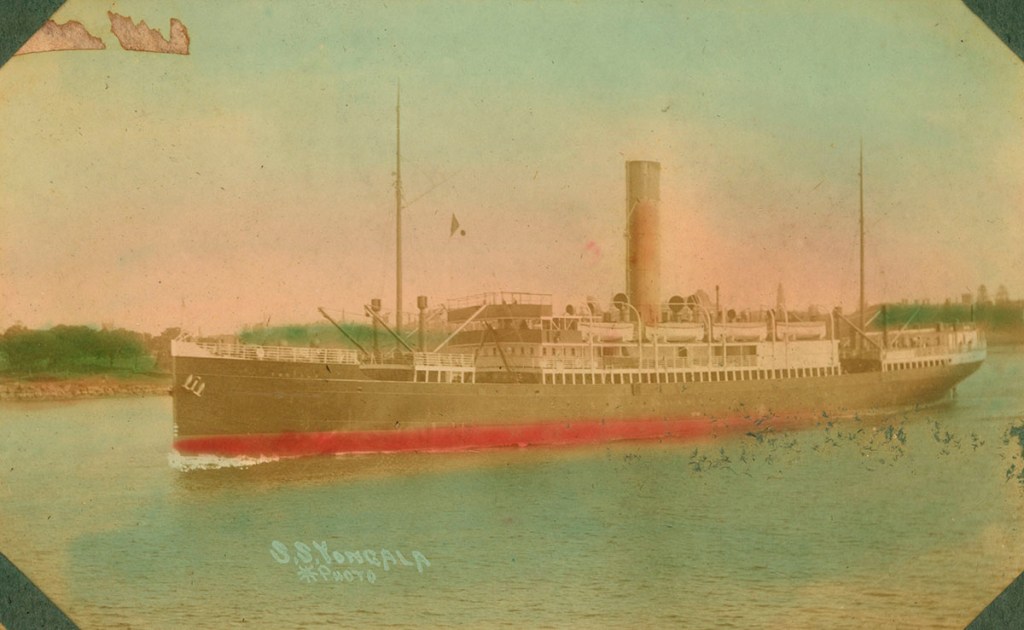
  • The Long Search for the Yongala

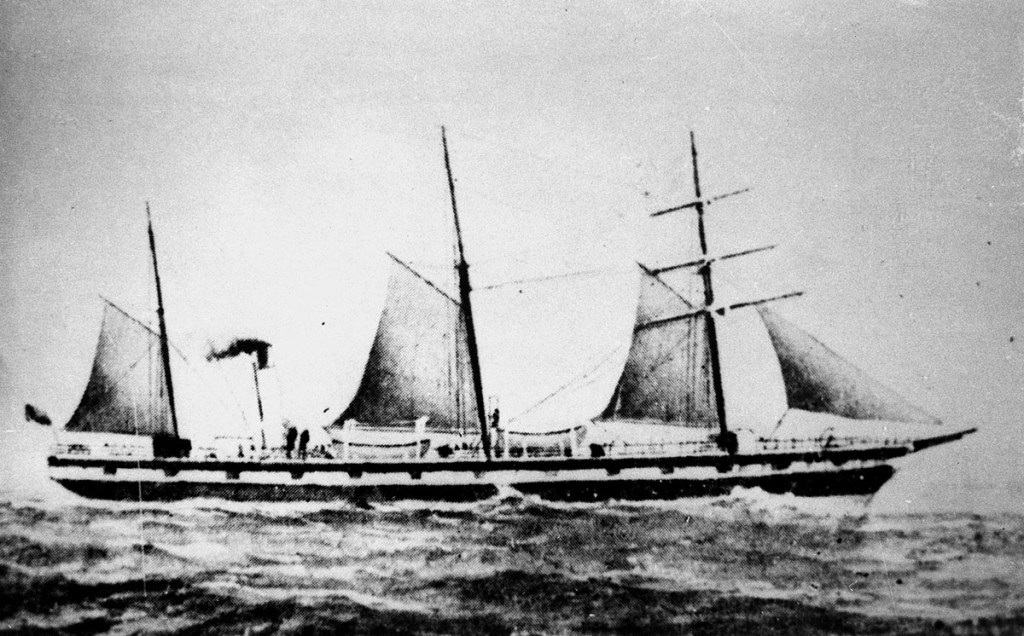
    Postcard showing the SS Yongala, circa 1905. Courtesy State Library of Queensland.

    In March 1911 the SS Yongala sank during a powerful cyclone with the loss of 122 lives making it one of Queensland’s worst maritime disasters.   Despite efforts to locate the wreck, the ship’s final resting place would remain a mystery for almost half a century.

    The Yongala departed Brisbane on 21 March bound for Townsville.   On 23 March she stopped briefly at Mackay to disembark passengers but by now the weather was rapidly deteriorating.   When she got under way again, she unwittingly carried 50 passengers and 72 crew towards a powerful storm brewing somewhere to the north.    

    Later the same day the Dent Island lighthouse keeper noted the Yongala passing through the Whitsunday Passage.     She soon faded from sight, enveloped by a curtain of rain and sea mist, as she ploughed towards Townsville.

    When the Yongala failed to arrive as scheduled there was no immediate concern.   It was assumed the captain had sought shelter to escape the cyclone and the ship would soon make its appearance.   But then reports reached Townsville of wreckage washed ashore on Palm and Hinchinbrook Islands 50 and 100 kilometres to the north.

    “The Missing Steamer Yongala” The Australasian, 1 Apr 1811, p. 41.

    It was clear the debris, including hatch covers, parts of lifeboats, ornate cabin fittings and other miscellanea, had come from the Yongala.   It spoke of a terrible tragedy having befallen the passenger steamer and all those onboard.   Oddly, not a single body was ever recovered.

    The waters and coastline between Townsville and the Whitsunday’s were scoured in hopes of finding survivors or the wreck but nothing but more debris was found.  A Marine Board Inquiry investigated the loss of the ship as best it could under the circumstances. With no eyewitnesses to what happened and no wreck to inspect, they had little to go on.   The Inquiry concluded that rumours about the ship’s stability were groundless and it found no fault with the ship’s construction or the competency of its captain.    A £1,000 reward was even offered for anyone who could pinpoint the wreck.

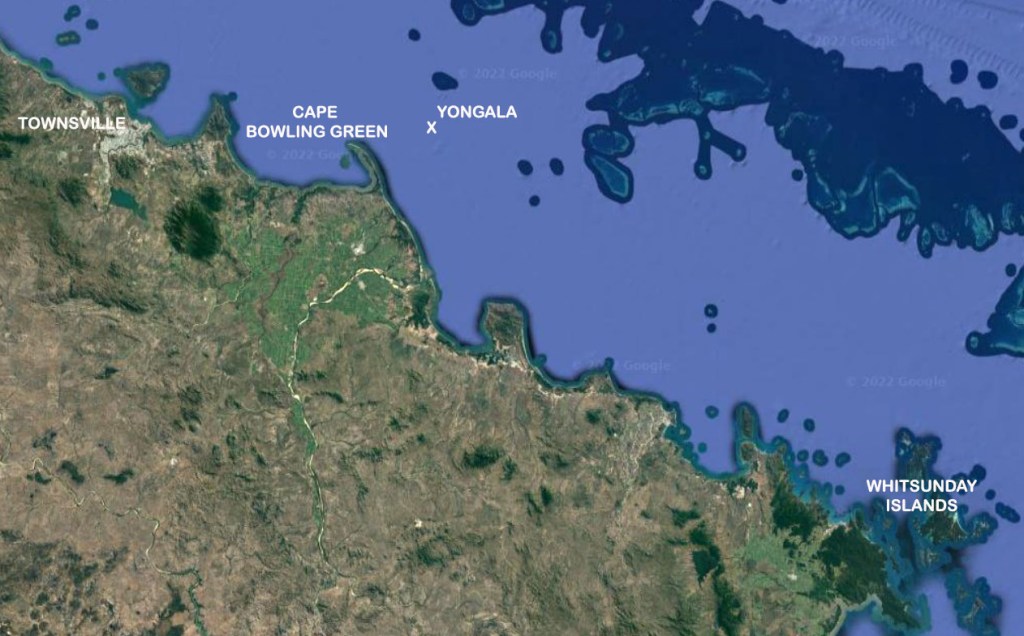
    In October 1911 Dr Cassidy believed he and his crew on the salvage schooner Norna had located the Yongala in deep water about 20kms off Cape Bowling Green.   They had discovered traces of oil bubbling up from the depths and believed that marked the resting place of the lost ship.   However, owing to the depth of the water and strong currents, they were unable to put a diver down to confirm the find or collect the reward.  

    Map showing location of the Yongala wreck. Courtesy Google Maps.

    For decades mystery surrounded the disappearance of the ship.   There were even far-fetched sightings of a “ghost ship” steaming through North Queensland waters periodically reported in the tabloid press.  

    Then in 1947, the navy survey ship HMAS Lachlan located the wreck using “anti-submarine instruments,” more commonly known today as sonar.    Three years earlier a minesweeper had snagged something they thought to be a reef rising steeply from the seabed in the middle of the regular shipping lane south of Townsville.   They had marked the spot on their chart as an unknown obstruction and reported it to Naval Headquarters.   They were about 20kms east of Cape Bowling Green where the Norna had found the oil slick all those years ago.

    After HMAS Lachlan made several passes over the “obstruction” the sonar operators were convinced they had found the remains of a “fair-sized steamer.”   It was thought to be the Yongala for it was the only such vessel to have been lost in the vicinity.  

    HMAS Lachlan. By Allan C. Green, Courtesy State Library of Victoria.

    However, it would be another 11 years before anyone visually confirmed that what the Lachlan had found was in fact a shipwreck.   In 1958 a diver named George Konrat finally descended into the deep and found the ship sitting on its keel in 30 metres of water with a distinct list to starboard.   He recovered a Chubb safe with part of the serial number still evident which would later prove to have been installed in the Yongala during her construction.

    Konrat speculated that the steamer had struck another vessel during the storm and sank for he also saw the remains of an old sailing ship nearby.   However, with the passage of so many years and no survivors to recount what happened, the actual reason why the ship foundered during the cyclone will likely never be known.

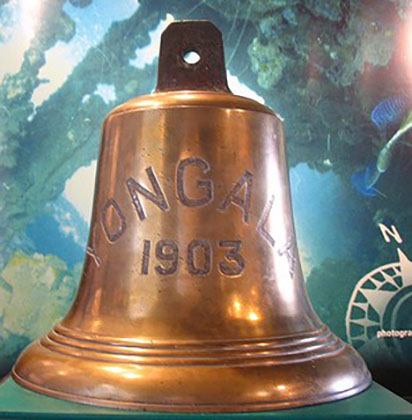
    Yongala Bell, Courtesy wikimedia commons.

    Today, some artifacts collected from the wreck and other memorabilia can be found in the Townsville Maritime Museum which is well worth a visit.   The Yongala, itself, is a popular dive site.

    © Copyright C.J. Ison / Tales from the Quarterdeck, 2022.

    To be notified of future blogs, please enter your email address below.

  • The Tragedy behind the Gothenburg Medals

    L-R Robert Brazil, John Cleland, and James Fitzgerald. Photo: Adelaide School of Photography, 1876.

       In September 1875, the South Australian Government honoured three men for the courage they displayed when the Gothenburg sank with fearsome loss of life. James Fitzgerald, John Cleland and Robert Brazil had risked their lives to save other survivors from the ill-fated steamer.

       The Gothenburg was a 501-ton steamer, and on this, her final voyage, she carried 37 crew and 88 passengers, 25 of whom were women or children. She departed Darwin on Tuesday, 16 February 1875, bound for Adelaide via Australia’s east coast. By the evening of the 24th, Cape Bowling Green just south of Townsville, would have been visible off the starboard side had it not been obscured by thick weather.

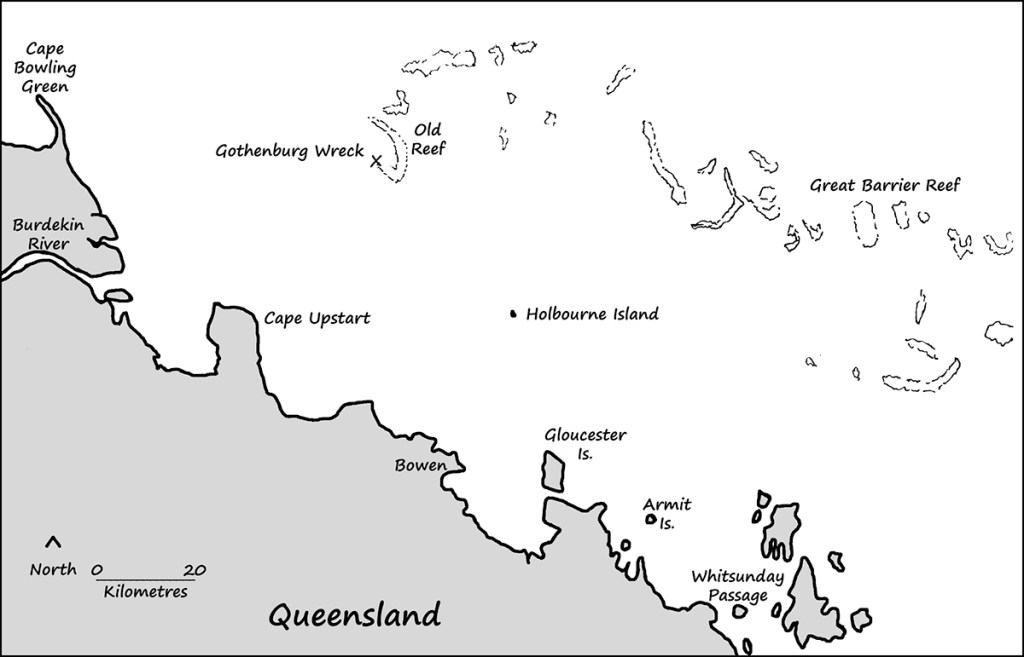
       The steamer had been followed by bad weather for most of the voyage down the Queensland coast. With usual landmarks hidden from view, the captain, James Pearce, was relying on his patent log to plot their progress. He thought he now had open seas ahead of him until they reached Flinders Passage, where he would pass through the Great Barrier Reef. It was early evening, and the Gothenburg was cutting through the water at 10 knots (19 km/h). Large swells made the ship roll uncomfortably, upsetting many of the passengers. But then the seas flattened.  It should have alerted the captain that they were in the lee of a large reef. But before any action could be taken, the Gothenburg ran onto a vast coral shoal hidden just under the sea’s surface.

    Illustration a the Human Society medal awarded to survivors of the Gothenburg shipwreck. Source: The Illustrated Adelaide News 1 Sep 1875, page 8.

       The impact was not particularly violent. The iron-hulled steamer had glided along the top of the reef, coming to a halt in less than her own length. By the time she stopped, her stern was still hanging out over deep water. It would transpire that the Gothenburg had drifted further east than Pearce had reckoned on, and they had struck Old Reef just north of Flinders Passage.

    Pearce was not particularly concerned at first; the hull had not been breached, and he thought he would be able to back the steamer off. However, when the engines were put in reverse, the ship didn’t budge. Pearce ordered the crew to move cargo from the fore hold and bring it aft. He also asked all the passengers to congregate on the stern. With the bow raised and the stern lowered, he hoped the ship would easily slide back off the reef. As the tide peaked, the engines were turning at maximum speed, but the vessel remained firmly stuck. The passengers and most of the crew retired for the night, expecting they would try again on the next high tide.

       Meanwhile, the weather continued to deteriorate. A powerful storm was fast approaching over the northern horizon. Through the rest of the night, the Gothenburg was lashed by high seas, torrential rain, and a gale-force wind.The steamer bumped and ground on the hard coral until the hull sprang leaks and she began taking on water, a lot of water.

       In just a few short hours, the situation became dire. Captain Pearce began preparations to abandon the ship, starting with the evacuation of women and children. It was now around 3 a.m., and pitch-black. Most of the passengers were already up on deck despite the atrocious weather. Few wished to remain in their cabins below.

       Pearce only had four lifeboats at his disposal, but two of them were swept away before he could get a single passenger off the ship. The third boat, only partly filled with passengers, capsized and broke apart as soon as it was lowered into the water. Then the ship heeled over, and a mountainous wave swept many of the passengers from the deck to drown in the turbulent sea.

    The wreck of the Steamer Gothenburg. Source: Australasian Sketcher, 20 Mar 1875, p. 13.

       A lucky few managed to swim back to the ship and were rescued by those who had climbed into the ship’s rigging before the wave struck. There they clung, hoping to ride out the storm. James Fitzgerald, John Cleland, both passengers, and one of the crew, Robert Brazil, were among the survivors.

       Fitzgerald would later recall, “We had seen illustrations of shipwrecks, but on this frightful morning … before daybreak, we saw the dreadful reality of its horrors. The ship was lying over on the port side, awfully listing, a hurricane was blowing, rain was coming down as it does in the tropics, and unmerciful breakers were rushing over the unfortunate vessel, seldom without taking some of the people with them.”

       John Cleland, a gold miner returning to Adelaide, spotted the fourth lifeboat floating upside down, still attached to its davits. He knew that if they were to have any chance of survival, they needed that boat. He climbed down from the rigging, tied a rope around his waist and swam through the breaking waves to better secure it.

    The Gothenburg. Photo Courtesy State Library of Queensland.

       Cleland’s first attempt failed, and he swam back through the surging seas to the relative safety of the main mast. James Fitzgerald then joined him, and together they repeatedly swam out to the boat, cut away at the tangled mess of ropes, and then swam back to the mast to rest. Finally, they cut through the last of the ropes securing the boat to the davits. They then tied it off again with a length of rope attached to the mast. But the boat still floated upside down. They had been unable to right the craft on their own.

       Seeing the pair struggling, Robert Brazil swam out and joined them, and with their combined weight, they were able to flip the lifeboat over. Cleland and the others were relieved to see that the oars were still securely locked in place.

       The trio then returned to the mast and tied themselves to the rigging high above the waves. They stayed there all that day and the following night, tied to rigging so they would not fall when they dozed off. Then, the following morning, the weather began to ease.

       The three men returned to the boat and bailed it out. Cleland, Fitzgerald, Brazil and eleven other men climbed into the lifeboat and eventually made it to the safety of Holbourne Island. They were rescued by boats sent out from Bowen to search for survivors the next day. Over one hundred people lost their lives in the disaster, Captain Pearce among them.

       A marine board enquiry found that the captain had not exercised sufficient care in the navigation of his ship. They felt that had he made the effort to sight Cape Bowling Green lighthouse or Cape Upstart as he steamed south, he might have more accurately fixed his position, and the disaster could have been averted.

    The full story of the Gothenburg shipwreck is told in A Treacherous Coast: Ten Tales of Shipwreck and Survival from Queensland Waters, available as a Kindle eBook or paperback through Amazon.

    © Copyright C.J. Ison, Tales from the Quarterdeck, 2021.

    Enter your email address below to be notified of new posts.