Tag: CSS Shenandoah

  • Tales from the Quarterdeck

    Sixty bite-sized stories from Australia’s maritime past

    The melancholy loss of H.M.S Sirius off Norfolk Island by George. Raper. Source National Library of Australia 136507434-1

    I have just launched a new book titled Tales from the Quarterdeck: Sixty bite-sized stories from Australia’s maritime past. Sixty of the most popular posts have been reedited. In some cases, I’ve rewritten a couple and updated a few where new information has come to light since first writing them.

    For those who would value ready access to the stories in their bookcase, Tales from the Quarterdeck is available in Kindle ebook and paperback formats through Amazon.

    The stories are organised in chronological order, starting with the Tryall shipwreck off the Western Australian coast in 1622, and finishing with the Second World War exploits of the Krait. See below for a full list of the stories covered in the book.
    Sydney Gazette 22 May 1808, p. 2.

    1622 – The Tryall: Australia’s earliest shipwreck

    1629 – The Batavia Tragedy

    1688 – William Dampier: Navigator, naturalist, writer, pirate

    1770  – The Endeavour’s Crappy Repair

    1788 – Loss of La Astrolabe and La Boussole, a 40-Year Mystery                        

    1789 – Bligh’s Epic Voyage to Timor

    1789 – HMS Guardian: All Hands to the Pumps

    1790 – The Loss of HMS Sirius

    1790 – Sydney’s First Desperate Escape

    1791 – HMS Pandora: Queensland’s earliest recorded Shipwreck

    1791 – William Bryant’s Great Escape

    1797 – The Loss of the Sydney Cove

    1803 – Loss of HMS Porpoise

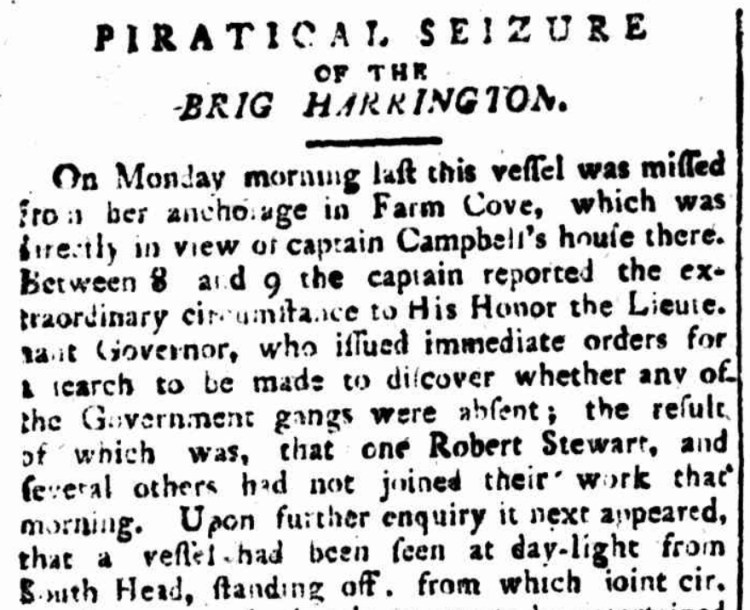
    1808 – Robert Stewart and the Seizure of the Harrington

    1814 – Wreck of the Morning Star

    1816 – The Life and Loss of HMSC Mermaid

    1824 – The Brig Amity’s Amazing Career

    1829 – The Cyprus mutiny 

    1831 – The Caledonia’s perilous last voyage

    1833 – The Badger’s Textbook Escape

    1835 – The Loss of the Convict Ship Neva

    1835 – The Post Office in the middle of nowhere

    1835 – The Tragic Loss of George III

    1845 – The Cataraqui: Australia’s worst shipwreck

    1846 – The Peruvian’s Lone Survivor

    1847 – The Foundering of the Sovereign

    1850 – The Loss of the Enchantress: A first-hand account

    1851 – The Countess of Minto’s brush with Disaster

    1852 – The Bourneuf’s Tragic Last Voyage

    1852 – The Nelson Gold Heist

    Woodbury, Walter B. (Walter Bentley), 1834-1885. Hamlet’s Ghost, Sourabaya [Surabaya], Java [Boat with Passengers and Crew], ca. 1865. Walter B. Woodbury Photograph Collection (PH 003). Special Collections and University Archives, University of Massachusetts Amherst Libraries

    1854 – Bato to the Rescue 

    1854 – HMS Torch and the rescue of the Ningpo

    1856 – The Loss of the Duroc and the Rise of La Deliverance

    1858 – The Loss of the Saint Paul and its Horrific Aftermath

    1858 – Narcisse Pelletier, An Extraordinary Tale of Survival

    1859 – The Indian Queen’s Icy Encounter

    1859 – The Sapphire and Marina

    1863 – The loss of the Grafton: Marooned for twenty months

    1864 – The Invercauld shipwreck

    1865 – The CSS Shenandoah: Victoria’s link to the American Civil War

    1866 – The Loss of the SS Cawarra: Bad luck or an avoidable tragedy?

    1868 – The Bogus Count and Hamlet’s Ghost

    1871 – The Mystery of the Peri

    1872 – The Loss of the Maria, A Cautionary Tale

    1875 – The Tragedy behind the Gothenburg Medals

    1876 – The Catalpa rescue

    1876 – The Banshee’s Terrible Loss

    1878 – The Loch Ard Tragedy

    1884 – The Macabre case of the Mignonette

    1885 – The Douro and its Piratical Captain

    1889 – The Windjammer Grace Harwar

    1891 – The Spanish Silver of Torres Strait

    1893 – The Foundering of the SS Alert

    1895 – The Norna and the Conman Commodore

    1899 – Cyclone Mahina

    1911 – The Loss of the Mandalay

    1918 – The Orete’s Robinson Crusoe-like Castaway

    1935 – The Life and Loss of  the SS Maheno

    1943 – Surviving the Centaur Sinking

    1943 – The Amazing Krait

  • The CSS Shenandoah: Victoria’s link to the American Civil War.

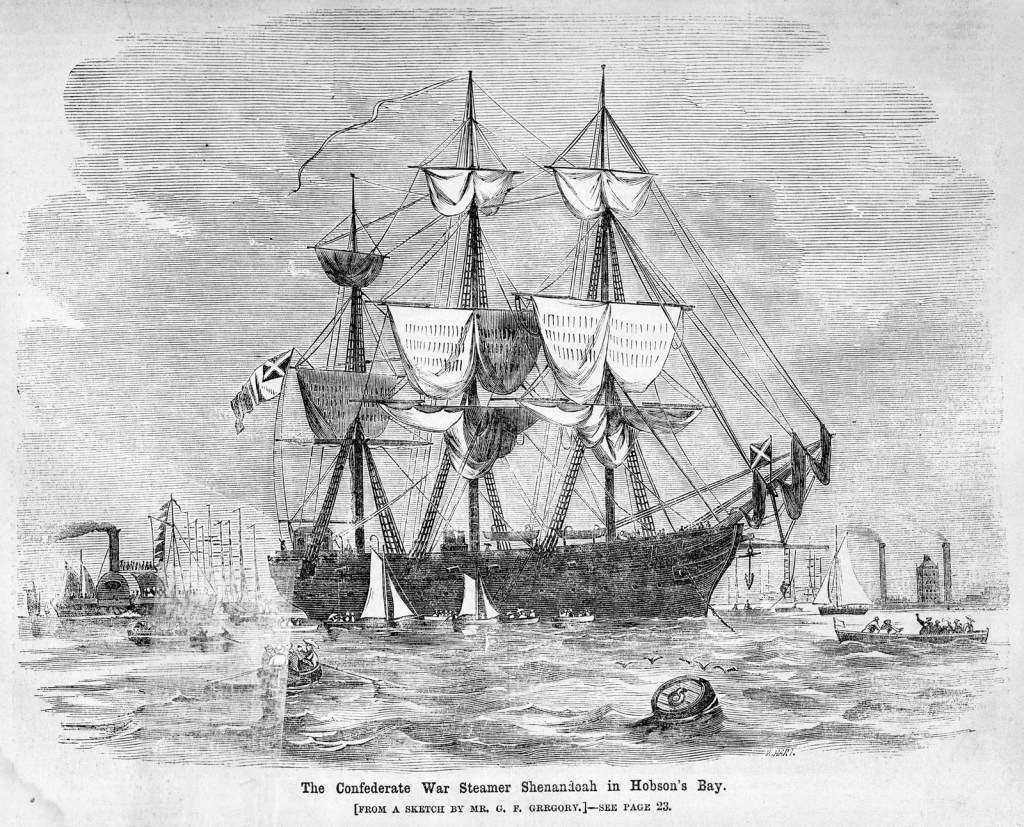
    CSS Shenandoah in Hobson’s Bay, Courtesy State Library of Victoria.

       On 25 January 1865, a large foreign warship unexpectedly sailed into Port Phillip Bay and dropped anchor off Melbourne. The arrival caused considerable consternation in Victoria’s Legislature, which long feared the colony was inadequately defended. The ship proved to be the 1160-ton, eight-gun auxiliary steamer CSS Shenandoah of the Confederate States of America. Her captain, James Wadell, reported to the port authorities that he had been forced to pull in to make urgent repairs.

       Five years earlier, America’s Southern states had seceded from the Union over the question of slavery, and the country had been embroiled in a brutal civil war ever since. The Shenandoah had been particularly busy in the three months before arriving in Australian waters. She had captured or sunk no less than 11 merchant ships belonging to the United States and was holding some of the sailors prisoner.

       Britain and, by extension, the colonies in Australia had declared neutrality in the hostilities between the North and the South. The arrival of an armed warship posed a delicate diplomatic problem for Victoria’s Governor, Sir Charles Darling.

    Some of the 12,000 visitors on the Shenandoah. Courtesy State Library of Victoria.

         Captain Waddell sent an officer ashore seeking permission to remain in port until they could make repairs to the Shenandoah’s propeller, which had been damaged during a recent storm. He also hoped to replenish his depleted bunkers with coal, purchase fresh supplies, and land his prisoners.

       One thing he neglected to ask permission for was recruiting replacement sailors, although he intended to do so anyway.

       Governor Darling allowed Waddell to repair the Shenandoah’s propeller and take on supplies, thinking the ship would be on its way again in a couple of days’ time. However, after engineers examined the propeller and shaft more carefully, they discovered the damage was far worse than they had first thought. The ship would have to be slipped so the repairs could be carried out, and that would take time.

       Conscious of their obligations of neutrality, the colonial government decided to allow the ship to be dry-docked, but “no other work should be performed on the vessel than absolutely and necessarily required,” to enable the Shenandoah to safely return to sea.   

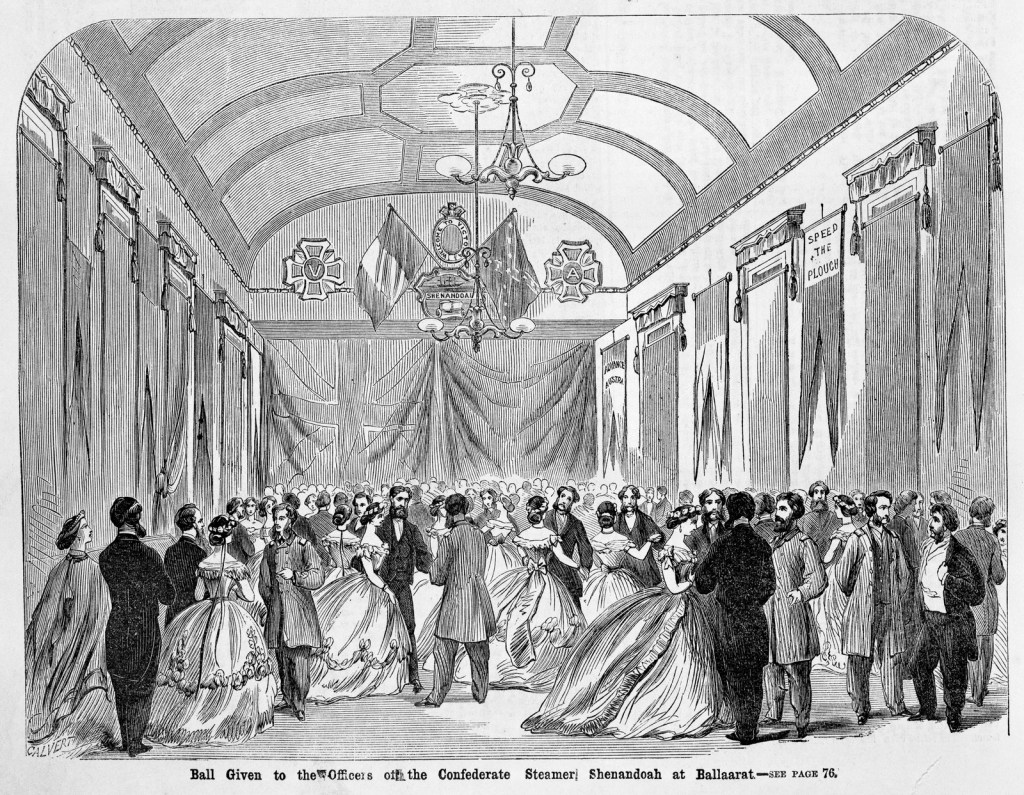
    While the government was careful to abide by the requirements of Britain’s proclaimed neutrality, the wider public was far less concerned. The arrival of the Confederate warship caused a sensation. During the first weekend the Shenandoah was in port, more than 12000 people went to take a close look at her. That amounted to 10 per cent of Melbourne’s total population. The visiting Americans were made as welcome as anyone possibly could be. A gala ball was held in their honour in the nearby goldfield town of Ballarat. And, Captain Waddell and his officers were also wined and dined by many of Melbourne’s leading citizens.

    Ballarat Ball for the officers of the Shenandoah. Courtesy State Library of Victoria.

       Meanwhile, as the bunkers were being filled with coal, supplies were loaded onboard, and repairs progressing, Waddell’s officers began surreptitiously recruiting seamen from Melbourne’s docks. It was rumoured that the captain was offering anyone willing to join his ship an £8 sign-on bonus, plus a share of any prize money, on top of a £6 per month salary.

       When the authorities learned what was going on, they were compelled to put a stop to it. A warrant was issued to search the ship, and the police had orders to remove any British subjects they found illegally on board. By now, the repairs had been completed, but the Shenandoah was still high and dry on the slip.

       A standoff ensued with Captain Waddell refusing to allow the police to board his ship, and port authorities prevented the Shenandoah from being launched. Waddell wrote to the Governor denying that any British subjects had joined his ship. However, four men were later arrested by the police after they were seen leaving the vessel. Waddell feigned ignorance of their presence, claiming they must have been stowaways.

       The Shenandoah was allowed to leave on 19 February, and a diplomatic crisis was averted. Or so Governor Darling thought. Then, in a parting shot, Waddell wrote that he felt that he and the Confederate States of America had been ill-treated at the hands of Victorian officials and that he would be informing his government at his earliest opportunity. However, that was likely just bluster, for it seems that when the Shenandoah sailed out of Port Phillip Bay, there were 40 newly recruited sailors, despite Captain Waddell’s assurances to the contrary.

    Captain Waddell. Courtesy State Library of Victoria.

       In the final months of the American Civil War, the Shenandoah ravaged the United States’ North Pacific whaling fleet. The predation only ceased after the surrender of the South.

       After the war, the United States Government proved that Britain had given assistance to Southern warships despite proclaiming neutrality. Britain would later pay millions of dollars (billions in today’s money) in compensation for losses to Union shipping caused by three Southern raiders, one of them being the Shenandoah.

    © Copyright C.J. Ison / Tales from the Quarterdeck, 2022.

    To be notified of future blogs, please enter your email address below.