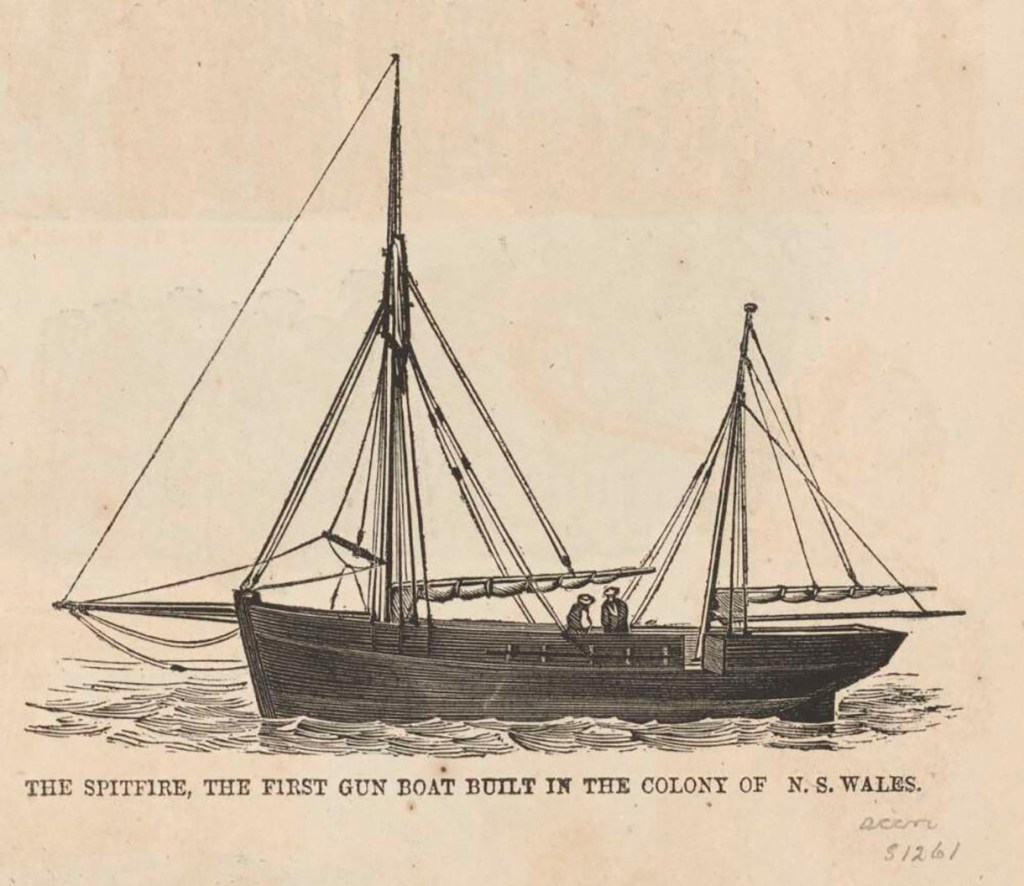
Launched in 1855, HMCS Spitfire has the distinction of being Australia’s first locally built naval vessel. Originally conceived as a gunboat to bolster Sydney Harbour’s defences, she never fired a shot in anger. Nonetheless she went on to serve New South Wales and Queensland in a variety of important roles, some of which she was patently ill-suited to. The Spitfire eventually saw out her days as a fishing boat operating in Far North Queensland waters in a career spanning some 43 years. This is her fascinating story.
In October 1853, war erupted between Russia and the Ottoman Empire, and in March the following year Britain joined on the side of the Ottomans. Fearing that Sydney might come under attack from Russian naval forces based in the North Pacific, the colonial NSW government commissioned the Spitfire to help defend Port Jackson.
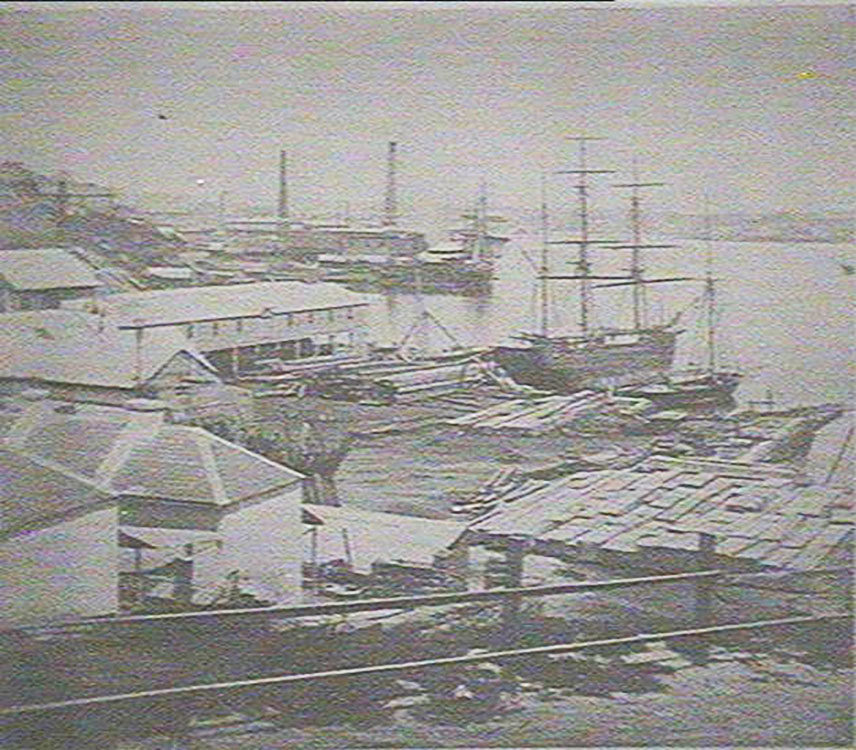
The Spitfire glided into the untroubled waters of Darling Harbour at 10 o’clock in the morning on 7 April 1855. The proceedings were attended by great fanfare, pomp and the cheers from a large crowd of onlookers, though the NSW Governor was conspicuously absent from the ceremony.
Built at Cuthbert’s Shipyard (in the vicinity of present-day Barangaroo), the Spitfire was a vessel of 60 tons, measuring 62 feet (18.9 m) in overall length, with a beam of 16 feet (4.9 m) and a draft of five feet six inches (1.7 m). The small ketch-rigged vessel was constructed of ironbark and blackbutt and sheathed with copper plate. She was built more robustly than usual to accommodate a 32-pound smooth-bore gun amidships on a traversing carriage. The bulwarks on either side could be lowered to allow the gun to engage targets to port and starboard.1
The Spitfire did not have its own full-time gunners. Rather, it was to rely on appropriately trained members from the local volunteer artillery should they ever be needed. However, though designated a “gunboat,” the main armament seems to have never actually been fitted.
Even though the government had paid for the Spitfire’s construction, it was less forthcoming when it came to paying for its ongoing operational and maintenance costs. And there was some debate in the corridors of power as to just how a single vessel would be deployed in the event of a Russian attack. But, fortunately that soon became a mute point.
Ten months after the Spitfire‘s launch, the Crimean War came to an end, as did any threat posed by Russia. The Spitfire was then put to use as a general utility vessel, conveying stores and personnel to lighthouses dotting the New South Wales coast. Then in July 1857 she was sent to Moreton Bay to maintain, set and recover that port’s navigation buoys. And when Queensland separated from New South Wales in December 1859, ownership of the Spitfire transferred to the new colonial government.
She was stationed at the Moreton Island Pilot Station at Cowan Cowan. Primarily the Spitfire was used to ferry pilots out to ships so they could be safely guided into the bay. From there, she could also readily attend to the navigation buoys as needed. However, from the outset she proved ill-suited for that task as she lacked the necessary maneuverability.
Between August and October 1860, the Spitfire was sent on a voyage of discovery under the command of Lt J W Smith, a Royal Navy officer seconded from HMS Herald. The party included the master of the Spitfire, Queensland’s Commissioner of Crown Lands, George Dalrymple, surveyor, R P Stone, and a botanical collector named Eugene Fitzalan. They were joined by seven seamen and two Aborigines, bringing the party to 14 in total.2
Eleven years earlier, explorer Ludwig Leichhardt had crossed a wide river on his 1849 inland expedition to Port Essington. He named the river after one of his sponsors, Thomas Burdekin. The Spitfire’s job was to locate where the Burdekin River flowed into the Pacific Ocean.
She returned to Moreton Bay in October, the voyage a resounding success. The mouth of the river was found to open into a bay north of Cape Upstart, Fitzalan returned with over 100 botanical specimens, and the future site of Bowen was surveyed.
While landed there, the party was confronted by a band of Aborigines. Thinking they had some hostile intent, the expeditioners drove them off. Years later, we would learn that the Aborigines had simply tried to alert Dalrymple and the others to the presence among them of James Morell, a sailor who had been shipwrecked back in 1846.3 See my blog “The Peruvian’s Lone Survivor” for his story.
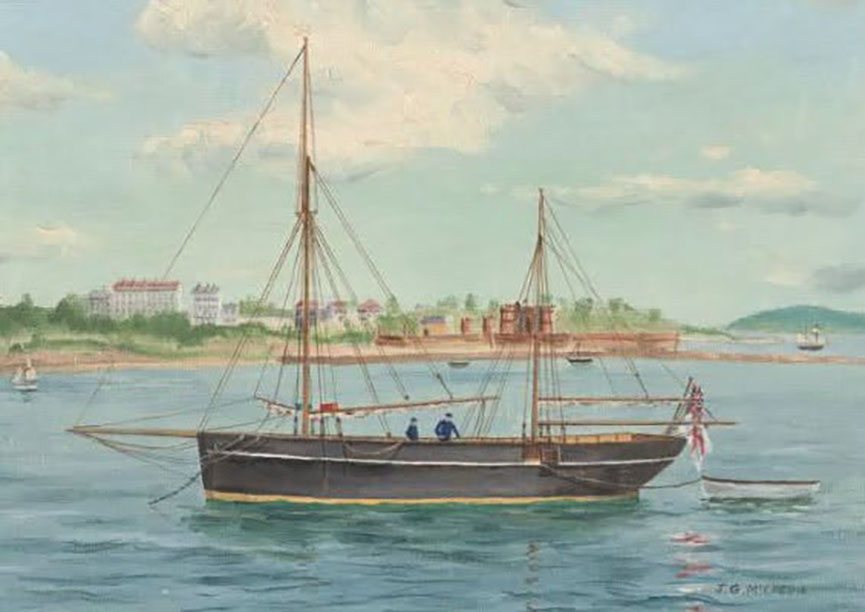
Once back at Moreton Bay, the Spitfire returned to her routine duties, and it is probably a testament to the men who sailed her, that she continued in service for so many years. One critic wrote that she was “totally unfit for her work, as everything afloat can leave her astern.”4
In January 1874, disaster struck which almost saw the end of the schooner and the lives of her seven man crew. After delivering a pilot to a ship waiting to enter the bay, the Spitfire was caught in a violent storm. As she approached the passage into Moreton Bay she was dismasted by huge seas and gale force winds. The crew battled to get a pair of anchors over the side as the maelstrom raging around them. Thankfully, they succeed and the anchors held, preventing the schooner from being driven ashore and smashed to pieces.
The captain and three volunteers then managed to get a whaleboat over the side and went in search of help while their shipmates remained with the Spitfire. They rowed for some 10 hours without a break and eventually reached the Lady Bowen anchored about 8 miles away. After the storm had subsided, the steamer took the Spitfire in tow and brought her safely into Moreton Bay.5
However, by now the Spitfire was long past her prime and even the authorities had to acknowledge that she was no longer suitable for continued service as Moreton Bay’s pilot boat. But rather than scrap her, she was given a new role in Far North Queensland.
Gold had been discovered on the Palmer River 100 km inland from what would become Cooktown on the banks of the Endeavour River. Thousands of miners flooded into the area, and the busy port was in want of a new pilot boat. The Spitfire was sent to fill the role.
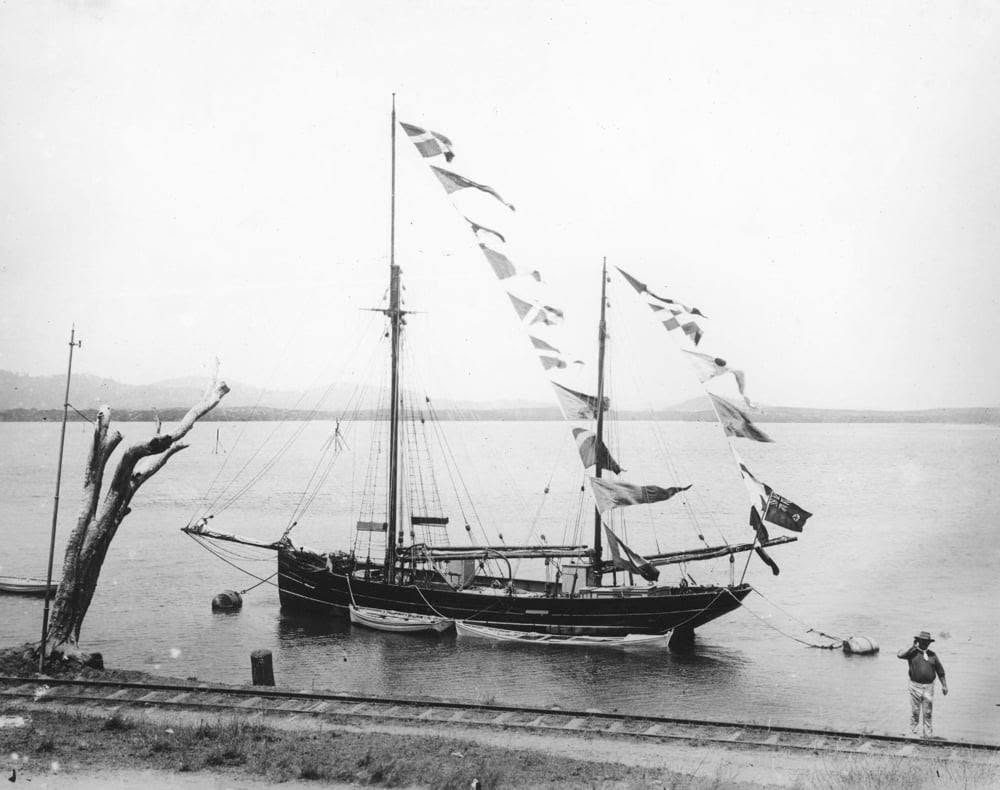
Though her limitations followed her, she still provided valuable service. She was regularly called upon to investigate reports of shipwrecks and to go in search of survivors in those remote waters. One such instance occurred shortly after the Spitfire arrived in Cooktown. She was sent to search for a white woman rumoured to be living with Aborigines near Cape Melville, however, after a couple of weeks in the area, no such woman was found.
More typically, the schooner was tasked with maintaining the lightships and navigation beacons safeguarding vessels making their way along Queensland’s northern coast.
Then, in January 1882, the Spitfire and her crew were given the melancholy task of retrieving the remains of Mary Watson (21), her infant son and a Chinese servant named Ah Sam. Mary’s husband Robert Watson and his business partner had established a Beche de Mer fishing station on Lizard Island. In September 1881, he and the rest of the men went in search of trepang, leaving his wife, son and two Chinese servants alone at the station. A party of Aborigines landed on the island and attacked them, killing one of the Chinese servants and wounding the other.
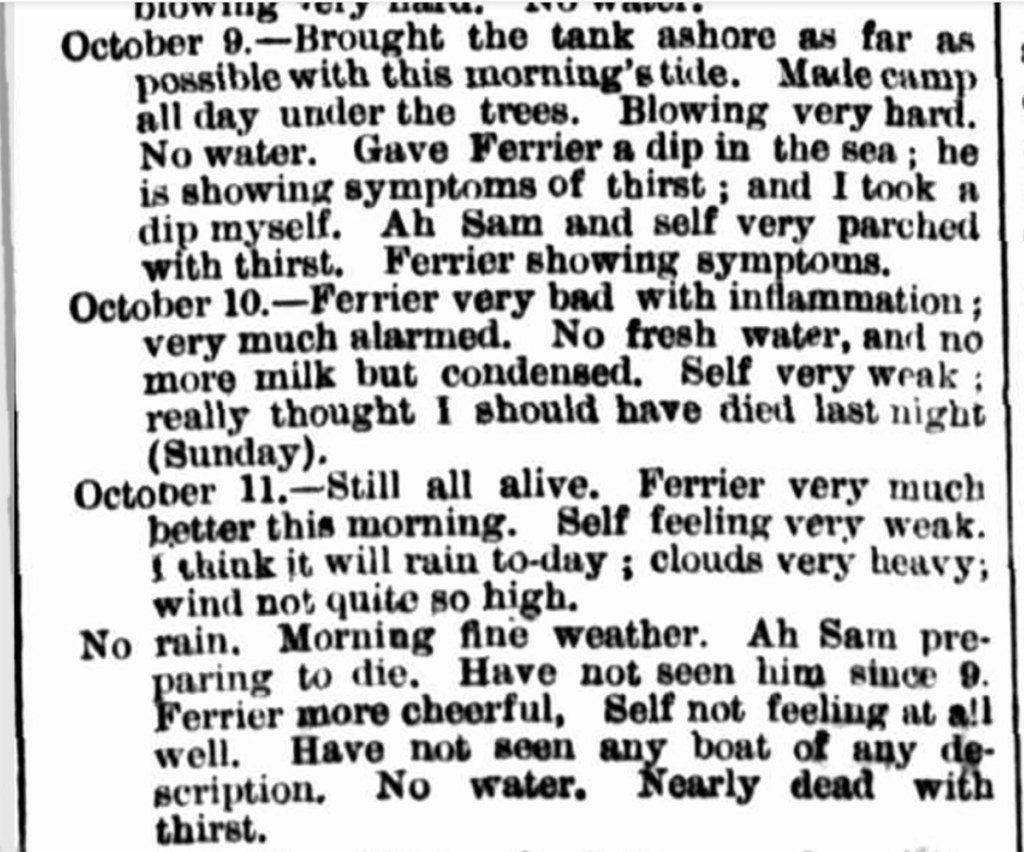
Mary Watson fled in a metal boiling tank with her son Ferrier and the wounded Ah Sam. Though adequately provisioned with food, they had left with only a small amount of fresh water. For the next eight days they drifted northwest with the current, and finally beached on one of the Howick Islands about 50 km away. However, before they were found, Ah Sam died from his wounds, and Watson and her son from dehydration. She left a poignant diary recording her final days.6
Despite being solidly constructed, or perhaps because of it, she proved a fairly poor sailer. One critic wrote, “Although she is periodically pitched and patched, the old tub is growing more shaky and useless every year. … She can make about 5½ to 6 knots with the wind over her quarter, but in beating to windward she gains about 10 miles in 24 hours going crab-like on every tack.” 7
In mid-July 1885, the Queensland government finally made the decision to auction off the now 30-year-old Spitfire. The new owners paid £300 for her and fitted her out for Beche de Mer fishing.
Over the next 14 years, she passed through several hands for Beche de Mer fishing was not for the faint hearted. Based out of Cooktown, the Spitfire would be gone for months at a time. The fishermen would establish a camp and a smokehouse on one of the Great Barrier Reef islands and harvest trepang from the surrounding waters. When the hold was filled, the Spitfire would return to port to offload the dried Beche de Mer and stock up with supplies before heading back out again.
In 1896, she was nearly lost off Hinchinbrook Island during a cyclone. With jury-rigged mast and sails, the Spitfire limped back to Cairns for repairs. But three years later her luck finally ran out.
On 21 August 1899, the Spitfire sprang a leak during rough weather, and her captain had little choice but to run her aground on a reef about 15 km south of the Piper Island lightship. All hands were subsequently rescued and a Marine Board Enquiry found the captain blameless for the little schooner’s loss.8
Thus ended the career of Australia’s first locally built gunboat. Although she was often criticised for being unsuited to many of the jobs she was called upon to do, she still provided valuable service for over four decades.
SOURCES
1. Launch of the First Australian Gunboat, The Empire, 5 Apr 1855, p. 4.
2. Report of the proceedings of the Queensland Government schooner “Spitfire” in search of the mouth of the River Burdekin, on the north-eastern coast of Australia … Brisbane: [Queensland Govt.], 1860
3. Gregory. Edmund, 1866, Sketch of the Residence of James Morrill among the Aborigines of Northern Queensland, Courier General Printing Office, Brisbane, p. 13.
4. The Courier, 23 Dec 1863, p. 2.
5. The Telegraph, 31 Jan 1874, p. 3.
6. Darling Downs Gazette, 23 Jan 1882, p. 3.
7. The Brisbane Courier, 17 Jun 1884, p. 5.
8. The Telegraph, 10 Sept 1898, p. 7, Morning Post, 15 Sept 1898, p. 4, and Tasmanian News, 2 Nov 1898, p. 2.
© Copyright C.J. Ison / Tales from the Quarterdeck, 2026.
Please enter your email address below to be notified of future blogs.