Tag: Convict History

  • Sydney’s First Convict Escape by Sea – 1790

    One of the first concerted efforts to escape from Sydney that did not involve trying to stow away on a homeward-bound ship took place in the latter part of 1790. Convicts, John Turwood, George Lee, George Connaway, John Watson, and John Strutton stole a boat and headed out to sea.

       Turwood and his mates had endured unimaginable hardships since leaving England, for they had come out on the infamous Second Fleet. Unsanitary living conditions and malnutrition had taken their toll on the voyage out. One-quarter of the 1006 convicts who left England died before ever reaching New South Wales. Of those who were put ashore, nearly 500 were immediately hospitalised. Of those, 124 would soon be dead. By September 1790, Turwood and his mates had been in the penal settlement for just eight weeks, but they had no desire to remain any longer to see if their fortunes might improve.

       Strutton had tried to escape once already. He had been smuggled aboard the Neptune and hidden among the firewood shortly before she was to sail back to England. However, sentries found his hiding place, and he was taken off the ship. He was flogged for trying to abscond, but the punishment only made him more determined to try again.

    Map of Sydney Cove Port Jackson, April 1788. Published by R. Cribb, London, 1789 original attributed to Fowkes, Francis – National Library of Australia, http://nla.gov.au/nla.map-nk276

    Soon after sunset on the night of 26 September, the five convicts stole a small flat-bottomed punt at Rose Hill and rowed down the Parramatta River into Sydney Harbour. Crammed in the small boat with them was one week’s supply of food, some cooking pots and other utensils, a few spare clothes and some bedding. At Watson’s Bay, just inside Sydney Heads, they put ashore and found another, much larger boat. Though it did not look particularly sturdy, it did have a mast and sail. Despite its shortcomings, the runaways thought they would have a better chance of surviving the open ocean in the larger boat. They transferred their belongings and headed out through Sydney Heads. By the time the bolters were reported missing and the two boats stolen, they were well on their way.

       Turwood had told friends before he had set off that they were going to sail to Tahiti, a place elevated in his mind to a tropical paradise where they could live freely among the Islanders. Tales from sailors who had visited Tahiti and other Pacific Islands had returned to England with fanciful stories about their time spent there. However, just how he intended to accomplish the 6,000-kilometre voyage without a sextant, charts, a compass, or any other navigation aids is a mystery.

       John Turwood was serving a life sentence for highway robbery. George Lee and George Connaway had stolen a pair of bullocks valued at £20. They had been sentenced to death, but that was later commuted to transportation for life. Watson and Strutton were each serving seven-year terms for stealing. Though nothing in their convict records suggests any of them had a nautical background, at least one of them knew how to handle a small vessel under sail.
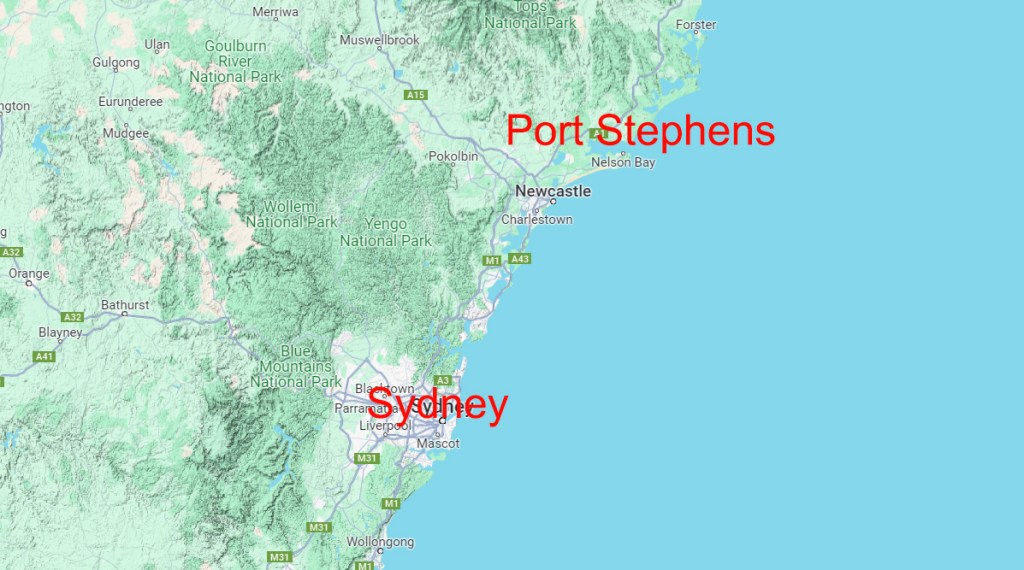
        After leaving Sydney Harbour, they set a course north, always remaining close to the coastline. When the sheltered waters of Port Stephens beckoned, they pulled in, and that’s where they stayed. After sailing 150 km, that was as close as they got to Tahiti. The local Aboriginal people, the Worimi, made them welcome and adopted them into their community. Over time, Turwood and the others learned to speak their language and were given Worimi names. They also seem to have undertaken formal initiation rituals, and at least a couple of the men took wives and began raising their own families. However, life was a constant struggle for the men, who were unaccustomed to the diet and customs of the Worimi people, especially in the beginning. Strutton died, although the circumstances and date of death were never recorded. Nonetheless, the other four lived there for five years and would have remained longer had a British warship not shown up.

       HMS Providence pulled into Port Stephens in mid-August 1795. She had just crossed the Pacific Ocean but had been unable to enter the Heads because of a strong westerly wind blowing off the land. Captain Broughton thought he would wait a few days in these sheltered waters before trying again. While there, he discovered Turwood and the other three white men living with the Aborigines. Broughton described them in his log as “miserable, half-starved objects, depending on the hospitality of the natives for their subsistence …” He offered to return them to Sydney, assuring them that they would likely not face punishment. Lee, Connaway and Watson immediately accepted the offer; however, Turwood was initially reluctant, but Broughton was eventually able to convince him to return as well. The arrival back in Sydney after a five-year absence was met with considerable surprise and of the runaway convicts in Sydney caused some consternation among the authorities, for they had long been given up for dead. But, true to Broughton’s word, they appear to have escaped punishment. Perhaps the Governor thought five years in the wilderness had been punishment enough.

    Families camped in the Port Stephens area, New South Wales, 1826 by Augustus Earle. Courtesy National Library of Australia.

       John Turwood and George Lee would flee from Sydney again in September 1797. They joined 13 other runaways who seized the small colonial cutter Cumberland near the mouth of the Hawkesbury River. After putting the captain and crew ashore, they headed out to sea. Neither the Cumberland nor the runaway convicts were ever seen again.

      © Copyright C.J. Ison / Tales from the Quarterdeck, 2025.

    Please enter your email address below to be notified of future blogs.

  • Capture of the Harrington, 1808

    Brig – similar to the Harrington.

    Robert Stewart was not your typical convict born into England’s poverty-stricken underclass and sentenced to transportation for committing some petty crime. Rather, he came from a comfortable though modest middle-class family. Born in 1771, the first ten years of his life would have likely been idyllic, but then his father died, and a year later, his widowed mother enrolled him into the Royal Mathematical Institution. There, he joined the ranks of boys learning maths and celestial navigation, preparing them for apprenticeships in the merchant marine or Royal Navy. Had he graduated, Stewart would have had a respectable and rewarding career that would one day see him master of his own ship. However, Stewart harboured ambitions of one day enjoying the sort of wealth and privileges that “higher-born” gentlemen took for granted.   

    In June 1785, Robert Stewart’s rebellious nature and frequent absences led to his expulsion from the institute.  He then joined the Royal Navy as an ordinary seaman and over the next 12 years rose to the rank of Petty Officer. But in 1798, aged 27, he deserted, likely embittered that he would never be promoted into the officer ranks.  Three years later, he stood trial on fraud and forgery charges. Stewart had purchased goods while posing as a Lieutenant in the Royal Navy and paid for them with a forged cheque. Caught, charged and found guilty, he was sentenced to transportation for life and sent to Van Diemen’s Land.

    Sydney Cove c1809. Courtesy State Library of NSW.

       Stewart arrived in Hobart on the Calcutta in 1803 and did not attract any undue attention for a year or so. However, twice, he attempted to escape by seizing small colonial vessels and setting sail. Both times ended in dismal failure, and he was returned to Hobart to face punishment. After his second attempt, he was sentenced to death. Stewart was only spared that punishment due to a blanket pardon given to all prisoners under capital sentence by the recently appointed Governor of NSW, William Bligh. However, in 1808, he was sent to Sydney to serve a period of time at hard labour.

       But Stewart never gave up hope of regaining his freedom. This time, he had his eye on the 180-ton brig Harrington anchored in Sydney Cove. She had recently returned to Port Jackson from China with her hold filled with tea after delivering a cargo of Fijian sandalwood. So lucrative was the trade that the Harrington’s captain was set to do it again.   The ship was stocked with enough supplies to last the crew several months and was to sail any day.   

    At 10 o’clock on the night of 15 May 1808, Stewart led as many as 30 fellow convicts out to the waiting ship in two boats they had just stolen. They came alongside as quietly as they could so as not to alert any sentries. But when Stewart climbed over the side, he found he had the deck to himself. The rest of the men swarmed over the gunwales. Some went forward to secure the crew. Others went aft to take care of the officers. The Harrington’s Chief Officer, Arnold Fisk, woke to the sight of Stewart holding a pistol to his head. The brig’s captain and owner could not be found, for he had gone ashore earlier that day. As Stewart and his men took control of the ship, the captain was blissfully asleep in his home overlooking Sydney Harbour.

    Sydney Gazette 22 May 1808, p. 2.

        With the ship’s company under guard, the convicts cut away the anchors and used the two stolen boats to tow the Harrington the length of Sydney Harbour. Once they reached the Heads, the sails were unfurled and the wind took them out to sea. By 7 a.m., they were about 20 nautical miles (40 kilometres) off the coast.

       Stewart ordered the Harrington’s crew into the two boats so they could make their way back to Sydney. They pulled into Sydney Cove later that afternoon to learn the alarm had already been raised. Earlier that morning, Captain Campbell had looked out across the Harbour to find his ship was not there.

       It took authorities three days to organise a ship, the Pegasus, to go in pursuit. By then, Stewart and the Harrington were long gone. The Pegasus cruised the Fijian Islands and then sailed on to Tonga before returning to Sydney via New Caledonia. She was gone nine weeks and arrived back empty-handed. For a time, it looked as if Robert Stewart and his band of bolters had made good their escape. Stewart had sailed the brig nearly 8000 kilometres north and was approaching Manila in the Philippines when their luck ran out. HMS Dedaigneuse spotted the unfamiliar vessel, and her captain sent a boarding party across to investigate. By then, the Harrington was flying American colours, and Stewart presented the officer with papers purporting that the ship was of American origin. The forged documents did not fool the officer in charge of the boarding party who seized the ship. Stewart, now calling himself Robert Bruce Keith Stuart, was taken back to the Dedaigneuse while the rest of the convicts were locked in the Harrington’s hold, now under the command of a British naval officer and a prize crew.

       Shortly thereafter, the Harrington ran aground off the island of Luzon. Most of the convicts were reported to have got ashore where they fled on foot. However, there is some evidence to suggest that their “escape” might have been fabricated, and they were actually press-ganged into Royal Navy service.

       Stewart, on the other hand, had a much easier time of it. He spoke and carried himself in a gentleman-like manner, professed to have enjoyed a liberal education and that he had connections to some of Britain’s most prestigious families. Stewart claimed to have once been a lieutenant in the Royal Navy before he fell victim to the penal system. As a result, he was accorded considerable leniency by the Dedaigneuse’s captain.    Captain Dawson allowed Stewart “every reasonable indulgence and forbade to place him under personal restraint.” That was until Stewart tried to escape and came very close to succeeding. After that, he was placed under close confinement. Stewart was eventually delivered to British officials in India, where he continued masquerading as a gentleman in need of help rather than the escaped convict that he was.

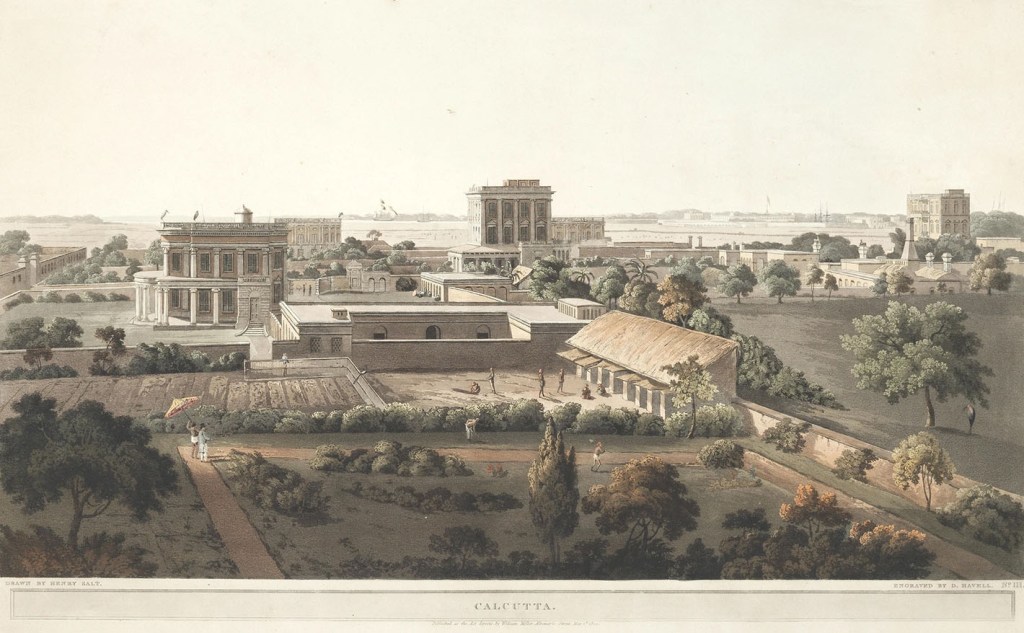
    Calcutta circa 1809.

       He knew he could not hide the fact that he had committed an offence serious enough to warrant transportation to New South Wales. So, instead, he fabricated a preposterous story about his conviction. Stewart claimed he had eloped with a young lady from a very respectable family, though chivalry required him to leave her unnamed. But, after they were secretly wed, a junior Baronet who also had desires for the lady broke into their apartment. Stewart said he had shot and injured the young aristocrat in what he described as an affair of honour. Stewart said he had been unfairly found guilty of attempted murder and sent to New South Wales. That sounded more in keeping with a gentleman than being caught for the more tawdry crime of passing a forged cheque. His tale garnered much sympathy from the colonial administrators in Calcutta. The Chief Magistrate even went as far as to champion Stewart’s cause, penning a letter to his superior suggesting he should be released.

       But then, in August 1809, Stewart’s time ran out. The British officials could not ignore that he was a fugitive from justice, and the Governor General ordered him to be returned to Sydney. He was placed on board a ship bound for Australia, but before it sailed, Stewart went missing. At first, the captain claimed he had jumped overboard and likely drowned, but it later transpired he had been whisked away in a boat by one of his many admirers and taken back to Calcutta.

       So, Robert Stewart may have escaped justice and settled in India under yet another assumed name, or caught the next ship leaving port. No one knows for the trail grows cold then. One thing is certain: he never returned to New South Wales to serve out his sentence. Nor did he face punishment for masterminding the seizure of the brig Harrington.

    © Copyright C.J. Ison / Tales from the Quarterdeck, 2024.

    Please enter your email address below to be notified of future blogs.