Tag: #Convict escape

  • The Catalpa rescue: a Most Audacious Prison Break

    The whaling barque Catalpa.

       In April 1875, the American whaling barque Catalpa quietly slipped out of New Bedford harbour without ceremony. To all appearances, she was just another whaler embarking on a routine hunt in the North Atlantic. However, Captain George Anthony had orders to sail halfway around the world and be stationed off Australia’s west coast, ready to rescue six convicts imprisoned by the British in Fremantle.

       The prisoners were all Irish nationalists who had been found guilty of treason and sent to Fremantle eight years earlier with scores of other revolutionaries. Over the years, most had been pardoned, but these six men had been serving soldiers in the British Army, and the government was disinclined to let them go. However, an Irish Independence organisation in the United States, the Clan-na-Gael, formulated a plan to set them free.

       They purchased the whaler, recruited a captain sympathetic to their cause and sent Irish agents, headed by John Breslin, to Fremantle to organise the escape on the ground. Breslin passed himself off as a wealthy American businessman looking for investment opportunities in the far-flung colony. He made contact with the convicts and warned them to be ready to leave at short notice. Breslin then assembled a small armoury of firearms and organised the hire of horses and carriages. He also reconnoitred the coastline south of Fremantle, looking for a suitable out-of-the-way place to take the escapees. There they would be taken off the beach in a whaleboat and delivered to the waiting ship.

    John J Breslin, AKA John Collins who orchestrated the Catalpa escape.

       By January 1876, all was in place except for the Catalpa. The ship was nowhere to be seen. As the weeks ticked by without any word from the whaler, Breslin grew increasingly concerned that some calamity had befallen her. However, his fears were unfounded. To Breslin’s great relief, the Catalpa finally dropped anchor in Bunbury on 28 March.

       Breslin met with Captain Anthony, and the two men thrashed out the final details of the escape. And, after a couple of unavoidable delays, the pair set on the escape, taking place on Monday, 17 April. On Sunday night, Captain Anthony took the Catalpa into international waters 30 kilometres west of Rockingham and then went ashore in the whaleboat to wait for Breslin and the Irish prisoners at a prearranged beach near Cape Peron.

       On Monday morning, the prisoners left their work gangs on various pretexts and made their way to Rockingham Road. There, they were met by Breslin and his men waiting with a change of clothes and horse-drawn carriages. They then raced south towards the waiting whaleboat. By 10.30, the prisoners, Breslin and all his men, were being loaded onto one of the Catalpa’s whaleboats as a plume of dark smoke from the government steamer smudged the morning sky. Captain Anthony wasted no time heading the boat out to sea to rendezvous with his ship.   

    However, it would not be smooth sailing getting back to the Catalpa. The seas had turned rough while he had been waiting on shore. To make matters worse, the whaleboat sat low in the water, weighed down by so many extra bodies. The boat crew battled the wind and waves all that day but made slow progress. But towards sunset, Captain Anthony spotted the Catalpa off in the distance. Then disaster struck. The mast snapped under the strain of the taut canvas and nearly flung everyone into the ocean. But for the quick actions of the man at the tiller, the brazen escape may well have failed there and then. Once night had descended and the ship was lost to sight, they had no choice but to spend an uncomfortable night in the cramped boat being buffeted about by the ocean swells. The next morning, the mast was repaired, and they were once again on their way. They soon sighted the Catalpa again and set a course to join her. Captain Anthony also spotted billowing black smoke, heralding the government steamer Georgette, on a course to intercept the whaler. Captain Anthony had the sail taken in and the mast lowered. The steamer passed within one kilometre of the whaleboat but failed to see it in the choppy sea conditions.

    “The Rescued Six.” By Charles Herbert Moore – https://archive.org/details/catalpaexpeditio01peas, Public Domain, https://commons.wikimedia.org/w/index.php?curid=33130178

       When the Georgette came alongside the Catalpa, the Superintendent of the Water Police enquired if there were any escaped prisoners on board. On being told there were none, the police officer asked if he could come aboard so he could see for himself. The first mate forbade him permission, reminding the Superintendent that the Catalpa was an American-flagged ship in international waters and was therefore not subject to British authority. Not wishing to spark an international incident, the Georgette broke off after 10 minutes and continued its fruitless search for the missing prisoners.

       As the Georgette steamed off, Captain Anthony had the mast and sail reset, and his oarsmen pulled for all they were worth. When the first mate sighted the whaleboat in the distance, he ordered the Catalpa’s helmsman to head towards them to close the gap. Hidden from sight by the bulk of the ship, Captain Anthony was unaware that a police cutter was also making for the ship.

       The whaleboat reached the Catalpa first and was hooked up to the davits, and within minutes, they were underway again and heading north. It was a close-run race. But, in the end, the police could do nothing but watch on as several of the Irish convicts jeered at them from the safety of the American ship’s deck. The police cutter’s commander gracefully accepted defeat with a snappy salute before returning to Fremantle empty-handed.    However, the Western Australian Governor was less sanguine about losing six prisoners so easily. He ordered the Georgette to go back out, find the ship and return the six prisoners to gaol. This time, she would carry a large complement of armed police and prison guards as well as a field artillery piece mounted on the foredeck. The next morning, the Georgette intercepted the Catalpa in international waters for the second time. This time, the Catalpa was heading south past Fremantle on her way towards the Southern Ocean to start her long voyage home.

    Mural commemorating the Catalpa rescue in Fremantle, WA. Photo CJ Ison.

       At 8 a.m., the Georgette pulled a little ahead of the Catalpa and fired a shot across her bows, signalling for the whaling ship to stop. Captain Anthony ignored the order and continued on his course until the Georgette’s gun crew had reloaded their piece. Only then did he put a speaking trumpet to his mouth and ask what they wanted.

       The Georgette’s Commanding Officer asked if there were any escaped prisoners onboard. This time, he warned Captain Anthony that the colonial secretary had been in contact with the American Government and had been authorised to use force to stop the ship. He also threatened to bring down the Catalpa’s masts with artillery fire should they not heave to. Breslin and Anthony agreed to call the bluff, thinking it unlikely that they had got permission to board, even with the magic of telegraphic communications. Anthony pointed to the Stars and Stripes fluttering in the wind and cautioned that an attack on his ship would be an attack on the United States.

       No one on the steamer wished to trigger a diplomatic row, so after shadowing the Catalpa for another half an hour or so, the Georgette veered off and returned to port empty-handed. Breslin would later write that the British left without even bidding them a hearty bon voyage.

       The Catalpa arrived in New York on 19 August after a four-month voyage via Cape Horn. The rescuers were feted as heroes, and the six Irish prisoners settled into their new lives as free men. This was arguably one of the best planned and executed escapes during Australia’s convict era. It was also the last.

    A more detailed account of the rescue can be found in Bolters: An Unruly Bunch of Malcontents.

    Sun sets over Flinders and Stanley Islands in Bathurst Bay with a fishing boat in the forground at Cape Melville on Cape York Peninsular, Far North Queensland. Photo Chris Ison / Wildshot Images.

    © Copyright C.J. Ison / Tales from the Quarterdeck, 2025.

    Please enter your email address below to be notified of future blogs.

  • Sydney’s First Convict Escape by Sea – 1790

    One of the first concerted efforts to escape from Sydney that did not involve trying to stow away on a homeward-bound ship took place in the latter part of 1790. Convicts, John Turwood, George Lee, George Connaway, John Watson, and John Strutton stole a boat and headed out to sea.

       Turwood and his mates had endured unimaginable hardships since leaving England, for they had come out on the infamous Second Fleet. Unsanitary living conditions and malnutrition had taken their toll on the voyage out. One-quarter of the 1006 convicts who left England died before ever reaching New South Wales. Of those who were put ashore, nearly 500 were immediately hospitalised. Of those, 124 would soon be dead. By September 1790, Turwood and his mates had been in the penal settlement for just eight weeks, but they had no desire to remain any longer to see if their fortunes might improve.

       Strutton had tried to escape once already. He had been smuggled aboard the Neptune and hidden among the firewood shortly before she was to sail back to England. However, sentries found his hiding place, and he was taken off the ship. He was flogged for trying to abscond, but the punishment only made him more determined to try again.

    Map of Sydney Cove Port Jackson, April 1788. Published by R. Cribb, London, 1789 original attributed to Fowkes, Francis – National Library of Australia, http://nla.gov.au/nla.map-nk276

    Soon after sunset on the night of 26 September, the five convicts stole a small flat-bottomed punt at Rose Hill and rowed down the Parramatta River into Sydney Harbour. Crammed in the small boat with them was one week’s supply of food, some cooking pots and other utensils, a few spare clothes and some bedding. At Watson’s Bay, just inside Sydney Heads, they put ashore and found another, much larger boat. Though it did not look particularly sturdy, it did have a mast and sail. Despite its shortcomings, the runaways thought they would have a better chance of surviving the open ocean in the larger boat. They transferred their belongings and headed out through Sydney Heads. By the time the bolters were reported missing and the two boats stolen, they were well on their way.

       Turwood had told friends before he had set off that they were going to sail to Tahiti, a place elevated in his mind to a tropical paradise where they could live freely among the Islanders. Tales from sailors who had visited Tahiti and other Pacific Islands had returned to England with fanciful stories about their time spent there. However, just how he intended to accomplish the 6,000-kilometre voyage without a sextant, charts, a compass, or any other navigation aids is a mystery.

       John Turwood was serving a life sentence for highway robbery. George Lee and George Connaway had stolen a pair of bullocks valued at £20. They had been sentenced to death, but that was later commuted to transportation for life. Watson and Strutton were each serving seven-year terms for stealing. Though nothing in their convict records suggests any of them had a nautical background, at least one of them knew how to handle a small vessel under sail.

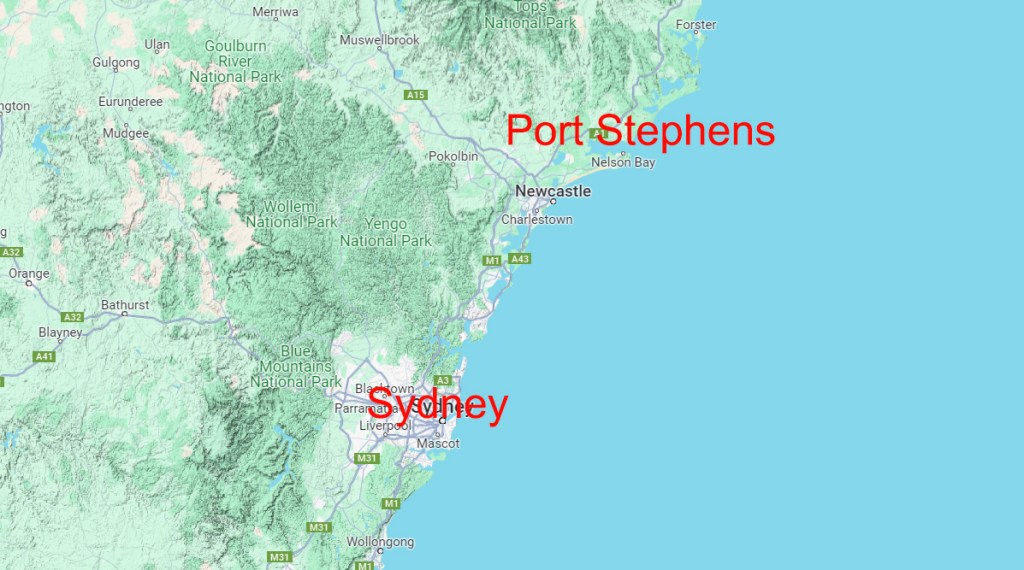
        After leaving Sydney Harbour, they set a course north, always remaining close to the coastline. When the sheltered waters of Port Stephens beckoned, they pulled in, and that’s where they stayed. After sailing 150 km, that was as close as they got to Tahiti. The local Aboriginal people, the Worimi, made them welcome and adopted them into their community. Over time, Turwood and the others learned to speak their language and were given Worimi names. They also seem to have undertaken formal initiation rituals, and at least a couple of the men took wives and began raising their own families. However, life was a constant struggle for the men, who were unaccustomed to the diet and customs of the Worimi people, especially in the beginning. Strutton died, although the circumstances and date of death were never recorded. Nonetheless, the other four lived there for five years and would have remained longer had a British warship not shown up.

       HMS Providence pulled into Port Stephens in mid-August 1795. She had just crossed the Pacific Ocean but had been unable to enter the Heads because of a strong westerly wind blowing off the land. Captain Broughton thought he would wait a few days in these sheltered waters before trying again. While there, he discovered Turwood and the other three white men living with the Aborigines. Broughton described them in his log as “miserable, half-starved objects, depending on the hospitality of the natives for their subsistence …” He offered to return them to Sydney, assuring them that they would likely not face punishment. Lee, Connaway and Watson immediately accepted the offer; however, Turwood was initially reluctant, but Broughton was eventually able to convince him to return as well. The arrival back in Sydney after a five-year absence was met with considerable surprise and of the runaway convicts in Sydney caused some consternation among the authorities, for they had long been given up for dead. But, true to Broughton’s word, they appear to have escaped punishment. Perhaps the Governor thought five years in the wilderness had been punishment enough.

    Families camped in the Port Stephens area, New South Wales, 1826 by Augustus Earle. Courtesy National Library of Australia.

       John Turwood and George Lee would flee from Sydney again in September 1797. They joined 13 other runaways who seized the small colonial cutter Cumberland near the mouth of the Hawkesbury River. After putting the captain and crew ashore, they headed out to sea. Neither the Cumberland nor the runaway convicts were ever seen again.

      © Copyright C.J. Ison / Tales from the Quarterdeck, 2025.

    Please enter your email address below to be notified of future blogs.

  • The Frederick: Stealing the Ship That Never Was

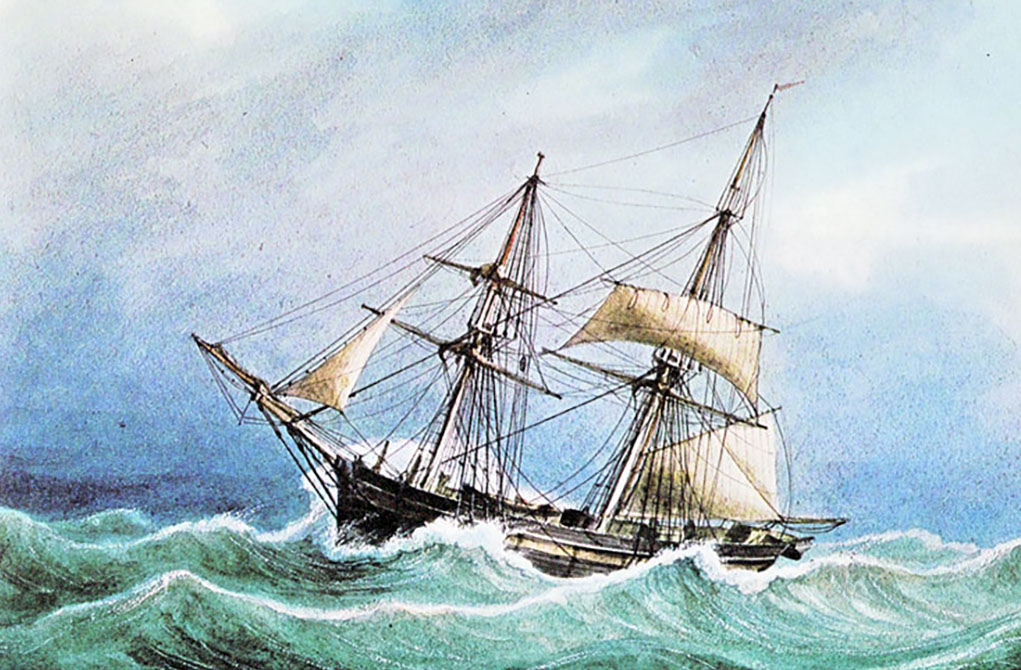
    Example of a merchant Brig of the era. (Water colours by Frederic Roux 1827-1828)

    By December 1833, the penal settlement at Macquarie Harbour in southwest Tasmania was all but deserted.   Only a dozen convicts remained to complete the 120-ton brig Frederick.   She would be the last of nearly 100 vessels to be built there.   Once launched, they were supposed to sail her around to the newly established station at Port Arthur.   However, ten of the convicts had a much more distant destination in mind.

    But, to seize the ship involved overpowering the soldiers and officers left behind to watch over them.   Tackling armed men with just bare hands was daunting, but they had a plan.   One of the convicts, John Barker, happened to be a master blacksmith.   He manufactured two flintlock pistols using discarded scraps of metal and a musket barrel found in the blacksmith shop.   He also forged a pair of tomahawks to add to their small arsenal.  

    The Frederick was finished on 10 January 1834, and at 10 am the next day they set sail.   Captain Taw sailed down the length of Macquarie Harbour but dropped anchor inside the heads.   He judged the weather too foul to safely pass through the narrow passage of Hells Gate and out to sea.    So they waited.   Then, on Monday, 13 January, the wind eased, signalling their imminent departure.    

    For the ten convicts, the time to strike had arrived.    If they did not seize the ship now, they likely never would.    However, they were up against nine men, seven of whom were armed. 

    Then, good fortune smiled upon them, and the odds shifted in their favour.   Two of the soldiers went fishing and took a boat out with a convict at the oars.     He was one of two prisoners not in on the plan.   So, with them gone, nine had been reduced to six.     

    Boat building Yard on Sarah Island, Macquarie Harbour by William Gould, 1833, Courtesy State Library of NSW.

    Around 6 o’clock in the evening, a prisoner beckoned a sentry to join him by the forecastle hatchway.   When the unsuspecting soldier obliged, he was jabbed in the chest with one of Barker’s pistols and ordered down the ladder into the crew’s cabin.   Meanwhile, two other convicts armed with hatchets pounce on the only other two men on deck.  They subdued the remaining soldier and the terrified mate, bundling them too into the forecastle cabin.   A convict stood guard, and a heavy kedge anchor was dragged across the hatchway cover in case they tried to escape.   The convicts now had control of the deck.   Three men were confined in the forecastle, and another three were out fishing, oblivious to what was unfolding on the Frederick.    This just left Captain Taw, David Hoy the shipyard supervisor, and the convict steward William Nicholls.   All were in the captain’s cabin

    The convicts, now armed with the soldiers’ muskets, were ready to confront the last men standing between them and liberty.   Three men stormed down the ladder and attacked Captain Taw and the others, hoping to quickly get the best of them.   However, Taw and Hoy fought back.   Hoy wrestled a pistol from one of the convicts, and the attackers retreated back up the ladder, leaving Taw, Hoy and Nicholls trapped in the cabin, bloodied and bruised from the brief but violent encounter.

    Taw and Hoy were trapped in the cabin.   The convicts would pay dearly if they attacked again, but the captain knew he could not retake the ship.   They were at a stalemate.   But Captain Taw had one small bargaining chip.   He had possession of the Frederick’s navigation instruments, items the convicts would need to escape.  The impasse lasted about ninety minutes, with occasional shots fired through the cabin’s skylight and each side calling for the other to surrender.  

    The Globe (London), 9 Jul 1834, p. 4.

    Around 7.30 in the evening, someone called for the pitch pot to be brought over and threatened to empty its boiling contents into the cabin if the trio did not immediately surrender.    Hoy and Taw agreed there was nothing to be gained by holding out any longer and gave themselves up.  

    Meanwhile, the fishing party had returned to the brig after hearing gunfire, only to find the prisoners already in charge.   The rest of Frederick’s men joined them in the boat, and they were sent ashore with half the ship’s provisions.

    Taw and Hoy assessed their situation.    There was plenty of food, so they would not be going hungry any time soon.    However, how long would it be before a ship was sent to investigate the whereabouts of the Frederick?     Taw had no intention of waiting to find out.   They set off on foot for the nearest settlement, 150 kilometres away.  It would take Taw over two weeks to eventually reach Hobart to report the incident.

    In those two weeks, the mutineers did not waste any time making good their escape. James Porter, one of the convicts, wrote the only record of what happened to the Frederick next.  

    Porter was not a typical convict transported to Australia.    For a start, he was born into a respectable middle-class family.  When he was 12, he dropped out of school and, by his own account, began mixing with the wrong kind of people.   Porter soon got himself in trouble with the law, but his father pulled some strings, and the charges were dropped.   However, to prevent Porter from getting into any more trouble, he was sent to sea to serve an apprenticeship and found himself bound for Rio de Janeiro.   

    So began his career as a seaman.   After changing ships several times, Porter claimed he had spent 12 months on the armed schooner Liberta helping the Chileans win their independence from Spanish rule.   However, by late 1821, he had had enough of life in South America and returned to England. 

    A year later, Porter was caught breaking into a house and was transported to Van Diemen’s Land for life.   He landed in Hobart in January 1824 but was soon caught stealing and sent to Macquarie Harbour.   

    When he was chosen to remain behind to finish work on the Frederick, a plan started to take shape in his mind, and South America once again beckoned.   His companions comprised a mix of experienced seamen like himself, shipwrights and the blacksmith John   Barker who had been schooled in celestial navigation, though he proved to be no seafarer.

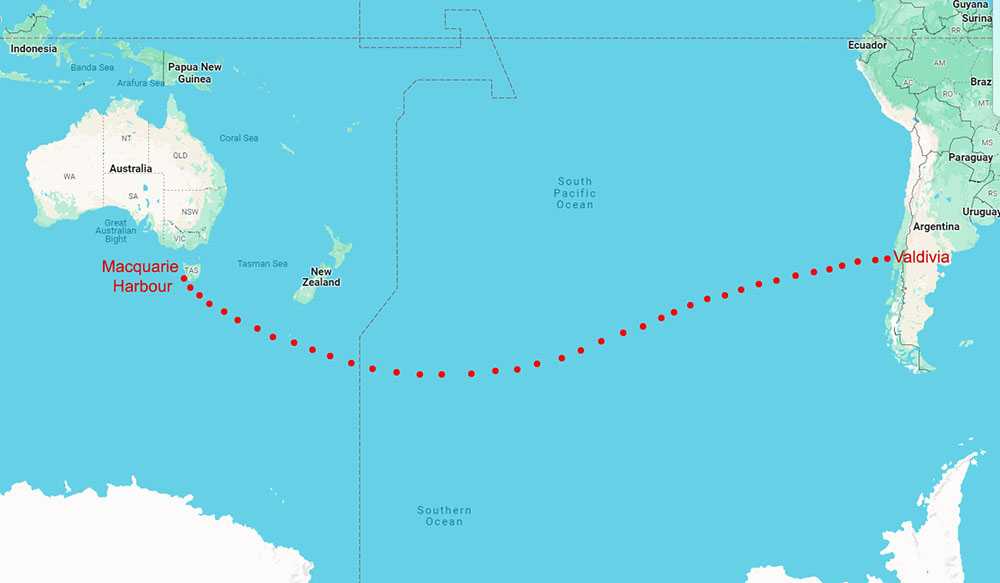
    The Frederick was sailed from Macquarie Harbour to South America where it was left to sink. Courtesy Google Maps.

    The Frederick no sooner made it out to sea when the wind freshened to a heavy gale.      It blew hard with mountainous seas for the next nine days as they bore south, then east under much-reduced canvas.   The burden of sailing fell heavily on the shoulders of the seasoned sailors.   The rest of the men, unused to such sea conditions, rarely left their bunks, suffering severely from sea sickness.    Barker was particularly prone to the malady, only coming on deck periodically to make observations and plot their course.  

    After being at sea for about three weeks with few opportunities to take observations, Barker found they had strayed too far south into the dangerous icy waters of the “Furious Fifties”.   He set a northeasterly course for the helmsmen and then retired to his quarters again.   Shortly after this, their voyage nearly came to an end when the Frederick was heeled over on her side by a powerful wind gust.  

    Fortunately, the ship righted herself once the canvas had been brought in.      Then, about six weeks out, they spotted land for the first time since leaving Tasmania.  They had sailed nearly 5,400 nautical miles (10,000 km) and arrived off the coast of South America.  

    On 27 February, they boarded the longboat and left the Frederick to sink as, by now, she was taking on a lot of water.    The next morning, they made landfall near the mouth of the Rio Bueno in Chile.       A week later, they arrived at the provincial capital of Valdivia, where they were promptly thrown in gaol for entering the country in a “clandestine manner.” 

    It was obvious to the Chilean officials that the men claiming to be shipwrecked sailors were not what they claimed to be.   Now that they were behind bars and facing an uncertain future, Porter and his comrades decided to admit to being runaway convicts and beg the Governor for asylum.  

    Illustration of a brig. Source: Nautical Dictionary by Arthur Young, published in 1863.

    They found a sympathetic ear in Governor Sanchez, and he agreed to petition the President of Chile in Santiago on their behalf.    They were released from gaol after promising not to leave town.   All ten men found work at the local shipbuilding yard, where their skills were much in demand.   As time passed, they settled into their new lives and felt their troubles had been put behind them.  

    But the British Consul in Santiago had learned of their presence in Valdivia unbeknownst to Porter and his colleagues.   He, in turn, had called on the Royal Navy to dispatch a ship to apprehend the runaways.   

    Eight months later, in February 1835, HMS Blonde dropped anchor at the mouth of the Valdivia River to collect the runaway convicts.   However, Governor Sanchez refused to hand them over, and the British warship left empty-handed.   While Porter and the others had avoided arrest this time, it was clear to them that the British knew where they were.  

    Life settled back into its regular routines until a few months later, when Governor Sanchez was replaced by a man far less sympathetic to the runaway convicts.    Within a month, three of the convicts departed on a merchant ship bound for North America.   Then Barker and two others left in the dead of night in a whaleboat they had been building for the new governor.    The governor was furious and gaoled Porter and the other three until they could be handed over to the Royal Navy.

    They were put on board the next British warship that stopped at Valdivia and returned to England.   As they had escaped from Van Diemen’s Land, it was decided to return them there to stand trial for piracy.   They arrived back in Hobart on 29 Mar 1837 after an absence of more than three years.  

    In a novel legal argument, Porter contended that because the Frederick had never been officially registered, it could not be considered a ship.  Instead, it was just a collection of timber, ropes, canvas and such like, which just happened to resemble a brig.    Consequently, he argued, they could not be found guilty of piracy.    The jury was unconvinced, and after 30 minutes of deliberation, they returned a guilty verdict, and the four men were banished to Norfolk Island for life.    

    © Copyright C.J. Ison / Tales from the Quarterdeck, 2025.

    Please enter your email address below to be notified of future blogs.