Tag: Convict era

  • The Loss of the Convict Ship Neva – 1835

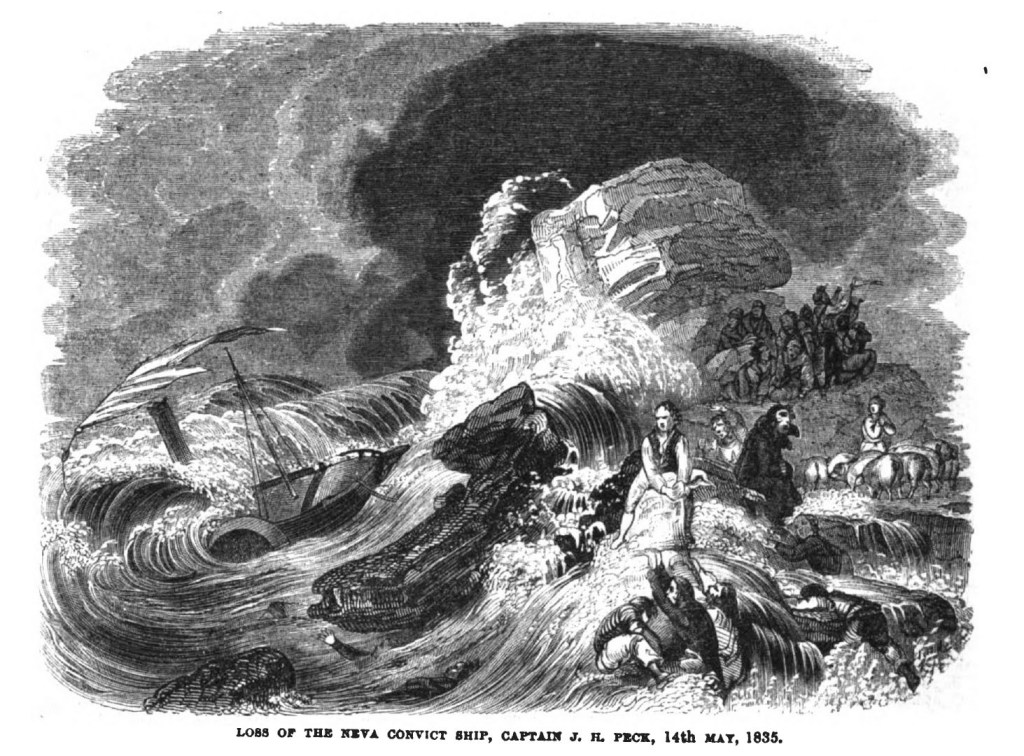
    Loss of the Neva. Source: Tales of Shipwrecks and Adventures at Sea, 1846.

       Between 1788 and 1868, more than 162,000 convicts were loaded onto transport ships and banished to the colonies to serve out their sentences. Such were the living conditions onboard some of these vessels, coupled with the hazards of sailing such vast distances in isolated waters, perhaps as many as one in one hundred perished before ever setting foot on Australian soil. When the Neva struck a reef in Bass Strait, of her 226 casualties, nearly 150 of them were convicts.

       The 337-ton barque Neva set sail from the Irish port of Cork on 8 January 1835, bound for Sydney, New South Wales. On board were 153 female prisoners of the crown, 55 children and nine free female emigrants. The crew, under the command of Captain Benjamin H. Peck, numbered 26. During the passage, three people died and one baby was born, so by the time they were nearing their destination, the ship’s complement numbered 241, passengers and crew.

       By 12 May, the Neva had rounded the Cape of Good Hope, stopped briefly at the island of St Paul for fresh supplies and was about to enter Bass Strait. At noon, Captain Peck calculated they were about 90nm (170 km) west of King Island. As daylight faded into night, he posted a lookout to warn of any dangers lying in their path. He would remain on deck through the night, but for a two-hour break, as his ship negotiated that dangerous stretch of water.   

    A stiff breeze was blowing, and the ship was being pushed along under double-reefed topsails. Around 2 o’clock in the morning, the lookout sighted the dark silhouette of land against the lighter night sky in the distance. Peck ordered the course altered a little to the north to ensure he safely cleared King Island. Then, about two or three hours later, the frantic call came from the lookout, “breakers ahead,” as a line of white water emerged from the pre-dawn gloom. 
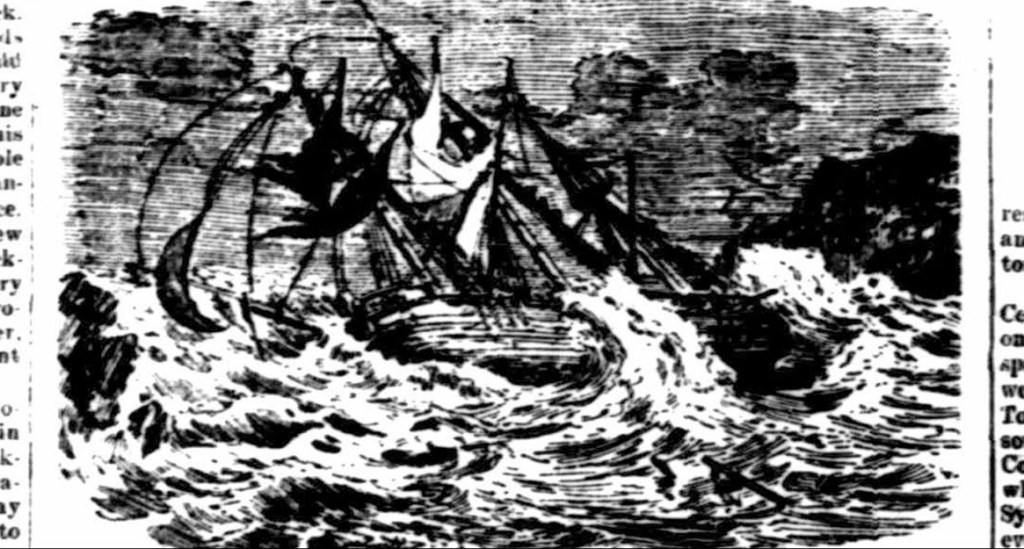
    Neva Shipwreck. illustration from The Capricornian, 26 May 1927.

       Captain Peck immediately gave the order to tack, but it came too late. As the Neva was turning into the wind, she struck a rock and lost her rudder. With the wheel spinning freely, the stricken ship was now at the mercy of the wind and current. They had likely struck Navarine Reef about three kilometres northeast of Cape Wickham, the northernmost point of King Island.

       Suddenly, the Neva struck hard a second time. She hit on her port bow and swung broadside against the reef and immediately started taking on water. Below decks, the prison cages collapsed under the violent force of the collision, and the terrified female convicts rushed on deck.

       The gig, one of the four available lifeboats, was lost as it was being lowered into the water. Captain Peck then ordered the pinnace over the side, and he, the ship’s surgeon, several sailors and some of the female passengers climbed in. But before they could put away, it was overwhelmed by a deluge of terrified women, frantically trying to escape the ship. The boat sank under their weight, and everyone was spilled into the churning water. Only Peck and the two seamen made it back to the ship alive.

       The captain then set about launching the longboat. However, this time, as he boarded, he made sure his panicking passengers were kept at bay. But this time, as soon as the boat was lowered, it was swamped by the surging seas crashing around the ship. Everyone was tossed into the water. Only Captain Peck and his first mate made it back to the ship this time.

       After the loss of three boats, the cutter was their only remaining lifeboat. It is not clear from reading survivor accounts why it was never launched. Considering the sea conditions it would likely have met with the same fate as the longboat. The most likely reason the cutter was never launched is that the Neva began to break up before it could be lowered.

    Account of the Neva shipwreck. Courtesy, State Library of NSW, FL3316306

       Part of the deck sprang away from the superstructure and then split in half, effectively forming two rafts. Captain Peck, some of the crew and several women made it onto one of them while the first mate and several other people were lucky enough to find themselves on the second. The two rafts drifted clear of the wreckage, leaving the remaining convict women clinging to those parts of the ship still jutting out of the surging seas.

       The rafts and several other pieces of wreckage with people clinging to them drifted with the currents for several hours before they came to ground in a sandy bay at the northern end of King Island. The mate’s raft rode the surf in and washed up high on the beach, and most of the people who had clung to it survived.

       The captain’s raft was not so lucky. The timber platform had come away with a large section of the foremast protruding below the surface. As they entered the shallows, the mast caught on the bottom some distance from the beach. Waves swept everyone from the raft, drowning anyone who could not swim. Only the captain, a seaman and one woman made it through the pounding surf to reach shore alive.

       Twenty-two people made it onto King Island, but seven of them died within 24 hours either from exposure or from injuries sustained during their escape from the wreck. The remaining 15 survivors used sails and spars washed ashore to build makeshift shelters, and then they began collecting what provisions had been washed ashore. Over 100 bodies were found scattered among the debris, and they were buried in several mass graves in the coming days.

       Having resigned to waiting it out until they could be rescued by the next passing ship, Peck and the others began foraging for food to supplement the provisions that had washed ashore from the Neva. But unbeknown to them, there was another party of castaways on King Island. They had been shipwrecked earlier on the south-eastern end of King Island and had come to investigate when they saw wreckage drifting down the coast. They eventually came upon the Neva survivors. A short time later all the survivors were discovered by a sealer and his Aboriginal wife who lived permanently on the island. They cared for the castaways until help finally arrived.

       After being marooned for a month, the castaways were found by Charles Friend, the master of the schooner Sarah Ann. He had touched at King Island on his way back to Launceston after delivering provisions to a whaling station elsewhere in Bass Strait. He took off all the survivors except two of the Neva’s sailors and a convict woman, who had been out foraging for food at the time. Unable to find a safe place to anchor, he was not prepared to risk losing his ship waiting for them to return.

       The Sarah Ann reached Launceston on 27 June, and a cutter was immediately dispatched to King Island to collect the remaining three castaways. In all, just fifteen of the 241 passengers and crew survived, making it one of Australia’s worst maritime disasters.

    © Copyright C.J. Ison / Tales from the Quarterdeck, 2023.

    To be notified of future blogs, please enter your email address below.

  • The Loss of HMS Sirius – 1790

    “The melancholy loss of H.M.S Sirius off Norfolk Island” by George. Raper. Courtesy: National Library of Australia 136507434-1

    When HMS Sirius was wrecked off Norfolk Island in 1790, the loss was keenly felt back in Sydney. She was one of only two ships available to Governor Phillip, and he desperately needed both of them. Sydney had so far been unable to grow sufficient food to feed itself and was now facing starvation. The loss of the Sirius only compounded the colony’s problems. 

       HMS Sirius had sailed from Portsmouth on 13 March 1787 as part of the First Fleet, a social experiment to rid England of its most troublesome and unwanted folk. They arrived in New South Wales in January 1788. A month later HMS Supply sailed for Norfolk Island with a small number of convicts and a detachment of guards to establish a penal settlement there. By October of the same year, Governor Phillip realised that Sydney would soon be facing starvation unless something was urgently done. He ordered Captain John Hunter to sail HMS Sirius to the Cape of Good Hope and purchase livestock, grain and other provisions for the fledgling colony.   

    Some months after her return, the Sirius, in company with HMS Supply, was ordered to sail for Norfolk Island with desperately needed provisions along with additional convicts and guards.

    First Fleet entering Sydney Heads January 1788. By E. Le Bihan, Courtesy State Library of NSW.

       They reached Norfolk Island on 13 March 1790, and over the next few days, they disembarked their passengers; however, the sea conditions were such that neither ship was able to land its stores. On 15 March, the unrelenting gale-force southerly forced them to leave the island. By the 19th, the wind had moderated and shifted around to the southeast, so Captain Hunter made landfall again, hoping to begin unloading.

       As Sirius neared the island, Captain Hunter saw the Supply already anchored in Sydney Bay, and there were signals flying on shore that longboats could land without danger from the surf. Hunter took his ship in as close as he dared, loaded the boats and sent them away, but then the wind freshened.

    “Part of the Reef in Sydney Bay, Norfolk Island, on which the Sirius was wreck’d. 19 March 1790.’ by William Bradley.

         Hunter ordered his men to haul up the anchor and make for open water, but before he could do so, the Sirius was driven onto the rocks. Powerful surf crashed around the stricken ship. Soon after they struck, the carpenter reported that water was pouring into the hold. The masts were cut away in the hope that the lightened vessel might be driven higher onto the reef, where the crew would have a better chance of saving their lives.

       By now, it was about 11 a.m. The provisions were brought up from the hold and stacked on deck so they might be floated ashore if the opportunity arose. However, the sea conditions continued to deteriorate. Towards evening, Hunter received word from shore urging him to abandon ship as it would be too dangerous to remain overnight. A rope was tied to an empty barrel and floated through the surf to waiting hands ashore. Then a seven-inch-thick hawser was sent across the narrow stretch of reef and surging seas and tied to a tree. Now the crew could be hauled ashore three or four at a time. Most sported cuts or bruises by the time the reached land from being bashed against the rocks on the perilous passage. The operation stopped only when it became too dark to continue safely, and the remaining men were taken off the following day.

       A couple of days later, two convicts volunteered to go aboard the Sirius to get the livestock ashore. They got a number of pigs and some poultry over the side and the current did the rest. However, as evening turned to night, the two convicts refused to leave the ship. They had found a cask of rum sometime during the day, and by evening, they were drunk as lords. Probably in an effort to keep themselves warm, they lit two fires, but they soon got out of hand and did significant damage to the ship. The following day, guards were sent out to the ship to forcibly return them to shore, where they were clapped in irons for their troubles.

       When the weather finally eased, Hunter sent some of his men across to begin ferrying the remaining provisions ashore using the hawser. Other stores, sealed in timber casks, were thrown into the water with the hope that they would wash ashore through the surf. Some made it. Some sank to the bottom.

       While the Supply had managed to unload its provisions on the sheltered side of the island, with so many additional mouths to feed, rations for everyone on Norfolk were cut in half.

    The Settlement on Norfolk Island, May 16th 1790 / George Raper. Courtesy State Library of NSW, FL541331.

    Captain Hunter and his crew would be stranded on Norfolk Island for several months before they could return to Sydney. Meanwhile, Governor Phillip was stunned to learn of the Sirius’ loss. He had been relying on her to go on another resupply mission to keep the struggling colony fed.

       His problems just kept mounting. The second fleet had recently arrived, delivering 800 extra mouths to feed, many were already in a terrible physical state when they came ashore. They were too ill to help cultivate crops or contribute in any other meaningful way. One of the fleet’s two supply ships, HMS Guardian, had been wrecked in the Southern Ocean, placing a greater strain on the settlement’s already meagre provisions. Food was tightly rationed and no distinction was made between the lowest convict and the Governor himself. Everyone received the same ration, one and a half pounds (700 g) of flour, two pounds (900 g) of salt pork, one pound (450 g) of rice and one pint (500ml) of peas per week.   

    The few privately owned boats in Sydney were requisitioned and sent out to catch fish. Hunting parties roamed the outskirts in search of game, and guards had to be stationed around the public vegetable gardens to prevent theft. HMS Supply was sent to Batavia for supplies, leaving Sydney without a single ship at its disposal. One hundred forty-three people died of sickness or malnutrition in Sydney that year. There was probably no other time when the existence of the settlement looked so tenuous. 

    © Copyright C.J. Ison / Tales from the Quarterdeck, 2023.

    To be notified of future blogs, please enter your email address below.

  • The Brig Amity’s Amazing Career

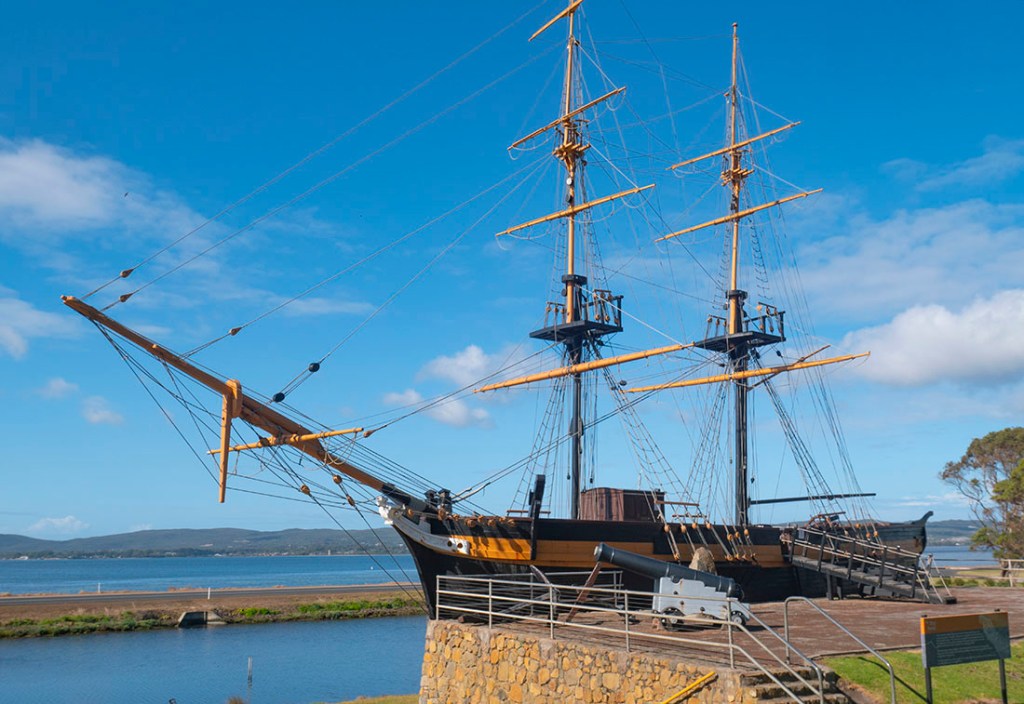
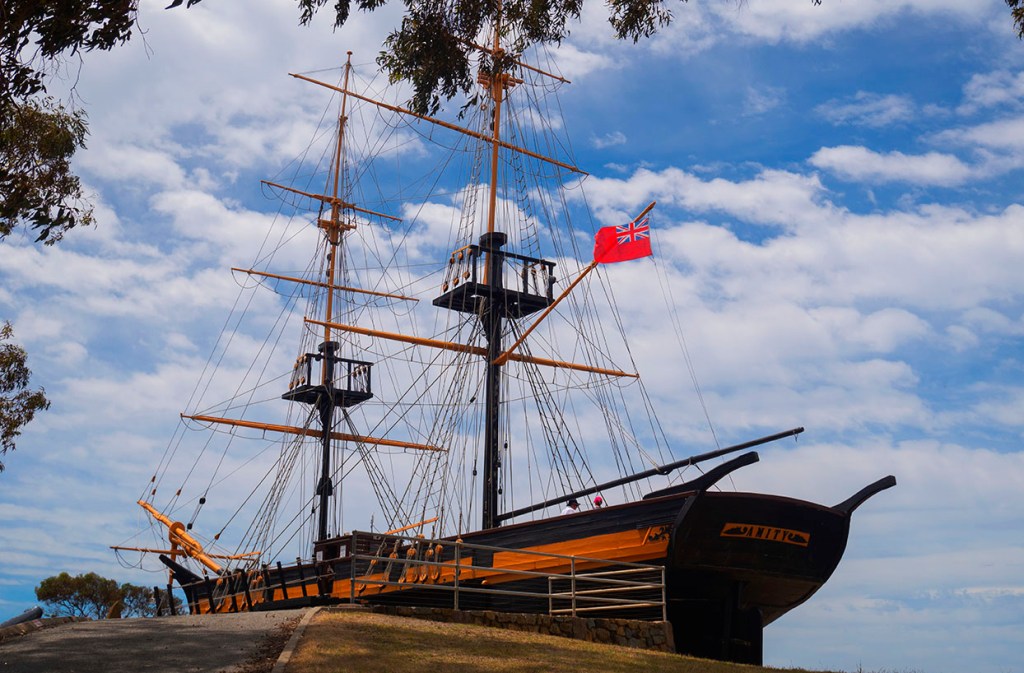
    Brig Amity replica at Albany Western Australia. Photo: C.J. Ison.

       All Australian school children learn of the Endeavour’s role in the history of Australia. Some people may have heard of the First Fleet’s flagship, Sirius, or the Investigator, which Matthew Flinders used to chart much of Australia’s coastline. But, I would wager few have ever heard of the brig Amity or know of her contribution to our colonial past.

       During the brig Amity’s six years as a colonial government vessel, she was employed to establish two new settlements in what would one day become Queensland and Western Australia. She went to the rescue of the Royal Charlotte survivors after that ship ran aground on Frederick Reef in Australia’s dangerous northern waters. She regularly transported convicts, soldiers, and supplies from Sydney to outlying settlements and circumnavigated the continent on two occasions.   

    The Amity was built in New Brunswick, Canada and launched in 1816. She was a modest-sized vessel even by the standards of the day, at 148 tons, measuring a fraction over 23 metres (75 feet) in length. But she was a sound ship and could handle rough weather.

    Officer’s stateroom with tiny individual sleeping cabins leading off the main room. Photo: C.J. Ison.

       The little brig spent the first few years of her life hauling cargo back and forth across the North Atlantic between North America and Britain. In 1823, a Scotsman named Robert Ralston purchased her, having decided to emigrate to Van Diemen’s Land with his large family. He fitted the vessel out for the long voyage and filled its hold with cargo and livestock for his new adopted home.

       After a five-month voyage, the Amity sailed up the Derwent River and dropped anchor in Hobart Town on 15 April 1824. Ralston and his family purchased land and established several businesses in Hobart and Launceston, and a few months after their arrival, he put the vessel up for sale.   

    The New South Wales colonial government purchased the Amity in August 1824. The brig’s first assignment was to establish a new settlement at Moreton Bay. Two years earlier, the Bigge Report had recommended establishing a place of secondary transportation somewhere far north of Sydney for convicts who had committed additional crimes in the colony.

    The Moreton Bay Penal Settlement about 10 years after its founding. Photo Courtesy SLQ.

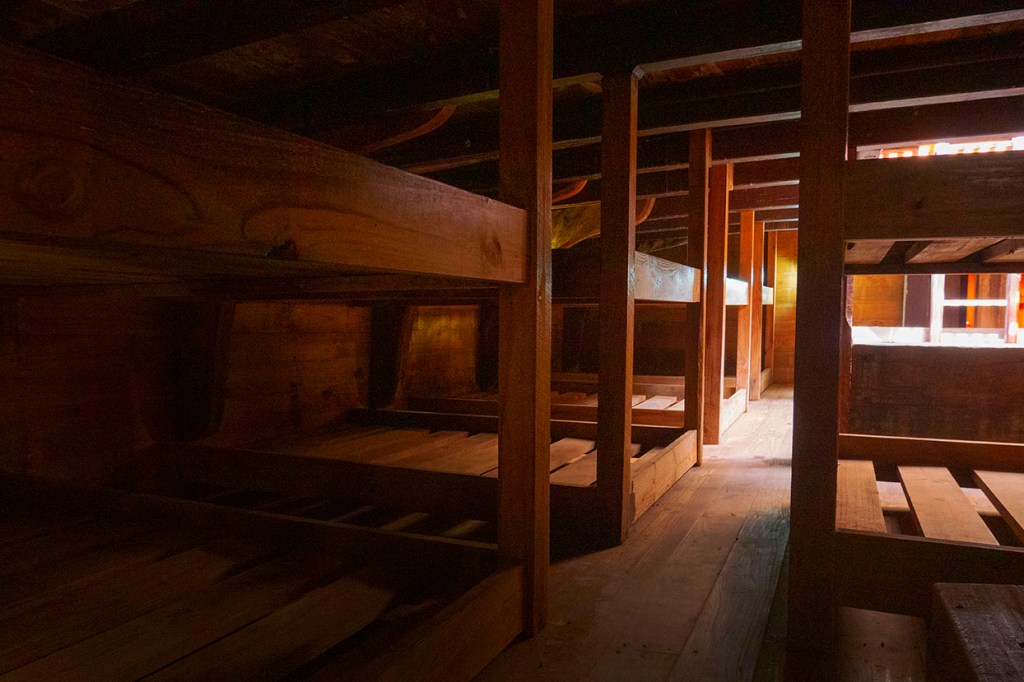
       On 1 September, the Amity and her crew sailed with a military officer, 20 soldiers, plus wives and children, a handful of civilian administrators, plus 30 convicts. The journey took 11 days and was marked by severe storms. Accommodation between decks measured just 1.5 metres (5 feet) high. Here, the seasick soldiers, wives, and convicts spent a miserable time packed in with the new settlement’s pigs, goats and poultry. Nonetheless, they made it at Moreton Bay and her passengers and stores were disembarked at Redcliffe, where John Oxley decided the new settlement would be established.

       Later in the month, the ship was nearly wrecked. She had been anchored out in Moreton Bay when a storm blew up. The Amity’s anchors started to drag as she was pushed towards shore. A third anchor was dropped, and the ship was held in place, averting disaster. Soon after that, she left the new settlement and returned to Sydney for more stores. On her third trip to Moreton Bay, in mid-1825, she helped relocate the settlement. Redcliffe had proved not as suitable as Oxley had thought it would be. The new location, on the north bank of the Brisbane River, was thought to be a far more suitable one.

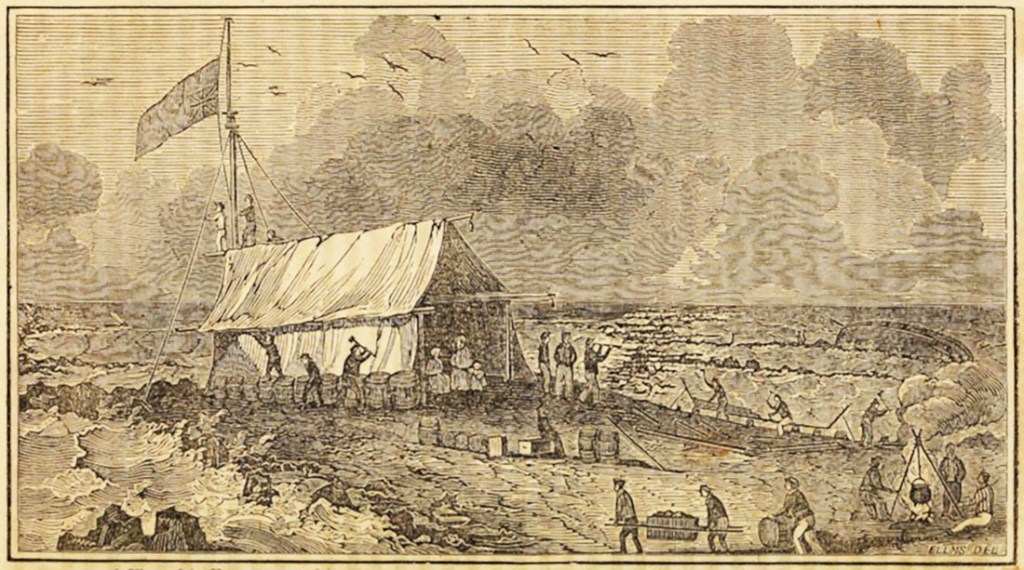
       While anchored in Moreton Bay, one of the crew spotted an unfamiliar longboat coming towards them. This turned out to be the first mate and several survivors from the ship Royal Charlotte, which had run aground a month earlier on Frederick Reef, some 720 km (almost 400 nautical miles) north in the Coral Sea.

       The first mate reported that there were still nearly one hundred souls, many of them women and children, stranded on a small sand cay which was almost awash at high tide. The Amity was immediately sent to rescue the castaways and arrived off the reef on 28 July. Getting close to the survivors proved a dangerous operation with powerful breakers crashing into the reef, threatening any vessel that got too close. The Amity eventually anchored several miles distant and its whaleboat was sent to evacuate the survivors and salvage as much as they could from the wreck. With an additional hundred people squeezed into the small brig, she sailed directly for Sydney, arriving there ten days later.

    A view of the encampment of the shipwrecked company of the Royal Charlotte on Frederick’s Reef. Illustration by Charles Ellms (circa 1848)

       For the next 18 months or so the Amity was in constant use ferrying convicts and supplies between Sydney and the outlying settlements at Norfolk Island, Moreton Bay and Port Macquarie. But, in late 1826, Governor Darling, who had recently replaced Governor Brisbane, had another important mission for the Amity and her crew.

       She was ordered to take three officers and a small detachment of soldiers, 23 convicts, plus a handful of civilian officials under the overall command of Major Edmund Lockyer to establish a new settlement. This one was to be located in the remote south-west of the continent at King George Sound (Albany).

    Convicts and other passengers were accommodated between decks which measured just five feet in height. Photo: C.J. Ison.

       Until then, Australia’s southern coast from Bass Strait to Cape Leeuwin was little known outside its indigenous peoples and the haunt of sealers who lived largely outside the law. Darling was increasingly concerned that the French, whom he had learned had recently visited the area, might try to establish a permanent presence there. 

       The small brig weighed anchor on 9 November 1826, but she soon ran into a severe storm, which saw her put into George Town on the Tamar River in Van Diemen’s Land for repairs. She finally anchored safely in King George Sound on Christmas Day, and the next morning, she began disembarking her passengers and cargo. A month later, the Amity returned to Sydney and resumed her regular resupply duties.   

    In May 1827, she accompanied HMS Supply and the brig Mary Elizabeth on a voyage via Torres Strait to Fort Dundas on Melville Island, not too far distant from present-day Darwin in the Northern Territory. Fort Dundas had been established three years earlier to facilitate trade with visiting Macassan fishermen, but it was eventually abandoned, due in part to the determined resistance put up by the indigenous Tiwi people.

    Sketch of Fort Dundas – 1824 by JS Roe. Picture courtesy State Library of Western Australia.

       Leaving Fort Dundas and the other two ships, the Amity continued circumnavigating the continent, stopping to drop off supplies at King George Sound before returning to Sydney via Bass Strait.

       In 1828-29, she paid another visit to the remote northern and western settlements when she dropped off stores before returning to her home port of Sydney, thereby completing a second circumnavigation.

       The following year, December 1830, the New South Wales government sold the brig off. She made her way back to Hobart and passed through several hands over the next decade. A couple of owners tried whaling while others employed her as a cargo ship, but they all seemed to struggle to turn a decent profit.

       In 1842, the Amity was now 26 years old and no doubt past her prime. Her new owner, a Hobart butcher named Gilbert, used her to transport livestock across Bass Strait from the mainland to Van Diemen’s Land.

       On 18 June 1845, she was driven onto a shoal off Flinders Island during one of the ferocious storms Bass Strait is rightly known for.   The ship was destroyed, but fortunately, the captain, owner and crew, numbering 11 in all, survived.    In 1976, a full-size replica of the Amity was completed in Albany to celebrate that town’s 150th anniversary. The replica provides a fascinating close-up look at an early 19th-century sailing ship and to stoop around below decks highlights just how small she really was.

    Brig Amity replica at Albany Western Australia. Photo: C.J. Ison.

    For more interesting stories from Australia’s maritime past check out A Treacherous Coast, Bolters and Tales from the Quarterdeck. All are available now as a Kindle eBook or paperback through Amazon.

    © Copyright: Tales from the Quarterdeck / C.J. Ison, 2020.

    To receive notifications of future blog posts please enter your email address below.