Tag: Chris Ison

  • The Norna and the Conman Commodore

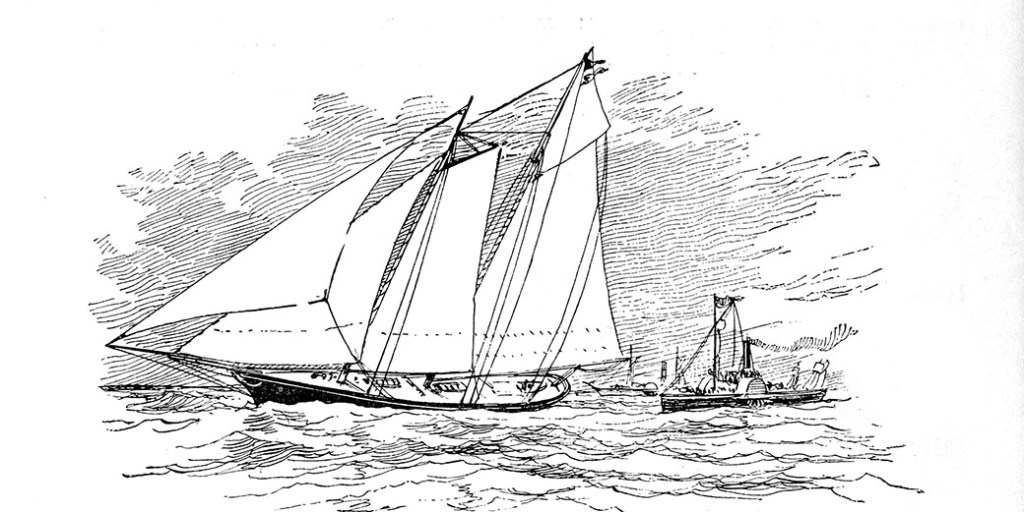
    The Norna’s sister ship Cornet.

       In the early 1900s, many hard-working sailing vessels saw out their days plying the waters between Australia and the islands of the South Pacific. Few, however, would have had such a fascinating history as that of the Norna.

       The Norna was built in New York in 1879 as a luxury ocean-going schooner rigged yacht. She was lavishly fitted out and built to be a fleet-footed racer. For the next decade or more, she held her own in many long-distance ocean races.

       Then, in 1895, she was purchased by self-styled “Commander” Nicholas Weaver, who claimed to represent a Boston newspaper empire seeking to establish a presence in New York. He was, in fact, a brazen conman.

       A few years earlier, Weaver had fallen foul of the law and only escaped gaol by testifying against his partner. He then hustled himself off to the West Coast, where he no doubt perfected his craft.

    Nicholas J Weaver, The Pacific Commercial Advertiser (Honolulu), 17 April 1900, p. 7.

       Now back in New York, he planned to take the Norna on a round-the-world cruise, sending back stories of his adventures which would be syndicated in America’s Sunday newspapers. He found several financial backers willing to cover his expenses in exchange for a share of the syndication fees. They founded a company, and Weaver sailed for the warm climes of the Caribbean.

       There, he made himself a favourite among the members of the Royal Bermuda Yacht Club, representing himself as the “Acting Commodore” of the prestigious Atlantic Yacht Club. The good people of Bermuda were not necessarily any more gullible than anyone else whom Weaver had separated from their money. But when someone sails into harbour aboard a 115-foot luxury yacht with a sailing crew of ten plus a cook and steward, few questions are likely to be raised. It also helped that Weaver himself was handsome, self-assured, and very charismatic.

       Weaver lived life to the full and spared himself no expense. He began hosting poker parties on his yacht, inviting only Bermuda’s most well-heeled residents. Though he proved to be uncannily lucky at cards, the winnings could not have covered his expenses. He funded his lavish lifestyle by chalking up credit with local merchants where possible, passing dud cheques if necessary, or forwarding invoices to his financial backers in New York.

       However, it was only a matter of time before things began to unravel. But before the inevitable day of reckoning, Bermudans awoke one fine morning to find the Norna and its flamboyant owner had cleared out in the dead of night.

    Yacht Norna leaving Honolulu. The Pacific Commercial Advertiser (Honolulu), 17 April 1900, p. 7.

       Weavers’ backers eventually realised they had been scammed and that they would never recoup their money. They wound up the company and stopped sending him money. But that did not deter Weaver from continuing on his round-the-world cruise.

       He visited many ports over the next couple of years, where he dazzled the wealthy with his largesse, while taking them to the cleaners at the poker table. He cruised around the Mediterranean, stopping long enough to run his con but always skipping out before debts became due.

       At the outbreak of the Spanish-American War, in April 1898, he and his American-flagged Norna found themselves in hostile waters. Realising his yacht might be seized, he set sail at his best speed with the Spanish navy in hot pursuit. Despite Weaver’s many character flaws, he was a superb mariner. Thanks to his skill and the luxury yacht’s fast sailing lines, the Norna outpaced the Spaniards, crossing into the safe waters of British-owned Gibraltar. There, he repaid his welcome by passing a fraudulent cheque for $5,000 and was once again on his way.
       During his travels around Europe, Weaver made the acquaintance of a man named Petersen, a fellow grifter. Together, they would prove a formidable team.

       Weaver and Pedersen would arrive in a new city independently, only to be introduced to one another by someone local, or they would fabricate a chance meeting as if they were strangers. Regardless of how they met, the result was always the same. They would get a high-stakes poker game going where one or the other would clean up.

       When Weaver reached Ceylon (present-day Sri Lanka), he was introduced to Petersen, who just happened to have recently arrived by steamer. They quickly got to work separating the wealthy from their wealth before moving on again. The pair repeated the same stunt in Sumatra, in the Dutch East Indies (now Indonesia), as well as in Hong Kong and Yokohama, Japan. At each port, they fleeced the local high society and vanished before alarm bells rang.    In Yokohama, Weaver passed himself off as the commodore of the New York Yacht Club and flew its pennant from his vessel. Weaver and Pedersen befriended each other and enjoyed many an evening with others playing poker on the Norna. Then, one morning, the yacht was gone. Pedersen joined the chorus baying for Weaver’s blood, claiming he, too, had been taken for a fortune. He then quietly slipped away on the next steamer leaving port.

    Schooner Norna circa 1911 now sporting a cabin on her aft deck. The Sun, 17 July 1911, p. 1.

       From Yokohama, the Norna made its way to Honolulu, where Weaver and Petersen briefly reunited. But when Weaver left Hawaii, Petersen remained. It seems as though the partnership had come to an end. The Norna stopped at Samoa long enough for Weaver to fleece the locals, then sailed on to New Zealand. At Auckland, Weaver began his now well-honed con, though this time without the able assistance of Petersen.

       Weaver racked up considerable debts, but before he could make his departure, the Norna was seized as surety. Realising the game was up, Weaver caught the next steamer bound for Sydney, vowing he would return to Auckland with the necessary funds to have his beloved yacht released. Not surprisingly, he vanished, and the yacht was put up for sale. It was purchased by a Sydney merchant and brought across the Tasman in June 1900.

       The Norna was stripped of her luxurious fittings, and the cabins were removed to make way for a spacious hold more fitting for her new working life. The Norna passed through several hands over the next 13 years. She served as a pearling lugger in Torres Strait and a trading vessel among the Pacific Islands. One owner even used her to salvage copper and other valuables from old shipwrecks far out in the Coral Sea. But, in June 1913, she, herself, was wrecked on Masthead Reef 50 km northeast of Gladstone Harbour. So ended the Norna’s fascinating and colourful career.

    © Copyright Tales from the Quarterdeck / C.J. Ison, 2022.

    To be notified of future blog posts, enter your email address below.
  • The Brig Amity’s Amazing Career

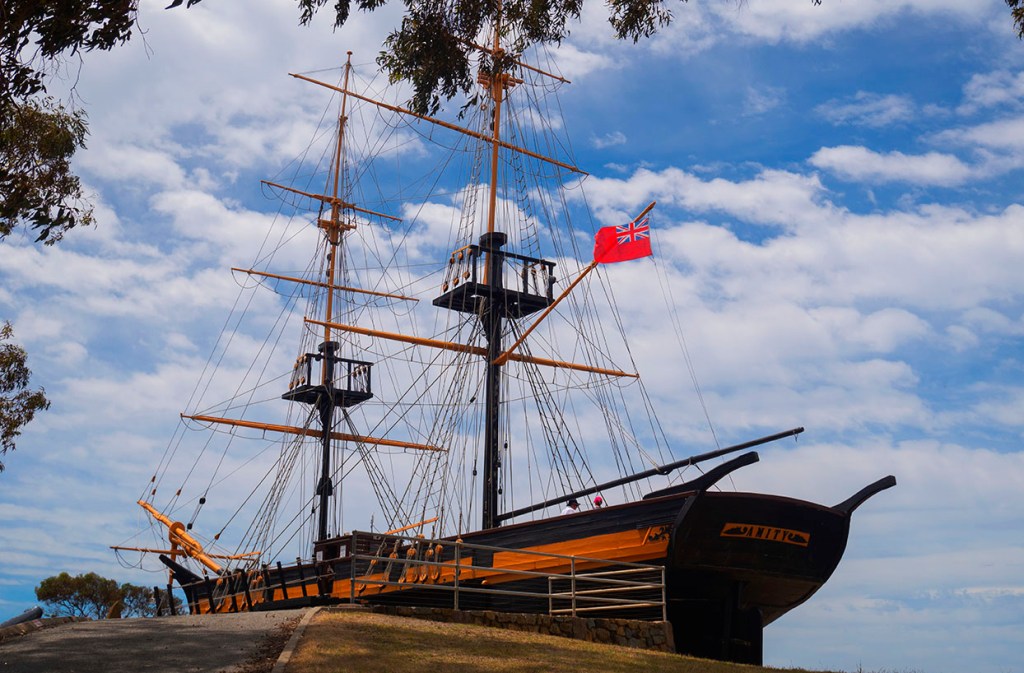
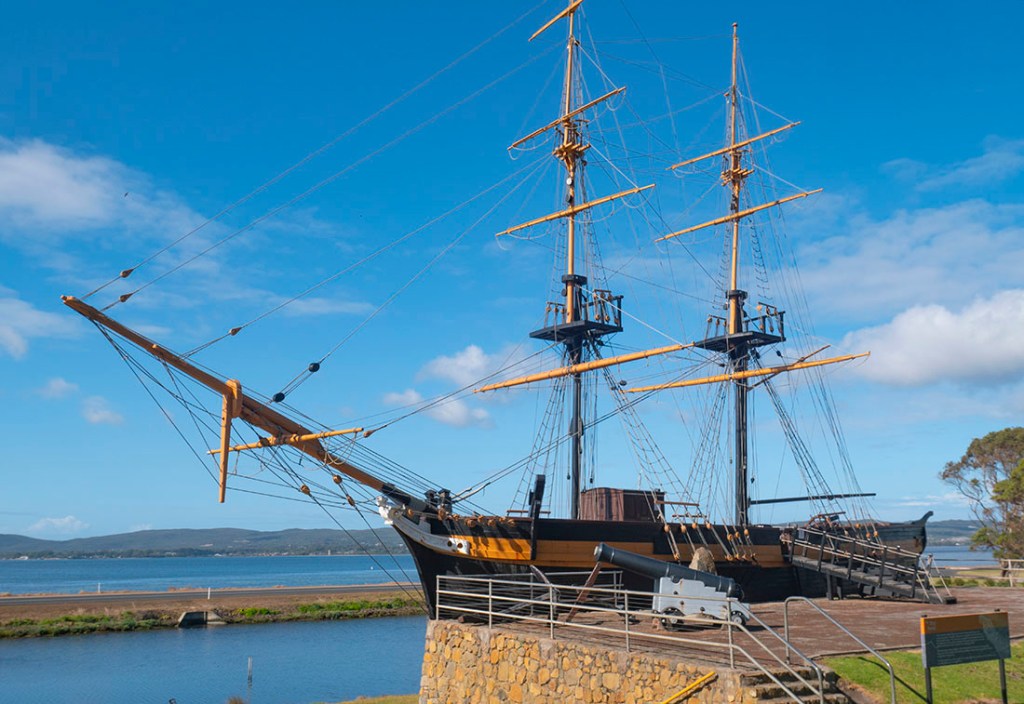
    Brig Amity replica at Albany Western Australia. Photo: C.J. Ison.

       All Australian school children learn of the Endeavour’s role in the history of Australia. Some people may have heard of the First Fleet’s flagship, Sirius, or the Investigator, which Matthew Flinders used to chart much of Australia’s coastline. But, I would wager few have ever heard of the brig Amity or know of her contribution to our colonial past.

       During the brig Amity’s six years as a colonial government vessel, she was employed to establish two new settlements in what would one day become Queensland and Western Australia. She went to the rescue of the Royal Charlotte survivors after that ship ran aground on Frederick Reef in Australia’s dangerous northern waters. She regularly transported convicts, soldiers, and supplies from Sydney to outlying settlements and circumnavigated the continent on two occasions.   

    The Amity was built in New Brunswick, Canada and launched in 1816. She was a modest-sized vessel even by the standards of the day, at 148 tons, measuring a fraction over 23 metres (75 feet) in length. But she was a sound ship and could handle rough weather.

    Officer’s stateroom with tiny individual sleeping cabins leading off the main room. Photo: C.J. Ison.

       The little brig spent the first few years of her life hauling cargo back and forth across the North Atlantic between North America and Britain. In 1823, a Scotsman named Robert Ralston purchased her, having decided to emigrate to Van Diemen’s Land with his large family. He fitted the vessel out for the long voyage and filled its hold with cargo and livestock for his new adopted home.

       After a five-month voyage, the Amity sailed up the Derwent River and dropped anchor in Hobart Town on 15 April 1824. Ralston and his family purchased land and established several businesses in Hobart and Launceston, and a few months after their arrival, he put the vessel up for sale.   

    The New South Wales colonial government purchased the Amity in August 1824. The brig’s first assignment was to establish a new settlement at Moreton Bay. Two years earlier, the Bigge Report had recommended establishing a place of secondary transportation somewhere far north of Sydney for convicts who had committed additional crimes in the colony.

    The Moreton Bay Penal Settlement about 10 years after its founding. Photo Courtesy SLQ.

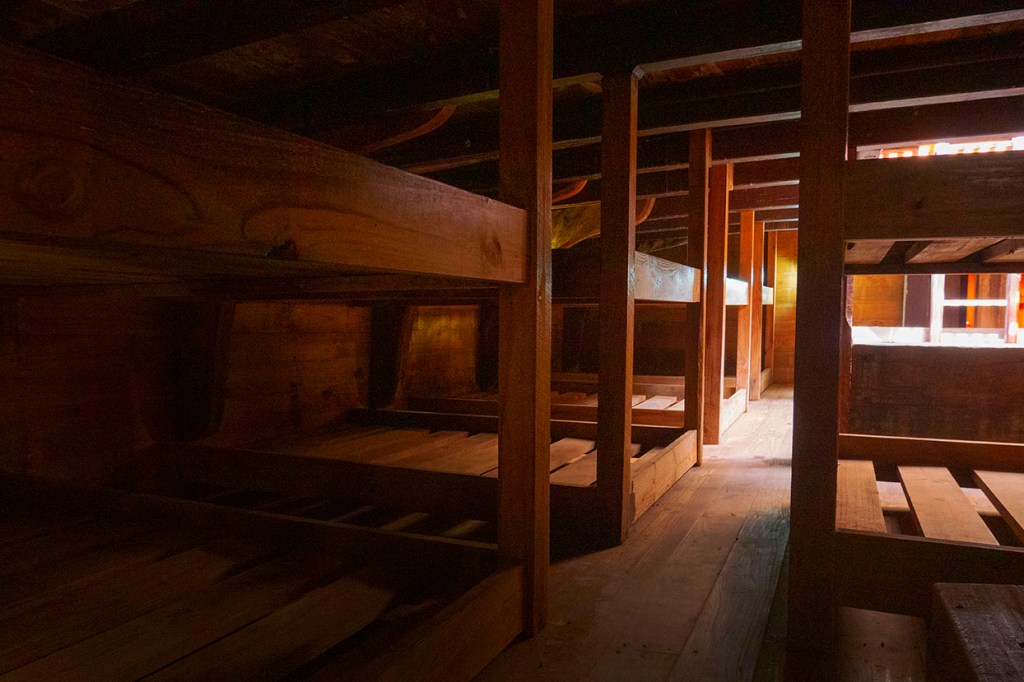
       On 1 September, the Amity and her crew sailed with a military officer, 20 soldiers, plus wives and children, a handful of civilian administrators, plus 30 convicts. The journey took 11 days and was marked by severe storms. Accommodation between decks measured just 1.5 metres (5 feet) high. Here, the seasick soldiers, wives, and convicts spent a miserable time packed in with the new settlement’s pigs, goats and poultry. Nonetheless, they made it at Moreton Bay and her passengers and stores were disembarked at Redcliffe, where John Oxley decided the new settlement would be established.

       Later in the month, the ship was nearly wrecked. She had been anchored out in Moreton Bay when a storm blew up. The Amity’s anchors started to drag as she was pushed towards shore. A third anchor was dropped, and the ship was held in place, averting disaster. Soon after that, she left the new settlement and returned to Sydney for more stores. On her third trip to Moreton Bay, in mid-1825, she helped relocate the settlement. Redcliffe had proved not as suitable as Oxley had thought it would be. The new location, on the north bank of the Brisbane River, was thought to be a far more suitable one.

       While anchored in Moreton Bay, one of the crew spotted an unfamiliar longboat coming towards them. This turned out to be the first mate and several survivors from the ship Royal Charlotte, which had run aground a month earlier on Frederick Reef, some 720 km (almost 400 nautical miles) north in the Coral Sea.

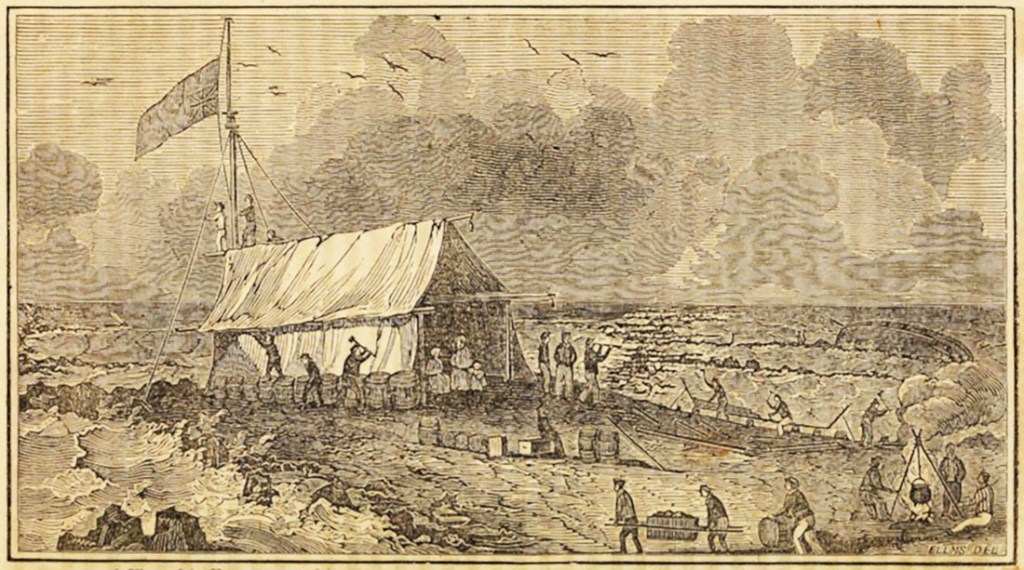
       The first mate reported that there were still nearly one hundred souls, many of them women and children, stranded on a small sand cay which was almost awash at high tide. The Amity was immediately sent to rescue the castaways and arrived off the reef on 28 July. Getting close to the survivors proved a dangerous operation with powerful breakers crashing into the reef, threatening any vessel that got too close. The Amity eventually anchored several miles distant and its whaleboat was sent to evacuate the survivors and salvage as much as they could from the wreck. With an additional hundred people squeezed into the small brig, she sailed directly for Sydney, arriving there ten days later.

    A view of the encampment of the shipwrecked company of the Royal Charlotte on Frederick’s Reef. Illustration by Charles Ellms (circa 1848)

       For the next 18 months or so the Amity was in constant use ferrying convicts and supplies between Sydney and the outlying settlements at Norfolk Island, Moreton Bay and Port Macquarie. But, in late 1826, Governor Darling, who had recently replaced Governor Brisbane, had another important mission for the Amity and her crew.

       She was ordered to take three officers and a small detachment of soldiers, 23 convicts, plus a handful of civilian officials under the overall command of Major Edmund Lockyer to establish a new settlement. This one was to be located in the remote south-west of the continent at King George Sound (Albany).

    Convicts and other passengers were accommodated between decks which measured just five feet in height. Photo: C.J. Ison.

       Until then, Australia’s southern coast from Bass Strait to Cape Leeuwin was little known outside its indigenous peoples and the haunt of sealers who lived largely outside the law. Darling was increasingly concerned that the French, whom he had learned had recently visited the area, might try to establish a permanent presence there. 

       The small brig weighed anchor on 9 November 1826, but she soon ran into a severe storm, which saw her put into George Town on the Tamar River in Van Diemen’s Land for repairs. She finally anchored safely in King George Sound on Christmas Day, and the next morning, she began disembarking her passengers and cargo. A month later, the Amity returned to Sydney and resumed her regular resupply duties.   

    In May 1827, she accompanied HMS Supply and the brig Mary Elizabeth on a voyage via Torres Strait to Fort Dundas on Melville Island, not too far distant from present-day Darwin in the Northern Territory. Fort Dundas had been established three years earlier to facilitate trade with visiting Macassan fishermen, but it was eventually abandoned, due in part to the determined resistance put up by the indigenous Tiwi people.

    Sketch of Fort Dundas – 1824 by JS Roe. Picture courtesy State Library of Western Australia.

       Leaving Fort Dundas and the other two ships, the Amity continued circumnavigating the continent, stopping to drop off supplies at King George Sound before returning to Sydney via Bass Strait.

       In 1828-29, she paid another visit to the remote northern and western settlements when she dropped off stores before returning to her home port of Sydney, thereby completing a second circumnavigation.

       The following year, December 1830, the New South Wales government sold the brig off. She made her way back to Hobart and passed through several hands over the next decade. A couple of owners tried whaling while others employed her as a cargo ship, but they all seemed to struggle to turn a decent profit.

       In 1842, the Amity was now 26 years old and no doubt past her prime. Her new owner, a Hobart butcher named Gilbert, used her to transport livestock across Bass Strait from the mainland to Van Diemen’s Land.

       On 18 June 1845, she was driven onto a shoal off Flinders Island during one of the ferocious storms Bass Strait is rightly known for.   The ship was destroyed, but fortunately, the captain, owner and crew, numbering 11 in all, survived.    In 1976, a full-size replica of the Amity was completed in Albany to celebrate that town’s 150th anniversary. The replica provides a fascinating close-up look at an early 19th-century sailing ship and to stoop around below decks highlights just how small she really was.

    Brig Amity replica at Albany Western Australia. Photo: C.J. Ison.

    For more interesting stories from Australia’s maritime past check out A Treacherous Coast, Bolters and Tales from the Quarterdeck. All are available now as a Kindle eBook or paperback through Amazon.

    © Copyright: Tales from the Quarterdeck / C.J. Ison, 2020.

    To receive notifications of future blog posts please enter your email address below.