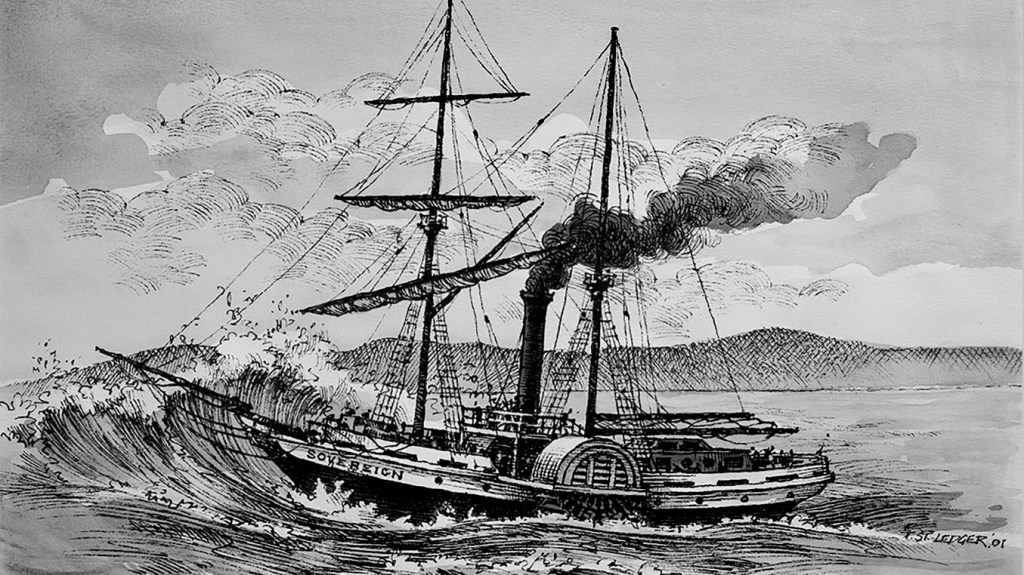
When the 119-ton paddle steamer Sovereign foundered in Moreton Bay, resulting in the loss of 44 lives, it was inevitable that people would want someone to blame. The most convenient shoulders to heap that criticism on were the steamer’s master, Captain Henry Cape. But was it deserved, or was the tragic accident a result of the steamer’s owners using her in the open ocean, a role for which she was never built?
On 3 March 1847, the Sovereign steamed down the Brisbane River. Captain Cape had intended to cross Moreton Bay and head out to sea before bearing south on her regularly scheduled service to Sydney. She had a crew of 24 and there were also 30 passengers. The Sovereign was also loaded down with 140 bales of wool and other cargo. What did not fit in the hold had been stowed on deck, making her sit low in the water.
By the time the Sovereign reached Amity Point near the southern passage leading from Moreton Bay out into the open ocean, it was too late in the day to cross the bar. Captain Cape anchored for the night off the pilot station so he could set off when the conditions were safe. However, for the next seven days, the winds blew strongly from the south, and he had to wait for the weather to ease off. Late on the 10th of March, he thought it was safe enough to make the passage between Moreton and Stradbroke Islands. However, as he approached the bar, he realised it was far too dangerous to try crossing. He returned to his anchorage, hoping the next day might prove calmer.
By 6 o’clock the next morning, 11 March, the wind had dropped to a light south-westerly breeze, so the captain got underway again. When he got to the bar, the Sovereign encountered a heavy swell rolling in from the ocean. Captain Cape had made it through in much worse conditions and was confident he could safely get out to sea that day.
And, he almost made it. After riding over most of the rolling swells, he failed to climb one huge wave that broke over the Sovereign, smashing the frames that supported the two paddle wheel shafts. The steamer lost propulsion and was instantly at the mercy of the powerful swells. Captain Cape could only rely on his sails at this stage, and with little wind to fill them, they were close to useless.
Waves swept across the deck, carrying away the cargo. The lifeboats were lost before anyone had a chance to climb aboard them.
Captain Cape dropped his anchors as the steamer drifted towards the sand spit extending from the southern end of Moreton Island. While they kept the ship’s head to the sea, they dragged along the seabed. The Sovereign was doomed from that moment on. She was inexorably being driven towards disaster.
Passengers and crew heaved the remaining wool bales overboard in a desperate attempt to lighten the load. Meanwhile, hatch covers leading below decks were washed away, and the sea poured in, filling the hold. The crew and several desperate passengers furiously worked the pumps to keep control of the water, but to no avail.
The Sovereign began to sink. From the time the engines stopped to that dreadful moment, about 45 minutes had elapsed. In the next five minutes, the ship was pounded to pieces as she wallowed in the breaking surf.
Several people clung to wool bales as they floated free, but they were soon left floundering in the tumultuous seas when the sodden bales sank. As a portion of the paddle box broke away, Captain Cape and several others found refuge on it. They held on for dear life and were swept towards Moreton Island, where the paddle box was smashed to pieces in the surf.

Several Aborigines who had witnessed the disaster waded into the pounding seas and pulled Cape and several others to safety on the beach. Those acts of bravery would later be justly rewarded. Several passengers found debris from the wreck, which had kept them afloat long enough to be picked up by some fishermen and a pilot boat that had been sent out from Amity Point. They had all risked their own lives to come to the rescue. In all, just ten people from the Sovereign survived. Forty-four others drowned.
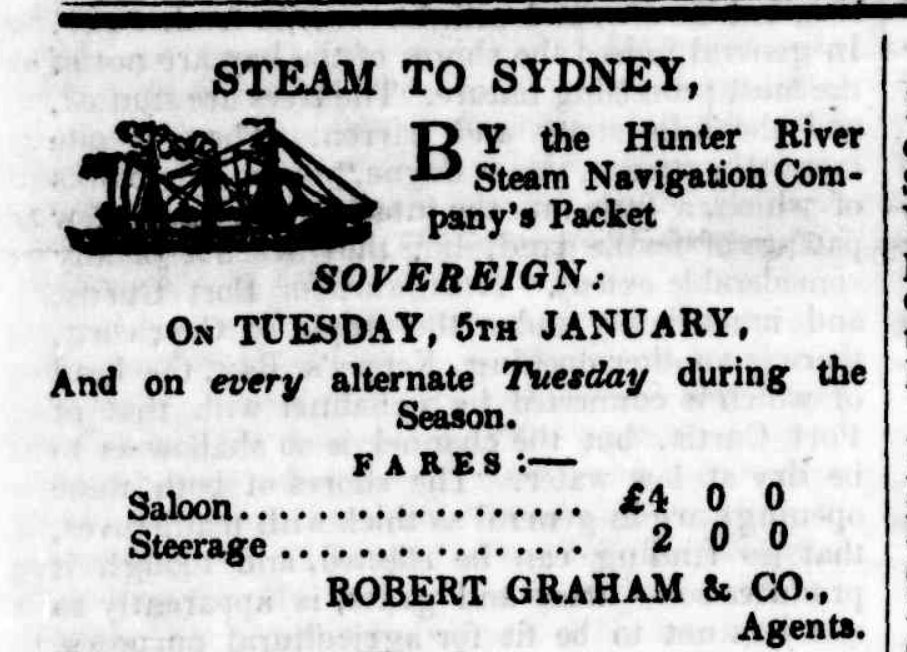
Allegations soon circulated that the steamer was ill-suited for the Brisbane – Sydney run and should never have been used for such a long and arduous ocean voyage. Built in Sydney seven years earlier, the Sovereign had begun regularly steaming between Newcastle and Sydney, then between Sydney and Brisbane. But she was thought by some to be ill-suited for the dangerous bar crossing at the entrance to Moreton Bay.
In response to the criticism, warranted or otherwise, the Sovereign’s owners, the Hunter River Steam Navigation Company, promptly sacked Captain Cape and released a statement absolving themselves of any blame.
They disputed that any fault lay with the design, build or maintenance of their steamer. Instead, they rejected Captain Cape’s claim that the frames supporting the paddlewheel shafts had failed as he described. Instead, they felt it was Captain Cape’s decision to go to sea under such dangerous conditions or his subsequent handling of the vessel that had resulted in the appalling loss of life.
Cape was so incensed with his treatment that he challenged his former employer’s report with sworn statements made by the Amity Point pilot and one of the surviving passengers. They swore they had observed the damage to the housings, which ultimately left the paddle steamer dead in the water. Regardless, a marine board inquiry found Captain Cape at fault. To this day, the loss of the Sovereign remains among the worst maritime disasters to occur in Queensland waters.

© Copyright C.J. Ison / Tales from the Quarterdeck, 2023.
To be notified of future blogs, please enter your email address below.
 Tales from the Quarterdeck