Tag: Caledonia

  • Tales from the Quarterdeck

    Sixty bite-sized stories from Australia’s maritime past

    The melancholy loss of H.M.S Sirius off Norfolk Island by George. Raper. Source National Library of Australia 136507434-1

    I have just launched a new book titled Tales from the Quarterdeck: Sixty bite-sized stories from Australia’s maritime past. Sixty of the most popular posts have been reedited. In some cases, I’ve rewritten a couple and updated a few where new information has come to light since first writing them.

    For those who would value ready access to the stories in their bookcase, Tales from the Quarterdeck is available in Kindle ebook and paperback formats through Amazon.

    The stories are organised in chronological order, starting with the Tryall shipwreck off the Western Australian coast in 1622, and finishing with the Second World War exploits of the Krait. See below for a full list of the stories covered in the book.
    Sydney Gazette 22 May 1808, p. 2.

    1622 – The Tryall: Australia’s earliest shipwreck

    1629 – The Batavia Tragedy

    1688 – William Dampier: Navigator, naturalist, writer, pirate

    1770  – The Endeavour’s Crappy Repair

    1788 – Loss of La Astrolabe and La Boussole, a 40-Year Mystery                        

    1789 – Bligh’s Epic Voyage to Timor

    1789 – HMS Guardian: All Hands to the Pumps

    1790 – The Loss of HMS Sirius

    1790 – Sydney’s First Desperate Escape

    1791 – HMS Pandora: Queensland’s earliest recorded Shipwreck

    1791 – William Bryant’s Great Escape

    1797 – The Loss of the Sydney Cove

    1803 – Loss of HMS Porpoise

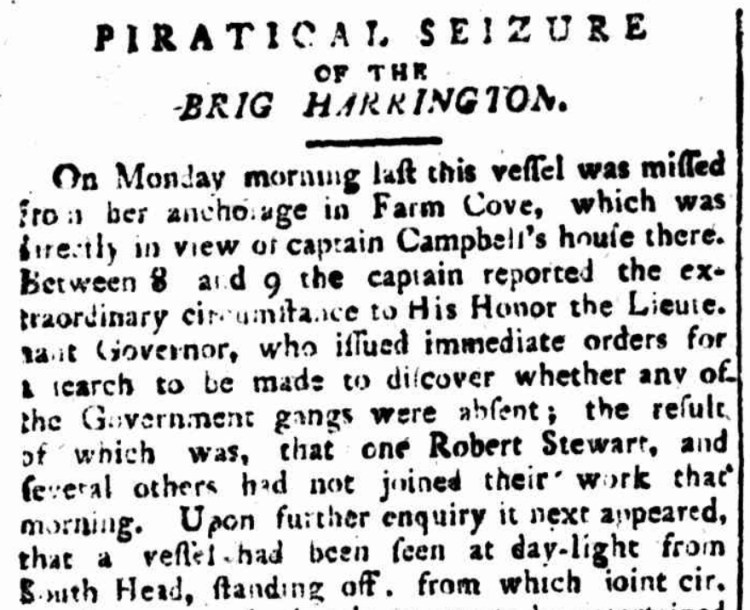
    1808 – Robert Stewart and the Seizure of the Harrington

    1814 – Wreck of the Morning Star

    1816 – The Life and Loss of HMSC Mermaid

    1824 – The Brig Amity’s Amazing Career

    1829 – The Cyprus mutiny 

    1831 – The Caledonia’s perilous last voyage

    1833 – The Badger’s Textbook Escape

    1835 – The Loss of the Convict Ship Neva

    1835 – The Post Office in the middle of nowhere

    1835 – The Tragic Loss of George III

    1845 – The Cataraqui: Australia’s worst shipwreck

    1846 – The Peruvian’s Lone Survivor

    1847 – The Foundering of the Sovereign

    1850 – The Loss of the Enchantress: A first-hand account

    1851 – The Countess of Minto’s brush with Disaster

    1852 – The Bourneuf’s Tragic Last Voyage

    1852 – The Nelson Gold Heist

    Woodbury, Walter B. (Walter Bentley), 1834-1885. Hamlet’s Ghost, Sourabaya [Surabaya], Java [Boat with Passengers and Crew], ca. 1865. Walter B. Woodbury Photograph Collection (PH 003). Special Collections and University Archives, University of Massachusetts Amherst Libraries

    1854 – Bato to the Rescue 

    1854 – HMS Torch and the rescue of the Ningpo

    1856 – The Loss of the Duroc and the Rise of La Deliverance

    1858 – The Loss of the Saint Paul and its Horrific Aftermath

    1858 – Narcisse Pelletier, An Extraordinary Tale of Survival

    1859 – The Indian Queen’s Icy Encounter

    1859 – The Sapphire and Marina

    1863 – The loss of the Grafton: Marooned for twenty months

    1864 – The Invercauld shipwreck

    1865 – The CSS Shenandoah: Victoria’s link to the American Civil War

    1866 – The Loss of the SS Cawarra: Bad luck or an avoidable tragedy?

    1868 – The Bogus Count and Hamlet’s Ghost

    1871 – The Mystery of the Peri

    1872 – The Loss of the Maria, A Cautionary Tale

    1875 – The Tragedy behind the Gothenburg Medals

    1876 – The Catalpa rescue

    1876 – The Banshee’s Terrible Loss

    1878 – The Loch Ard Tragedy

    1884 – The Macabre case of the Mignonette

    1885 – The Douro and its Piratical Captain

    1889 – The Windjammer Grace Harwar

    1891 – The Spanish Silver of Torres Strait

    1893 – The Foundering of the SS Alert

    1895 – The Norna and the Conman Commodore

    1899 – Cyclone Mahina

    1911 – The Loss of the Mandalay

    1918 – The Orete’s Robinson Crusoe-like Castaway

    1935 – The Life and Loss of  the SS Maheno

    1943 – Surviving the Centaur Sinking

    1943 – The Amazing Krait

  • No Charts, No Worries

    A schooner of the early 1800s. Courtesy State Library of Queensland.

    When Captain George Browning sailed the small schooner Caledonia from Sydney in December 1831, he intended to follow the coast north as far as the Tropic of Capricorn.   There he was to collect salvage from a ship that had been wrecked in the Bunker Islands and return it to Sydney to be sold.   But on the way, he was to call in at the Moreton Bay Penal Settlement to collect a whaleboat the crew had used to escape the wreck.   That was where things began to go wrong for the young master mariner.

    While anchored in Moreton Bay his ship was seized by a band of convicts who sent the crew ashore and ordered Browning to take them to the tiny South Pacific Island of Rotuma some 1,500 nautical miles or 3,000 kilometres away over open ocean.   See my blog “The Caledonia’s perilous last voyage,” for a more detailed account.

    Among the many challenges he faced, he had no charts covering the South Pacific.  Yet, Browning had to find a way to deliver his unwanted passengers to their destination if he was to have any chance of saving his ship and preserving his own life.   He consulted his “Epitome of Practical Navigation,” a book all master mariners kept close at hand.   The regularly updated volume was considered the standard text on maritime navigation and was packed with charts and tables to help mariners navigate the world’s oceans.   

    Example from The American Practical Navigator, 1837. There were several such books used by master mariners.

    Browning referred to a table of South Pacific Islands with their corresponding geographic coordinates.  With this information, he flipped over one of his coastal charts and drew a grid labelling the key lines of longitudes and latitudes for the waters he would be sailing and marked the various known islands and features identified in the table, albeit with many reefs, shoals and other hazards left unrecorded.   Notwithstanding its limitations, he could now take observations and plot his whereabouts and relate that to his destination – Rotuma – and any other islands in the course of his travels.   

    Using his makeshift chart, Browning navigated from Moreton Bay to New Caledonia where they stopped to collect fresh drinking water.   From there he charted a course to Rotuma and when he was directed to leave that island at a moment’s notice and make for Wallis Island he did that too.  

    Perhaps the chart’s greatest value came as they sailed towards Wallis Island.   A couple of the convicts warned Browning that their leader intended to scuttle the Caledonia and do away with its captain once they had arrived.   He knew Wallis Island lay a short distance over the horizon and they would likely arrive late that afternoon.  

    He shaped the sails to slow the ship’s progress until nightfall.   Then, during the hours of darkness, he picked up speed again and was able to slip by Wallis thereby prolonging his life a little longer.   A couple of days later they pulled in at the Samoan island of Savai’i.   There the Caledonia was scuttled but Browning was befriended by a local chief and escaped the convicts’ clutches.  He eventually returned to Australia to tell his amazing story.

    The full story is told in A Treacherous Coast: Ten Tales of Shipwreck and Survival from Queensland Waters available through Amazon.

    © Copyright C.J. Ison / Tales from the Quarterdeck, 2022.

    To be notified of future blog posts, please enter your email address below.

  • The Caledonia’s perilous last voyage

    A schooner of the early 1800s. Courtesy State Library of Queensland.

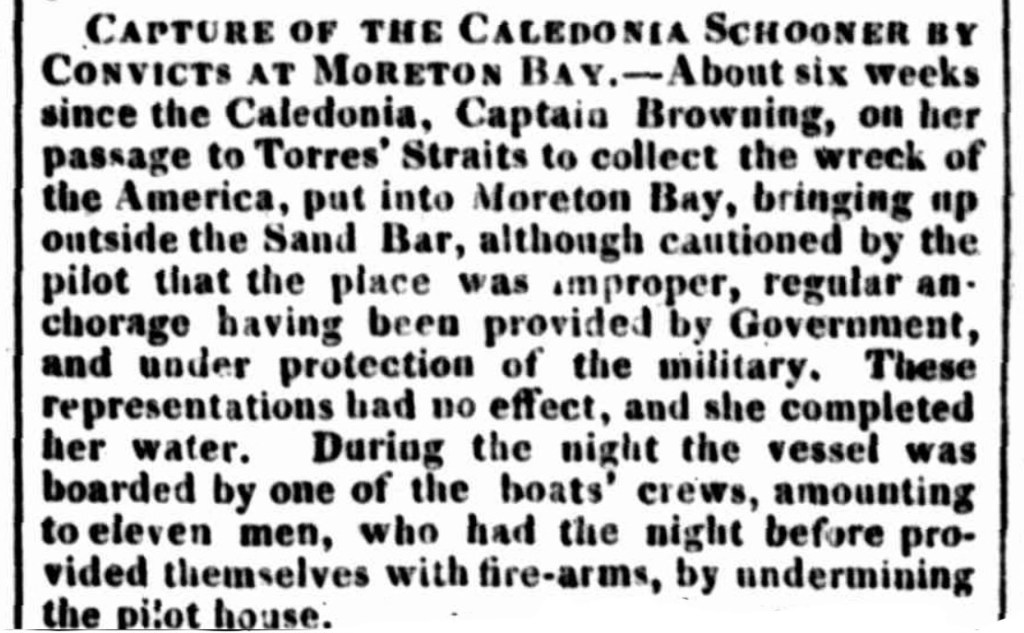
    On a hot December night in 1831, a storm rolled across Moreton Bay as they often do at that time of year. Outside the Amity Point pilot house, nearly a dozen convicts huddled under a sheet of canvas as they bided their time. There was a small schooner anchored a short distance offshore, and the storm would provide the soaking prisoners with a rare opportunity to escape.

       But what the hapless runaways did not know as they seized the Caledonia and sailed her out of Moreton Bay, their self-appointed leader was a dangerous psychopath, and they would be swapping one reign of terror for another far worse. Three of them would soon be murdered. A fourth would be abandoned on an inhospitable island, and the rest would flee for their lives at the earliest opportunity.

       The Caledonia had pulled into Moreton Bay the previous day to collect a whaleboat, which belonged to the sailing ship America. The crew had used it to reach Moreton Bay after their ship was wrecked further north. Two Sydney businessmen had purchased the salvage rights to the wrecked ship and sent Captain George Browning north to retrieve the boat and strip the America of everything of value. Browning had reported to the Amity Point pilot station and explained their unexpected visit. He was now waiting for the boat to be brought down the Brisbane River before he continued on his way to the wreck site.

    Sydney Herald, 20 Feb 1832, p. 3.

    That night, as lightning streaked across the sky and deafening claps of thunder boomed around them, the convicts got to work. The guard had taken shelter and the raging storm muffled any noise they made. They easily dug down through the sand and tunnelled under the pilothouse wall. A couple of them crawled inside, stole the keys to the boat shed and armed themselves with muskets and pistols while the pilot and a guard slept. Then they jumped into the pilot boat and rowed out to the Caledonia. No guard had been posted on deck, and the crew were easily overwhelmed before they had fully awoken. The Caledonia’s crew were ordered into the pilot boat to make their way back to Amity Point using only one oar. However, the convicts held on to Captain Browning. He was needed to navigate the schooner to the tiny island of Rotuma, 3000 km away. By dawn, the Caledonia was heading out to sea, as the crew drifted back to shore to raise the alarm.

       The leader of the runaways was a former sailor named William Evans. He was unusual, for he had come to New South Wales as part of the crew of a merchant ship. One night while moored in Sydney Harbour, Evans had broken into the captain’s cabin and stolen a purse full of money. He was spotted leaving the ship in a small dinghy and was soon caught. Evans was found guilty and sentenced to seven years’ hard labour at Moreton Bay. Now, in the closing days of 1831, Evans still had three more years of back-breaking toil, poor rations and loathsome living conditions to endure. When he realised there was a chance he could make his escape on the schooner, he pounced, convincing the rest of the prisoners to join him.

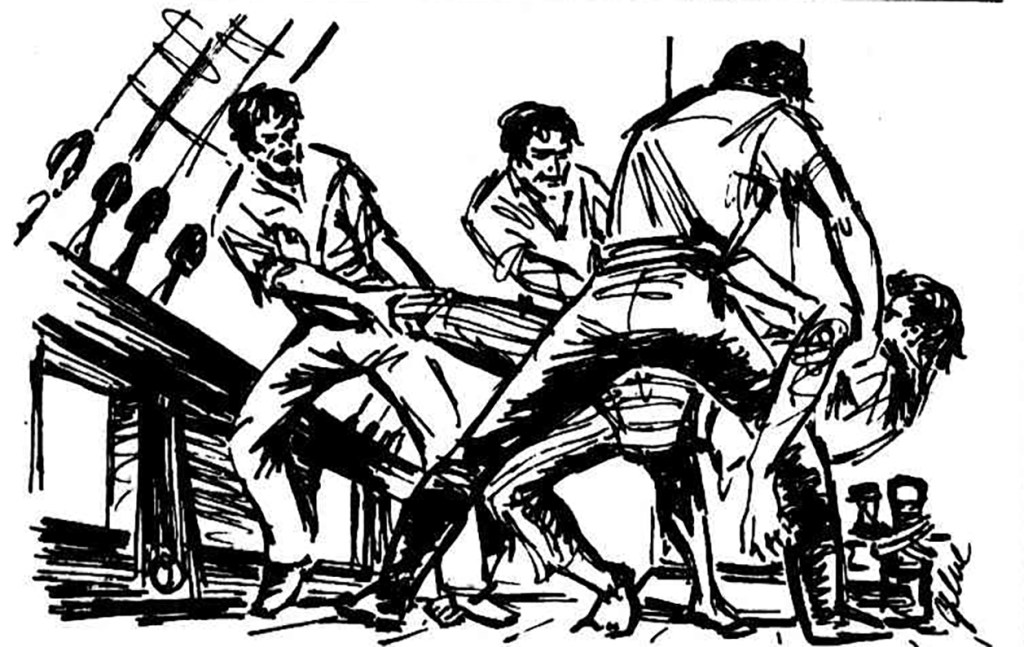
    Newspaper illustration of Evans and others throwing convict over the side of the Caledonia. The Argus, circa 1950s

       After they had been at sea for a week, tensions came to a head among the convicts. The common purpose that had seen them work together to seize the ship and escape had been replaced by bitterness and division. After hearing a rumour that a mutiny was looming, Evans struck first. He stood outside the entrance to the crew’s cabin, backed up by two mates, and ordered one of the mutineers to come on deck. As he emerged, Evans shot him point-blank in the head. Evans then ordered two others to come out, and they were killed on the spot. That ended any thought of challenging his leadership.

       About a week later, the schoonerstopped at New Caledonia for water. Evans’ right-hand man, Hugh Hastings, and a couple of others took a boat out to fill the water barrels. But, while they were gone, a party of Islanders came out to the schooner, indicating that they wanted to trade. As the Islanders outnumbered those on the schooner, they were barred from boarding. Only a volley of shots fired over their heads saw them leave. Fearing they might return under the cover of darkness, Evans had the Caledonia taken out to sea. But, when Hastings returned to find the schooner missing, he thought the worst and swore he would kill Evans for his treachery.

       Hastings and the others spent an uncomfortable night in the boat, but in the morning the Caledonia returned to pick them up. When Evans heard that Hastings had threatened him, he gave his mate two choices. Either stay on the island and take his chances with the hostile natives, or be shot. Hastings remained on the island when the Caledonia sailed away.

    Likely route taken by the Caledonia from Moreton Bay to Savai’i Island

       The Caledonia continued back out to sea and headed for the tiny island of Rotuma, still 1000 km away. Evans had heard rumours that whaling ships regularly stopped there for water and fresh supplies. He planned to join the next American whaler to visit Rotuma and work his way to the United States.

       The Caledonia dropped anchor off Rotuma a week or so later, however, their stay was cut short. One of the convicts bragged that they had just escaped from Moreton Bay. When Evans found out, he was furious and vowed to kill the man, but he fled into the bush before the threat could be carried out. Evans felt it was no longer safe to stay on Rotuma, so he ordered Captain Browning to set sail.

       The Caledonia eventually pulled up off Savai’i Island in Samoa. As soon as they dropped anchor, three more of the convicts jumped ship and fled inland, taking with them three women Evans had kidnapped off Rotuma. Of the ten convicts who escaped with Evans, only three were left.

       Evans went ashore and learned that whaling ships regularly called in there for supplies, so he scuttled the Caledonia and awaited the next ship. Browning, whose life had hung in the balance since leaving Moreton Bay, was finally able to escape Evans’s clutches. A local chief had taken a liking to Browning and gave him protection as Evans and his mates kept their distance. When, a fortnight later, the whaler Oldham dropped anchor, Browning raced out to meet the captain. Browning told him that Evans was an escaped convict and had murdered three men since fleeing Moreton Bay. The Oldham’s captain and crew went ashore and brought Evans back to their ship in chains. Evans’ mates, by then, had taken off into the bush. However, Evans would never front court for his crimes. On the way back to Sydney, he jumped over the side of the ship, preferring to drown rather than face the hangman.

       Several months after the Caledonia sailed out of Moreton Bay, Captain Browning arrived back in Sydney, long after he had been given up for dead.

    The full story is told in A Treacherous Coast: Ten Tales of Shipwreck and Survival from Queensland Waters available through Amazon.

    © Copyright C.J. Ison / Tales from the Quarterdeck, 2022.

    To be notified of future blog posts, please enter your email address below.