Tag: C.J. Ison

  • The 1909 Loss of the Norwegian barque Errol

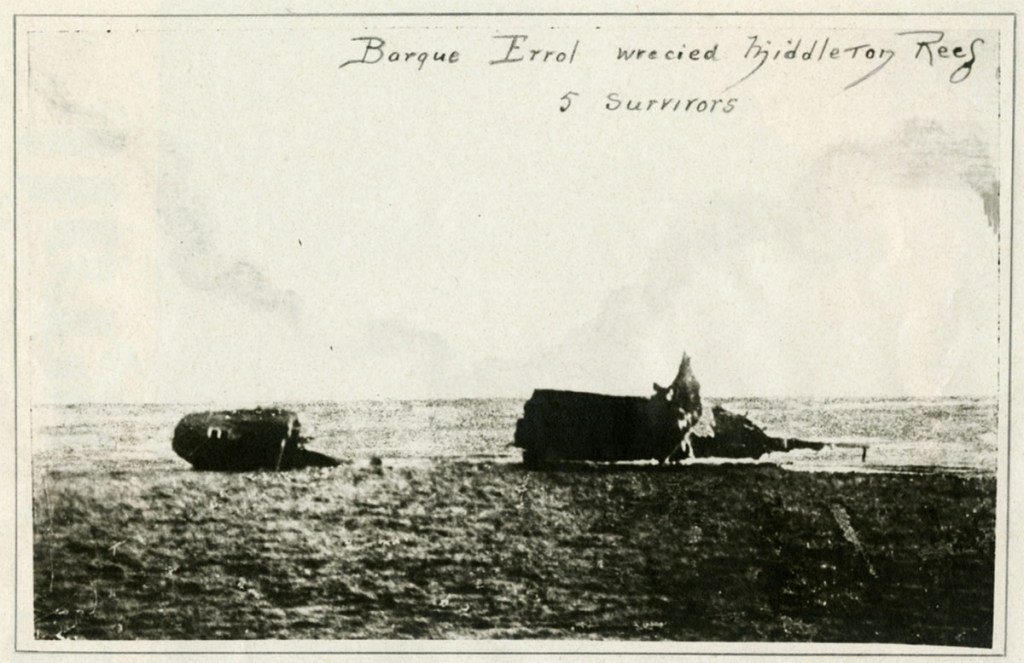
    The remains of the Errol on Middleton Reef. Courtesy: Norsk Maritim Museum.

    On 12 July 1909, the mail steamer Tofua was passing Middleton Reef in the Coral Sea bound for Sydney.    Captain George Holford gave the order to steam close by as was his want every time he passed.   This time, he noticed a new ship’s carcass had been added to the dangerous reef since he had seen it last.     Since the Britannia Godspeed ran aground on Middleton Reef in 1806, it and neighbouring Elizabeth Reef have claimed over 30 ships and countless lives over the years.

    Captain Holford steamed as close as he dared, then had a boat lowered to go across and investigate.   As the steamer neared the reef, he also noticed that some rags were flying from the mast of another ship, the Annasona, which had been wrecked two years earlier.  

    The boat soon returned with five survivors from the Norwegian barque Errol, which had run aground a month earlier with 22 souls onboard.  They had a tragic tale to tell.
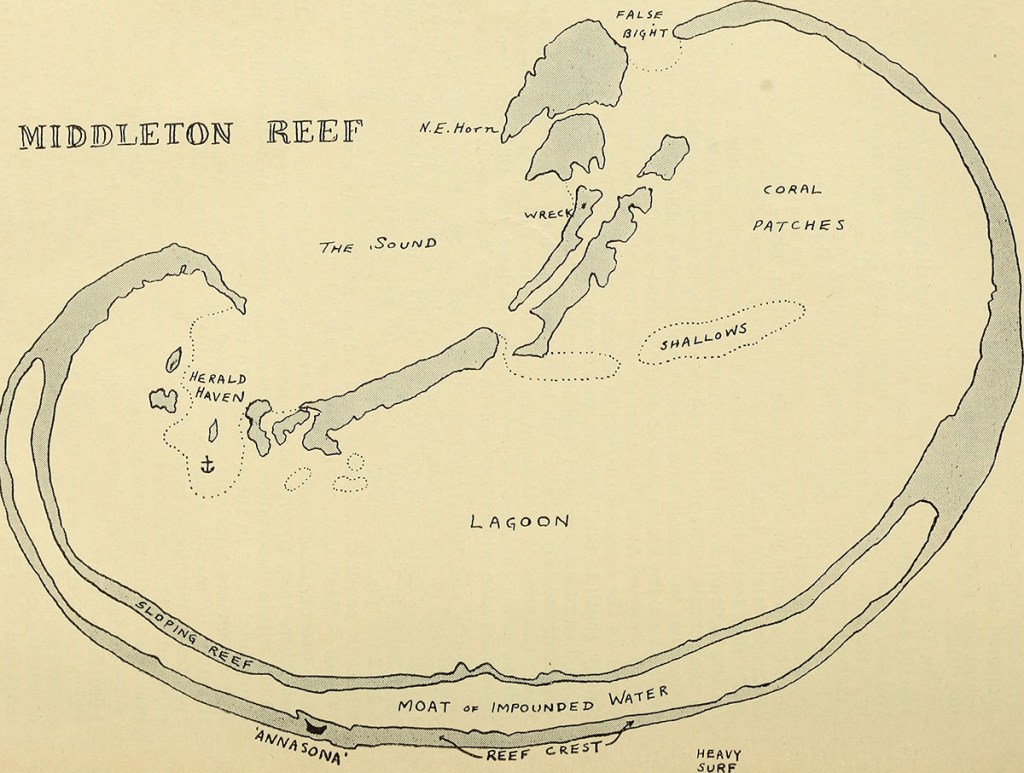
    Middleton Reef. Source: The Australian zoologist, 1934.

    The Errol had left the port of Chimote in Peru on 15 April, with a crew of 17 men and five passengers, comprising the Captain’s wife and four children.   The barque was headed to Newcastle to take on a cargo of coal.   However, disaster struck around midnight on 18 June when, without warning, the barque slammed into Middleton Reef.  

    The ship was swung broadside to the reef before there was even a chance to try and save her. The hull was torn out, and she rapidly settled with a heavy list to starboard.   Powerful waves swept over her, ripping apart the houses and washing away much of their stores along with the ship’s lifeboats.  She quickly succumbed to the pummelling and broke into four separate parts.    

    The First Mate was swept away and drowned as he and one of the crew tried vainly to clear one of the lifeboats.   Two more seamen also died that first night or on the second, the survivors could not recall.   Captain Andreason and the Second Mate were lost a couple of days later.   They had been on the reef, not far from the ship, building a raft comprised of spars and other timbers when they were caught by the rising tide.   Though they tried to swim back to the Errol, the current was too strong and they were washed away.  The Captain’s wife and children could only look on in horror. 

    The survivors were in dire straits.   The only food they had been able to salvage was a dozen loaves of bread, a few pounds of butter and a couple of tins of milk. What’s more, they had precious little fresh water.  A shelter of sorts was constructed on the exposed hull for the Captain’s wife and her children while the sailors made do with a canvas sail for protection from the elements. 

    Location of Middleton Reef. Courtesy Google Maps.

    Meanwhile, they continued to work on the raft.  After a few days, it was completed, and five of the crew set off for the Annasona, about 8 miles, 15 kilometres away, hoping they might find food and water.

    The raft barely held together long enough to reach the long-abandoned ship.  Fortunately, they found some fresh water, but the only sustenance available was shellfish clinging to the side of the wreck and the reef it stood on.  They spent 12 days on the Annasona building a more substantial craft to get them back to the Errol and their shipmates.  But before leaving, they hoisted a couple of shirts up the mast.   They had seen one ship pass by during their time there, but it had failed to see them or their signal of distress.   One of their number perished on the expedition across to the Annasona; however, a far greater tragedy had played out among those waiting on the Errol.

    When they climbed back aboard the Errol, they found only one man alive, Able Seaman Jack Lawrence, and he was barely clinging to life.   They had survived on a small amount of rain collected in the sails, but it proved almost as salt-laden as seawater.   Lawrence described how the others, including the Captain’s wife and children, had passed away one by one from thirst, starvation and exposure.  As each person died, their body was pushed over the side to splash in the sea. At least some of those corpses had been savaged by sharks, leaving the grisly spectacle of bones or body parts deposited on the reef at low tide.

    Photo of the Errol survivors. Daily Telegraph, 15 Jul 1909.

    All five men would likely have died on Middleton Reef had Captain Holford not made his customary search for castaways.   They were returned to his ship and cared for until they arrived in Sydney.   At a time before any sort of public safety net, the Tofua’s passengers generously donated over £100 to assist the shipwreck survivors get back on their feet.

    An inquiry into the tragedy heard that the Errol had experienced several days of overcast weather, where no astrological sightings could be made.   They were essentially sailing blind when they struck the reef.   One of the survivors also claimed that Captain Andreason had not taken the precaution of sending a lookout aloft to warn of any hazards in their path.

    For his act of humanity in rescuing the Errol survivors, Captain George Holford of the Tofua was later presented with an engraved silver coffee service by a grateful Norwegian Government.

    © Copyright C.J. Ison / Tales from the Quarterdeck, 2025.
  • The Catalpa rescue: a Most Audacious Prison Break

    The whaling barque Catalpa.

       In April 1875, the American whaling barque Catalpa quietly slipped out of New Bedford harbour without ceremony. To all appearances, she was just another whaler embarking on a routine hunt in the North Atlantic. However, Captain George Anthony had orders to sail halfway around the world and be stationed off Australia’s west coast, ready to rescue six convicts imprisoned by the British in Fremantle.

       The prisoners were all Irish nationalists who had been found guilty of treason and sent to Fremantle eight years earlier with scores of other revolutionaries. Over the years, most had been pardoned, but these six men had been serving soldiers in the British Army, and the government was disinclined to let them go. However, an Irish Independence organisation in the United States, the Clan-na-Gael, formulated a plan to set them free.

       They purchased the whaler, recruited a captain sympathetic to their cause and sent Irish agents, headed by John Breslin, to Fremantle to organise the escape on the ground. Breslin passed himself off as a wealthy American businessman looking for investment opportunities in the far-flung colony. He made contact with the convicts and warned them to be ready to leave at short notice. Breslin then assembled a small armoury of firearms and organised the hire of horses and carriages. He also reconnoitred the coastline south of Fremantle, looking for a suitable out-of-the-way place to take the escapees. There they would be taken off the beach in a whaleboat and delivered to the waiting ship.

    John J Breslin, AKA John Collins who orchestrated the Catalpa escape.

       By January 1876, all was in place except for the Catalpa. The ship was nowhere to be seen. As the weeks ticked by without any word from the whaler, Breslin grew increasingly concerned that some calamity had befallen her. However, his fears were unfounded. To Breslin’s great relief, the Catalpa finally dropped anchor in Bunbury on 28 March.

       Breslin met with Captain Anthony, and the two men thrashed out the final details of the escape. And, after a couple of unavoidable delays, the pair set on the escape, taking place on Monday, 17 April. On Sunday night, Captain Anthony took the Catalpa into international waters 30 kilometres west of Rockingham and then went ashore in the whaleboat to wait for Breslin and the Irish prisoners at a prearranged beach near Cape Peron.

       On Monday morning, the prisoners left their work gangs on various pretexts and made their way to Rockingham Road. There, they were met by Breslin and his men waiting with a change of clothes and horse-drawn carriages. They then raced south towards the waiting whaleboat. By 10.30, the prisoners, Breslin and all his men, were being loaded onto one of the Catalpa’s whaleboats as a plume of dark smoke from the government steamer smudged the morning sky. Captain Anthony wasted no time heading the boat out to sea to rendezvous with his ship.   

    However, it would not be smooth sailing getting back to the Catalpa. The seas had turned rough while he had been waiting on shore. To make matters worse, the whaleboat sat low in the water, weighed down by so many extra bodies. The boat crew battled the wind and waves all that day but made slow progress. But towards sunset, Captain Anthony spotted the Catalpa off in the distance. Then disaster struck. The mast snapped under the strain of the taut canvas and nearly flung everyone into the ocean. But for the quick actions of the man at the tiller, the brazen escape may well have failed there and then. Once night had descended and the ship was lost to sight, they had no choice but to spend an uncomfortable night in the cramped boat being buffeted about by the ocean swells. The next morning, the mast was repaired, and they were once again on their way. They soon sighted the Catalpa again and set a course to join her. Captain Anthony also spotted billowing black smoke, heralding the government steamer Georgette, on a course to intercept the whaler. Captain Anthony had the sail taken in and the mast lowered. The steamer passed within one kilometre of the whaleboat but failed to see it in the choppy sea conditions.

    “The Rescued Six.” By Charles Herbert Moore – https://archive.org/details/catalpaexpeditio01peas, Public Domain, https://commons.wikimedia.org/w/index.php?curid=33130178

       When the Georgette came alongside the Catalpa, the Superintendent of the Water Police enquired if there were any escaped prisoners on board. On being told there were none, the police officer asked if he could come aboard so he could see for himself. The first mate forbade him permission, reminding the Superintendent that the Catalpa was an American-flagged ship in international waters and was therefore not subject to British authority. Not wishing to spark an international incident, the Georgette broke off after 10 minutes and continued its fruitless search for the missing prisoners.

       As the Georgette steamed off, Captain Anthony had the mast and sail reset, and his oarsmen pulled for all they were worth. When the first mate sighted the whaleboat in the distance, he ordered the Catalpa’s helmsman to head towards them to close the gap. Hidden from sight by the bulk of the ship, Captain Anthony was unaware that a police cutter was also making for the ship.

       The whaleboat reached the Catalpa first and was hooked up to the davits, and within minutes, they were underway again and heading north. It was a close-run race. But, in the end, the police could do nothing but watch on as several of the Irish convicts jeered at them from the safety of the American ship’s deck. The police cutter’s commander gracefully accepted defeat with a snappy salute before returning to Fremantle empty-handed.    However, the Western Australian Governor was less sanguine about losing six prisoners so easily. He ordered the Georgette to go back out, find the ship and return the six prisoners to gaol. This time, she would carry a large complement of armed police and prison guards as well as a field artillery piece mounted on the foredeck. The next morning, the Georgette intercepted the Catalpa in international waters for the second time. This time, the Catalpa was heading south past Fremantle on her way towards the Southern Ocean to start her long voyage home.

    Mural commemorating the Catalpa rescue in Fremantle, WA. Photo CJ Ison.

       At 8 a.m., the Georgette pulled a little ahead of the Catalpa and fired a shot across her bows, signalling for the whaling ship to stop. Captain Anthony ignored the order and continued on his course until the Georgette’s gun crew had reloaded their piece. Only then did he put a speaking trumpet to his mouth and ask what they wanted.

       The Georgette’s Commanding Officer asked if there were any escaped prisoners onboard. This time, he warned Captain Anthony that the colonial secretary had been in contact with the American Government and had been authorised to use force to stop the ship. He also threatened to bring down the Catalpa’s masts with artillery fire should they not heave to. Breslin and Anthony agreed to call the bluff, thinking it unlikely that they had got permission to board, even with the magic of telegraphic communications. Anthony pointed to the Stars and Stripes fluttering in the wind and cautioned that an attack on his ship would be an attack on the United States.

       No one on the steamer wished to trigger a diplomatic row, so after shadowing the Catalpa for another half an hour or so, the Georgette veered off and returned to port empty-handed. Breslin would later write that the British left without even bidding them a hearty bon voyage.

       The Catalpa arrived in New York on 19 August after a four-month voyage via Cape Horn. The rescuers were feted as heroes, and the six Irish prisoners settled into their new lives as free men. This was arguably one of the best planned and executed escapes during Australia’s convict era. It was also the last.

    A more detailed account of the rescue can be found in Bolters: An Unruly Bunch of Malcontents.

    © Copyright C.J. Ison / Tales from the Quarterdeck, 2025.

    Please enter your email address below to be notified of future blogs.

  • Wreck of the Morning Star – 1814

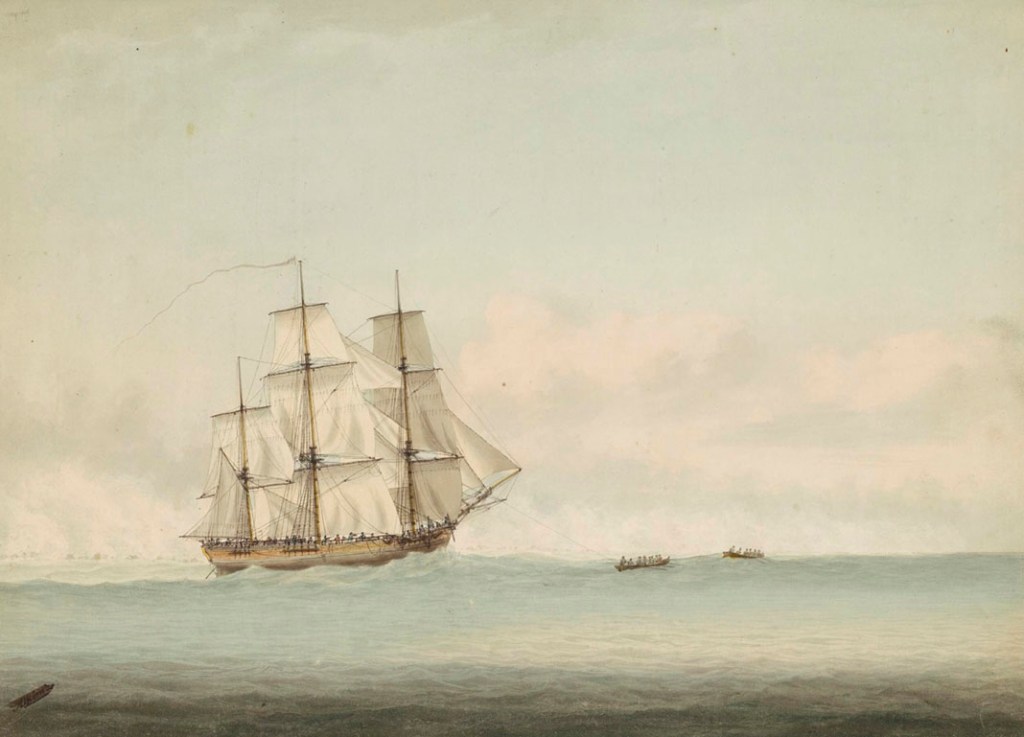
    Example of a Brig. Source: Winston’s Cumulative Loose-Leaf Encyclopedia 1918

       On Sunday, 3 July 1814, the merchant ship Morning Star sailed out of Sydney Harbour bound for Calcutta by way of Torres Strait and Batavia.  However, her voyage north ended abruptly on a coral reef south of the Forbes Islands off the far north Queensland coast. The vessel was a 140-ton Calcutta-built brig owned by the Indian-based trading house Lackersteen and Co. When she left Sydney, the crew numbered 37 men, a mix of European and Indian seamen, all under the command of Captain Robert Smart. Only six of them would survive the ordeal.

       No account exists of how the ship was lost, but from the location of the wreck site, it appears that Captain Smart was sailing within the Great Barrier Reef when he ran aground and had to abandon ship.

       Lieutenant James Cook had charted the route back in 1770, and he had only narrowly avoided total disaster on what he would name Endeavour Reef, some 450 km south of where the Morning Star was lost.

       The passage was fraught with danger. Thousands of reefs, many hidden just below the surface, dotted the coastal waters inside the Great Barrier Reef. However, the route had two distinct advantages. Rarely did a ship have to stray far from land, so refuge could be sought should disaster strike. There were also ample safe anchorages where ships could lay up overnight or when the conditions made it difficult to detect hazards lying in their path. Later, mariners would prefer a route that took them far out into the Coral Sea as they made their way north. They would cross the Barrier Reef near Raine Island or other similar narrow passages to pass through Torres Strait. This “outer passage” avoided the labyrinth of reefs but came with its own set of dangers.

    Booby Island. Image courtesy National Library of Australia

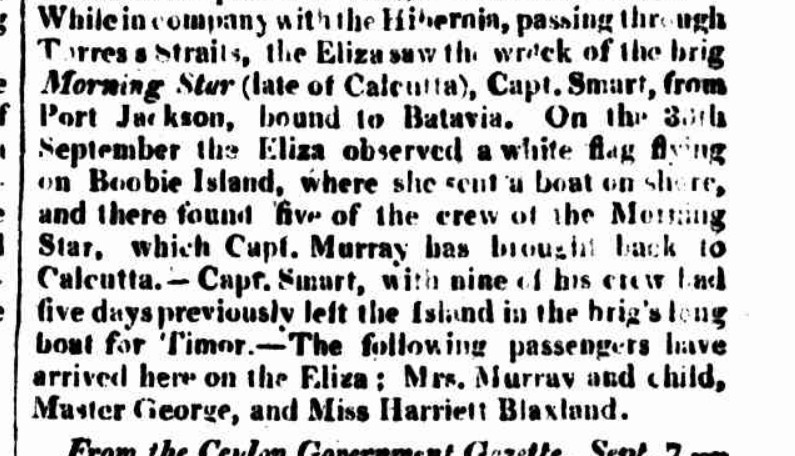
       On 30 September, the fully rigged Ship Eliza was sailing through Torres Strait when the lookout spotted a white flag flying from a staff on Booby Island.   The captain heaved to and sent a boat across to investigate. When it returned, she carried five marooned sailors from the Morning Star. This is the first recorded instance of shipwrecked sailors seeking refuge on Booby Island. Later, it would be stocked with food and water to assist shipwrecked sailors. A primitive post office with a logbook would also be established, so passing mariners could pass on the location of any uncharted reefs they may have discovered.

       The castaways had been among 15 men who had taken to the Morning Star’s longboat and made the perilous journey north after abandoning the wreck. They reported that Captain Smart and nine other sailors had left Booby Island five days earlier, intending to make for the Dutch port of Kupang on Timor Island. There is no record of them ever arriving there or anywhere else, for that matter.

    Morning Star reported wrecked on a reef south of Forbes Islands. Courtesy: Google Maps.

       The remaining 22 members of the Morning Star’s crew were thought to have perished as a result of the wreck or some calamity that befell them sometime afterwards. But four years later, another Morning Star survivor was found living with the Islanders on Murray Island on the Eastern entrance to Torres Strait.   

    The Claudine had anchored off Murray Island in September 1818 and sent a jolly boat ashore to meet with the islanders. To the astonishment of all, an Indian sailor was there to greet them in Hindustani. Fortunately, one of the sailors in the jolly boat spoke the language and was able to translate for the others. He told the sailors from the Claudine that he had been on the Morning Star when it ran aground and that since then he had been living with the Murray Islanders. He had learned their language and been accepted into their community, but the circumstances of his arrival on the island and the fate of his shipmates were not recorded. When the Claudine set sail, the Indian castaway was with them.

       The Morning Star is just one of many hundreds of vessels, large and small, that came to grief in Queensland’s northern waters from the late 18th and into the early part of the 20th Century.

    © Copyright C.J. Ison / Tales from the Quarterdeck, 2025.

    Please enter your email address below to be notified of future blogs.

  • An 1829 Narrative of a Voyage Through Torres Strait

    A ship passing through the Great Barrier Reef at Raine Island. Illustrated Australian News for Home Readers.

    Passing through the Great Barrier Reef during the age of sail must have been both terrifying and exhilarating in equal parts.    The following account, written by an anonymous passenger on a ship sailing through Torres Strait in 1829, was published in the Sydney Times on 19 Sept 1834.   It is a fascinating read and has been posted with only minor alterations to improve readability.

    A Narrative of a Voyage Through Torres Strait – 1829

    “Perhaps there is no part of the navigable world which offers the adventurous mariner a more terrific picture than the passage through Torres Strait — none more mis-represented — and none contemplated with greater horror. … There are three routes by which the passage through Torres Strait can be made, known among nautical men as the Inner, Middle, and Outer passages.

    Of these, the preference is generally given to the first, both because it affords convenient anchorage for the night, when it would be dangerous for a vessel to continue her course among the reefs, and because the mainland of New Holland is constantly in sight, and consequently easily attainable in case of wreck. Yet this of all is the most dangerous and intricate, and never could be preferred were it not for the reasons just mentioned.

    The middle passage was that through which the writer of these remarks passed in 1829, and if ever a satisfaction from disappointment were realised, it was in the accomplishment of this voyage, which had been before regarded as holding out but a mere chance of escape from the miseries of shipwreck.

    Detail of the 1846 Barrier Reef chart showing Pandora, and Raine Island Entrances – Courtesy: National Library of Australia.

    On the fourteenth day after our departure from Sydney, the man at the mast head called out reefs on the “starboard bow.”   Everyone was anxiously looking for this intelligence, for on that morning, the altitude of the sun proved we were within a few leagues of them.

    The reef soon proved to be the “great barrier” in latitude 11° 54 south, reaching across the ocean in a direction from the N. W. to the S. E. until the surf created by its breakers was lost to the sight beneath the horizon.

    All sail was immediately crowded on the vessel in order to make the entrance of the reef by noon, when the sun would not prevent the bed of the shoals from being distinctly marked.

    By noon, we had reached the spot we had desired and were within half a mile of the reef, which from its immense extent seemed to shut out all intercourse with the opposite part of the ocean.

    As we approached it more closely, we discovered that it contained two or three small openings, or passages of about a cable’s length in breadth, and through one of which our course was directed.

    The wind, was high, and there was a considerable swell, but beyond the wall-edge of the mighty reef, which served as a breakwater to the ocean, and upon which the whole volume of water was thrown, all was calm as a basin; — upon its broad surface there was but a ripple, while the rush and roar of waters, breaking as it were in anger on its side, presented a scene of mingled horror and beauty.

    In 1770, Cook charted what would become known as the Inner Passage. The Endeavour was nearly lost in the attempt. Painting by Samuel Atkins (1787-1808). National Library of Australia.

    We sailed on, we were close upon it and could fully discover the small opening through which our vessel was to pass. There was a breathless silence throughout the ship, save at intervals the voice of the captain giving instructions to the man at the helm.

    A deviation of a hair’s breadth and we might be lost forever. On either side the narrow passage was total and instant destruction; our vessel entered, and as she glided into the smooth channel, she felt the force of the current more powerfully, which being concentrated and brought into so close a space, swept her through with a velocity that no wind, however violent, could effect.

    It occupied but a quarter of an hour to pass through this channel, which formed the great danger of our voyage; but during that time, I had gone to the main top with a military officer who was on board to look upon the reefs.

    What a splendid scene was there; I had seen nothing like it before in nature or art, and perhaps never shall again. As far as the eye could reach, the sea was filled with white coral reefs, whose surface was just covered with water, and partaking of its hue, presented to the view the appearance of beautiful meadows so slightly inundated as to preserve their colouring.

    HMS Pandora came to grief when it tried to pass through the Great Barrier Reef in 1791. Photo courtesy SLQ.

    The shades of green produced by the sea flowing upon the white coral were most beautiful and variegated, and in proportion as the reefs deepened or became shallow, the colouring was diversified.

    But the most striking feature in the scene was the snow-like bordering which encompassed the whole, keeping out as it appeared, all influx of the ruder wave, while that upon the surface of the reef was as a calm lake. This was produced by the breaking of the sea on the sides of the reefs, and became more conspicuous in proportion as the coral approached the surface of the water.

    What a field was here for the contemplation of the artist or the philosopher, whether their time were given to look on Nature’s beauty, girt as it was with desolation, or in searching on the reefs, amid the conflux of currents, for the materials of science, they would be alike repaid for the anxiety the anticipated danger of such a route might produce.

    For myself, I can say that the impression of that picture is fresh upon me, and rests alone within a memory filled with the recollections of that beautiful voyage.”

    © Copyright C.J. Ison / Tales from the Quarterdeck, 2025. If you wish to be notified when new stories are posted, please enter your email address below.

  • Sydney’s First Convict Escape by Sea – 1790

    One of the first concerted efforts to escape from Sydney that did not involve trying to stow away on a homeward-bound ship took place in the latter part of 1790. Convicts, John Turwood, George Lee, George Connaway, John Watson, and John Strutton stole a boat and headed out to sea.

       Turwood and his mates had endured unimaginable hardships since leaving England, for they had come out on the infamous Second Fleet. Unsanitary living conditions and malnutrition had taken their toll on the voyage out. One-quarter of the 1006 convicts who left England died before ever reaching New South Wales. Of those who were put ashore, nearly 500 were immediately hospitalised. Of those, 124 would soon be dead. By September 1790, Turwood and his mates had been in the penal settlement for just eight weeks, but they had no desire to remain any longer to see if their fortunes might improve.

       Strutton had tried to escape once already. He had been smuggled aboard the Neptune and hidden among the firewood shortly before she was to sail back to England. However, sentries found his hiding place, and he was taken off the ship. He was flogged for trying to abscond, but the punishment only made him more determined to try again.

    Map of Sydney Cove Port Jackson, April 1788. Published by R. Cribb, London, 1789 original attributed to Fowkes, Francis – National Library of Australia, http://nla.gov.au/nla.map-nk276

    Soon after sunset on the night of 26 September, the five convicts stole a small flat-bottomed punt at Rose Hill and rowed down the Parramatta River into Sydney Harbour. Crammed in the small boat with them was one week’s supply of food, some cooking pots and other utensils, a few spare clothes and some bedding. At Watson’s Bay, just inside Sydney Heads, they put ashore and found another, much larger boat. Though it did not look particularly sturdy, it did have a mast and sail. Despite its shortcomings, the runaways thought they would have a better chance of surviving the open ocean in the larger boat. They transferred their belongings and headed out through Sydney Heads. By the time the bolters were reported missing and the two boats stolen, they were well on their way.

       Turwood had told friends before he had set off that they were going to sail to Tahiti, a place elevated in his mind to a tropical paradise where they could live freely among the Islanders. Tales from sailors who had visited Tahiti and other Pacific Islands had returned to England with fanciful stories about their time spent there. However, just how he intended to accomplish the 6,000-kilometre voyage without a sextant, charts, a compass, or any other navigation aids is a mystery.

       John Turwood was serving a life sentence for highway robbery. George Lee and George Connaway had stolen a pair of bullocks valued at £20. They had been sentenced to death, but that was later commuted to transportation for life. Watson and Strutton were each serving seven-year terms for stealing. Though nothing in their convict records suggests any of them had a nautical background, at least one of them knew how to handle a small vessel under sail.

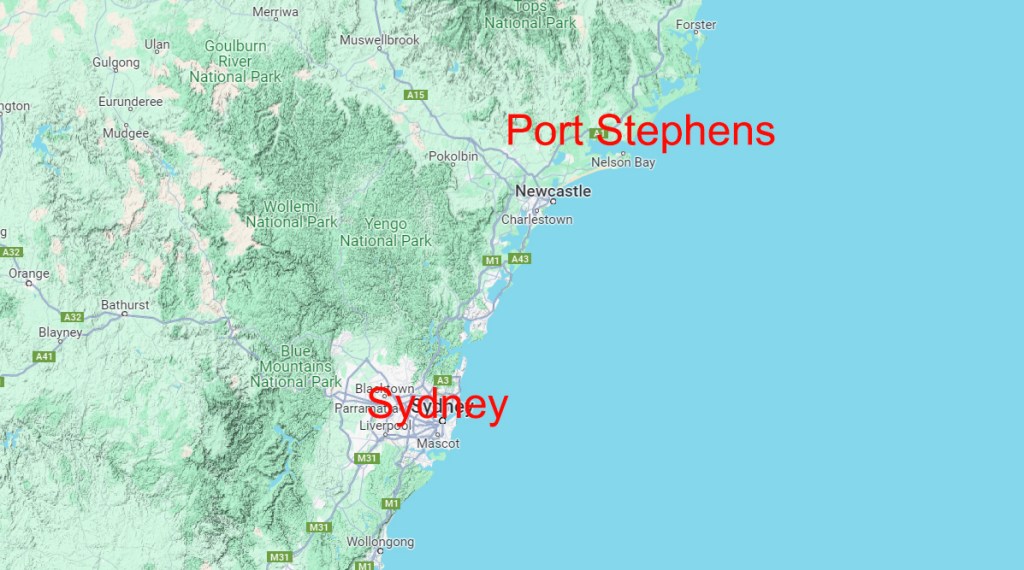
        After leaving Sydney Harbour, they set a course north, always remaining close to the coastline. When the sheltered waters of Port Stephens beckoned, they pulled in, and that’s where they stayed. After sailing 150 km, that was as close as they got to Tahiti. The local Aboriginal people, the Worimi, made them welcome and adopted them into their community. Over time, Turwood and the others learned to speak their language and were given Worimi names. They also seem to have undertaken formal initiation rituals, and at least a couple of the men took wives and began raising their own families. However, life was a constant struggle for the men, who were unaccustomed to the diet and customs of the Worimi people, especially in the beginning. Strutton died, although the circumstances and date of death were never recorded. Nonetheless, the other four lived there for five years and would have remained longer had a British warship not shown up.

       HMS Providence pulled into Port Stephens in mid-August 1795. She had just crossed the Pacific Ocean but had been unable to enter the Heads because of a strong westerly wind blowing off the land. Captain Broughton thought he would wait a few days in these sheltered waters before trying again. While there, he discovered Turwood and the other three white men living with the Aborigines. Broughton described them in his log as “miserable, half-starved objects, depending on the hospitality of the natives for their subsistence …” He offered to return them to Sydney, assuring them that they would likely not face punishment. Lee, Connaway and Watson immediately accepted the offer; however, Turwood was initially reluctant, but Broughton was eventually able to convince him to return as well. The arrival back in Sydney after a five-year absence was met with considerable surprise and of the runaway convicts in Sydney caused some consternation among the authorities, for they had long been given up for dead. But, true to Broughton’s word, they appear to have escaped punishment. Perhaps the Governor thought five years in the wilderness had been punishment enough.

    Families camped in the Port Stephens area, New South Wales, 1826 by Augustus Earle. Courtesy National Library of Australia.

       John Turwood and George Lee would flee from Sydney again in September 1797. They joined 13 other runaways who seized the small colonial cutter Cumberland near the mouth of the Hawkesbury River. After putting the captain and crew ashore, they headed out to sea. Neither the Cumberland nor the runaway convicts were ever seen again.

      © Copyright C.J. Ison / Tales from the Quarterdeck, 2025.

    Please enter your email address below to be notified of future blogs.