Tag: Booby Island

  • Bato to the Rescue – 1854

    Shipwreck survivors take to their boat.. Source: Tales of Shipwrecks and Adventures at Sea, 1856.

       In 1854, the fully-rigged Dutch ship Bato rescued not one, not two, but three separate parties of shipwreck survivors whose ships had come to grief in separate mishaps in Australia’s northern waters. In the space of a few weeks, these three ships all ran aground while attempting to navigate the treacherous waters of the Great Barrier Reef and the Torres Strait.

       The first casualty was the 521-ton ship Fatima. On 3 June, the Fatima left Melbourne bound for Singapore via Torres Strait. She made good time sailing up the east coast until, on 26 June, she was within sight of Raine Island. The low-lying island and its distinctive 20-metre-tall tower marked a channel through the Great Barrier Reef and the start of a well-charted passage through Torres Strait.

       Then, just 12nm (20 km) south of Raine Island, her voyage ended abruptly and violently when she crashed into the Great Detached Reef. The Fatima could not be saved, and her captain and crew were forced to take to the boats to save their lives. A refuge of sorts was close at hand, so they struck out for Raine Island off in the distance. There they remained, subsisting on a plentiful supply of seabird eggs while they waited to be rescued.

       A couple of days after the Fatima left Melbourne, the 391-ton barque Elizabeth also set sail from that same port. She was bound for Moulmein, Burma, and also intended to pass through Torres Strait by the Raine Island passage. However, disaster struck on 28 June when the barque ran aground on a small coral outcrop about 28nm (55 km) south of Raine Island. Fortunately, no lives were lost, and after a considerable amount of effort, the crew managed to get the ship off the reef and back into deep water. However, the hull had been breached, and Captain Churchill realised that his ship was taking on more water than the pumps could remove. Churchill made the difficult decision to abandon his ship, and he and his men took to the boats. They made their way through Torres Strait and arrived at Booby Island five days later. The island was marked on charts of the day as a haven for shipwrecked sailors where a supply of food and fresh water could be found.
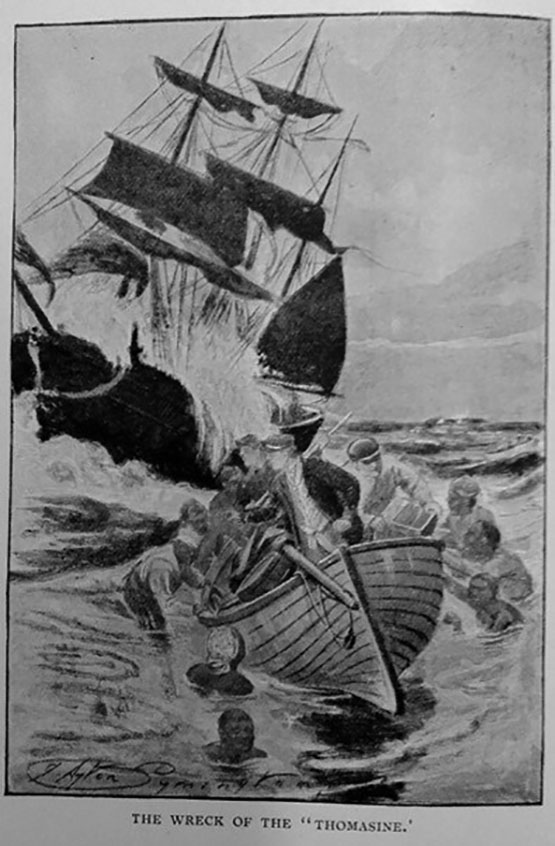
    The Wreck of the Thomasine. Courtesy State Library of Queensland.

       The third ship, the Thomasine, departed Sydney on 8 June bound for Batavia. She also intended to cross through the Torres Strait. But she ended her northerly run up the coast on 19 June when she struck an uncharted reef about 270 km east of present-day Port Douglas.

       Her master, Captain Holmes would later recall that around 8 o’clock on the evening of the 19th, the ship grazed a submerged reef where no such obstruction should have existed. He had been on deck at the time and had immediately gone to his cabin to consult his chart, to confirm what he suspected. While he was standing at his chart table, still consulting his map, the look-out called, “Breakers ahead.” Captain Holmes raced back on deck to the daunting sight of a long line of breaking waves ahead that extended around to his left and right, almost completely encircling the ship.

       Holmes and his crew kept the Thomasine from running aground during the night by tacking back and forth in the open water between the reefs. The next morning he saw how dire their situation was. The ship was trapped by an almost unbroken ring of breaking waves, denoting the presence of submerged coral reefs. Reefs that were absent from the charts but have since been added and bear the name Holmes Reefs.

       The wind began to rise and Holmes realised his only chance of escape was to try to make it through one of the narrow gaps he could see in the otherwise extended line of surf. He selected one, hoping it would allow his ship to reach the safety of deep water beyond. Unfortunately, the channel proved too shallow, and the Thomasine struck heavily, becoming stuck. Unable to get the Tomasine free, the captain made the difficult decision to abandon ship. The crew then readied two boats with as much food and water as they dared carry.

       Captain Holmes was doubly concerned as they tried to escape the ship and the surrounding reef. Not only did he feel responsible for his crew, but he was also accompanied by his wife and three children, the youngest of whom was just four months old. He divided his crew evenly between the two boats for the voyage north to Booby Island and a cache of stores. However, one sailor died during the struggle to get the boats through the roiling seas surging around the ship. Holmes   

    Over the next fortnight or so, the 18 castaways steadily made their way north, surviving on short rations and less than one litre of water per day from a small cask taken from the ship. But by 6 July, they had covered about 800 km and had reached Bird Island in the Torres Strait. Captain Holmes calculated that it would only take them another one or two days to reach Booby Island.  

    Map showing location of the three shipwrecks in Torres Strait. Courtesy Google Maps.

       It was around this time, the Dutch ship Bato was passing through the same waters. She had sailed from Hobart on 10 June and steadily made her way up the east coast of Australia. As Captain Brocksmit approached the Raine Island entrance, he sighted the Fatima castaways camped on the island. Ten men were taken on board while the rest followed in the Bato’s wake in their own boat until they had reached the Middle Bank well inside the Great Barrier Reef.

       The next day, 6 July, the Bato’s captain came across the survivors from the Thomasine off Bird Island and made room for them on his ship as well. Finally, the following day, the castaways from the Elizabeth were spotted on Booby Island, where they had landed four days earlier.

       Now carrying as many as 60 additional people, the Bato put the dangerous waters of Torres Strait behind her. Captain Brocksmit made his way along the Indonesian archipelago, arriving in Batavia on 25 July 1854. The survivors were disembarked, and the captains were faced with the unenviable task of notifying their respective ship owners of their losses.

    © Copyright C.J. Ison / Tales from the Quarterdeck, 2023.

    To be notified of future blogs, please enter your email address below.

  • The Sapphire and Marina: Three Months in a Leaky Boat

       At midday on 8 September 1859, the 749-ton merchant shipSapphire weighed anchor and began slowly making her way out of Port Curtis (present-day Gladstone, Queensland). She was ultimately bound for India via Torres Strait, with a consignment of 60 Australian horses purchased by the British Indian Army. But before the ship could clear the natural harbour, she ran aground on a sandbar and had to wait for the rising tide to lift her off.  So began a voyage that would cost 18 men their lives and last five gruelling months, only for the few survivors to wind up back where they had started. Their story is a remarkable one of perseverance in the face of unimaginable hardship, served with a healthy measure of good luck.   

    The Sapphire bore out into the Coral Sea and then headed north outside the Great Barrier Reef. On 23 September, Captain Bowden calculated he was somewhere off Raine Island. That afternoon, the lookout sighted a line of breaking surf heralding the outer edge of the reef. Bowden had the ship put about, and they tacked back and forth through the late afternoon. Captain Bowden intended to hold his position in deep water overnight and make his way through the reef first thing in the morning.

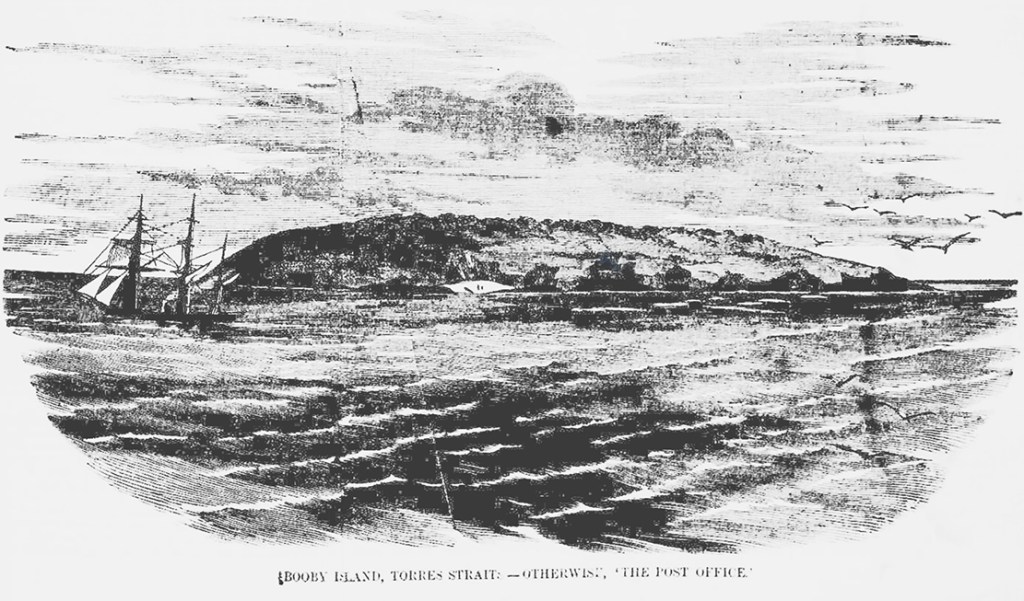
    Illustration of Booby Island, Torres Strait – Otherwise, Post Office. From the Illustrated Sydney News, Fri 16 Dec 1864, Page 9.

        But shortly after sunset, the alarm was raised. A lookout sighted a long, uninterrupted curve of white water directly in their path. By the time the ship responded to the call to pull hard about, the breakers were just 500 metres off the leeward bow. There was now insufficient sea room to turn the ship around and point her back out to sea.  The Sapphire struck the coral reef broadside. Huge waves swept her deck. The force of the collision brought down the fore-top-gallant mast, and one of their lifeboats was swept from its davits. The ship heeled over, and all seemed lost. Captain Bowden ordered the main mast cut away, hoping the vessel might right itself. When the mast came down, it landed on the deck, smashing the longboat to pieces. It also brought down the mizzen mast, which in turn crashed onto the lifeboat, damaging it. Within minutes, three of the Sapphire’s five boats were lost. Everyone spent a harrowing night sheltering as best they could while the terrified horses remained trapped in the hold.

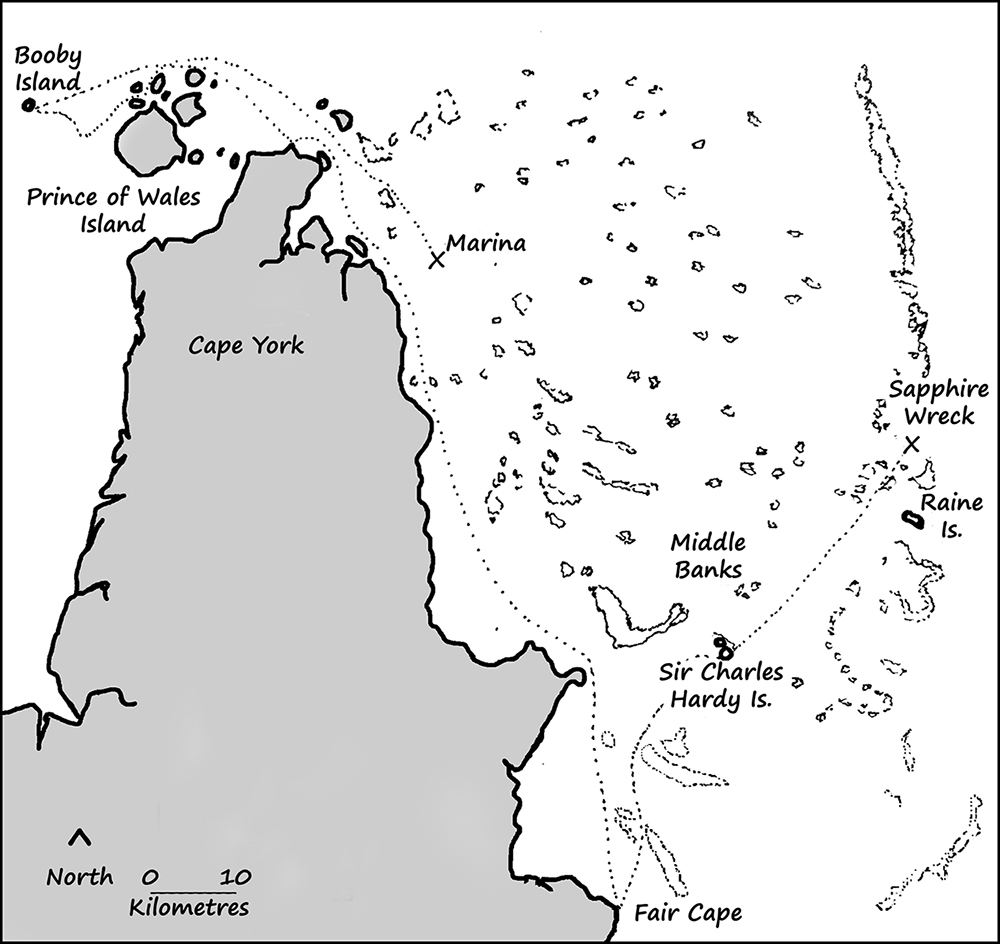
       Breaking with maritime convention, by leaving his ship, Captain Bowden set off in the morning to search for somewhere to land. First Mate William Beveridge was left in charge of the stranded vessel. Beveridge began preparations to abandon the ship and also had the carpenters try to repair the two badly damaged boats, only half expecting that Bowden might return. It seems that Beveridge and Bowden did not see eye to eye, and the first mate may even have blamed his captain for running aground. However, Bowden did return to the Sapphire, having found a suitable refuge on Sir Charles Hardy Island about 85 km away.

       The Sapphire’s crew of 28 men took to the two surviving boats and headed to the island, abandoning the ship and the 60 horses still trapped below. Captain Bowden decided they should return to Port Curtis, 1,500 kilometres to the south, and they left messages in a bottle hung from a tree telling of their intentions. They set off south on October 6 but immediately encountered strong headwinds. Bowden soon gave up on heading south, turning his boat around to head north, through Torres Strait, intending to make for Booby Island. In another unusual turn of events, Beveridge did not follow suit. He continued trying to push south for another day or two before he also gave up and turned around.

    Sapphire survivors route through Torres Strait from leaving the Sapphire and finding the Marina.

       Beveridge reached Booby Island in mid-October to find Bowden and the rest of the men already there. By now, they had been roaming the seas around Torres Strait for almost a month. The provisions they found there were a godsend for the hungry sailors, but they would not last indefinitely. Bowden and Beveridge agreed that they would have to leave there sooner or later. It was approaching cyclone season, and they had not seen another vessel since becoming marooned. They would likely not see another ship pass by Booby Island until April or even May the next year.

       Bowden and Beveridge put their differences aside and decided to make another attempt to return to Port Curtis, despite their recent failure. But as soon as they got clear of the island, they were struck by the same contrary winds that had plagued them earlier.

       While Beveridge and his boat were off Friday Island, they were set upon by Torres Strait Islanders and one of the men was speared to death. Meanwhile, Captain Bowden’s boat was off Hammond Island. They had stopped to trade with a party of Islanders, but in what seemed like an unprovoked attack, a volley of spears and arrows was launched into their overcrowded boat. Only one man was able to jump clear and swim away. He would later be rescued by Beveridge, who had gone in search of Bowden’s boat.

       Beveridge and his men continued pushing back east and eventually made it around the tip of Cape York. They then picked their way through the maze of coral reefs, and their luck finally changed for the better.

       They spotted a ship in the distance, the first they had seen since abandoning their own vessel some six weeks earlier. But, as they drew closer, they found it was deserted. The ship proved to be the barque Marina, which had run aground around the same time the Sapphire had been wrecked. It too had been abandoned by its crew, and they had also made it to Sir Charles Hardy, reaching it only hours after the Sapphire castaways had left. Miraculously, the Marina had floated off the reef on a spring tide only to drift around Torres Strait for the next several weeks.

    Marina’s course down the Queensland Coast. Source Google Maps.

       The Marina’s crew had then set off south for Port Curtis, and after 43 days of arduous sailing, they made it safely to port and notified the authorities of the loss of their own ship and also of the Sapphire. HMS Cordelia was dispatched north to search for the Sapphire’s missing men. However, she only steamed as far as Cape Upstart, thinking the lost sailors could not still be any further north. But they were wrong. By now, it was late January 1860, and the Sapphire’s crew was anchored off Lizard Island in the Marina, 500 km further north.

       Back in late November, Beveridge had decided they should sail the Marina to Port Curtis rather than try to do so in their small pinnace. Setting off on the 26th, they battled the same contrary winds and currents that had previously frustrated them. For the next two months, they made painfully slow progress. They anchored for days and weeks at a time, waiting for the south-easterlies to fall off. In the first month, they travelled just 180 km.

       They spent tiring Christmas Day kedging the stranded barque off a sandbar, and they would run aground twice more in the weeks that followed. The Marina’s hull was so damaged that water flowed freely in and out of the hold. The only thing keeping the ship afloat was her cargo of tightly packed Kauri logs.

       On 9 February, they were anchored off Palm Island.   In the past two and a half months, they had covered a little more than half the distance to Port Curtis. They still had another 800 km or more to go.   All seemed lost.   Their food had all but run out, and they were slowly starving to death.    

    Finally, their luck turned around. The wind started blowing from the north. They put to sea and made steady progress south. Three days later, Beveridge sighted Cape Upstart off the port bow. The next day, they were cruising through the Whitsundays. They were now only 400 km from Port Curtis. A couple of days after that, they crossed Keppel Bay, and the next day, 17 February, they anchored off Facing Island just outside Port Curtis. No one had the strength to manoeuvre the crippled vessel into port. They took to the Sapphire’s pinnace again and surprised everyone with their return, for they had long been given up for dead.

    The Sapphire’s full story is told in A Treacherous Coast: Ten Tales of Shipwreck and Survival from Queensland Waters, available as an eBook or paperback through Amazon.

    © Copyright C.J. Ison, Tales from the Quarterdeck, 2021.

    Enter your email address in the form below to be notified of new posts.

  • The Post Office in the middle of nowhere

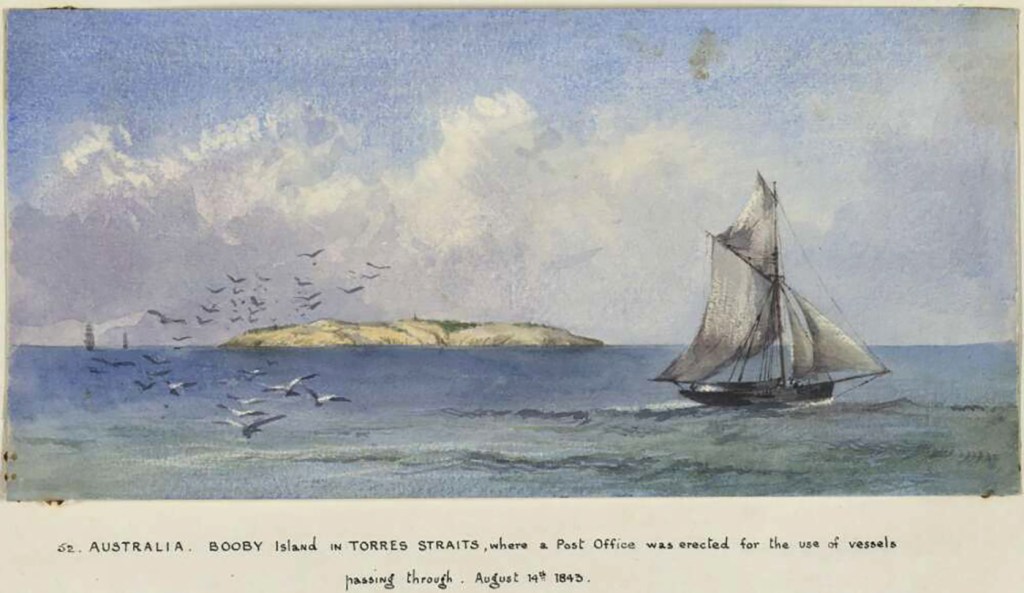
    Booby Island. Image courtesy National Library of Australia

       It might seem strange that one of Australia’s earliest post offices was also one of its most remote. It was set up on Booby Island in Torres Strait in 1835. However, the practice of passing mariners leaving correspondence on the island was already well established.

       Booby Island (Ngiangu to the Torres Strait Islanders) lies west of the tip of Cape York, about 1,800 nm or 3200 km by sea from Sydney. The nearest European settlement was the Dutch outpost of Kupang on Timor Island, 2000 km west across the Arafura Sea.

       Cook named the small outcrop Booby Island after the birds he saw nesting on its rocky slopes. The island would go on to serve as a crucial navigation landmark, especially for those mariners who had sailed up Australia’s east coast and were bound for Timor and beyond. Reaching Booby Island meant they had made it safely through the labyrinth of dangerous coral shoals plaguing the Torres Strait.  

       The earliest record of shipwrecked sailors finding refuge on Booby Island dates to 1814. The merchant vessel Morning Star, sailing from Sydney to Batavia, struck a reef and sank in Torres Strait. The crew abandoned the ship and made for nearby Booby Island. They were stranded there for five months, living in one of the island’s caves and surviving on rainwater and the seabirds that resided there. Then a sharp-eyed observer on a passing ship noticed a white flag being vigorously waved by one of the survivors. Five men were rescued. Twenty-two of their shipmates, including the captain, lost their lives.

       By the 1820s, ships were regularly passing through Torres Strait on their way from Sydney and Hobart bound for ports in India, China and England. Too many ran aground or sank in those remote and treacherous waters.

       In 1822, a flagstaff was erected on Booby Island’s summit, and a logbook was placed in one of the island’s caves so ships’ captains could register their safe passage through the Great Barrier Reef and Torres Strait. Those same mariners also began leaving sailing reports in the ledger to aid their fellow seafarers. The location of uncharted reefs or the strength and direction of hazardous currents were all recorded, sometimes at the cost of the vessel. Much of this information would be used to update later naval charts of the region.

    From an unidentified illustrated newspaper depicting Booby Island in the Torres Strait. Illustration Courtesy State Library of Queensland.

       Shortly after taking up duties as the Governor of New South Wales in 1824, William Bligh had the island stocked with barrels of fresh water, preserved meat and sea biscuits. Bligh knew stocking the island with provisions would go a long way towards saving the lives of sailors unfortunate enough to come to grief in those remote northern waters. He had first-hand knowledge of just how dangerous they could be. As a young Lieutenant, Bligh had sailed a small open cutter through Torres Strait after he had been unceremoniously relieved of his ship, HMS Bounty, by its mutinous crew.

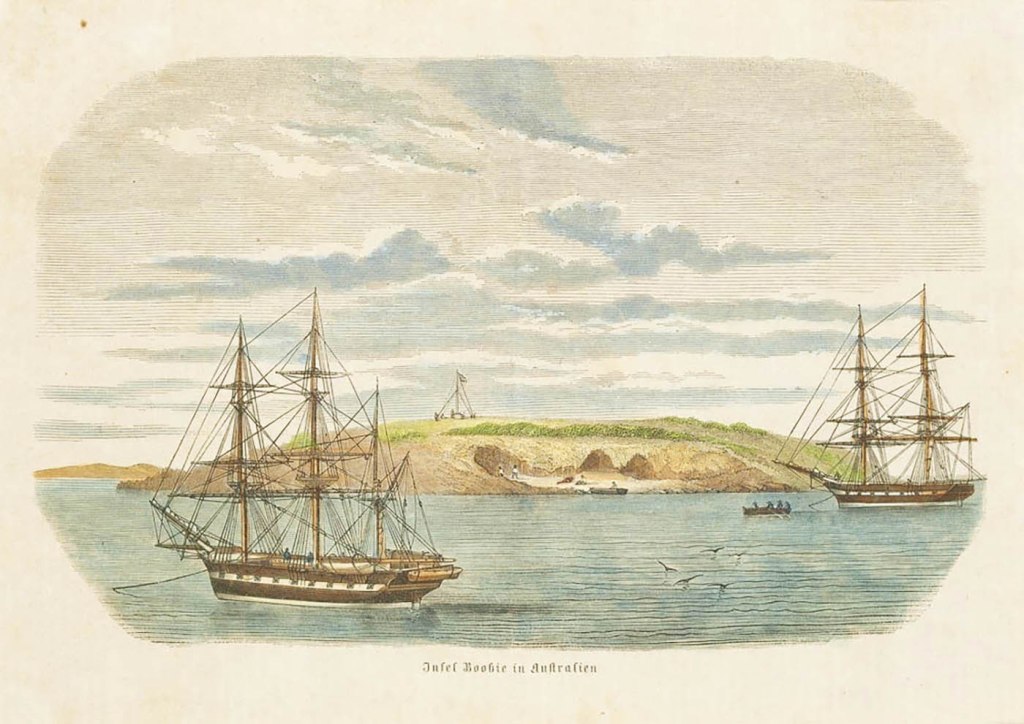
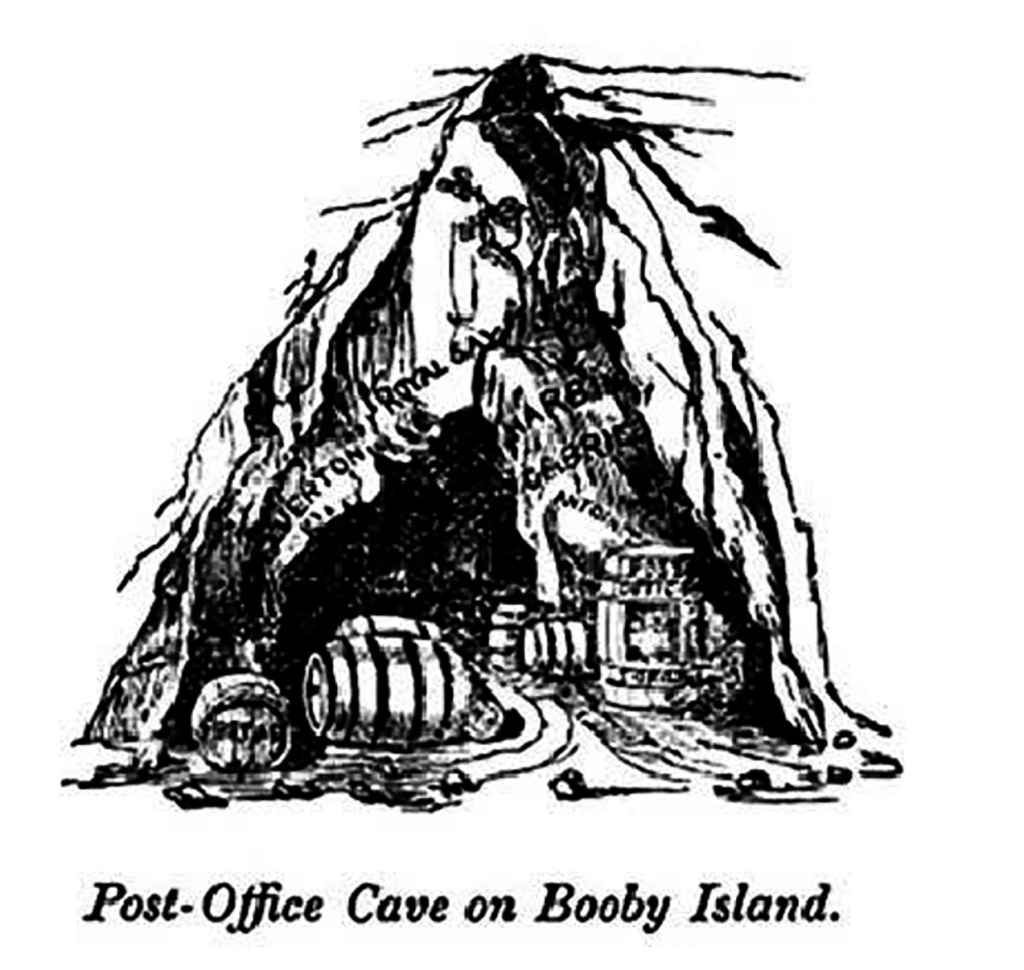
       Then, 11 years later, in 1835, Captain Hobson of HMS Rattlesnake established the unmanned “post office” in one of the island’s small caves. The practice of leaving details of sailing hazards continued. But mariners also began leaving letters in the box in the hope they might be taken on to various destinations by other passing ships. For example, someone on a ship bound for India might leave a letter addressed to a recipient in Canton, China. The next ship bound for that port would take it on to its destination.   

    When the Upton Castle stopped briefly at Booby Island in 1838, one of its passengers visited the post box and described it thus,“[it is] covered with canvas and well secured, and supplied with a quantity of pens, paper, and ink, and pencils in excellent order.”

    Early illustration of the Booby Island Post Office.

    It is worth remembering that the only other post office in Australia at the time was in Sydney.    Melbourne would not get a post office for another couple of years and it would be seven years before another post office appeared in what would become Queensland.

    In the span of just 15 years castaways from at least ten ships owed their lives to Booby Island.   The Coringa Packet, and Hydrabad (1845) Ceres (1849), Victoria (1853), Elizabeth, Frances Walk   It is worth noting that, at the time, the only other post offices in Australia were located in Sydney and Hobart. Melbourne would not get a post office for another couple of years, and it would be seven years before Brisbane got one.

       In the span of just 15 years, castaways from at least ten ships owed their lives to supplies left at Booby Island. Survivors from the Coringa Packet, and Hydrabad (1845), Ceres (1849), Victoria (1853), Elizabeth, Frances Walker and Sultana (1854), Chesterholme (1858), Equateur, and Sapphire (1859) and many more before and since made for the island after their ships were lost.

       Booby Island remained a vital refuge for shipwrecked mariners and a place to exchange information until the 1870s, when a government outpost was established on nearby Thursday Island.er and Sultana (1854), Chesterholme (1858), Equateur, and Sapphire (1859) and many more before and since made for the island after their ships were lost.

    Booby Island remained an important refuge for shipwrecked mariners and a place to exchange information until the 1870s when it was supplanted by a government outpost on Thursday Island.

    Copyright © C.J. Ison, Tales from the Quarterdeck, 2021.

    To be notified of future blog posts, please enter your email address below.