Tag: Badger

  • Tales from the Quarterdeck

    Sixty bite-sized stories from Australia’s maritime past

    The melancholy loss of H.M.S Sirius off Norfolk Island by George. Raper. Source National Library of Australia 136507434-1

    I have just launched a new book titled Tales from the Quarterdeck: Sixty bite-sized stories from Australia’s maritime past. Sixty of the most popular posts have been reedited. In some cases, I’ve rewritten a couple and updated a few where new information has come to light since first writing them.

    For those who would value ready access to the stories in their bookcase, Tales from the Quarterdeck is available in Kindle ebook and paperback formats through Amazon.

    The stories are organised in chronological order, starting with the Tryall shipwreck off the Western Australian coast in 1622, and finishing with the Second World War exploits of the Krait. See below for a full list of the stories covered in the book.
    Sydney Gazette 22 May 1808, p. 2.

    1622 – The Tryall: Australia’s earliest shipwreck

    1629 – The Batavia Tragedy

    1688 – William Dampier: Navigator, naturalist, writer, pirate

    1770  – The Endeavour’s Crappy Repair

    1788 – Loss of La Astrolabe and La Boussole, a 40-Year Mystery                        

    1789 – Bligh’s Epic Voyage to Timor

    1789 – HMS Guardian: All Hands to the Pumps

    1790 – The Loss of HMS Sirius

    1790 – Sydney’s First Desperate Escape

    1791 – HMS Pandora: Queensland’s earliest recorded Shipwreck

    1791 – William Bryant’s Great Escape

    1797 – The Loss of the Sydney Cove

    1803 – Loss of HMS Porpoise

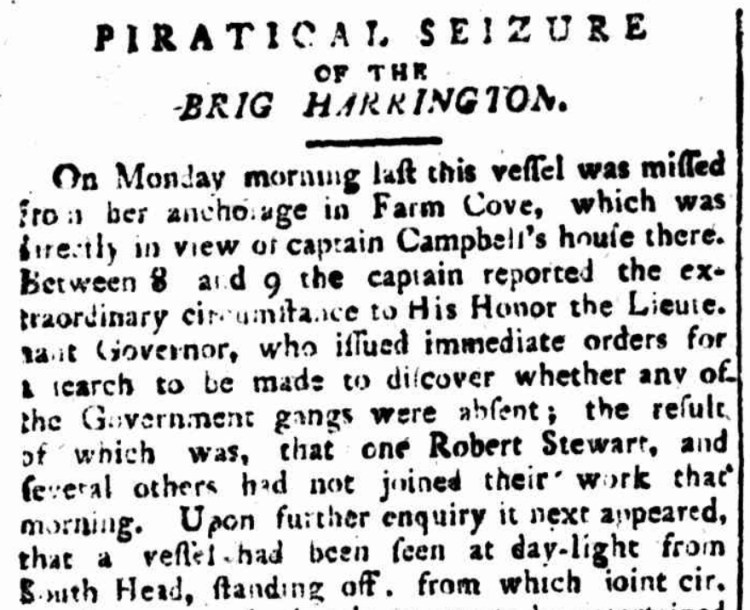
    1808 – Robert Stewart and the Seizure of the Harrington

    1814 – Wreck of the Morning Star

    1816 – The Life and Loss of HMSC Mermaid

    1824 – The Brig Amity’s Amazing Career

    1829 – The Cyprus mutiny 

    1831 – The Caledonia’s perilous last voyage

    1833 – The Badger’s Textbook Escape

    1835 – The Loss of the Convict Ship Neva

    1835 – The Post Office in the middle of nowhere

    1835 – The Tragic Loss of George III

    1845 – The Cataraqui: Australia’s worst shipwreck

    1846 – The Peruvian’s Lone Survivor

    1847 – The Foundering of the Sovereign

    1850 – The Loss of the Enchantress: A first-hand account

    1851 – The Countess of Minto’s brush with Disaster

    1852 – The Bourneuf’s Tragic Last Voyage

    1852 – The Nelson Gold Heist

    Woodbury, Walter B. (Walter Bentley), 1834-1885. Hamlet’s Ghost, Sourabaya [Surabaya], Java [Boat with Passengers and Crew], ca. 1865. Walter B. Woodbury Photograph Collection (PH 003). Special Collections and University Archives, University of Massachusetts Amherst Libraries

    1854 – Bato to the Rescue 

    1854 – HMS Torch and the rescue of the Ningpo

    1856 – The Loss of the Duroc and the Rise of La Deliverance

    1858 – The Loss of the Saint Paul and its Horrific Aftermath

    1858 – Narcisse Pelletier, An Extraordinary Tale of Survival

    1859 – The Indian Queen’s Icy Encounter

    1859 – The Sapphire and Marina

    1863 – The loss of the Grafton: Marooned for twenty months

    1864 – The Invercauld shipwreck

    1865 – The CSS Shenandoah: Victoria’s link to the American Civil War

    1866 – The Loss of the SS Cawarra: Bad luck or an avoidable tragedy?

    1868 – The Bogus Count and Hamlet’s Ghost

    1871 – The Mystery of the Peri

    1872 – The Loss of the Maria, A Cautionary Tale

    1875 – The Tragedy behind the Gothenburg Medals

    1876 – The Catalpa rescue

    1876 – The Banshee’s Terrible Loss

    1878 – The Loch Ard Tragedy

    1884 – The Macabre case of the Mignonette

    1885 – The Douro and its Piratical Captain

    1889 – The Windjammer Grace Harwar

    1891 – The Spanish Silver of Torres Strait

    1893 – The Foundering of the SS Alert

    1895 – The Norna and the Conman Commodore

    1899 – Cyclone Mahina

    1911 – The Loss of the Mandalay

    1918 – The Orete’s Robinson Crusoe-like Castaway

    1935 – The Life and Loss of  the SS Maheno

    1943 – Surviving the Centaur Sinking

    1943 – The Amazing Krait

  • A Textbook Escape – The Badger 1833.

    Example of an English Cutter of early 1800s. Source: All About Ships, Dorling, 1912.

       In July 1833, the colonial cutter Badger left Hobart with its hold filled with supplies intended for Port Arthur. Only this time, as she set off down the Derwent River instead of rounding Cape Raoul and delivering her stores, she kept heading east, past Tasman Island, past Cape Pillar and out to sea. The captain and crew, all convicts still under sentence, had likely been planning their escape for some time. Now they were putting it into action.

       The Badger had a crew of four under the command of Captain William Philp.   All the men had been mariners before they had run afoul of the law and been banished to Van Diemen’s Land. All but one were serving life sentences, meaning there was no likelihood they would ever return home. Their captain was a former master mariner who had been found guilty of “Wilfully and maliciously destroying the sloop Jane”. Philp had been a part-owner of the vessel as well as its captain. Late one night, he loaded it with gunpowder and blew it up in Penzance Harbour after a falling out with his business partners.

       He was tried, found guilty and sentenced to transportation for life. Aged 51, Philp was sent out to Van Diemen’s Land on the convict transport Argyle in 1831. During the passage, he was suspected of conspiring with others to seize the ship and make their escape. The evidence was circumstantial and most likely supplied by a convict informant, but that was enough for Philp and eight or so others to be clapped in chains and separated from the rest of the prisoners. On the Argyle’s arrival in Hobart, the conspirators, including Philp, were tried, found guilty and sentenced to serve hard labour at Macquarie Harbour. 

       On his eventual return to Hobart, Philp finally got a break. He was put in charge of the 25-ton schooner Badger, ferrying stores from Hobart to Port Arthur about 70 kilometres sailing down the Derwent River. Port Arthur had recently been established to replace Macquarie Harbour, which was about to be shut down the following year.

    The Colonist, 6 Aug 1833, p. 3.

       By 1833, the Badger’s entire crew were experienced seamen. It was not uncommon for the authorities to assign sailors to work on government vessels, for they already had the necessary skills. However, there was always the obvious risk that the colonial administrators were giving them the means of effecting their own escape. Such was the case with the Badger. Governor Arthur was mercilessly criticised for allowing such a situation to eventuate.

       On Tuesday, 23 July 1833, William Philp took the Badger out of Sullivan Cove and headed down the Derwent River much as he had done many times before. As well as carrying plenty of provisions, on this trip the Badger was also well equipped with nautical charts, navigation instruments and several muskets recently procured by Philp and his men. What’s more, as many as a dozen convicts had also been smuggled aboard and hidden in the hold.

       The Badger left the wharf unchallenged and did not raise any suspicion as she sailed under the guns of Battery Point. To everyone but those on board, she was on her regular passage to Port Arthur. But before she had gone more than five kilometres down the Derwent, she briefly pulled into shore and picked up a final passenger, one George Harding Darby.

       Darby, like all the rest of the men on the Badger, was a convict still under sentence. But he enjoyed many privileges not accorded to ordinary convicts sent out to the colonies. A gentleman by birth, he was a member of the same class as the military officers and administrators governing Van Diemen’s Land. At the time, he was employed as a signalman at Mount Nelson Signal Station, which relayed messages from Port Arthur to Hobart. He had also worked at the Water Bailiff’s office and was likely the person who got Philp his job as the Badger’s master and ensured he had a crew of loyal and competent sailors.

    Courtesy Google Maps

       Darby and Philp, both nautical men, had become friends while held in a prison hulk awaiting transportation. Darby had come out to Van Diemen’s Land on the William Glen Anderson the same year as Philp had come out on the Argyle. George Darby had served in the Royal Navy and, during Greece’s war of independence from the Ottoman Empire, had commanded a naval vessel under Lord Cochrane. He was also reputed to have served with distinction during the battle of Navarino in 1827 further enhancing his reputation among Hobart’s administrators. However, by 1830, he had left the navy and had found employment as a clerk. By 30 March 1830, he was standing in the docks answering charges of stealing £90 from a fellow gentleman. He was found guilty and sentenced to be transported for life.

       Several days passed before anyone realised the Badger had not delivered her stores to Port Arthur. Boats were sent out to track her down. It was thought that Philp might have sought refuge in the Bay of Islands in New Zealand.   So, the brig Isabella was even sent to investigate with a party of soldiers on board. However, she returned to Hobart in late September, having found no trace of the missing Badger. Philp, Darby, and the others had somewhere much further afield in mind when they sailed away from Hobart. They had made their way north, first through the Tasman and from there into the Coral Sea. In September, they pulled into Lifuka in the Friendly Islands (present-day Tonga) before resuming their journey north across the equator and on towards the Philippines.

       Philp, Darby and the rest of the runaways eventually arrived in Manila in a longboat, claiming their ship had sunk not far from that port. It is certainly possible that they ran into trouble close to their destination, as they claimed. But it is more likely they had deliberately scuttled the ship rather than risk it being identified as the missing Badger. Philp and Darby would have known that Governor Arthur would have sent a description of the Badger and its runaways far and wide in his effort to track them down.

    The Pria Granda, Macao, by Thomas Allom, from a sketch by Lieut. White, Royal Marines. (1843)

       The bolters did not linger in Manila for very long. They boarded a Spanish ship bound for the Portuguese colony of Macau. But in Macau, their luck nearly ran out. William Philp was spotted by the master of the British merchant ship Mermaid, which happened to be in port. Before taking command of the Mermaid, Captain Stavers had served as the mate on the convict transport Argyle. He immediately recognised Philp as one of the convicts who was suspected of plotting to seize his ship.

       Stavers tried to have the Portuguese colonial authorities detain the Philp and his mates. He showed the officials an old copy of the Sydney Herald newspaper, which included a report on the seizure of the Badger as evidence. Philp and Darby were picked up and questioned by a Portuguese official, but they claimed to have never heard of the Badger.

       As Philp and the others had kept their noses clean while in Macau, the Governor was not inclined to lock them up on the say-so of a foreigner brandishing an old newspaper in a language he did not understand. Philp and Darby were released to go about their business unmolested, but now that their true identities were known, they thought it was time to move on in. Apparently, most of the runaways had already found berths on an American-flagged ship about to leave port. Philp was last seen in Macau after kindly declining an invitation to join a ship bound for Sydney, telling the British captain, “[he] did not wish to go so far southward.”

    Philp, Darby and the rest of the men who fled from Van Diemen’s Land on the Badger are among a very select group of convicts. Of the many hundreds who escaped in stolen or seized vessels, very few are known to have made it to a friendly port. None of the Badger’s men were ever heard of again after leaving Macau.


    © Copyright C.J. Ison / Tales from the Quarterdeck, 2024.

    Please enter your email address below to be notified of future blogs.