Tag: Australia

  • The Mystery of the Missing Madagascar

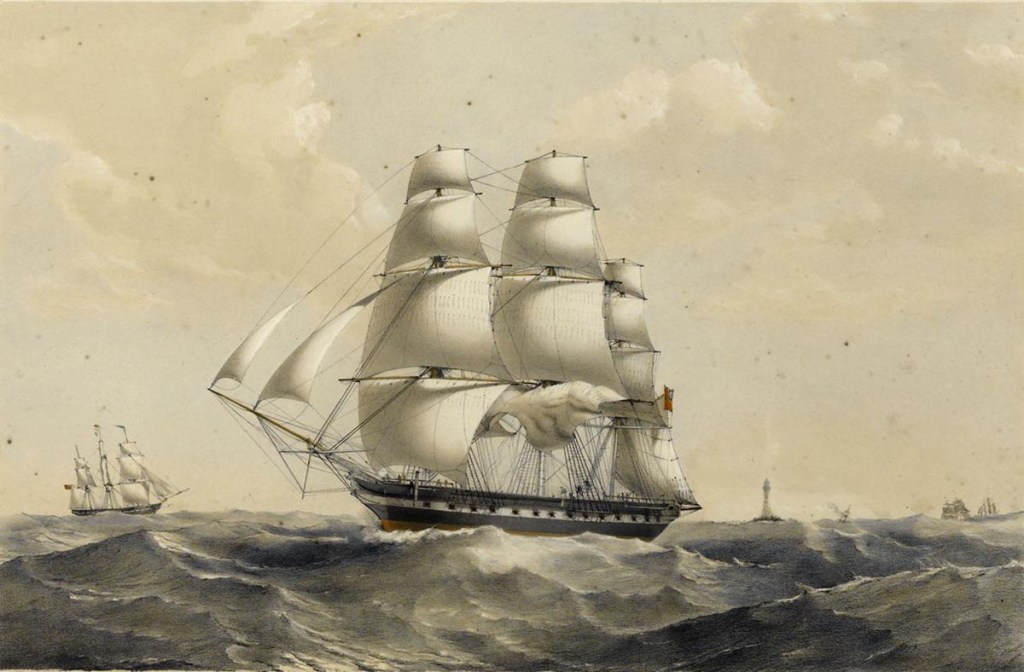
    By Thomas Goldsworth Dutton (fl 1840) – National Maritime Museum Greenwich, London [1], Public Domain, https://commons.wikimedia.org/w/index.php?curid=30836816

    In August 1853, the Madagascar set sail from Melbourne, Australia, and was never seen again.  On board were her full complement of crew and 62 passengers. Men, women and children all bound for England. She was not the first to vanish at sea, and she would not be the last. But her disappearance has fuelled keen interest over the years, not because of the tragic loss of life, but for her large and valuable cargo of gold.

    The Victorian gold rush was in its third year and was showing no signs of slowing. As well as wool and other cargo, the Madagascar had carried consignments of gold from gold traders and banks, totalling over 68,000 ounces, worth at least a quarter of a million pounds at the time.   Today, the missing fortune would be worth nearly half a billion Australian dollars.

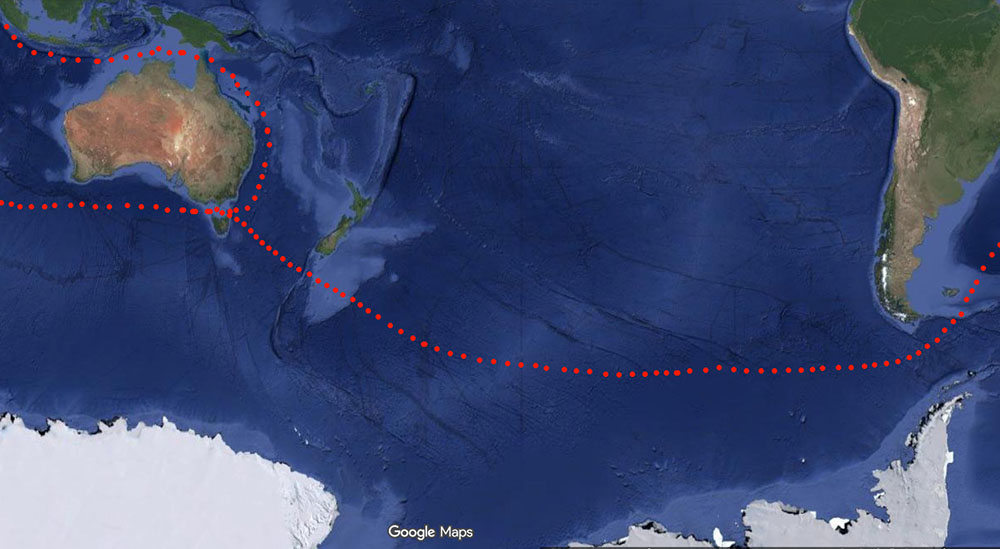
    The Madagascar was a 950-ton fully rigged sailing ship commanded by an experienced and highly respected master mariner named Captain Fortescue W. Harris. He had a choice of three routes he could take on his return voyage to London.   Once clear of Port Phillip, he could have turned his vessel west to cross the Great Australian Bight and the Indian Ocean, then round the Cape of Good Hope before turning north up the East African coast towards home.  He could also have turned to port to cross the South Pacific, round Cape Horn, before again turning north through the Atlantic. Or he might have followed Australia’s east coast north, through the Coral Sea, Torres Strait, and on to Singapore, India, the Cape of Good Hope, and home.   Unfortunately, he left no clue as to which route he intended to take.

    The ship was only 15 years old, solidly built, well-maintained, and had made the passage out to Australia in just 87 days without incident. There was no reason to think the ship would not make the routine passage home in a similar time. But after six months had passed with no sign of the ship, people grew anxious, for she was now long overdue.
    In February 1854, a report reached London via the captain of the Jessica in Calla, Chile, that the Madagascar had put into Rio de Janeiro “in a very leaky state, near upon foundering.” It was thought that her passengers and the gold would have been loaded onto another vessel to complete the remainder of their voyage. However, nothing further was heard, and the report ultimately proved to be an unfounded rumour.

    Word that the ship was missing finally reached Melbourne nearly ten months after she had made her departure. Several theories immediately emerged.   Some thought her cargo of wool might have spontaneously combusted and engulfed the ship in fire. Others thought she might have been sunk by a Russian frigate operating in the southern seas. One experienced mariner dismissed both of these theories. He believed it was more likely that she had struck an iceberg in those freezing latitudes of the Southern Ocean.

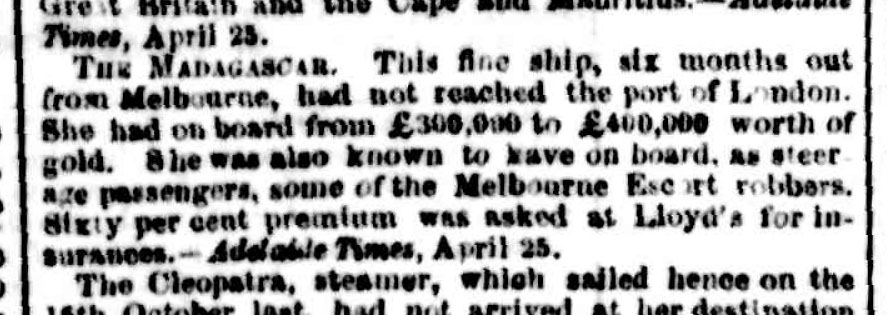
    There were also fears that her disappearance might have been at the hands of a ruthless gang of bandits.  Three bushrangers had been taken off the Madagascar the day before she departed. They, and their mates, had robbed the McIvor Gold Escort of £10,000 worth of gold, shooting four troopers in the process.  It was widely believed that other dangerous outlaws had left on the missing ship as paying passengers or members of the crew. Once they were far from land, it was argued, they had plundered the ship and sank her, before taking to the boats with their ill-got gains.    Of course, there is no way to prove or disprove if this actually happened.

    Then, a year later, in May 1855, a gentleman in Geelong received a letter from an acquaintance in Cape Town telling him that the missing Madagascar had been found safe and sound. According to the letter writer, she had become trapped in ice while trying to round Cape Horn and had been stranded for some six months in those remote Antarctic waters. No other corroborating news came out of Cape Town or anywhere else, for that matter, and the rumour was dismissed. What’s more, Lloyds had since listed the ship as missing and had paid out on its insurance liability.
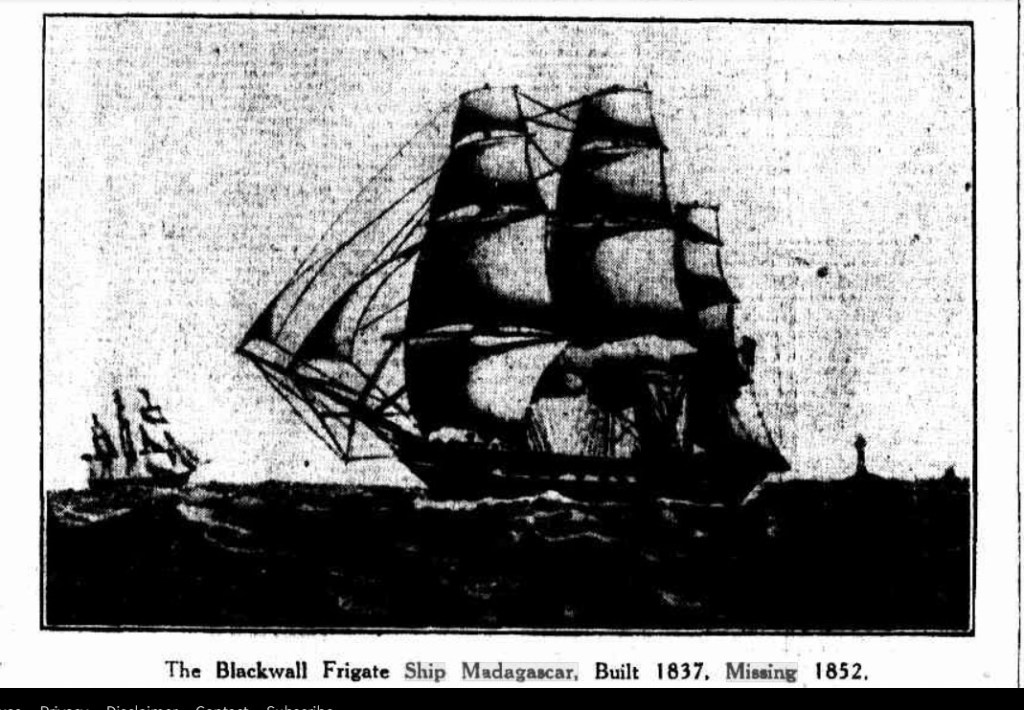
    The Madagascar, The Age, 6 APr 1929, p. 7.

    But some people never gave up hope of finding out what happened to the ship and their loved ones. Twenty-seven years after the ship had vanished, the crew of the ketch Rosebud found 15 skeletons on Bountiful Island in the Gulf of Carpentaria. On learning of the discovery, the nephew of one of the Madagascar’s missing passengers begged the Queensland government to find out if the remains might be linked to the missing ship.   An expedition was sent to Bountiful Island, and concluded the skeletons were likely those of Aborigines or Malay fishermen rather than survivors from the Madagascar. The report also noted that the island was some 350 miles (650 km) away from the regular shipping channel through Torres Strait.

    In 1889, the remains of an old ship were discovered off the New Zealand coast. So sure were some Sydney treasure hunters that they raised sufficient money to send an expedition, including an experienced diver, to New Zealand to examine the wreck. Needless to say, they did not come back with the gold or anything else that shed light on the fate of the Madagascar.

    But the most enduring theory as to the loss of the Madagascar centred on it being seized by desperate robbers who made off with the gold and sank the ship. Some stories came with elaborate details, although they were impossible to verify.

    In 1914, a New Zealand newspaper published a story claiming the Madagascar had been lost off the South American coast.  In a recently discovered written statement made to the police in 1867, a sailor named “Bully” Hayes said he had survived the wreck of a treasure ship off Peru.  Hayes claimed the ship was seized and set on fire by a band of robbers who escaped in the boats laden with thousands of pounds of stolen gold.  He had somehow managed to secure a seat on one of the boats, which later struck a reef. The gold was lost, and he was the only survivor.  Though he would not be drawn on the name of the ship, the man who took his statement believed he was referring to the Madagascar.
    Fifteen years later, another tale emerged regarding the missing ship. Supposedly, a clergyman said that years earlier, he had taken a deathbed statement from a woman who claimed to have survived the sinking of the Madagascar. Her story went thus. The Madagascar had been seized by mutineers who had locked everyone below deck, set fire to the ship, and taken to the boats with the gold and several young women, herself included. The boat was swamped by surf as they tried to land somewhere on the South American coast, and the gold was lost.   A handful of mutineers survived only to die of yellow fever on reaching a small town. Only she and one man survived, and he would later abandon her.   Unfortunately, the story makes no mention of her name or the priest who took her final confession, making it impossible to verify.

    After the passage of some 175 years, it seems likely that we will never know what befell the Madagascar.  Perhaps she struck an iceberg in the deep reaches of the Southern Ocean or perished in a powerful storm. Perhaps her cargo of wool did catch fire and she sank. It would not be the first time a ship had succumbed to such a tragedy. Or maybe an attempt was made to seize the gold, which ended with the loss of the ship. But one thing is for sure: piled among what remains of the ship and the final resting place of her passengers and crew, there is nearly half a billion dollars of gold sitting somewhere on the ocean floor.
    © Copyright C.J. Ison / Tales from the Quarterdeck, 2026.

    Please enter your email address below to be notified of future blogs.
  • Four Years in Torres Strait: The Extraordinary Tale of Barbara Thompson

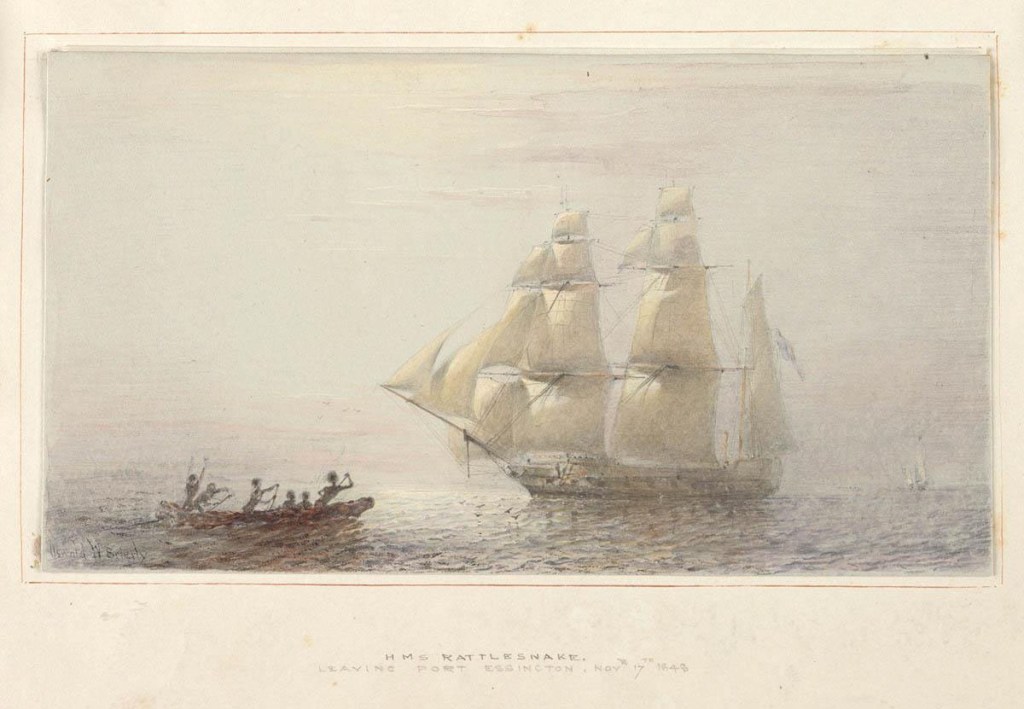
    HMS Rattlesnake circa 1848. Courtesy State Library of NSW.

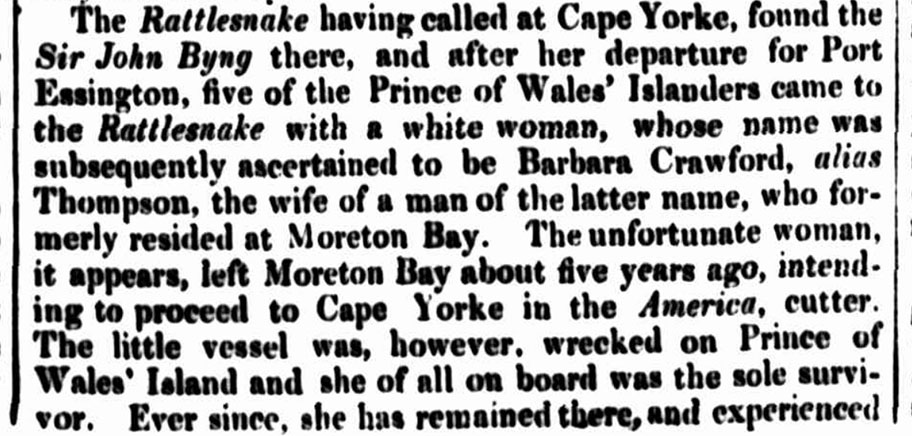
    In 1845, a small cutter quietly slipped out of Moreton Bay, supposedly bound 300 km up the coast to salvage whatever they could from a ship reported to have been wrecked in that vicinity.  The three-ton vessel and her crew were never heard of again, at least not for nearly five years. Then, in late 1849, sailors from HMS Rattlesnake were ashore near the tip of Cape York when they were approached by a white woman seeking their protection.  In halting English, she claimed to be Barbara Thompson, the only survivor from the missing cutter. This is her remarkable story.

    Born in Aberdeen in the late 1820s. Barbara Crawford arrived in New South Wales with her parents as free settlers on the convict transport John Barry. Her father, a tinsmith by trade, had left Scotland to start a new life for himself and his children in Sydney. By 1845, Barbara had left the family home in Pyrmont, married a man named William Thompson and was living in Moreton Bay.

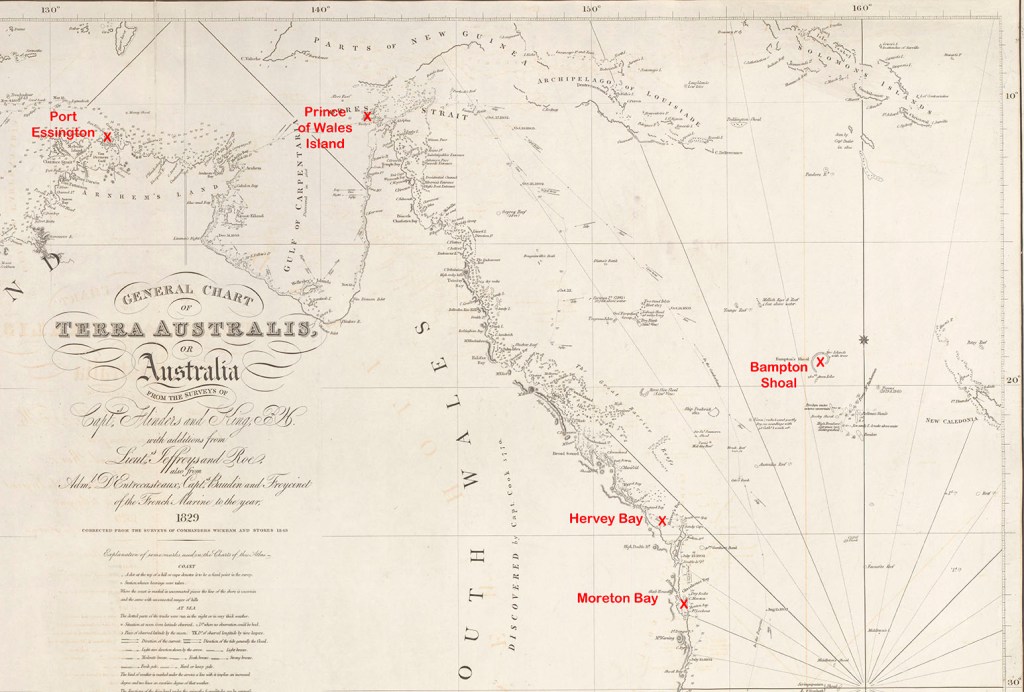
    Around the middle of 1845, it seems William Thompson thought he had found an easy way to make some money. He had learned that a ship filled with whale oil had run aground on Bampton Shoals, over 1,000 km away in the vast expanse of the Coral Sea. Despite having no salvage rights to do so, he decided to search for the ship and take as many barrels of oil as his tiny vessel could carry.

    A year earlier, in June 1844, the American whaler Clarence had run aground at Horseshoe Reef in the Bamptons. Unable to get his off, the captain made the difficult decision to abandon her and make for Moreton Bay in the boats.    Salvage rights to the Clarence and her valuable cargo were sold at auction in Sydney to a man named Cole. He quickly dispatched the schooner Elizabeth, under the command of Captain Riley, to Bampton Shoals to make good on his investment.   Purchasing the salvage rights to any wreck, sight unseen, in such a remote and dangerous part of the world, was always risky. Cole would have to wait to see if his gamble would pay off.

    Background map courtesy National Library of Australia.

    After Captain Riley arrived at the wreck site and carefully examined the damage to the Clarence, he was convinced he could not only retrieve the whale oil, but he could also save the ship and sail it back to Sydney.  So, he loaded the Clarence’s more valuable stores onto his schooner and sailed for home with the good news. He then returned to Bampton Shoals with a couple of shipwrights and the necessary equipment to repair the whaler’s hull and refloat her. However, Riley’s luck took a turn for the worse in January 1845, when a ferocious storm swept the Elizabeth from her moorings and out to sea. Captain Riley and six of his men were now stranded, having taken shelter on the Clarence during the storm. After waiting six weeks for the Elizabeth to return, Riley accepted that his schooner had likely sunk during the storm.  He had the shipwrights prepare their longboat for the hazardous open-ocean voyage to the Australian mainland by raising the freeboard and building a temporary deck. Once work was complete, they set sail for Moreton Bay with just an old hand compass to guide them. The passage would take them 37 gruelling days.

    At Moreton Bay, Captain Riley sold the longboat to William Thompson, who named the three-ton cutter-rigged vessel America. By now, it was mid-1845.   Thompson told people that he intended to salvage the remains of a ship Captain Riley said he had spotted aground on the northern end of Fraser Island (K’Gari).  In reality, Thompson planned to sail to Bampton Shoals and fill his hold with the Clarence’s whale oil before continuing through Torres Strait and on to Port Essington with his spoils.   While Thompson had bought the Elizabeth’s longboat, it’s unlikely he had also bought the salvage rights to the Clarence and her cargo. They would still have belonged to Cole.

    The America set sail from Moreton Bay around August or September 1845.  Joining Thompson were his young wife Barbara and four crew, one of whom was likely a man named Harris who had been on the Elizabeth and said he knew where to find the Clarence.  

    It seems to have been an unhappy vessel.  They were plagued by foul weather, and according to Barbara, there was much “quarrelling on board.”  Two of the crew even drowned during the voyage, though the circumstances remain a mystery.  As it turned out, Harris was unable to find the Clarence or even Bampton Shoals, for that matter. With their provisions almost depleted, Thompson abandoned the search and made for Port Essington via Torres Strait. Somewhere along the way, he put Harris ashore under circumstances that are not entirely clear.  Harris would spend eight months as a castaway somewhere on Cape York before being rescued by a passing ship and taken on to Hong Kong.  

    Meanwhile, Thompson, his wife and one remaining member of the crew cleared the tip of Cape York, but the America struck a reef off the eastern end of Prince of Wales Island (Muralag) during bad weather.  Thompson and the seaman drowned when they tried to swim ashore through the surging seas.   Barbara was left trapped on the cutter until she was rescued by Islanders returning from a turtle hunt after the weather had moderated.

    One of her rescuers, a man named Boroto, claimed Barbara as his wife, something she had no say in. Despite this, she also later claimed she had been well-treated by the Kaurareg. Her place in the community was assured after an elder declared that Barbara was the reincarnated form of his deceased daughter, Giaom. Barbara was renamed Giaom in her honour.

    Giaom, as she was now called, lived with the Kaurareg for the next four years. She learned their language, customs, and way of life. She shared their good times and bad and seems to have been well-liked. That is not to say her life was easy. Life with the Kaurareg would have been challenging for any white person of that era to adapt to. But adapt she did.  

    The only restriction placed on her was that she was barred from communicating with any of the scores of ships that passed through Torres Strait each year. It is quite likely that she always harboured a dream to return to her former life, and a few years later, she got her chance.

    In October 1849, a friend told her that a ship had stopped near the tip of Cape York.  She enlisted the help of several female friends, and they made the crossing to the mainland. She had assured them that she only wanted to meet the white men and shake their hands. Actually, she had already decided to leave the Kaurareg and hoped to do so on that ship. She figured this might be the only chance she had to make it back to Sydney to see her family again. When her husband, Boroto, was told what she was up to, he and several of his mates set off in pursuit.

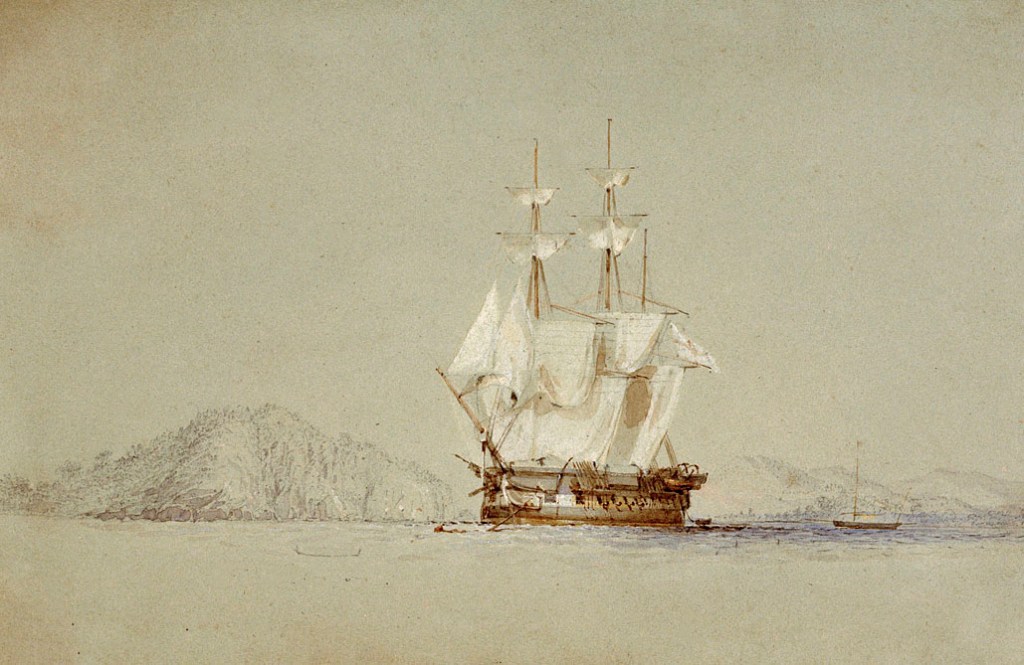
    HMS Rattlesnake at anchor circa 1850. By Capt. Owen Stanley.

    On 16 October, Barbara Thompson and her friends stumbled on a party of seamen from the British survey ship HMS Rattlesnake.  Barbara was not immediately recognised as a white woman. For though naked but for a fringe of leaves strung around her waist, her skin was so deeply tanned and blistered by long exposure to the tropical sun as to make her indistinguishable from the other Aboriginal women. Barbara was reportedly “wretched in appearance,” and blind in one eye, and it was only when she spoke a few halting words that they realised she was a British subject. “I am a white woman. Why do you leave me?” she pleaded, wanting to be taken back to their ship. She was clearly awkward about her nudity in the company of white men, so the sailors gave her two shirts to cover herself and then took her back to the Rattlesnake.

    It was not long before Boroto was alongside in a canoe demanding that she be returned to him.   Meanwhile, Captain Owen Stanley had listened to her story and told her that the choice to stay or go was hers alone to make.  She chose to remain on the Rattlesnake. Captain Stanely remained at Cape York for several more days, and during that time, many of Barbara’s friends came out to visit her. Even Boroto was allowed on board to speak with his wife. At first, he tried using soft talk and promises to convince her to change her mind and come back home. When that didn’t work, he grew furious and threatened to kill her if she did not do as she was told. Boroto finally stormed off the ship empty-handed.

    While on the Rattlesnake, Barbara AKA Giaom was befriended by the Rattlesnake’s naturalist, John MacGillivray. Barbara proved to be a godsend when it came to understanding the ways of the local peoples. She added several hundred Kaurareg words and their English translations to his dictionary, and she also helped him to understand how Kaurareg grammar worked. She also freely shared her knowledge of the manners, customs, and daily life of her adopted people, giving MacGillivray insights he could never have gained on his own.   MacGillivray’s account of the Rattlesnake’s expedition, Narrative of the Voyage of HMS Rattlesnake, published in 1852, is dotted with references to Giaom’s contributions on the Kaurareg people of Torres Strait.

    Barbara Thompson’s health improved with medical attention and a return to a Western diet. The Rattlesnake arrived back in Sydney in February 1850, where Barbara was reunited with her parents.

    © Copyright C.J. Ison / Tales from the Quarterdeck, 2026.

    If you would like to be notified of future blog posts, please enter your email address below.

  • Tales from the Quarterdeck

    Sixty bite-sized stories from Australia’s maritime past

    The melancholy loss of H.M.S Sirius off Norfolk Island by George. Raper. Source National Library of Australia 136507434-1

    I have just launched a new book titled Tales from the Quarterdeck: Sixty bite-sized stories from Australia’s maritime past. Sixty of the most popular posts have been reedited. In some cases, I’ve rewritten a couple and updated a few where new information has come to light since first writing them.

    For those who would value ready access to the stories in their bookcase, Tales from the Quarterdeck is available in Kindle ebook and paperback formats through Amazon.

    The stories are organised in chronological order, starting with the Tryall shipwreck off the Western Australian coast in 1622, and finishing with the Second World War exploits of the Krait. See below for a full list of the stories covered in the book.

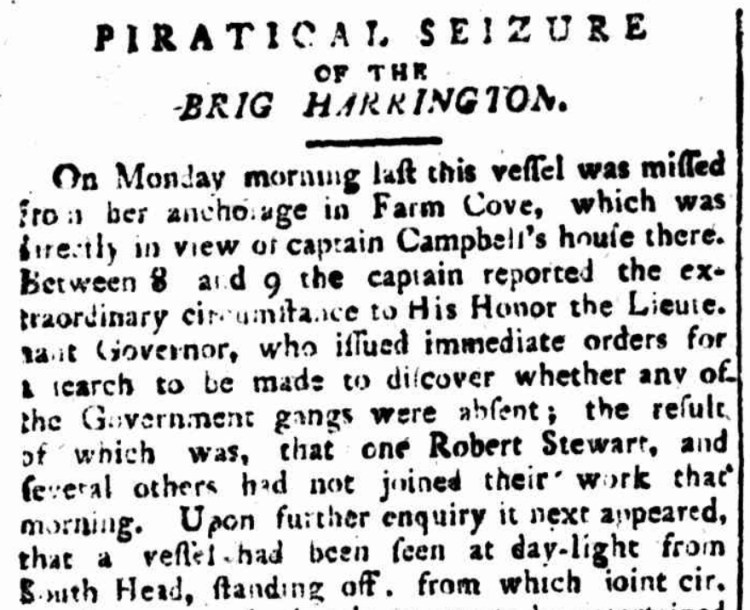
    Sydney Gazette 22 May 1808, p. 2.

    1622 – The Tryall: Australia’s earliest shipwreck

    1629 – The Batavia Tragedy

    1688 – William Dampier: Navigator, naturalist, writer, pirate

    1770  – The Endeavour’s Crappy Repair

    1788 – Loss of La Astrolabe and La Boussole, a 40-Year Mystery                        

    1789 – Bligh’s Epic Voyage to Timor

    1789 – HMS Guardian: All Hands to the Pumps

    1790 – The Loss of HMS Sirius

    1790 – Sydney’s First Desperate Escape

    1791 – HMS Pandora: Queensland’s earliest recorded Shipwreck

    1791 – William Bryant’s Great Escape

    1797 – The Loss of the Sydney Cove

    1803 – Loss of HMS Porpoise

    1808 – Robert Stewart and the Seizure of the Harrington

    1814 – Wreck of the Morning Star

    1816 – The Life and Loss of HMSC Mermaid

    1824 – The Brig Amity’s Amazing Career

    1829 – The Cyprus mutiny 

    1831 – The Caledonia’s perilous last voyage

    1833 – The Badger’s Textbook Escape

    1835 – The Loss of the Convict Ship Neva

    1835 – The Post Office in the middle of nowhere

    1835 – The Tragic Loss of George III

    1845 – The Cataraqui: Australia’s worst shipwreck

    1846 – The Peruvian’s Lone Survivor

    1847 – The Foundering of the Sovereign

    1850 – The Loss of the Enchantress: A first-hand account

    1851 – The Countess of Minto’s brush with Disaster

    1852 – The Bourneuf’s Tragic Last Voyage

    1852 – The Nelson Gold Heist

    Woodbury, Walter B. (Walter Bentley), 1834-1885. Hamlet’s Ghost, Sourabaya [Surabaya], Java [Boat with Passengers and Crew], ca. 1865. Walter B. Woodbury Photograph Collection (PH 003). Special Collections and University Archives, University of Massachusetts Amherst Libraries

    1854 – Bato to the Rescue 

    1854 – HMS Torch and the rescue of the Ningpo

    1856 – The Loss of the Duroc and the Rise of La Deliverance

    1858 – The Loss of the Saint Paul and its Horrific Aftermath

    1858 – Narcisse Pelletier, An Extraordinary Tale of Survival

    1859 – The Indian Queen’s Icy Encounter

    1859 – The Sapphire and Marina

    1863 – The loss of the Grafton: Marooned for twenty months

    1864 – The Invercauld shipwreck

    1865 – The CSS Shenandoah: Victoria’s link to the American Civil War

    1866 – The Loss of the SS Cawarra: Bad luck or an avoidable tragedy?

    1868 – The Bogus Count and Hamlet’s Ghost

    1871 – The Mystery of the Peri

    1872 – The Loss of the Maria, A Cautionary Tale

    1875 – The Tragedy behind the Gothenburg Medals

    1876 – The Catalpa rescue

    1876 – The Banshee’s Terrible Loss

    1878 – The Loch Ard Tragedy

    1884 – The Macabre case of the Mignonette

    1885 – The Douro and its Piratical Captain

    1889 – The Windjammer Grace Harwar

    1891 – The Spanish Silver of Torres Strait

    1893 – The Foundering of the SS Alert

    1895 – The Norna and the Conman Commodore

    1899 – Cyclone Mahina

    1911 – The Loss of the Mandalay

    1918 – The Orete’s Robinson Crusoe-like Castaway

    1935 – The Life and Loss of  the SS Maheno

    1943 – Surviving the Centaur Sinking

    1943 – The Amazing Krait

  • The 1909 Loss of the Norwegian barque Errol

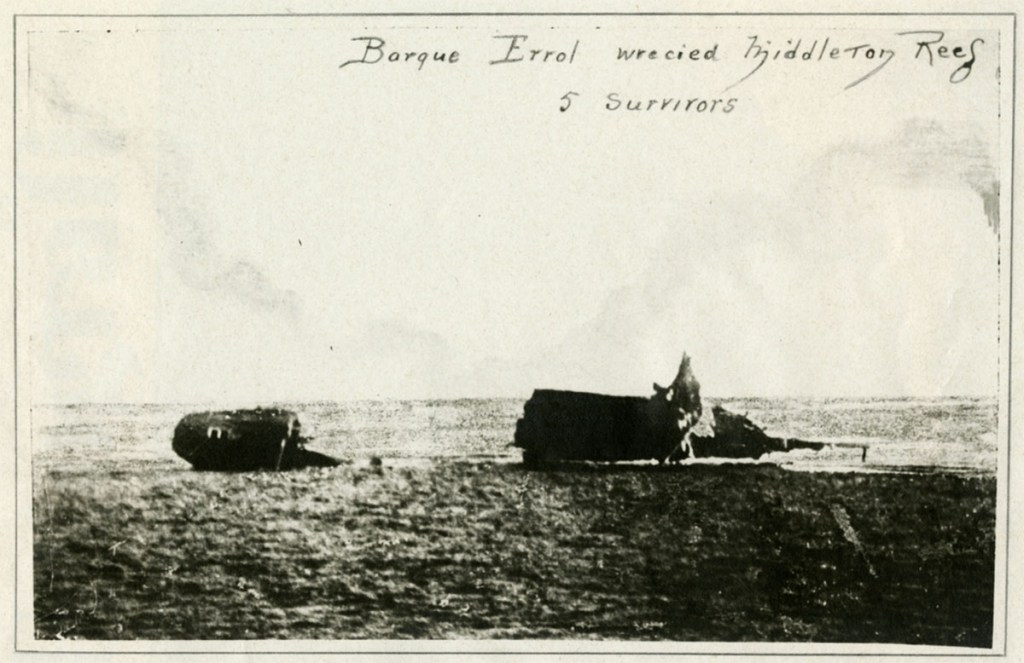
    The remains of the Errol on Middleton Reef. Courtesy: Norsk Maritim Museum.

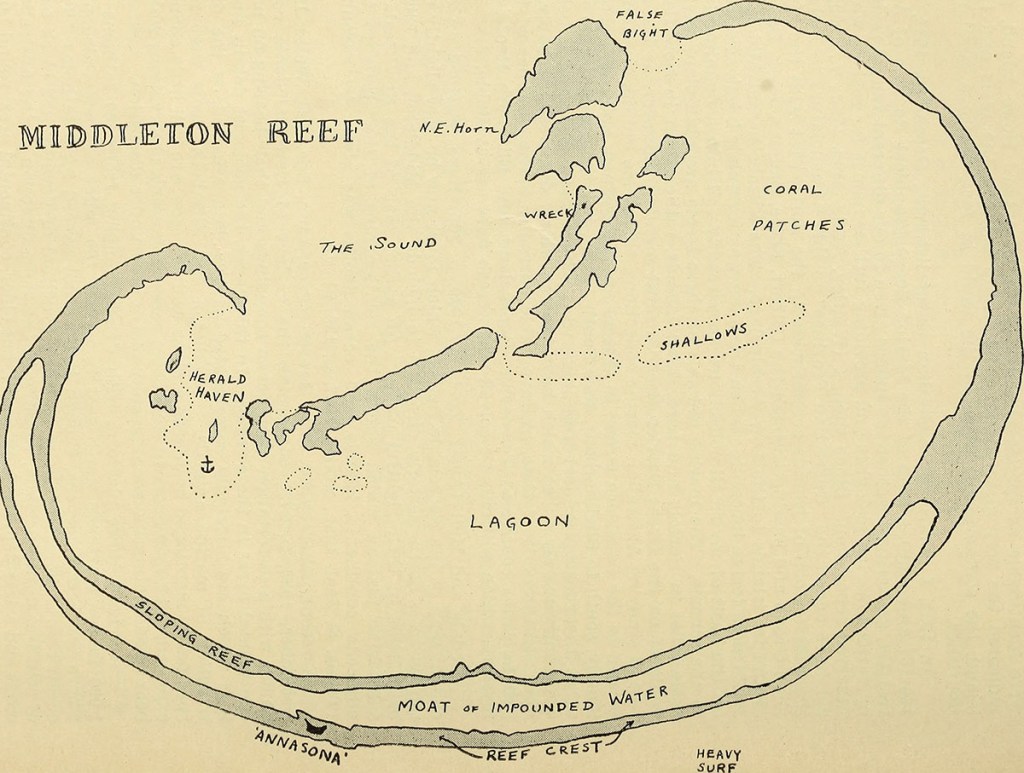
    On 12 July 1909, the mail steamer Tofua was passing Middleton Reef in the Coral Sea bound for Sydney.    Captain George Holford gave the order to steam close by as was his want every time he passed.   This time, he noticed a new ship’s carcass had been added to the dangerous reef since he had seen it last.     Since the Britannia Godspeed ran aground on Middleton Reef in 1806, it and neighbouring Elizabeth Reef have claimed over 30 ships and countless lives over the years.

    Captain Holford steamed as close as he dared, then had a boat lowered to go across and investigate.   As the steamer neared the reef, he also noticed that some rags were flying from the mast of another ship, the Annasona, which had been wrecked two years earlier.  

    The boat soon returned with five survivors from the Norwegian barque Errol, which had run aground a month earlier with 22 souls onboard.  They had a tragic tale to tell.

    Middleton Reef. Source: The Australian zoologist, 1934.

    The Errol had left the port of Chimote in Peru on 15 April, with a crew of 17 men and five passengers, comprising the Captain’s wife and four children.   The barque was headed to Newcastle to take on a cargo of coal.   However, disaster struck around midnight on 18 June when, without warning, the barque slammed into Middleton Reef.  

    The ship was swung broadside to the reef before there was even a chance to try and save her. The hull was torn out, and she rapidly settled with a heavy list to starboard.   Powerful waves swept over her, ripping apart the houses and washing away much of their stores along with the ship’s lifeboats.  She quickly succumbed to the pummelling and broke into four separate parts.    

    The First Mate was swept away and drowned as he and one of the crew tried vainly to clear one of the lifeboats.   Two more seamen also died that first night or on the second, the survivors could not recall.   Captain Andreason and the Second Mate were lost a couple of days later.   They had been on the reef, not far from the ship, building a raft comprised of spars and other timbers when they were caught by the rising tide.   Though they tried to swim back to the Errol, the current was too strong and they were washed away.  The Captain’s wife and children could only look on in horror. 

    The survivors were in dire straits.   The only food they had been able to salvage was a dozen loaves of bread, a few pounds of butter and a couple of tins of milk. What’s more, they had precious little fresh water.  A shelter of sorts was constructed on the exposed hull for the Captain’s wife and her children while the sailors made do with a canvas sail for protection from the elements. 

    Location of Middleton Reef. Courtesy Google Maps.

    Meanwhile, they continued to work on the raft.  After a few days, it was completed, and five of the crew set off for the Annasona, about 8 miles, 15 kilometres away, hoping they might find food and water.

    The raft barely held together long enough to reach the long-abandoned ship.  Fortunately, they found some fresh water, but the only sustenance available was shellfish clinging to the side of the wreck and the reef it stood on.  They spent 12 days on the Annasona building a more substantial craft to get them back to the Errol and their shipmates.  But before leaving, they hoisted a couple of shirts up the mast.   They had seen one ship pass by during their time there, but it had failed to see them or their signal of distress.   One of their number perished on the expedition across to the Annasona; however, a far greater tragedy had played out among those waiting on the Errol.

    When they climbed back aboard the Errol, they found only one man alive, Able Seaman Jack Lawrence, and he was barely clinging to life.   They had survived on a small amount of rain collected in the sails, but it proved almost as salt-laden as seawater.   Lawrence described how the others, including the Captain’s wife and children, had passed away one by one from thirst, starvation and exposure.  As each person died, their body was pushed over the side to splash in the sea. At least some of those corpses had been savaged by sharks, leaving the grisly spectacle of bones or body parts deposited on the reef at low tide.

    Photo of the Errol survivors. Daily Telegraph, 15 Jul 1909.

    All five men would likely have died on Middleton Reef had Captain Holford not made his customary search for castaways.   They were returned to his ship and cared for until they arrived in Sydney.   At a time before any sort of public safety net, the Tofua’s passengers generously donated over £100 to assist the shipwreck survivors get back on their feet.

    An inquiry into the tragedy heard that the Errol had experienced several days of overcast weather, where no astrological sightings could be made.   They were essentially sailing blind when they struck the reef.   One of the survivors also claimed that Captain Andreason had not taken the precaution of sending a lookout aloft to warn of any hazards in their path.

    For his act of humanity in rescuing the Errol survivors, Captain George Holford of the Tofua was later presented with an engraved silver coffee service by a grateful Norwegian Government.

    © Copyright C.J. Ison / Tales from the Quarterdeck, 2025.

    Sun sets over Flinders and Stanley Islands in Bathurst Bay with a fishing boat in the forground at Cape Melville on Cape York Peninsular, Far North Queensland. Photo Chris Ison / Wildshot Images.
  • The Catalpa rescue: a Most Audacious Prison Break

    The whaling barque Catalpa.

       In April 1875, the American whaling barque Catalpa quietly slipped out of New Bedford harbour without ceremony. To all appearances, she was just another whaler embarking on a routine hunt in the North Atlantic. However, Captain George Anthony had orders to sail halfway around the world and be stationed off Australia’s west coast, ready to rescue six convicts imprisoned by the British in Fremantle.

       The prisoners were all Irish nationalists who had been found guilty of treason and sent to Fremantle eight years earlier with scores of other revolutionaries. Over the years, most had been pardoned, but these six men had been serving soldiers in the British Army, and the government was disinclined to let them go. However, an Irish Independence organisation in the United States, the Clan-na-Gael, formulated a plan to set them free.

       They purchased the whaler, recruited a captain sympathetic to their cause and sent Irish agents, headed by John Breslin, to Fremantle to organise the escape on the ground. Breslin passed himself off as a wealthy American businessman looking for investment opportunities in the far-flung colony. He made contact with the convicts and warned them to be ready to leave at short notice. Breslin then assembled a small armoury of firearms and organised the hire of horses and carriages. He also reconnoitred the coastline south of Fremantle, looking for a suitable out-of-the-way place to take the escapees. There they would be taken off the beach in a whaleboat and delivered to the waiting ship.

    John J Breslin, AKA John Collins who orchestrated the Catalpa escape.

       By January 1876, all was in place except for the Catalpa. The ship was nowhere to be seen. As the weeks ticked by without any word from the whaler, Breslin grew increasingly concerned that some calamity had befallen her. However, his fears were unfounded. To Breslin’s great relief, the Catalpa finally dropped anchor in Bunbury on 28 March.

       Breslin met with Captain Anthony, and the two men thrashed out the final details of the escape. And, after a couple of unavoidable delays, the pair set on the escape, taking place on Monday, 17 April. On Sunday night, Captain Anthony took the Catalpa into international waters 30 kilometres west of Rockingham and then went ashore in the whaleboat to wait for Breslin and the Irish prisoners at a prearranged beach near Cape Peron.

       On Monday morning, the prisoners left their work gangs on various pretexts and made their way to Rockingham Road. There, they were met by Breslin and his men waiting with a change of clothes and horse-drawn carriages. They then raced south towards the waiting whaleboat. By 10.30, the prisoners, Breslin and all his men, were being loaded onto one of the Catalpa’s whaleboats as a plume of dark smoke from the government steamer smudged the morning sky. Captain Anthony wasted no time heading the boat out to sea to rendezvous with his ship.   

    However, it would not be smooth sailing getting back to the Catalpa. The seas had turned rough while he had been waiting on shore. To make matters worse, the whaleboat sat low in the water, weighed down by so many extra bodies. The boat crew battled the wind and waves all that day but made slow progress. But towards sunset, Captain Anthony spotted the Catalpa off in the distance. Then disaster struck. The mast snapped under the strain of the taut canvas and nearly flung everyone into the ocean. But for the quick actions of the man at the tiller, the brazen escape may well have failed there and then. Once night had descended and the ship was lost to sight, they had no choice but to spend an uncomfortable night in the cramped boat being buffeted about by the ocean swells. The next morning, the mast was repaired, and they were once again on their way. They soon sighted the Catalpa again and set a course to join her. Captain Anthony also spotted billowing black smoke, heralding the government steamer Georgette, on a course to intercept the whaler. Captain Anthony had the sail taken in and the mast lowered. The steamer passed within one kilometre of the whaleboat but failed to see it in the choppy sea conditions.

    “The Rescued Six.” By Charles Herbert Moore – https://archive.org/details/catalpaexpeditio01peas, Public Domain, https://commons.wikimedia.org/w/index.php?curid=33130178

       When the Georgette came alongside the Catalpa, the Superintendent of the Water Police enquired if there were any escaped prisoners on board. On being told there were none, the police officer asked if he could come aboard so he could see for himself. The first mate forbade him permission, reminding the Superintendent that the Catalpa was an American-flagged ship in international waters and was therefore not subject to British authority. Not wishing to spark an international incident, the Georgette broke off after 10 minutes and continued its fruitless search for the missing prisoners.

       As the Georgette steamed off, Captain Anthony had the mast and sail reset, and his oarsmen pulled for all they were worth. When the first mate sighted the whaleboat in the distance, he ordered the Catalpa’s helmsman to head towards them to close the gap. Hidden from sight by the bulk of the ship, Captain Anthony was unaware that a police cutter was also making for the ship.

       The whaleboat reached the Catalpa first and was hooked up to the davits, and within minutes, they were underway again and heading north. It was a close-run race. But, in the end, the police could do nothing but watch on as several of the Irish convicts jeered at them from the safety of the American ship’s deck. The police cutter’s commander gracefully accepted defeat with a snappy salute before returning to Fremantle empty-handed.    However, the Western Australian Governor was less sanguine about losing six prisoners so easily. He ordered the Georgette to go back out, find the ship and return the six prisoners to gaol. This time, she would carry a large complement of armed police and prison guards as well as a field artillery piece mounted on the foredeck. The next morning, the Georgette intercepted the Catalpa in international waters for the second time. This time, the Catalpa was heading south past Fremantle on her way towards the Southern Ocean to start her long voyage home.

    Mural commemorating the Catalpa rescue in Fremantle, WA. Photo CJ Ison.

       At 8 a.m., the Georgette pulled a little ahead of the Catalpa and fired a shot across her bows, signalling for the whaling ship to stop. Captain Anthony ignored the order and continued on his course until the Georgette’s gun crew had reloaded their piece. Only then did he put a speaking trumpet to his mouth and ask what they wanted.

       The Georgette’s Commanding Officer asked if there were any escaped prisoners onboard. This time, he warned Captain Anthony that the colonial secretary had been in contact with the American Government and had been authorised to use force to stop the ship. He also threatened to bring down the Catalpa’s masts with artillery fire should they not heave to. Breslin and Anthony agreed to call the bluff, thinking it unlikely that they had got permission to board, even with the magic of telegraphic communications. Anthony pointed to the Stars and Stripes fluttering in the wind and cautioned that an attack on his ship would be an attack on the United States.

       No one on the steamer wished to trigger a diplomatic row, so after shadowing the Catalpa for another half an hour or so, the Georgette veered off and returned to port empty-handed. Breslin would later write that the British left without even bidding them a hearty bon voyage.

       The Catalpa arrived in New York on 19 August after a four-month voyage via Cape Horn. The rescuers were feted as heroes, and the six Irish prisoners settled into their new lives as free men. This was arguably one of the best planned and executed escapes during Australia’s convict era. It was also the last.

    A more detailed account of the rescue can be found in Bolters: An Unruly Bunch of Malcontents.

    Sun sets over Flinders and Stanley Islands in Bathurst Bay with a fishing boat in the forground at Cape Melville on Cape York Peninsular, Far North Queensland. Photo Chris Ison / Wildshot Images.

    © Copyright C.J. Ison / Tales from the Quarterdeck, 2025.

    Please enter your email address below to be notified of future blogs.