Category: Shipwrecks

  • William Swallow and the 1829 Cyprus mutiny

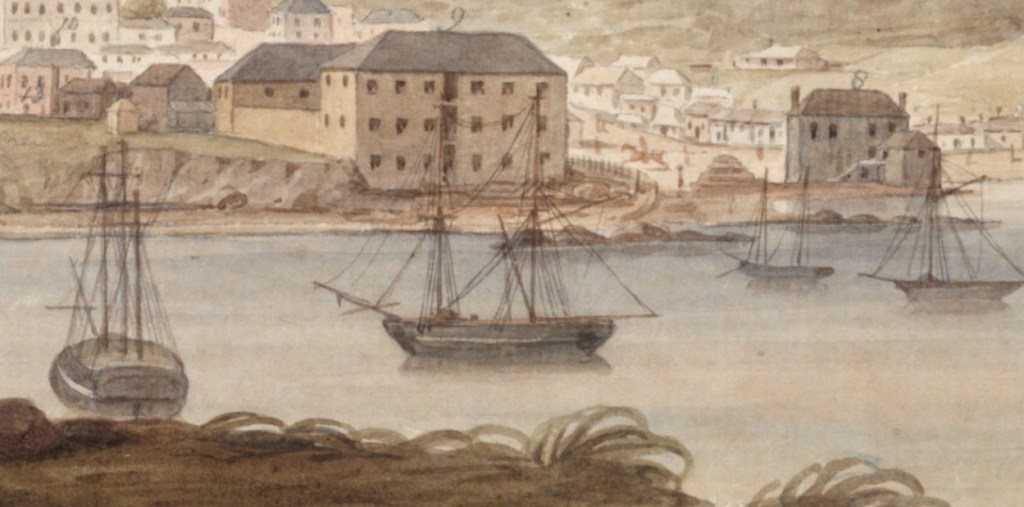
    Detail reputedly showing the brig Cyprus (centre) from a panorama of Hobart 1828 – watercolour drawings by Augustus Earle, Courtesy State Library of NSW.

       In August 1829, the brig Cyprus sailed from Hobart bound for Macquarie Harbour with provisions and 31 convicts sentenced to serve hard labour at that infamous penal settlement. However, while windbound at Recherche Bay in Tasmania’s south, the prisoners rose up, overpowered their guards and seized control of the ship. Thus began one of the most extraordinary escapes of Australia’s convict era.

       Their leader was a 37-year-old convict named William Swallow. He was likely the only man among the prisoners who had any seagoing experience, so in true pirate tradition, the men voted for him to be their captain. Swallow had once earned a living as a seaman on colliers plying England’s coastal waters. That was until he tired of the seagoing life and found it was more lucrative to break into portside houses or ships moored in harbour. He finally came undone when the police suspected him of being involved in several recent burglaries and raided his house. A large haul of stolen property was found in the house, and Swallow was whisked off to gaol. This took place in 1821 when Swallow was going by the name William Walker. He was found guilty of housebreaking and sentenced to be transported to Van Diemen’s Land (Tasmania) for seven years.

       William Swallow, however, had no intention of going quietly, leaving his wife and three children to fend for themselves. His first attempt to escape took place even before he had left England. He and a fellow prisoner jumped from the ship carrying them to the prison hulks to await the next Australia-bound convict transport.  His mate drowned in the attempt, but Swallow survived and returned to his hometown. However, he was quickly recaptured and charged with returning from transportation. This time, he was loaded on a ship and sent to Van Diemen’s Land.  

    Swallow made a second attempt to escape eight months after arriving in Hobart. He and three other convicts seized a small schooner, crossed Bass Strait and made it to within 80 kilometres of Sydney before they ran aground and were taken back into custody. Swallow received 150 lashes and was sentenced to serve hard labour at Macquarie Harbour Penal Settlement. But he escaped again before ever setting foot in that much-feared hellhole. This time, he escaped from gaol and stowed away on a merchant ship bound for England. There, he lived free until being discovered in 1828. This time, he was sent to Van Diemen’s Land for life. But Swallow was still not ready to give up and accept his fate. Shortly after arriving back in Hobart, he stowed away on the very ship that had so recently brought him from England. By now, guards were masters at finding stowaways, and Swallow was taken off before it left port. He was flogged again and was on his way to Macquarie Harbour on the Cyprus when, in 1829, he and the other convicts seized the ship.

    A tranquil Recherche Bay in southern Tasmania in 2019. Photo CJ Ison.

       On 13 August, while the Cyprus was windbound in Recherche Bay, the convicts pounced, catching their guards by surprise and wresting control of the ship. They put the soldiers, captain and crew ashore and the following morning, hauled up the anchor, unfurled the sails and gave three hearty cheers as they got underway. The castaways would remain stranded in that remote and inhospitable corner of Tasmania for two weeks before they were discovered. That gave Swallow and his men ample time to get far away from Van Diemen’s Land before the alarm was raised.

       It was supposed by the authorities that the runaways would try to make their way across the Pacific, where they would scuttle the Cyprus and pass themselves off as shipwrecked sailors at some unsuspecting South American port. But Swallow and the others had another idea in mind as Van Diemen’s Land disappeared over the horizon behind them.

       The Cyprus was well stocked with food, for it carried sufficient supplies to see the Macquarie Harbour Penal Settlement through the coming winter months when it was all but cut off from the outside world. Swallow set a course to take them to New Zealand, where the men painted the vessel’s hull black and renamed her the Friends of Boston. Passing themselves off as an American-flagged ship, they then sailed north towards the Friendly Islands, known today as Tonga.

       However, this leg of their voyage was far from smooth sailing. One man was lost overboard during a powerful storm, and the common purpose that had seen the convicts unite to capture the brig had begun to dissipate. After they reached the island of Tongatapu, present-day Nukualofa, seven men chose to remain there when the Cyprus set sail. Swallow continued north across the equator and eventually reached southern Japan after an impressive voyage of nearly 12,500 km. They pulled into a sheltered bay on the island of Shikoku in January 1830, hoping to resupply with firewood and fresh water. However, at the time, Japan was unwelcoming of foreigners. Despite the language barriers, the Japanese made it clear that the Cyprus had to be gone by sunset; otherwise, it would be fired upon.

    A watercolour of what is beieved to be the Cyprus by low-ranking Samurai artist Makita Hamaguchi in documents from the Tokushima prefectural archive. CC BY-SA 4.0, https://commons.wikimedia.org/w/index.php?curid=59397258

       Swallow heeded the warning, hoping to resupply somewhere more friendly, but as the sun dipped towards the horizon, the wind dropped and the ship was becalmed. The Japanese coastal battery opened fire as they warned they would, and one of the cannonballs struck the vessel on the waterline. But before any more damage could be inflicted, a breeze sprang up, and Swallow wasted no time getting the ship underway. They followed the Ryukyu Island chain south before crossing the East China Sea, all the time taking on water.   

    In February 1830, the Cyprus was off the coast of China, near the estuary of the Pearl River (Zhu Jiang River). By now, the leak had worsened, and the pumps had to be manned constantly to keep the ship afloat. Several of the runaways had had enough and wanted to abandon the ship. However, Swallow wasn’t ready to give up on the Cyprus just yet, despite the risk of being discovered by British naval vessels in the area. He hoped they might repair the ship and soon be on their way. However, those wishing to go ashore went below and punched a hole in the hull. They then boarded a lifeboat and left the Cyprus to sink. Swallow and his few remaining loyalists could not stem the steady inflow of water and were forced to abandon the ship a few hours later in the remaining lifeboat and make their way to Canton (Guangzhou).

    View of the Canton factories by William Daniell, circa early 1800s. Courtesy British National Maritime Museum via Wikipedia.

       The unexpected arrival of British subjects in the trading enclave raised the interest of the local East India Company officials. William Swallow was asked to visit their offices, where he was questioned at length.

       As news of the seizure of Cyprus had yet to reach that port, Swallow passed himself off as Captain William Waldon and late master of the 200-ton English brig Edward. His story was a mixture of fact and fiction. He said that they had left London on 14 December 1828, bound for Rio de Janeiro and had then rounded Cape Horn and crossed the Pacific to Japan, where they were fired upon. The Edward, he said, had steadily taken on water as he tried to make for Manila, but his ship had finally foundered near Formosa (Taiwan).

       He told the East India Company officials that he and his crew had boarded two lifeboats and headed for the Chinese mainland, but on the way, he lost contact with the second boat. On the strength that Swallow, AKA Waldon, had a sextant engraved with the ship’s name in his possession, and he had arrived in a longboat bearing the name “Edward of London,” his story was accepted. The East India Company officials gave Swallow and his men free passage to London on a merchant ship about to depart from Canton. The escaped convicts might just have got away with the subterfuge but for a stroke of bad luck.

       A second boat arrived at the docks just days after they left. The men on that boat also claimed to be survivors from the Edward. But their version of the story was at odds with the one provided by Swallow. One of the new arrivals was immediately detained, but the rest fled Canton on an outbound ship one step ahead of the law. Then, two more men from the Cyprus turned up in Canton. They had been found on one of the Ryukyu islands and taken to Canton for questioning. When news of the seizure of the Cyprus finally reached the British enclave, the men in custody were questioned more closely, and they eventually confessed to who they were.
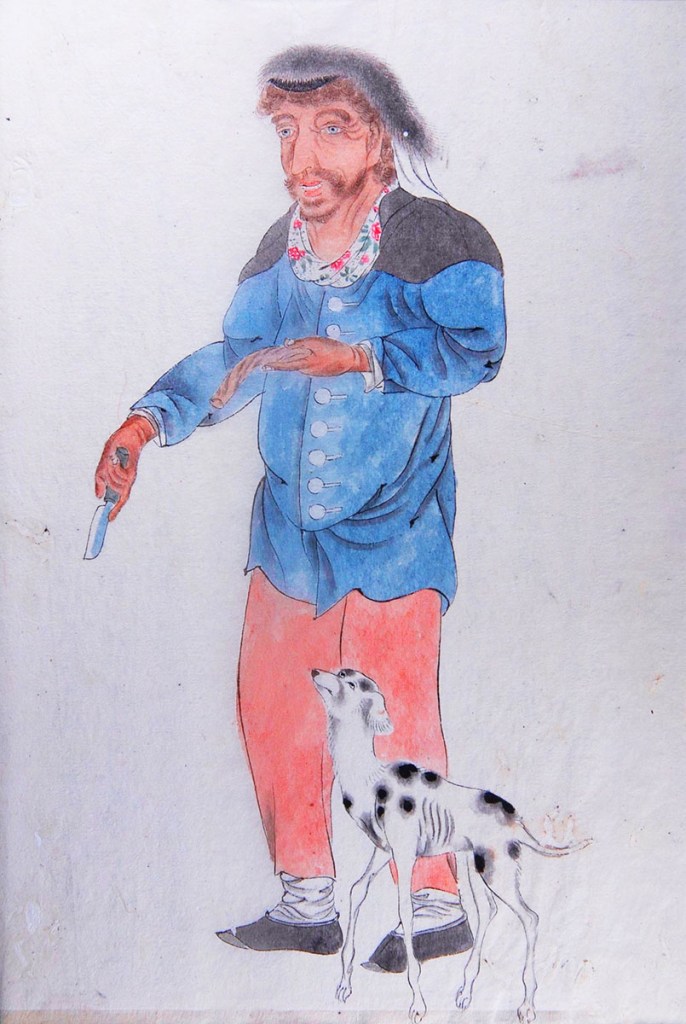
    A watercolour by samurai Makita Hamaguchi showing one of the mutineers. CC BY-SA 4.0, https://commons.wikimedia.org/w/index.php?curid=59845977

       A letter was dispatched to London on the next ship to leave, warning the police to be on the lookout for Swallow and the others. That ship arrived in London before Swallow, and the police were waiting. However, by pure luck, he had disembarked at Margate rather than travel up the River Thames to London.   The rest of Swallow’s travelling companions were arrested at the dock, and a couple of weeks later, Swallow was tracked down to a Lambeth boarding house, living under an assumed name.

       In October 1830, Swallow and four others stood trial for piracy. The jury found the others guilty as charged, but acquitted William Swallow after he convincingly pleaded that he had been forced to take part in the mutiny against his will. Although Swallow escaped punishment for piracy, there was still the matter of his returning to England illegally. He was once again sent to Van Diemen’s Land, where he died at Port Arthur Penal Settlement on 12 May 1834.

    © Copyright C.J. Ison / Tales from the Quarterdeck, 2024.

    Please enter your email address below to be notified of future blogs.
  • The search for the Sydney Cove – 1797

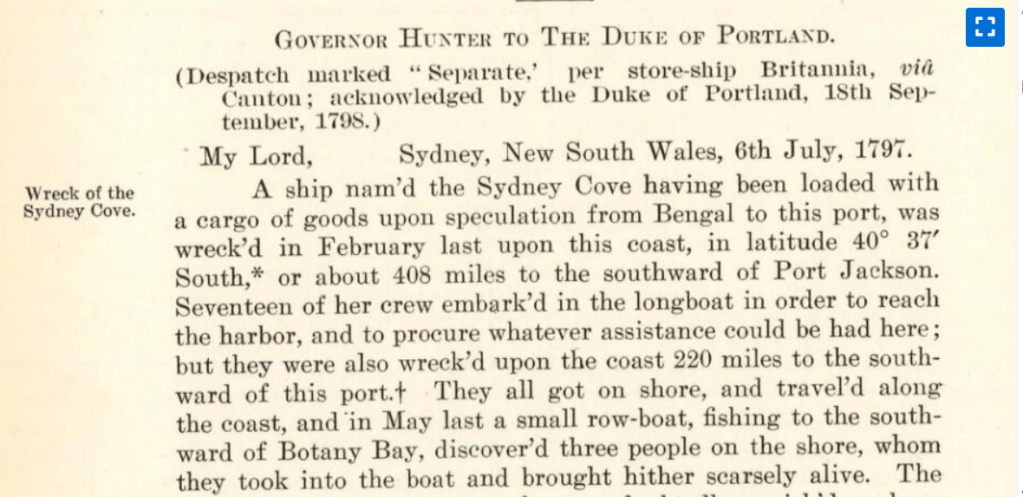
    On the night of 2 October 1797, fourteen convicts stole a boat and made their way down the Paramatta River across Sydney harbour and out through the Heads.  When the men were discovered missing, the authorities sent boats in pursuit, but they returned a few days later, having never caught sight of the runaways.    As a storm had swept the area shortly after they had escaped, it was thought the bolters had died at sea.   However, that was no more than wishful thinking.    Their story is one of desperation, betrayal, and ultimately defeat.

    The runaways’ leaders were John Boroughbridge and Michael Gibson.   They had been labouring away in the back blocks of Paramatta when they convinced 12 other desperate men to join them in an audacious escape.    Their plan was to find the remains of the 250-ton Sydney Cove, a ship that had recently been wrecked somewhere far to the south of Sydney.   Boroughbridge and Gibson were sure they could build a new vessel from the timbers and fittings and make for some distant port far from the clutches of British law.   That the Sydney Cove had been carrying a massive cargo of rum and other alcoholic spirits added to its allure.

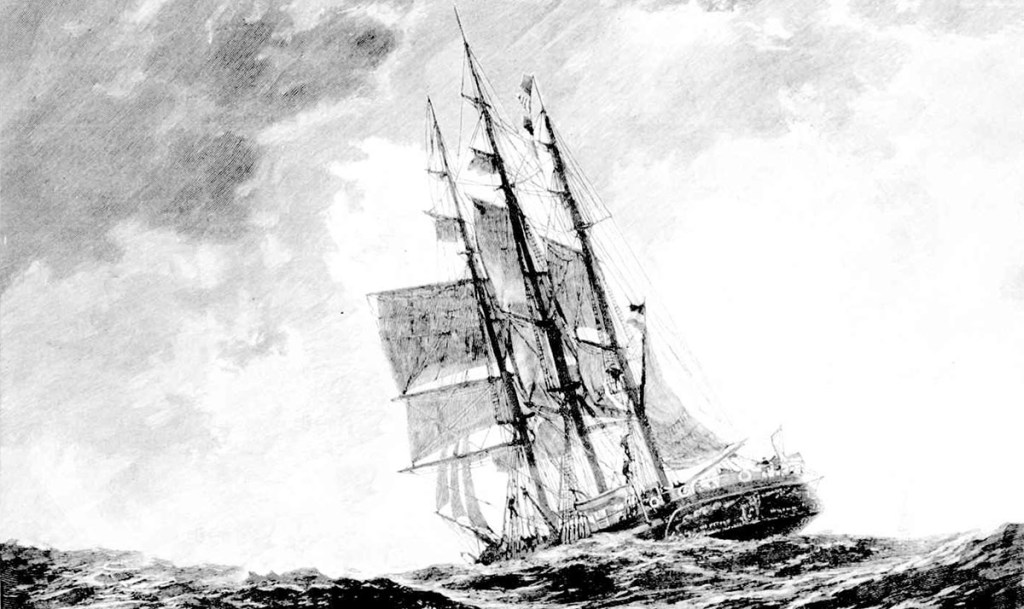
    Painting of Sydney, Port Jackson. circa 1804.

    Boroughbridge was serving 14 years for some unspecified crime and had landed in New South Wales only four months earlier and was keen to leave at the first opportunity.  Gibson had already spent five long years there, but with nine more to serve, he was no less eager to put the place behind him.     It seems they had little difficulty finding 12 others willing to join them.

    With nothing more than a small pocket compass and the knowledge that the wreck lay somewhere far to the south, they headed out through Sydney Heads and turned right.    A day or so later, the weather turned nasty, but Boroughbridge and his mates ploughed on.   Twice, their boat was driven ashore, and both times, they were lucky to avoid serious damage.  

    In time, the weather eased, and they continued following the coast and unknowingly strayed into Bass Strait.   In 1797, no one knew that a body of water separated Van Diemen’s Land from the rest of Australia.    All Boroughbridge and the others would have known was that the Sydney Cove was aground on an island somewhere off the coast.   They likely had no accurate idea how far they had come or how much further they had to go.   They certainly could not have known that they needed to cross 200 km of open water to reach the beached ship.   By now, the compass would have shown that they were heading in a south-westerly rather than southerly direction as they doggedly follow the contours of the coast.

    Finally, they ran out of food and fresh water.   In desperation, they put ashore on one of the small islands in the vicinity of Wilson’s Promontory.   There, they found a ready supply of fresh water, while seabirds and seals made easy prey for the starving men.    But, the trying conditions took their toll.   By now, many of the runaways would have gladly returned to Sydney to face any punishment short of death if it meant an end to their suffering.  

    Any sense of common purpose they may have once possessed had since evaporated.   They could not agree on what they should do next.   Should they stick to their original plan and continue searching for the elusive Sydney Cove?   Or should they abandon the search and head back north?   Then, one night, in a callous act of betrayal, Boroughbridge, Gibson and five others quietly set off in the boat, abandoning the rest of the men as they slept. 

    After leaving their comrades to their fate and giving up the search for the Sydney Cove, they returned north again.   Bypassing the entrance to Sydney Harbour, they continued on to the mouth of the Hawkesbury River, where it emptied into Broken Bay.   It cannot have been lost on the weary men that after three or four months on the run, they were now barely a day’s sailing from where they had started.   

    After months at sea, their boat was in such a derelict state that they did not trust it to carry them any further.    The men agreed they would continue sailing north, but to do so, they would have to find another boat.     They did not have long to wait.

    Boroughbridge and his men seized a passing vessel and set a course north. Their plan now was to make for Timor in the Dutch East Indies as William Bryant, his wife Mary and others had done some six years earlier.   News that Mary and some of the other runaways had reached England and been pardoned had only recently reached Sydney offering hope for anyone contemplating following in their wake.   

    Nothing more was heard of them for another couple of months.  Then, in late March 1798, they returned to Broken Bay and hailed down a passing boat.  Boroughbridge handed a letter to the boatswain asking him to deliver it to the NSW Governor.   The letter, signed by Boroughbridge, Gibson and three remaining runaways, claimed they wished to give themselves up and begged for clemency.   They wrote that they had sailed about 400 nautical miles (750 km) north, which would have put them on either Stradbroke or Moreton Island.   Then, they claimed, disaster struck.    When they tried to run ashore, their boat was caught in the surf and driven hard onto the beach, where it broke apart with the pounding of successive waves.   They were stranded on an inhospitable stretch of coast.   But all was not lost.   They were able to salvage enough timber from the wreckage to build a smaller craft and put back out to sea.   However, by now, they had all had enough of life on the run.  They decided that rather than continue sailing north, they would return to Sydney and beg for mercy. 

    Their plea for mercy fell on deaf ears, for the Governor had learned that Boroughbridge and the rest of the men seeking clemency had callously abandoned half their mates to die on the island in Bass Strait.   In an unlikely turn of events, they had been found by George Bass while he was endeavouring to prove the existence of the body of water which now bears his name.   Unable to carry all seven back to Sydney on his small boat, he ferried five across to the mainland, gave them a compass, a musket and as much food as he could spare and told them to follow the coast north to Sydney.   They were never heard of again.   Two men, too weak to walk, remained with Bass.   He returned to Sydney on 25 February and handed the pair to the authorities and they reported what had befallen them.     

    In April, Boroughbridge and the four remaining runaways were returned to Sydney, where they were tried for piracy and found guilty.   Jonathon Boroughbridge and Michael Gibson were hanged, while their three companions were only given clemency at the last minute as they stood before the gallows contemplating their final moments of life.

    © Copyright C.J. Ison / Tales from the Quarterdeck, 2024.

    Please enter your email address below to be notified of future blogs.

  • The Foundering of the S.S. Alert – 1893

    Foundering of the SS Alert. Source: The Queenslander 13 Jan 1894, p. 71.

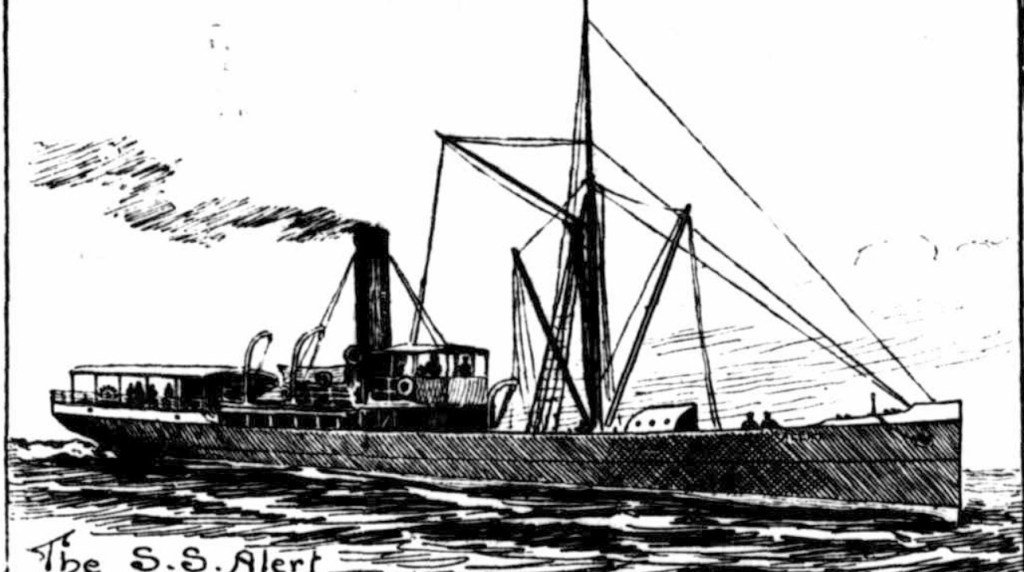
       On Friday, 29 December 1893, around 11 o’clock in the morning, two ladies were strolling along Sorrento Ocean Beach on the Mornington Peninsula when they discovered an unconscious man washed up on the sand. He would prove to be the sole survivor of the steamer Alert, which sank during foul weather.

       The SS Alert had left Bairnsdale on Victoria’s southeast coast at 4 p.m. two days earlier, bound for Port Albert and Melbourne. But a little more than 24 hours later, she would be lying at the bottom of Bass Strait off Jubilee Point.

       The Alert was a 16-year-old 243-ton iron screw steamer owned by Huddart and Parker. She had recently been refurbished and, for the past two months, had been carrying passengers and cargo between Gippsland and Melbourne. Prior to that, the Alert had been a favourite of the excursion fleet, which ferried passengers between Melbourne and Geelong.

       From the moment the little steamer cleared the Gippsland Lakes, she felt the full fury of a storm lashing the Victorian coast. Nonetheless, Captain Albert Mathieson thought the sea conditions were nothing his ship could not handle. They stopped briefly at Port Albert, 150 kilometres down the coast, to deliver some cargo and then continued on towards the entrance to Port Phillip Bay and respite from the atrocious weather.

    S.S. Alert. Source: Leader, 6 Jan 1894, p. 30.

       By 4 p.m. Thursday, they were off Cape Schanck, just 30 kilometres short of Port Phillip Bay. Owing to the trying conditions, Captain Mathieson had remained on the bridge the entire trip. Such were the conditions that it required two men at the helm to keep the steamer pointed on its course. Then disaster struck.

       About half an hour later, the Alert was struck by a massive rogue wave that swamped the deck with tons of water and pushed the steamer over onto her side. Then, they were hit by a second large wave before the water from the first had time to drain away. The saloon skylight and a porthole window were smashed, and the sea poured in. The helm was unresponsive by now, and the ship’s lee rail was pushed underwater. Another wave swept over the bridge as seawater snuffed out the struggling steamer’s engine fires.

       The captain ordered everyone to don their lifebelts as he vainly tried to head the stricken steamer into the wind, but to no avail. He ordered the lifeboats to be lowered, but one had already been swept off its davits, and the other had seas continuously sweeping over it. There was nothing anyone could do now.

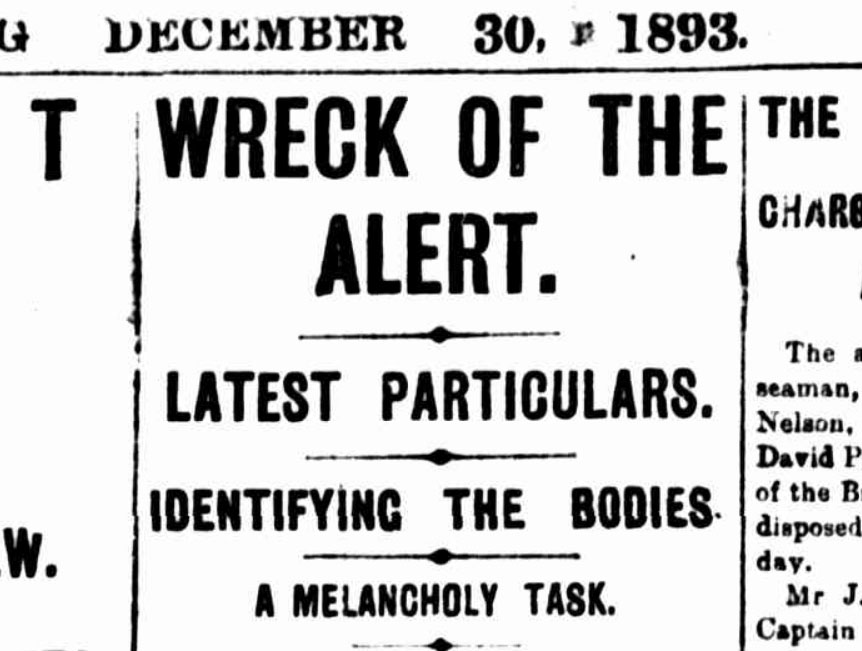
    The Herald, 30 Dec 1893, p. 2.

       Robert Ponting, the ship’s cook, joined the rest of the crew on deck, and minutes later, the Alert went to the bottom. Ponting climbed onto a hatch cover, but in the turbulent seas, it kept turning over and flipping him into the water. He eventually lost hold of it altogether and began swimming. He spotted the ship’s steward nearby and kept pace with him. Ponting and the steward remained together until the poor fellow could no longer keep his head above water and drowned. Around this time, Ponting spotted Captain Mathieson swimming strongly, but lost sight of him again shortly after.   

    Ponting spent the night swimming about in the cold Bass Strait waters within view of the Cape Schanck Lighthouse. The cold water chilled him to the bone, and he eventually passed out. He continued drifting with the current, slowly pushing him towards land. Then, around daybreak, he felt himself being tumbled ashore and used the last of his strength to drag himself away from the pull of the surf. He had spent over 12 hours in the water and would spend another five or six hours passed out on the beach.

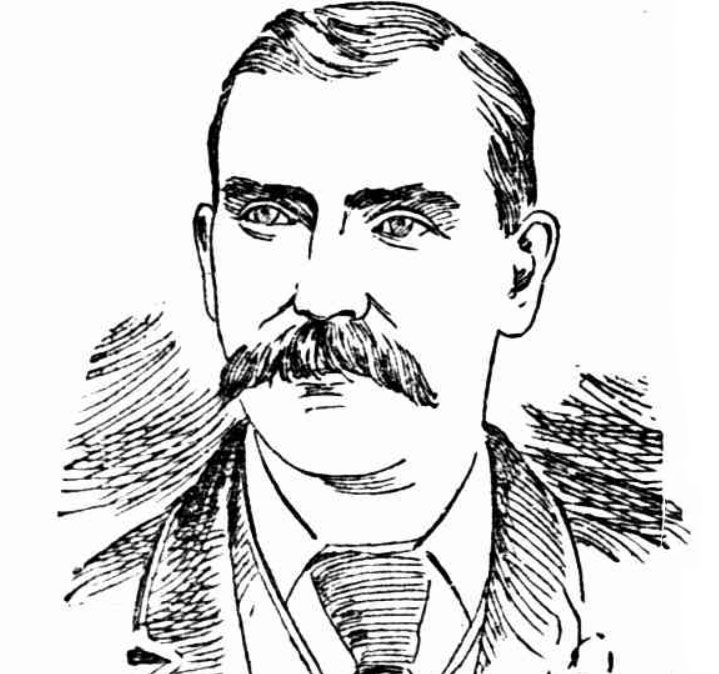
    Robert Ponting. Source. Weekly Times (Melb), 6 Jan 1894, p. 19..

       When, around 11 o’clock, he came too, he found he was surrounded by a group of ladies and a gentleman who had been walking along the beach. The first ladies to discover the unconscious man had called on the others to come to Ponting’s aid. Among his saviours was Douglas Ramsay, a doctor on holiday from his practice in Elsternwick. At first, Ramsay thought that Ponting was dead. He had tried to find a pulse but could not. and “his eyes were shut and all sanded over, his nostrils were also clogged with sand, and his body was stiff and cold,” he later recalled. The doctor didn’t give up, though. He opened Ponting’s mouth and poured some drops of brandy down his throat while vigorously working his arms “to restore animation.” After about ten minutes of this bizarre medical attention, Ponting began to show signs of life.

       Ramsay then dragged him behind a rock to shelter him from the cold wind and one of the ladies removed her jacket and wrapped it around his frozen feet. A couple of the other ladies began the long walk back to their carriage and headed to Sorrento for assistance. Meanwhile, Dr Ramsay continued with his ministrations. While they were waiting for help to arrive, another man happened on the scene while walking his giant St Bernard dog. He had his huge canine nestle up against Ponting for warmth. That, and a steady administration of medicinal brandy, brought some colour back to Ponting’s cheeks.   

    After a while, he was able to tell his rescuers his name and what had befallen him. He also asked that someone send his wife a telegram to tell her he was alive. He did not want her to think he had perished with everyone else when news of the shipwreck broke. Eventually, he was taken to the Mornington Hotel in Sorrento, where a couple of local doctors cared for him. As apparently was best practice in such cases during the late 1800s, the good doctors rubbed his entire body with mustard and poured hot brandy down his throat. In response – or perhaps despite it – Ponting made a full recovery.

    The Argus, 30 Dec 1893, p. 7.

       Over the next couple of days, several bodies and much wreckage washed up on Mornington Peninsula’s rugged ocean beaches. In all, 14 men lost their lives: 11 crew and three passengers. Robert Ponting was the only one to survive the catastrophe.

       A marine board inquiry concluded that the Alert had insufficient ballast for the prevailing sea conditions, which had made her ride higher in the water and less stable on her final voyage. The board also felt that Captain Mathieson should have found shelter in Western Port rather than continue down the coast to Port Phillip Bay. It chose not to give an opinion on the captain’s handling of the vessel in its final minutes due to insufficient evidence.

    © Copyright C.J. Ison / Tales from the Quarterdeck, 2024.

    Please enter your email address below to be notified of future blogs.

  • The Banshee’s Terrible Loss, 1876.

    Australian Illustrated News, 15 May 1876.

       The Banshee steamed out of Townsville at 6 o’clock on the morning of Tuesday, 21 March 1876, bound for Cooktown, some 240 nautical miles (450 km) up the Queensland coast. Captain Daniel Owen had command of the 58-ton steamer and its crew of 10 men.   On this trip, the Banshee was carrying 30 paying passengers, and 12 stowaways.   Almost everyone was on their way to the Palmer River, where gold had recently been discovered.   But disaster would strike long before they reached their destination.

       A moderate breeze blew from the southeast, accompanied by some drizzling rain, as they left Townsville.   But nothing about the dismal weather hinted at the violent storm that would engulf them seven hours later.   At 1.30 p.m., when a few kilometres off the southern end of Hinchinbrook Island, they were lashed by hurricane-force winds, high seas, and torrential rain. Visibility was reduced almost to zero.

       Captain Owen did not see land again for over an hour as he steered a north-north-westerly course along Hinchinbrook’s east coast. In his 35 years at sea, he had never experienced such ferocious weather. So, he decided to exercise caution and seek shelter at Sandwich Bay. Once some normality had returned to the world, he would continue on to Cooktown. Captain Owen ordered the engines slowed to half speed and he placed a lookout forward to warn of any dangers.   

    Then, a little after 3 o’clock, the lookout sighted land dead ahead. The rocky cliffs of Cape Sandwich loomed out of the pelting rain before them. Captain Owen ordered the helmsman to steer “hard a port” and for the engines to increase to full speed. The bow started to come around, but it was too little, too late. The Banshee struck aft and was slammed broadside onto the rocks. Had they cleared that promontory, they would have made it safely into the sheltered waters beyond. But that was not to be.

    Map showing Banshee wreck site. Courtesy Google Maps.

       The ship almost immediately started breaking up. The saloon house gave way under Captain Owen’s feet. “I jumped from the saloon to the top of the steam chest, and from there to the top of the house aft,” Owen later recalled, “and stuck to the mizzen rigging.”

       Around the same time one of the passengers, Charles Price, grabbed hold of the boom as the ship ran aground, but when the funnel came crashing down, it knocked him onto the deck. From there, he climbed up on the side rail and leapt onto the rocks. Not all the passengers were so lucky. Many jumped into the sea in panic and drowned before they could scramble to safety. Price went to the aid of one female passenger clinging to the rocks as the waves crashed about her. He reached down but only got a handful of hair before she was swept away.

       The ship’s stewardess had a lucky escape. She was seen clinging to a piece of wreckage in that dangerous space between the ship and the rocks. Before anyone could get to her, she was dragged under the vessel before coming back up again. This time, she caught hold of a rope and was pulled to safety. Price tried to save another passenger who he saw struggling to get clear of the waves. But before he could reach the man, he was washed from the rocks and crushed by the ship.

       Another pair to have a lucky escape were the Banshee’s cook and a stowaway. They had remained with the ship until it was washed high on the rocks and then stepped off through a rent in the hull.

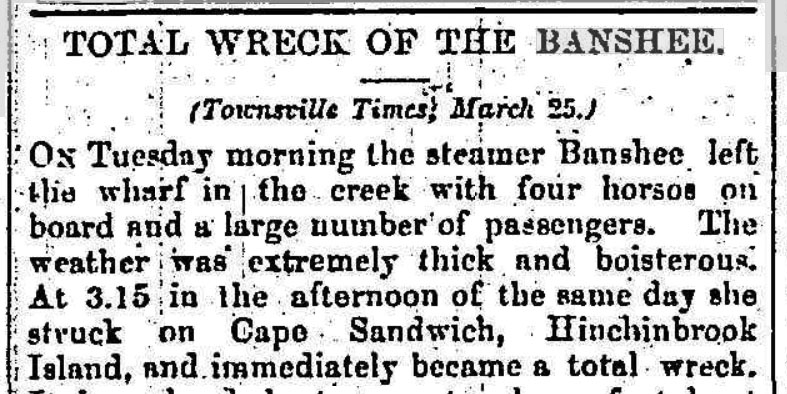
    Total Wreck of the Banshee. Mackay Mercury, 1 Apr 1876, p. 3.

       Captain Owen lost his perch in the mizzen rigging and found himself fighting for his life in the water. Twice he reached the rocks and twice he was washed back out into the cauldron. But on the third attempt, he got a firm hold and was able to clamber to safety above the pull of the waves.

       A passenger named Elliot Mullens was reading in the saloon when he heard someone call, “We are going aground.” He rushed onto the main deck just as the Banshee struck. Mullens climbed onto the bridge and, from there, launched himself across to a rock but was immediately washed off by a giant wave. Fortunately, he latched onto another rock, and despite being pummelled by successive waves, he scrambled out of the danger zone somewhat unscathed.

       “I turned, and just then the saloon … was smashed to atoms, burying beneath it four women and four children, whom we never saw again,” he later recalled. “Five minutes from the time of striking, all was over – all were saved or hopelessly gone from our sight forever.”

    In all, 17 people lost their lives, including all the children and women on board, except the stewardess. The survivors, most nursing deep cuts, bruises or broken bones, spent a cold, wet and miserable night on land. The next morning, two bodies were found washed ashore. Captain Owen held a brief service over them as they were buried where they lay.   

    By now, the storm had blown itself out, leaving a dead calm in its place. Six men volunteered to cross Hinchinbrook’s thickly forested and mountainous interior so they could signal the small settlement of Cardwell for help. Meanwhile, Captain Owen and everyone else remained where they were, but they did not have long to wait to be rescued.

    Hinchinbrook Passage circa 1880s. Source: Picturesque atlas of Australasia 1886.

       Around 6 p.m., someone cried out, “Sail Ho.” And, sure enough, there was a sailing vessel out to sea heading south. A large red flannel blanket was hastily hoisted on a makeshift mast, and everyone waited, praying that they would be seen.

       Five minutes later, the schooner The Spunkie turned towards land to investigate. But it was only by chance that the survivors had been spotted. The Spunkie’s mate had recently purchased a new telescope and was want to look through it at any opportunity. Luckily, when he brought it to his eye this day, he spotted the red flag and the bedraggled survivors lining the shore. By 10 o’clock that night, everyone had been transferred to the schooner, and they continued on their way to Townsville. The six men who crossed the island were picked up by the steamer Leichhardt as it was passing through the Hinchinbrook Passage.   

    A Marine Board Inquiry concluded the Banshee was lost due to the stress of the weather. Although they believed that Captain Owen had erred in not heading further offshore than he did, they found that “he acted as he believed for the best under very trying circumstances.”

    © Copyright C.J. Ison / Tales from the Quarterdeck, 2024.

    Please enter your email address below to be notified of future blogs.
  • COSPATRICK: A tale of fire, cannibalism and a desperate fight for survival

    The burning of the Cospatrick at sea. Penny Illustrated Paper, 09 January 1875, p. 1. (Detail)

    On 27 November 1874, a lookout on the British ship Spectre spotted something floating in the water deep in the Indian Ocean.   As they drew near, they realised it was a small boat holding six men.     When they came alongside, they found one man was already dead. The other five were barely clinging to life and two of those would soon die.   They were the only survivors from the emigrant ship Cospatrick, which had caught fire and sank with the loss of nearly 470 people.

    The 1200-ton  Cospatrick had sailed from London bound for Auckland with 433 passengers, most of whom were assisted migrants looking forward to starting life afresh in New Zealand.   But, just after midnight on 17/18 November, when they were about 750 km southwest of the Cape of Good Hope, smoke was seen coming from the forehatch.  

    The alarm was immediately raised, and Captain Elmslie rushed on deck.   The whole crew were turned out to tackle the blaze thought to have started in the Boatswain’s Locker, where many flammables were stored.     Pumps poured water down the forescuttle, hoping to extinguish the fire before it spread.    Meanwhile, the captain was trying to turn the ship before the wind in a vain attempt to keep the fire contained to the fore part of the vessel.

    Cospatrick, source: London Illustrated News, 9 Jan 1875.

    As the crew battled the fire, almost all the passengers rushed on deck, fearing for their lives, and screaming for help.    Then the Cospatrick swung head to the wind, “which drove the flames and a thick body of smoke aft, setting fire to the forward boats,”* 2nd mate Henry McDonald recalled.  He and the sailors fighting the fire with pumps and buckets were forced to retreat aft with the flames licking at their heels.    With half the ships’ lifeboats lost Macdonald asked Captain Elmslie if he should lower the remaining two.   Elmslie told him “no” but instead to continue fighting the fire.

    But, by then, terrified passengers had taken matters into their own hands.   As many as 80 people, many of them women, climbed into the starboard boat meant only to carry 30 while it was still suspended in its davits.   They buckled under the weight, and when the boat dipped into the sea, it capsized, spilling everyone out.   Under the circumstances, no crew could go to their assistance, and they all drowned.

    A guard was placed on the port lifeboat, but it was also swarmed by panicked passengers.   Flames burnt through the ship’s rigging, and the foremast collapsed and fell over the side.   By now, the captain realised his ship was lost.   Standing by the helm with his wife and son beside him, he told the few men assembled around him to do what they could to save their own lives.  

    The Rush to the Boats. The Australasian Sketcher, 20 Mar 1875, p. 9.

    Macdonald and a couple of the seamen tried launching the pinnace which was stored upside down on the deck.   But before they could get it over the side, its bow caught fire, and they abandoned it.   Macdonald then ordered the port-side lifeboat to be lowered, and as it descended, he jumped on board.    Moments later, he was joined by the Chief Mate, who leapt from the Cospatrick as it was fully ablaze.  Captain Elmslie was last seen jumping into the sea with his wife.  The ship’s doctor followed, carrying Elmslie’s young son.  

    The boat, carrying 34 people, remained by the Cospatrick throughout the night as it continued to blaze.   The main and mizzen masts fell, and then an explosion deep in the hold blew out the stern under the poop deck.   This was probably caused by the large quantities of alcoholic spirits, and other volatile liquids stored in the hold.

    The next morning, Macdonald found that some of his shipmates had managed to right the starboard boat, and it, too, was full of survivors.   They found a few other people clinging to wreckage and hauled them onto the two boats.    They remained with the Cospatrick until it finally burned to the waterline and sank on the evening of 19 November.   Then, Macdonald took command of the starboard boat while the Chief Mate remained in the portside boat.  

    They divided the surviving people between the two boats and shared out the available oars.   The Chief Mat’s boat carried around 35 people while Macdonald’s carried 30.   Neither boat had a mast or sail, but Macdonald got a petticoat from a female passenger, which he used as a makeshift sail fastened to an upright plank.    Neither boat had any freshwater or any other provisions.   Nor does it seem they had so much as a compass to steer by.  

    Sail Oh! Rescue of the Survivors. The Australasian Sketcher, 20 Mar 1875, p. 9.

    They set a course for where they thought the southern tip of Africa lay some 750 kilometres away.    The boats remained together for the next two days, but on Sunday night, 22 November, a gale blew up, and they became separated.    The Chief Mate’s boat was never heard of again.

    Henry Macdonald kept a daily log of their voyage as any good office would.   “Sunday 22, … thirst began to tell severely on us all. … three men died, having first become made in consequence of drinking salt water.”*   Four more men died the following day, but before their bodies were dispatched over the side, Macdonald wrote that “we were that hungry and thirsty that we drank the blood and ate the liver of two of them.”*  Over the next several days, they would continue to live off the dead.

    The weather raged around them, and deaths were a daily occurrence.   Early in the morning of Thursday, 26 November, a barque sailed past but failed to spot them among the white caps.    They continued drinking the blood of the dead, but they were getting weaker by the day.  

    On Friday, 27, two more men died, but they had only the strength to throw one of them overboard.   “We are all fearfully bad, and had drunk sea water,” Macdonald entered in his log.*

    There were now just five men still alive, but only barely.   They were all dozing when Macdonald was woken by a passenger, who had gone made with delirium, biting his feet.   When Macdonald looked up, he saw that an end to their suffering was at hand.    The Spectre, returning home to Scotland from Calcutta, was bearing down on them.   The five men were taken aboard, but two of them died soon after being rescued.   The three survivors, including Henry Macdonald, were put ashore at St Helena when the barque stopped there for supplies.

    The Survivors, L-R Cotter, Macdonald, Lewis. The Illustrated London News, 16 January 1875, p. 61.

    An inquiry held in London into the loss was not convinced the fire had started in the boatswain’s locker.   It concluded that the blaze was likely caused by a careless match or candle carried by someone breaking into the hold in search of liquor the ship was known to be carrying in large quantities.    It recommended that a more robust bulkhead be installed in ships but did not consider whether highly flammable cargo should be carried on the same vessel as so many passengers.

    Nor did the inquiry make any firm recommendations regarding the number of lifeboats carried by passenger ships.    Even had the crew been able to launch all the Cospatrick’s boats, fewer than half the people on board could have been saved.   It simply advised that ship owners should consider some increase in lifeboat carrying capacity.   It would take another 40 years and the loss of the Titanic before laws mandated that all ships have enough lifeboats to evacuate everyone in an emergency.

    (*) Henry Macdonald’s log was published in the Sydney Morning Herald on 26 Feb 1875, p. 3.

    © Copyright C.J. Ison / Tales from the Quarterdeck, 2024.

    Please enter your email address below to be notified of future blogs.