Category: Shipwrecks

  • The Endeavour’s Crappy Repair

    The Endeavour being towed off the reef into deep water by Samuel Atkins (1787-1808).

    As the Endeavour famously made its way up Australia’s east coast in 1770, there was a moment when the success of Cook’s voyage hinged on a pile of sticky animal dung, and some handfuls of wool and rope fibre. The incident occurred shortly after passing Cape Tribulation, so named by Cook because that was where his troubles began.

       All of Monday, 11 June, the Endeavour had been sailing about 15 kilometres off the coast, pushed along by an east-southeasterly breeze. At 6 in the evening, Cook ordered the sail to be shortened, and he instructed the helmsman to steer to the seaward of two small islands lying directly in their path. He also had a seaman in the bow constantly sounding the depth, for he was literally sailing into the unknown. Then, shortly after 9 o’clock, as he and his officers sat down to supper, the seabed suddenly rose to within 15 metres of the sea’s surface. Cook called the crew to their stations and was prepared to drop anchor or adjust sail, but as suddenly as the seabed had risen, it dropped away again. They had just passed over a coral reef.

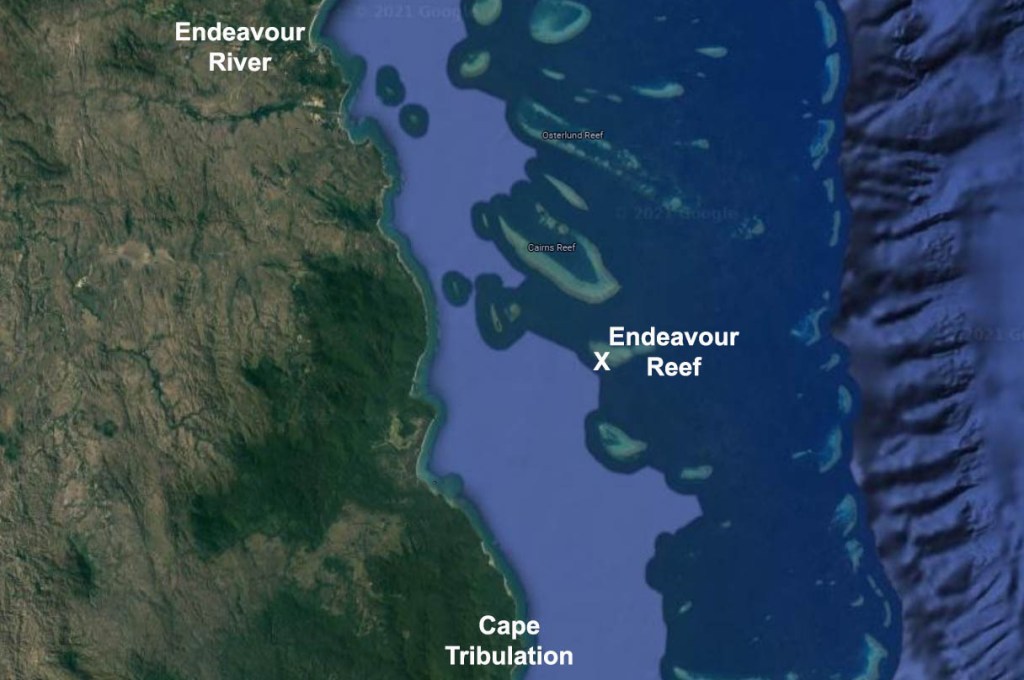
       Then, an hour or so later, the Endeavour ran up on a coral reef and stuck fast. Cook was about to discover he had stumbled into a dangerous labyrinth of reefs and shoals where the Great Barrier Reef pinched in close to the Australian mainland.

    “The Endeavour on the Reef” Source: Picturesque atlas of Australasia, 1886.

    An anchor was taken out aft in the hope that they might be able to kedge the Endeavour back off the reef on the high tide. But when the time came for the men to heave, she would not budge. The next high tide would be at 11 a.m., so he ordered the crew to lighten the ship for the next attempt. Cannons, ballast, water casks, stores of all sorts were tossed over the side.  At high tide, they tried kedging off the reef a second time, but again she would not budge.  Yet more stores went over the side, and on the third attempt, the Endeavour floated free, but the hull had been breached, and water was pouring into the hold.

       All three working bilge pumps were manned non-stop to stop the Endeavour from sinking. Everyone, sailors, officers, civilian scientists, and even Cook himself, took fifteen-minute turns at the pumps. Cook knew their survival hinged on finding a suitable place to beach the stricken vessel so they could make repairs. But there was no guarantee he would find such a place before his ship foundered.

       Then, a young midshipman, Jonathan Monkhouse, suggested fothering as a means of plugging the leak and buying them some much-needed time. He had seen it done with great effect on a ship he had previously served on. With nothing to lose, Cook set him to work, aided by as many men as he could spare from pumping and sailing duties.

       Monkhouse took a spare canvas sail and spread it out on the deck. He gathered up a large quantity of rope fibre and wool and had his men chop it up finely. The short fibres were mixed with dung from the animal pens and formed fist-sized sticky balls of odorous matting. These were slopped onto the sail about six to eight centimetres apart until a sizeable portion of the canvas had been covered.

       The sail was then lowered over the side of the ship forward of the hole in the hull, and then drawn back along the side. As the fother – the particles of oakum and wool – were sucked in through the rents in the hull, they caught on the edges, and in no time at all, they plugged the holes and slowed the leaks to a trickle.

    Map showing Endeavour Reef when the ship went aground. Source: Google Maps.

       “In about half an hour, to our great surprise, the ship was pumped dry, and upon letting the pumps stand, she was found to make very little water, so much beyond our most sanguine expectations had this singular expedient succeeded,” Joseph Banks would later write in his journal.

       For the first time since striking the reef, the Endeavour was out of immediate danger.  She was now taking on less than half a metre of water each hour, and that could be easily managed using just a single bilge pump.

       The Endeavour sailed a bit further up the coast until they reached what is now named Endeavour River. There, Cook found a steeply sloping sandy beach ideally suited to careening his ship. And, after several days’ delay waiting for safe conditions to enter the river mouth, he ran the barque onto the beach to examine the damage.

    The Endeavour beached for repairs. Photo courtesy SLQ

    At 2 a.m. [on 23 June] the tide left her, which gave us an opportunity to examine the leak, … the rocks had made their way [through] 4 planks, quite to, and even into the timbers, and wounded 3 more. The manner these planks were damaged – or cut out, as I may say – is hardly credible; scarce a splinter was to be seen, but the whole was cut away as if it had been done by the hands of man with a blunt-edged tool,” Lieutenant James Cook later wrote.

       Cook also found a fist-sized lump of coral lodged in the hull, along with pieces of matted wool and oakum, which so successfully stemmed the leak.

       At low tide the next day, the ship’s carpenters began replacing the damaged planks and the armourers got the forge going to manufacture replacement bolts and nails to secure the new timbers in place. In all, Cook and his crew spent six weeks there making repairs and re-provisioning.

    HMB Endeavour. Photo Courtesy SLV.

       Once the hull was repaired, the Endeavour put back out to sea on 4 August and gingerly made her way north. But they were still trapped in the same dangerous stretch of water that had come so close to ending the voyage. It would take several days of careful and nerve-wracking sailing before they escaped the intricate maze of coral shoals.

    The full story of the Endeavour’s stranding on the Great Barrier Reef is told in A Treacherous Coast: Ten Tales of Shipwreck and Survival from Queensland Waters.

    © Copyright C.J. Ison, Tales from the Quarterdeck, 2022.

    Enter your email address below to be notified of new posts.

  • The Tragedy behind the Gothenburg Medals

    L-R Robert Brazil, John Cleland, and James Fitzgerald. Photo: Adelaide School of Photography, 1876.

       In September 1875, the South Australian Government honoured three men for the courage they displayed when the Gothenburg sank with fearsome loss of life. James Fitzgerald, John Cleland and Robert Brazil had risked their lives to save other survivors from the ill-fated steamer.

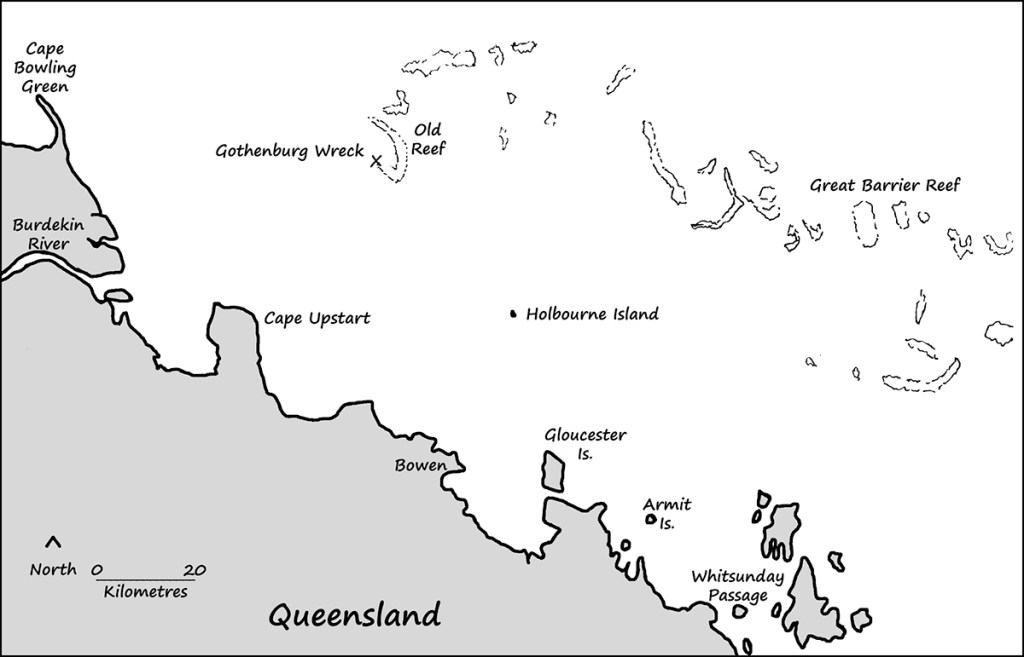
       The Gothenburg was a 501-ton steamer, and on this, her final voyage, she carried 37 crew and 88 passengers, 25 of whom were women or children. She departed Darwin on Tuesday, 16 February 1875, bound for Adelaide via Australia’s east coast. By the evening of the 24th, Cape Bowling Green just south of Townsville, would have been visible off the starboard side had it not been obscured by thick weather.

       The steamer had been followed by bad weather for most of the voyage down the Queensland coast. With usual landmarks hidden from view, the captain, James Pearce, was relying on his patent log to plot their progress. He thought he now had open seas ahead of him until they reached Flinders Passage, where he would pass through the Great Barrier Reef. It was early evening, and the Gothenburg was cutting through the water at 10 knots (19 km/h). Large swells made the ship roll uncomfortably, upsetting many of the passengers. But then the seas flattened.  It should have alerted the captain that they were in the lee of a large reef. But before any action could be taken, the Gothenburg ran onto a vast coral shoal hidden just under the sea’s surface.

    Illustration a the Human Society medal awarded to survivors of the Gothenburg shipwreck. Source: The Illustrated Adelaide News 1 Sep 1875, page 8.

       The impact was not particularly violent. The iron-hulled steamer had glided along the top of the reef, coming to a halt in less than her own length. By the time she stopped, her stern was still hanging out over deep water. It would transpire that the Gothenburg had drifted further east than Pearce had reckoned on, and they had struck Old Reef just north of Flinders Passage.

    Pearce was not particularly concerned at first; the hull had not been breached, and he thought he would be able to back the steamer off. However, when the engines were put in reverse, the ship didn’t budge. Pearce ordered the crew to move cargo from the fore hold and bring it aft. He also asked all the passengers to congregate on the stern. With the bow raised and the stern lowered, he hoped the ship would easily slide back off the reef. As the tide peaked, the engines were turning at maximum speed, but the vessel remained firmly stuck. The passengers and most of the crew retired for the night, expecting they would try again on the next high tide.

       Meanwhile, the weather continued to deteriorate. A powerful storm was fast approaching over the northern horizon. Through the rest of the night, the Gothenburg was lashed by high seas, torrential rain, and a gale-force wind.The steamer bumped and ground on the hard coral until the hull sprang leaks and she began taking on water, a lot of water.

       In just a few short hours, the situation became dire. Captain Pearce began preparations to abandon the ship, starting with the evacuation of women and children. It was now around 3 a.m., and pitch-black. Most of the passengers were already up on deck despite the atrocious weather. Few wished to remain in their cabins below.

       Pearce only had four lifeboats at his disposal, but two of them were swept away before he could get a single passenger off the ship. The third boat, only partly filled with passengers, capsized and broke apart as soon as it was lowered into the water. Then the ship heeled over, and a mountainous wave swept many of the passengers from the deck to drown in the turbulent sea.

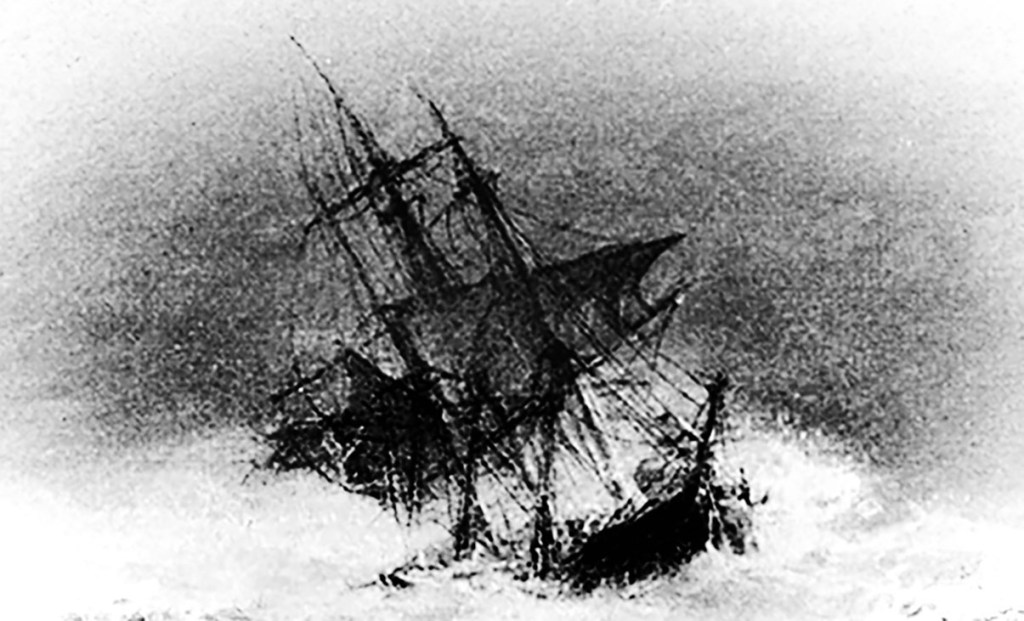
    The wreck of the Steamer Gothenburg. Source: Australasian Sketcher, 20 Mar 1875, p. 13.

       A lucky few managed to swim back to the ship and were rescued by those who had climbed into the ship’s rigging before the wave struck. There they clung, hoping to ride out the storm. James Fitzgerald, John Cleland, both passengers, and one of the crew, Robert Brazil, were among the survivors.

       Fitzgerald would later recall, “We had seen illustrations of shipwrecks, but on this frightful morning … before daybreak, we saw the dreadful reality of its horrors. The ship was lying over on the port side, awfully listing, a hurricane was blowing, rain was coming down as it does in the tropics, and unmerciful breakers were rushing over the unfortunate vessel, seldom without taking some of the people with them.”

       John Cleland, a gold miner returning to Adelaide, spotted the fourth lifeboat floating upside down, still attached to its davits. He knew that if they were to have any chance of survival, they needed that boat. He climbed down from the rigging, tied a rope around his waist and swam through the breaking waves to better secure it.

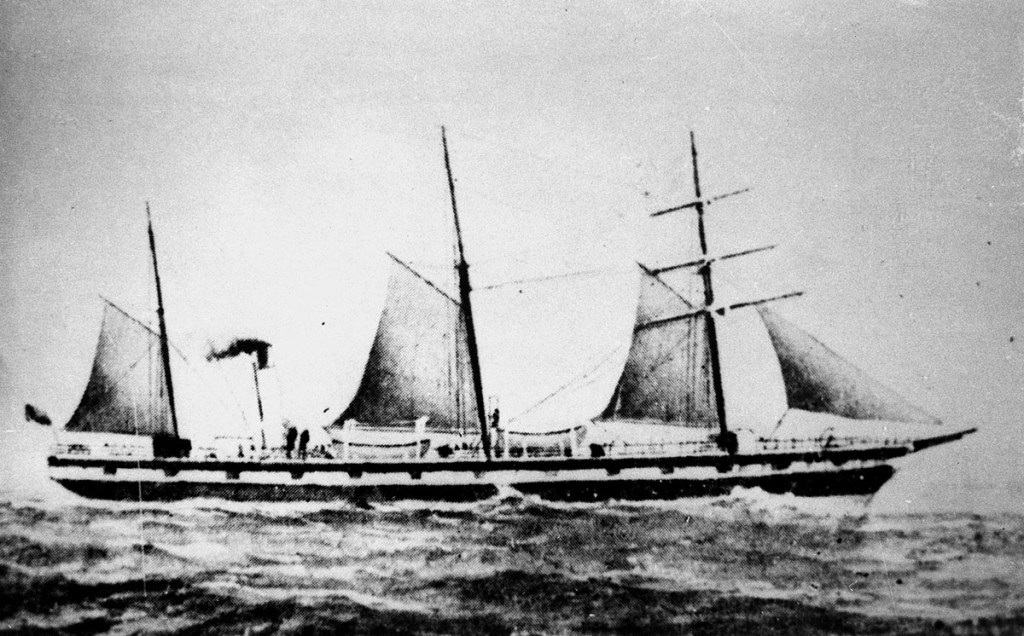
    The Gothenburg. Photo Courtesy State Library of Queensland.

       Cleland’s first attempt failed, and he swam back through the surging seas to the relative safety of the main mast. James Fitzgerald then joined him, and together they repeatedly swam out to the boat, cut away at the tangled mess of ropes, and then swam back to the mast to rest. Finally, they cut through the last of the ropes securing the boat to the davits. They then tied it off again with a length of rope attached to the mast. But the boat still floated upside down. They had been unable to right the craft on their own.

       Seeing the pair struggling, Robert Brazil swam out and joined them, and with their combined weight, they were able to flip the lifeboat over. Cleland and the others were relieved to see that the oars were still securely locked in place.

       The trio then returned to the mast and tied themselves to the rigging high above the waves. They stayed there all that day and the following night, tied to rigging so they would not fall when they dozed off. Then, the following morning, the weather began to ease.

       The three men returned to the boat and bailed it out. Cleland, Fitzgerald, Brazil and eleven other men climbed into the lifeboat and eventually made it to the safety of Holbourne Island. They were rescued by boats sent out from Bowen to search for survivors the next day. Over one hundred people lost their lives in the disaster, Captain Pearce among them.

       A marine board enquiry found that the captain had not exercised sufficient care in the navigation of his ship. They felt that had he made the effort to sight Cape Bowling Green lighthouse or Cape Upstart as he steamed south, he might have more accurately fixed his position, and the disaster could have been averted.

    The full story of the Gothenburg shipwreck is told in A Treacherous Coast: Ten Tales of Shipwreck and Survival from Queensland Waters, available as a Kindle eBook or paperback through Amazon.

    © Copyright C.J. Ison, Tales from the Quarterdeck, 2021.

    Enter your email address below to be notified of new posts.
  • The Sapphire and Marina: Three Months in a Leaky Boat

       At midday on 8 September 1859, the 749-ton merchant shipSapphire weighed anchor and began slowly making her way out of Port Curtis (present-day Gladstone, Queensland). She was ultimately bound for India via Torres Strait, with a consignment of 60 Australian horses purchased by the British Indian Army. But before the ship could clear the natural harbour, she ran aground on a sandbar and had to wait for the rising tide to lift her off.  So began a voyage that would cost 18 men their lives and last five gruelling months, only for the few survivors to wind up back where they had started. Their story is a remarkable one of perseverance in the face of unimaginable hardship, served with a healthy measure of good luck.   

    The Sapphire bore out into the Coral Sea and then headed north outside the Great Barrier Reef. On 23 September, Captain Bowden calculated he was somewhere off Raine Island. That afternoon, the lookout sighted a line of breaking surf heralding the outer edge of the reef. Bowden had the ship put about, and they tacked back and forth through the late afternoon. Captain Bowden intended to hold his position in deep water overnight and make his way through the reef first thing in the morning.

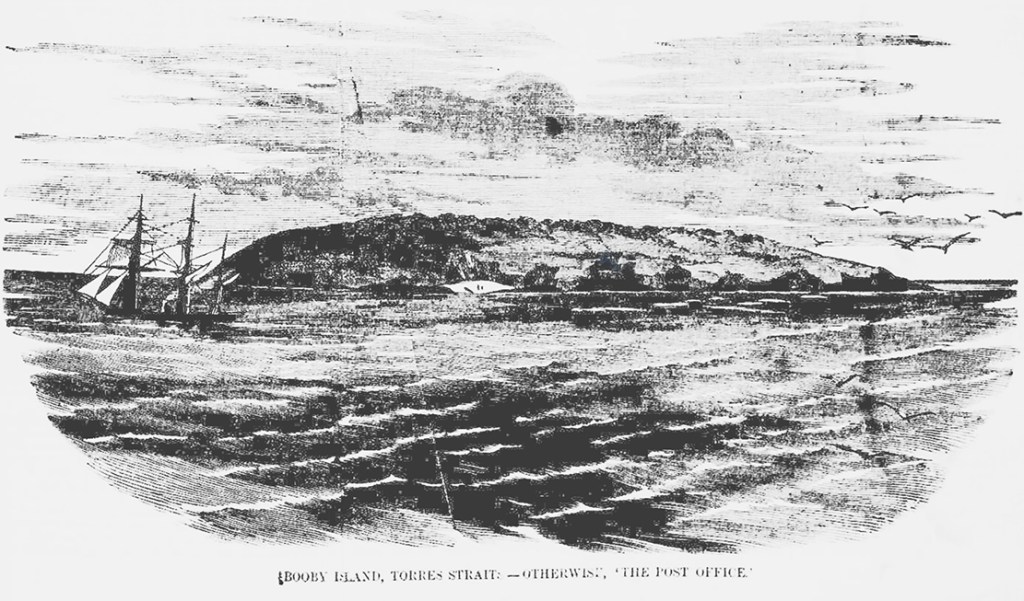
    Illustration of Booby Island, Torres Strait – Otherwise, Post Office. From the Illustrated Sydney News, Fri 16 Dec 1864, Page 9.

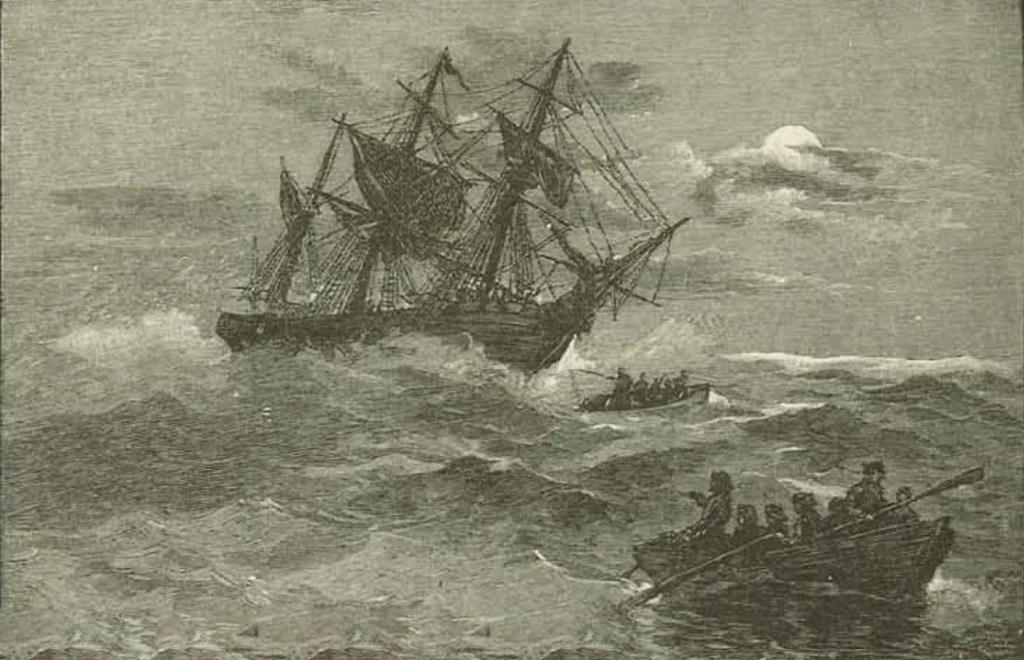
        But shortly after sunset, the alarm was raised. A lookout sighted a long, uninterrupted curve of white water directly in their path. By the time the ship responded to the call to pull hard about, the breakers were just 500 metres off the leeward bow. There was now insufficient sea room to turn the ship around and point her back out to sea.  The Sapphire struck the coral reef broadside. Huge waves swept her deck. The force of the collision brought down the fore-top-gallant mast, and one of their lifeboats was swept from its davits. The ship heeled over, and all seemed lost. Captain Bowden ordered the main mast cut away, hoping the vessel might right itself. When the mast came down, it landed on the deck, smashing the longboat to pieces. It also brought down the mizzen mast, which in turn crashed onto the lifeboat, damaging it. Within minutes, three of the Sapphire’s five boats were lost. Everyone spent a harrowing night sheltering as best they could while the terrified horses remained trapped in the hold.

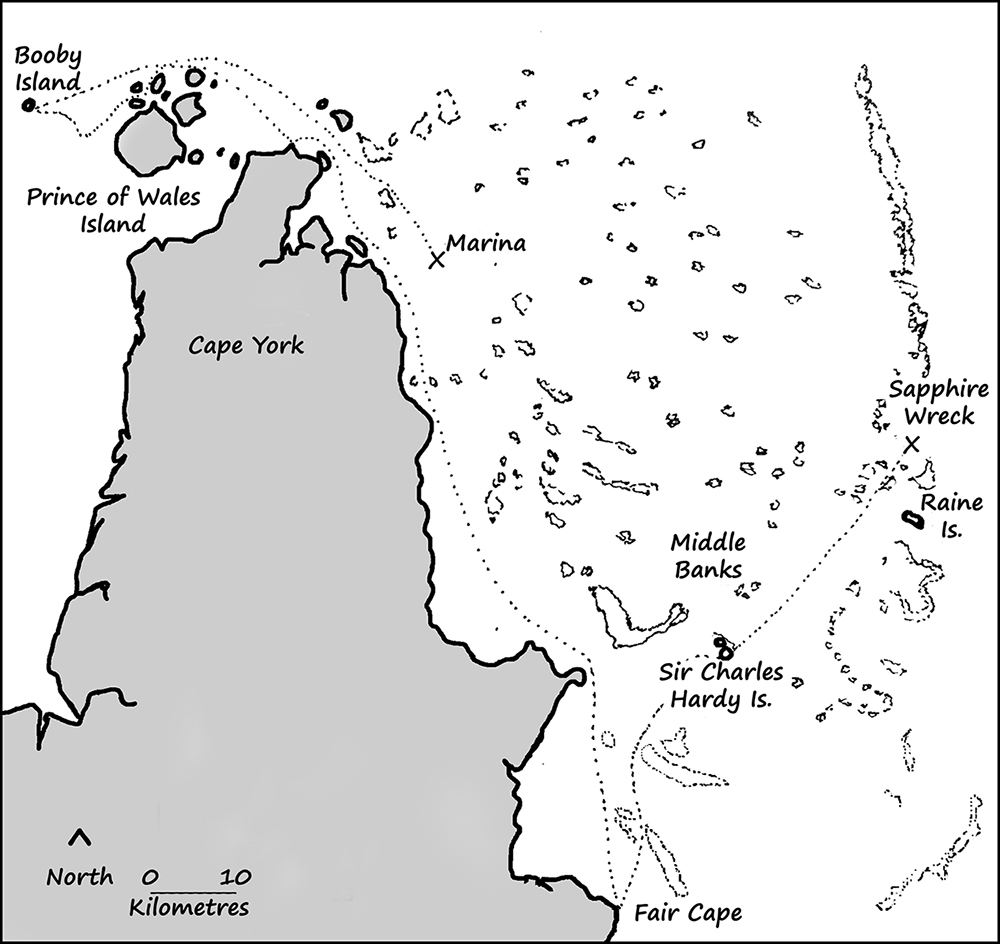
       Breaking with maritime convention, by leaving his ship, Captain Bowden set off in the morning to search for somewhere to land. First Mate William Beveridge was left in charge of the stranded vessel. Beveridge began preparations to abandon the ship and also had the carpenters try to repair the two badly damaged boats, only half expecting that Bowden might return. It seems that Beveridge and Bowden did not see eye to eye, and the first mate may even have blamed his captain for running aground. However, Bowden did return to the Sapphire, having found a suitable refuge on Sir Charles Hardy Island about 85 km away.

       The Sapphire’s crew of 28 men took to the two surviving boats and headed to the island, abandoning the ship and the 60 horses still trapped below. Captain Bowden decided they should return to Port Curtis, 1,500 kilometres to the south, and they left messages in a bottle hung from a tree telling of their intentions. They set off south on October 6 but immediately encountered strong headwinds. Bowden soon gave up on heading south, turning his boat around to head north, through Torres Strait, intending to make for Booby Island. In another unusual turn of events, Beveridge did not follow suit. He continued trying to push south for another day or two before he also gave up and turned around.

    Sapphire survivors route through Torres Strait from leaving the Sapphire and finding the Marina.

       Beveridge reached Booby Island in mid-October to find Bowden and the rest of the men already there. By now, they had been roaming the seas around Torres Strait for almost a month. The provisions they found there were a godsend for the hungry sailors, but they would not last indefinitely. Bowden and Beveridge agreed that they would have to leave there sooner or later. It was approaching cyclone season, and they had not seen another vessel since becoming marooned. They would likely not see another ship pass by Booby Island until April or even May the next year.

       Bowden and Beveridge put their differences aside and decided to make another attempt to return to Port Curtis, despite their recent failure. But as soon as they got clear of the island, they were struck by the same contrary winds that had plagued them earlier.

       While Beveridge and his boat were off Friday Island, they were set upon by Torres Strait Islanders and one of the men was speared to death. Meanwhile, Captain Bowden’s boat was off Hammond Island. They had stopped to trade with a party of Islanders, but in what seemed like an unprovoked attack, a volley of spears and arrows was launched into their overcrowded boat. Only one man was able to jump clear and swim away. He would later be rescued by Beveridge, who had gone in search of Bowden’s boat.

       Beveridge and his men continued pushing back east and eventually made it around the tip of Cape York. They then picked their way through the maze of coral reefs, and their luck finally changed for the better.

       They spotted a ship in the distance, the first they had seen since abandoning their own vessel some six weeks earlier. But, as they drew closer, they found it was deserted. The ship proved to be the barque Marina, which had run aground around the same time the Sapphire had been wrecked. It too had been abandoned by its crew, and they had also made it to Sir Charles Hardy, reaching it only hours after the Sapphire castaways had left. Miraculously, the Marina had floated off the reef on a spring tide only to drift around Torres Strait for the next several weeks.

    Marina’s course down the Queensland Coast. Source Google Maps.

       The Marina’s crew had then set off south for Port Curtis, and after 43 days of arduous sailing, they made it safely to port and notified the authorities of the loss of their own ship and also of the Sapphire. HMS Cordelia was dispatched north to search for the Sapphire’s missing men. However, she only steamed as far as Cape Upstart, thinking the lost sailors could not still be any further north. But they were wrong. By now, it was late January 1860, and the Sapphire’s crew was anchored off Lizard Island in the Marina, 500 km further north.

       Back in late November, Beveridge had decided they should sail the Marina to Port Curtis rather than try to do so in their small pinnace. Setting off on the 26th, they battled the same contrary winds and currents that had previously frustrated them. For the next two months, they made painfully slow progress. They anchored for days and weeks at a time, waiting for the south-easterlies to fall off. In the first month, they travelled just 180 km.

       They spent tiring Christmas Day kedging the stranded barque off a sandbar, and they would run aground twice more in the weeks that followed. The Marina’s hull was so damaged that water flowed freely in and out of the hold. The only thing keeping the ship afloat was her cargo of tightly packed Kauri logs.

       On 9 February, they were anchored off Palm Island.   In the past two and a half months, they had covered a little more than half the distance to Port Curtis. They still had another 800 km or more to go.   All seemed lost.   Their food had all but run out, and they were slowly starving to death.    

    Finally, their luck turned around. The wind started blowing from the north. They put to sea and made steady progress south. Three days later, Beveridge sighted Cape Upstart off the port bow. The next day, they were cruising through the Whitsundays. They were now only 400 km from Port Curtis. A couple of days after that, they crossed Keppel Bay, and the next day, 17 February, they anchored off Facing Island just outside Port Curtis. No one had the strength to manoeuvre the crippled vessel into port. They took to the Sapphire’s pinnace again and surprised everyone with their return, for they had long been given up for dead.

    The Sapphire’s full story is told in A Treacherous Coast: Ten Tales of Shipwreck and Survival from Queensland Waters, available as an eBook or paperback through Amazon.

    © Copyright C.J. Ison, Tales from the Quarterdeck, 2021.

    Enter your email address in the form below to be notified of new posts.

  • The Spanish Silver of Torres Strait

    Example of a mechant brig, similar to the Sun. Source: “L’Album De Marine Du Duc D’Orleans,” 1827.

       Sometime around 1891, a group of beche-de-mer fishermen stumbled upon a huge hoard of Spanish silver coins. The men had been fishing in the shallow waters of the Eastern Fields at the eastern approach to Torres Strait when they made the surprise discovery.

       At low tide, when much of the reef was exposed, they spotted an old, coral-encrusted anchor fluke jutting from the reef’s surface. The shoals of Torres Strait had claimed many a ship during the 19th Century, and the fishermen were keen to see what else they might find.

       They began chipping away at the decades of accumulated growth until the anchor finally broke free from the surrounding coral. When it was rolled clear, a mass of silver coins, all fused together by time and saltwater, was revealed. Buoyed by the find, the fishermen forgot about the beche-de-mer and extended their excavations. Each day, as soon as the falling tide exposed the reef, they got to work chipping away at the coral. In the end, they uncovered a staggering 410 kgs (900 pounds) of silver. It took them two trips to carry it all back to Somerset, the fishing and cattle station near the tip of Cape York owned by the early pioneering family of Frank Jardine.

    Spanish silver coins as circulated in the early days of New South Wales.

       At the time, it was supposed that the coins might have been carried on a Spanish ship on her way to Manila to pay the wages of the civil and military staff. Either that, or it was to be used to purchase spices from traders in the Indonesian Archipelago, further to the west. Regardless, the ship that had been carrying the fortune in silver had ended its voyage on that remote coral outcrop many decades earlier. They knew it was an old wreck, for by 1891, the timbers had long since rotted away.

       The mystery was only solved years later. It turned out not to have been a Spanish galleon at all. Instead, the fishermen had stumbled upon the remains of the English brig, Sun, which had been lost in Torres Strait in May 1826. Earlier that same year, the Sun had delivered a cargo of tea from China to merchants in Hobart and Sydney. In Sydney, a local businessman had entrusted the ship and her captain with a new cargo of between 30,000 and 40,000 Spanish silver dollars. At the time, one Spanish dollar was worth 4 shillings and 4 pence, which would have valued the somewhere between £7,000 and £10,000. In today’s money, the silver content alone would be worth well over one million Australian dollars.

       The Sun sailed from Sydney on 7 May, bound for Singapore by way of Torres Strait. But it never arrived. The voyage was cut short three weeks later when the Sun struck a submerged reef as it attempted to navigate the dangerous waters separating Cape York from New Guinea.

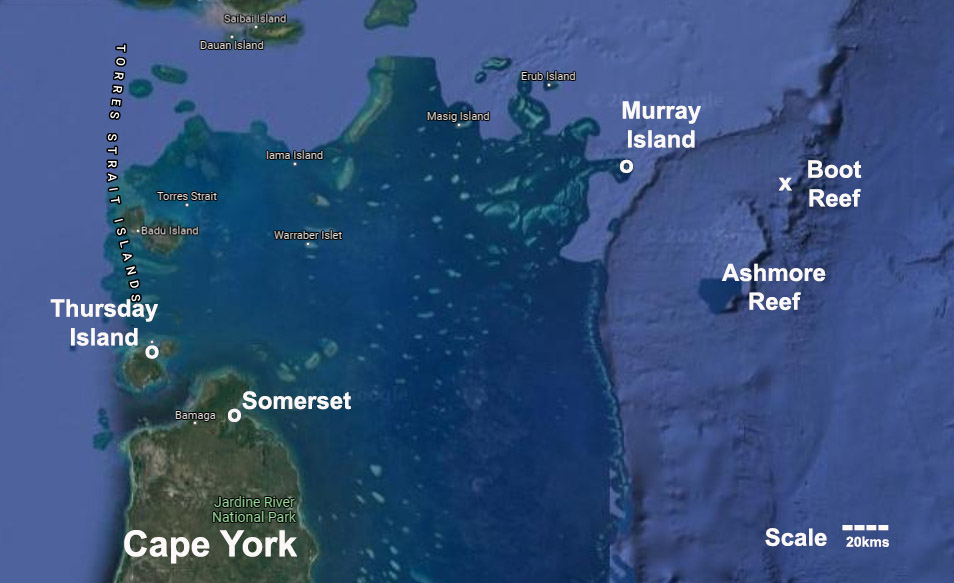
    Torres Strait. Source: Google Maps.

       The ship broke up almost immediately. Captain Gillet and his crew took to the longboat and jolly boat and made for Murray Island, about 30 nm (60 km) away. Such was the haste with which they were forced to abandon the ship that there was certainly no time to save the silver. The crew didn’t even have time to provision the boats with food or water before they pushed away from the wreck. Fortunately, they would only be at sea for two days before sighting land.

       As fate would have it, just as their safety seemed assured, the longboat struck a reef and capsized, spilling all the occupants into the water. The first and second mates, plus 22 lascar sailors, drowned. Only the jolly boat with the ship’s captain and 11 remaining seamen reached Murray Island, where they were looked after by the Islanders. Three days later, Captain Gillet and his men were rescued by a passing ship and eventually delivered to Calcutta, where he reported the loss of his ship.   

    So, there the Spanish silver dollars remained undisturbed for the next 65 years as the Sun slowly disintegrated around them. As the employer of the fishermen, Frank Jardine claimed the lion’s share of the haul. He reportedly had at least some of the coins melted down and made into silver tableware and cutlery for the Jardine Homestead.

    © Copyright C.J. Ison, Tales from the Quarterdeck, 2021.

    Enter your email address below to be notified of new posts.
  • The Macabre case of the Mignonette

    Illustration of the yacht Mignonette.

       Genuine verifiable instances of cannibalism among shipwreck survivors are remarkably rare. But when they have occurred, those involved have often been met with revulsion and sympathy in equal measure. Such was the case with the survivors of the small yacht Mignonette, which foundered in the Atlantic Ocean on its way to Australia in 1884.

       The Mignonette was a small yacht of about 33 tons. It had been purchased in England by Sydney barrister and Commodore of the Sydney Yacht Club, John Want. He hired a respected master mariner named Thomas Dudley and a crew of three to sail the vessel to Australia while he returned home by a regular steamer service in more salubrious surroundings.

       The Mignonette sailed from Southampton on 19 May 1884 and briefly stopped at Madeira off the Moroccan coast around the middle of June. Then, nothing further was heard of her until 6 September, when Dudley and two of his crew returned to England after being rescued at sea by the German barque Montezuma.    The world then learned the horrifying truth of their ordeal. Six weeks after leaving England, they were far from land, some 3000 kilometres south of the equator and 2500 kilometres off the Namibian coast. By now, the weather had turned foul. The seas ran high, and Captain Dudley was running before a strong wind, taking them further south. On the afternoon of 5 July, the Mignonette was struck by a gigantic rogue wave that had risen from nowhere and crashed into her side. The yacht’s hull was stoved in.

    As the Mignonette went down, The Illustrated London News, 20 Sept 1884, p. 268.

       The mate, Edwin Stevens, was at the wheel and barely had time to call out a warning before the monster wave struck. Fortunately, Dudley grabbed hold of the boom and held on as a wall of water swept across the deck.

       The Mignonette immediately started filling with water. Dudley ordered the men to prepare to abandon ship. They got the lifeboat over the side while he went below to gather provisions. By then, seawater was already swirling around the cabin interior. He only had time to grab a couple of tins of what he thought was preserved meat, before he raced back on deck and leapt into the dinghy as the Mignonette sank below the waves.

       Dudley, Stevens, Edward Brooks, and seventeen-year-old Richard Parker spent a frightening night in the tiny four-metre dinghy as the storm raged around them. When Dudley opened the tinned provisions, he discovered they contained not meat but preserved turnips. Even worse, they had no fresh water.   

    For the next five days, they subsisted on morsels of turnip and tiny quantities of rainwater, but it was never enough. Then their luck improved, at least for a short while. They captured and killed a turtle that had been basking on the sea’s surface.

    “Sailing Before the Wind.” The Illustrated London News, 29 Sept 1884.

       By day 19, the last of the turnips and the turtle meat had long gone, and the young cabin boy, Parker, had started drinking seawater to quench his burning thirst. He was now lying in the bottom of the boat in a delirious state.

      Wracked with hunger and despair, that night, Thomas Dudley suggested drawing lots to see who should be killed to provide sustenance so the rest might live. Brooks wanted no part of it and told the others he believed they should all live or die together.

       Dudley and Stevens discussed their options and felt that, as they were both married men with families to support, it should be Parker they butchered, as he was already close to death. The matter was settled.

       Dudley prayed for forgiveness for what they were about to do, then, as Stephens held Parker down, Dudley pulled out his knife and slit the boy’s throat. Brooks turned away, covering his eyes with his hands, but he could not block out Parker’s feeble pleas for mercy.    As Parker’s blood drained from his body, they caught it in an empty turnip tin and drank it. Brooks, despite his horror, was unable to resist taking a share. The three men fed on Parker until they were rescued by the passing barque Montezuma, five days later.

    Newspaper illustration showing the “terrible tale of the sea. and the horrible sufferings,” of the shipwrecked sailors.

       When Captain Dudley returned to England, he reported the loss of his vessel and the hardships they had endured afterwards, including the death of the delirious Parker. As abhorrent as his actions were, he believed he had committed no crime. In his mind, he had sacrificed one life to save three. But the police saw it otherwise. He and Stephens were remanded in custody to stand trial for the capital crime of murder.

       There was widespread interest in the tragic story in both Britain and Australia. Many people were sympathetic towards the captain and his first mate. But there were also those who felt the pair had acted prematurely in killing the dying Parker.

       At their trial, Dudley and Stephens pleaded not guilty, their barrister arguing they had acted in self-defence. He used the analogy that if two shipwrecked men were on a plank that would only support one, one or the other could be excused for pushing away the other man to drown. For, he argued, were both men to remain on the plank, both would perish.

    FEARFUL SUFFERINGS AT SEA. LAD KILLED AND EATEN. Courtesy State Library of Scotland.

         The judge didn’t see things that way. In summing up the case, he told the jury:

       “It was impossible to say that the act of Dudley and Stephens was an act of self-defence. Parker at the bottom of the boat was not endangering their lives by any act of his. The boat could hold them all, and the motive for killing him was not for the purpose of lightening the boat, but for the purpose of eating him, which they could do when dead, but not while living. What really imperilled their lives was not the presence of Parker, but the absence of food and drink.”

       The jury found the pair guilty, and the judge sentenced them to death, but it appears there was little likelihood that the death sentence would ever be carried out. Even Parker’s family had forgiven the two men on trial. After waiting on death row for six months, both sentences were commuted to time served, and they were released from custody.   

    It was generally agreed that they had acted as they did under the extreme duress of being lost at sea for so long without food or water. No one felt that justice would be served by punishing the two men any more than they had already suffered.

    Copyright © C.J. Ison, Tales from the Quarterdeck, 2021.

    To be notified of future blog posts please enter your email address below.