Category: Shipwrecks

  • Tales from the Quarterdeck

    Sixty bite-sized stories from Australia’s maritime past

    The melancholy loss of H.M.S Sirius off Norfolk Island by George. Raper. Source National Library of Australia 136507434-1

    I have just launched a new book titled Tales from the Quarterdeck: Sixty bite-sized stories from Australia’s maritime past. Sixty of the most popular posts have been reedited. In some cases, I’ve rewritten a couple and updated a few where new information has come to light since first writing them.

    For those who would value ready access to the stories in their bookcase, Tales from the Quarterdeck is available in Kindle ebook and paperback formats through Amazon.

    The stories are organised in chronological order, starting with the Tryall shipwreck off the Western Australian coast in 1622, and finishing with the Second World War exploits of the Krait. See below for a full list of the stories covered in the book.

    Sydney Gazette 22 May 1808, p. 2.

    1622 – The Tryall: Australia’s earliest shipwreck

    1629 – The Batavia Tragedy

    1688 – William Dampier: Navigator, naturalist, writer, pirate

    1770  – The Endeavour’s Crappy Repair

    1788 – Loss of La Astrolabe and La Boussole, a 40-Year Mystery                        

    1789 – Bligh’s Epic Voyage to Timor

    1789 – HMS Guardian: All Hands to the Pumps

    1790 – The Loss of HMS Sirius

    1790 – Sydney’s First Desperate Escape

    1791 – HMS Pandora: Queensland’s earliest recorded Shipwreck

    1791 – William Bryant’s Great Escape

    1797 – The Loss of the Sydney Cove

    1803 – Loss of HMS Porpoise

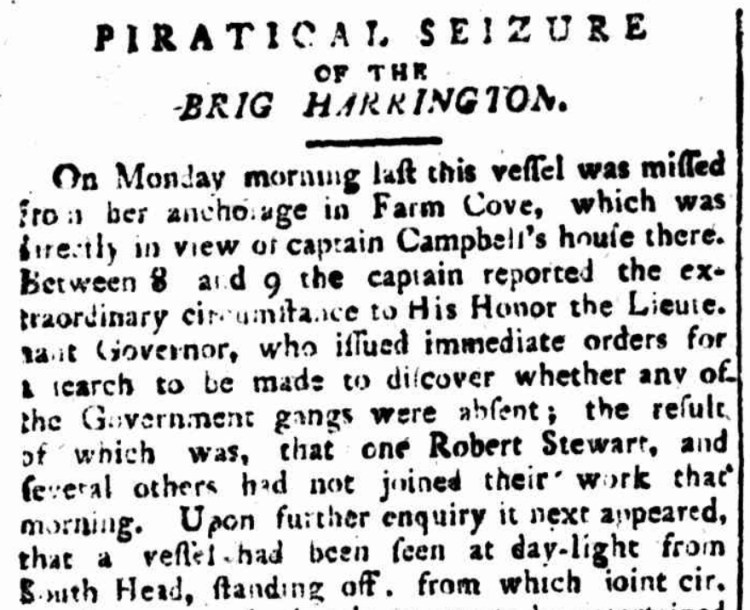
    1808 – Robert Stewart and the Seizure of the Harrington

    1814 – Wreck of the Morning Star

    1816 – The Life and Loss of HMSC Mermaid

    1824 – The Brig Amity’s Amazing Career

    1829 – The Cyprus mutiny 

    1831 – The Caledonia’s perilous last voyage

    1833 – The Badger’s Textbook Escape

    1835 – The Loss of the Convict Ship Neva

    1835 – The Post Office in the middle of nowhere

    1835 – The Tragic Loss of George III

    1845 – The Cataraqui: Australia’s worst shipwreck

    1846 – The Peruvian’s Lone Survivor

    1847 – The Foundering of the Sovereign

    1850 – The Loss of the Enchantress: A first-hand account

    1851 – The Countess of Minto’s brush with Disaster

    1852 – The Bourneuf’s Tragic Last Voyage

    1852 – The Nelson Gold Heist

    Woodbury, Walter B. (Walter Bentley), 1834-1885. Hamlet’s Ghost, Sourabaya [Surabaya], Java [Boat with Passengers and Crew], ca. 1865. Walter B. Woodbury Photograph Collection (PH 003). Special Collections and University Archives, University of Massachusetts Amherst Libraries

    1854 – Bato to the Rescue 

    1854 – HMS Torch and the rescue of the Ningpo

    1856 – The Loss of the Duroc and the Rise of La Deliverance

    1858 – The Loss of the Saint Paul and its Horrific Aftermath

    1858 – Narcisse Pelletier, An Extraordinary Tale of Survival

    1859 – The Indian Queen’s Icy Encounter

    1859 – The Sapphire and Marina

    1863 – The loss of the Grafton: Marooned for twenty months

    1864 – The Invercauld shipwreck

    1865 – The CSS Shenandoah: Victoria’s link to the American Civil War

    1866 – The Loss of the SS Cawarra: Bad luck or an avoidable tragedy?

    1868 – The Bogus Count and Hamlet’s Ghost

    1871 – The Mystery of the Peri

    1872 – The Loss of the Maria, A Cautionary Tale

    1875 – The Tragedy behind the Gothenburg Medals

    1876 – The Catalpa rescue

    1876 – The Banshee’s Terrible Loss

    1878 – The Loch Ard Tragedy

    1884 – The Macabre case of the Mignonette

    1885 – The Douro and its Piratical Captain

    1889 – The Windjammer Grace Harwar

    1891 – The Spanish Silver of Torres Strait

    1893 – The Foundering of the SS Alert

    1895 – The Norna and the Conman Commodore

    1899 – Cyclone Mahina

    1911 – The Loss of the Mandalay

    1918 – The Orete’s Robinson Crusoe-like Castaway

    1935 – The Life and Loss of  the SS Maheno

    1943 – Surviving the Centaur Sinking

    1943 – The Amazing Krait

  • The 1909 Loss of the Norwegian barque Errol

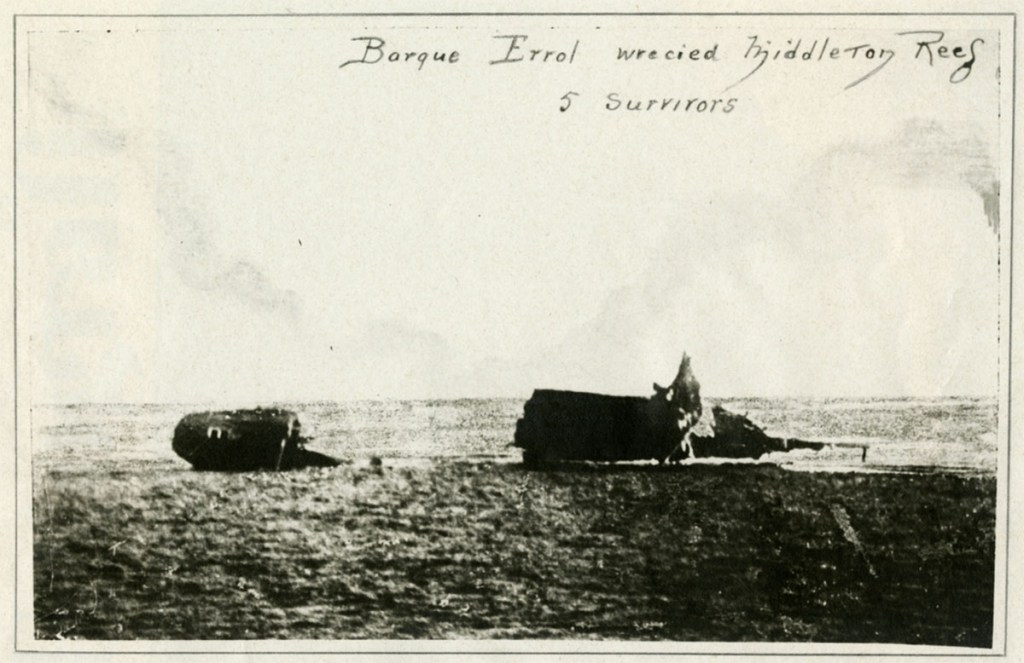
    The remains of the Errol on Middleton Reef. Courtesy: Norsk Maritim Museum.

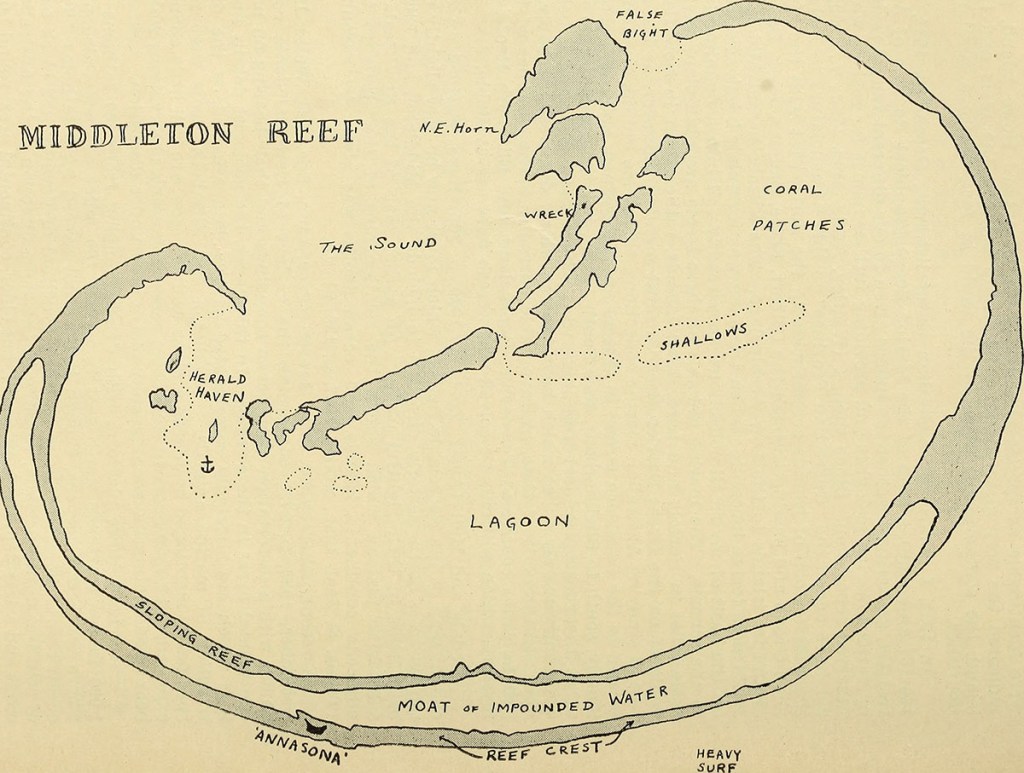
    On 12 July 1909, the mail steamer Tofua was passing Middleton Reef in the Coral Sea bound for Sydney.    Captain George Holford gave the order to steam close by as was his want every time he passed.   This time, he noticed a new ship’s carcass had been added to the dangerous reef since he had seen it last.     Since the Britannia Godspeed ran aground on Middleton Reef in 1806, it and neighbouring Elizabeth Reef have claimed over 30 ships and countless lives over the years.

    Captain Holford steamed as close as he dared, then had a boat lowered to go across and investigate.   As the steamer neared the reef, he also noticed that some rags were flying from the mast of another ship, the Annasona, which had been wrecked two years earlier.  

    The boat soon returned with five survivors from the Norwegian barque Errol, which had run aground a month earlier with 22 souls onboard.  They had a tragic tale to tell.

    Middleton Reef. Source: The Australian zoologist, 1934.

    The Errol had left the port of Chimote in Peru on 15 April, with a crew of 17 men and five passengers, comprising the Captain’s wife and four children.   The barque was headed to Newcastle to take on a cargo of coal.   However, disaster struck around midnight on 18 June when, without warning, the barque slammed into Middleton Reef.  

    The ship was swung broadside to the reef before there was even a chance to try and save her. The hull was torn out, and she rapidly settled with a heavy list to starboard.   Powerful waves swept over her, ripping apart the houses and washing away much of their stores along with the ship’s lifeboats.  She quickly succumbed to the pummelling and broke into four separate parts.    

    The First Mate was swept away and drowned as he and one of the crew tried vainly to clear one of the lifeboats.   Two more seamen also died that first night or on the second, the survivors could not recall.   Captain Andreason and the Second Mate were lost a couple of days later.   They had been on the reef, not far from the ship, building a raft comprised of spars and other timbers when they were caught by the rising tide.   Though they tried to swim back to the Errol, the current was too strong and they were washed away.  The Captain’s wife and children could only look on in horror. 

    The survivors were in dire straits.   The only food they had been able to salvage was a dozen loaves of bread, a few pounds of butter and a couple of tins of milk. What’s more, they had precious little fresh water.  A shelter of sorts was constructed on the exposed hull for the Captain’s wife and her children while the sailors made do with a canvas sail for protection from the elements. 

    Location of Middleton Reef. Courtesy Google Maps.

    Meanwhile, they continued to work on the raft.  After a few days, it was completed, and five of the crew set off for the Annasona, about 8 miles, 15 kilometres away, hoping they might find food and water.

    The raft barely held together long enough to reach the long-abandoned ship.  Fortunately, they found some fresh water, but the only sustenance available was shellfish clinging to the side of the wreck and the reef it stood on.  They spent 12 days on the Annasona building a more substantial craft to get them back to the Errol and their shipmates.  But before leaving, they hoisted a couple of shirts up the mast.   They had seen one ship pass by during their time there, but it had failed to see them or their signal of distress.   One of their number perished on the expedition across to the Annasona; however, a far greater tragedy had played out among those waiting on the Errol.

    When they climbed back aboard the Errol, they found only one man alive, Able Seaman Jack Lawrence, and he was barely clinging to life.   They had survived on a small amount of rain collected in the sails, but it proved almost as salt-laden as seawater.   Lawrence described how the others, including the Captain’s wife and children, had passed away one by one from thirst, starvation and exposure.  As each person died, their body was pushed over the side to splash in the sea. At least some of those corpses had been savaged by sharks, leaving the grisly spectacle of bones or body parts deposited on the reef at low tide.

    Photo of the Errol survivors. Daily Telegraph, 15 Jul 1909.

    All five men would likely have died on Middleton Reef had Captain Holford not made his customary search for castaways.   They were returned to his ship and cared for until they arrived in Sydney.   At a time before any sort of public safety net, the Tofua’s passengers generously donated over £100 to assist the shipwreck survivors get back on their feet.

    An inquiry into the tragedy heard that the Errol had experienced several days of overcast weather, where no astrological sightings could be made.   They were essentially sailing blind when they struck the reef.   One of the survivors also claimed that Captain Andreason had not taken the precaution of sending a lookout aloft to warn of any hazards in their path.

    For his act of humanity in rescuing the Errol survivors, Captain George Holford of the Tofua was later presented with an engraved silver coffee service by a grateful Norwegian Government.

    © Copyright C.J. Ison / Tales from the Quarterdeck, 2025.

    Sun sets over Flinders and Stanley Islands in Bathurst Bay with a fishing boat in the forground at Cape Melville on Cape York Peninsular, Far North Queensland. Photo Chris Ison / Wildshot Images.
  • Wreck of the Morning Star – 1814

    Example of a Brig. Source: Winston’s Cumulative Loose-Leaf Encyclopedia 1918

       On Sunday, 3 July 1814, the merchant ship Morning Star sailed out of Sydney Harbour bound for Calcutta by way of Torres Strait and Batavia.  However, her voyage north ended abruptly on a coral reef south of the Forbes Islands off the far north Queensland coast. The vessel was a 140-ton Calcutta-built brig owned by the Indian-based trading house Lackersteen and Co. When she left Sydney, the crew numbered 37 men, a mix of European and Indian seamen, all under the command of Captain Robert Smart. Only six of them would survive the ordeal.

       No account exists of how the ship was lost, but from the location of the wreck site, it appears that Captain Smart was sailing within the Great Barrier Reef when he ran aground and had to abandon ship.

       Lieutenant James Cook had charted the route back in 1770, and he had only narrowly avoided total disaster on what he would name Endeavour Reef, some 450 km south of where the Morning Star was lost.

       The passage was fraught with danger. Thousands of reefs, many hidden just below the surface, dotted the coastal waters inside the Great Barrier Reef. However, the route had two distinct advantages. Rarely did a ship have to stray far from land, so refuge could be sought should disaster strike. There were also ample safe anchorages where ships could lay up overnight or when the conditions made it difficult to detect hazards lying in their path. Later, mariners would prefer a route that took them far out into the Coral Sea as they made their way north. They would cross the Barrier Reef near Raine Island or other similar narrow passages to pass through Torres Strait. This “outer passage” avoided the labyrinth of reefs but came with its own set of dangers.

    Booby Island. Image courtesy National Library of Australia

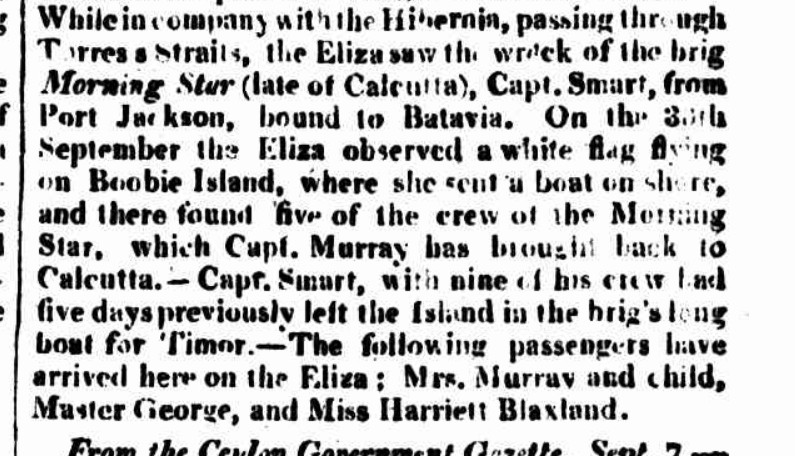
       On 30 September, the fully rigged Ship Eliza was sailing through Torres Strait when the lookout spotted a white flag flying from a staff on Booby Island.   The captain heaved to and sent a boat across to investigate. When it returned, she carried five marooned sailors from the Morning Star. This is the first recorded instance of shipwrecked sailors seeking refuge on Booby Island. Later, it would be stocked with food and water to assist shipwrecked sailors. A primitive post office with a logbook would also be established, so passing mariners could pass on the location of any uncharted reefs they may have discovered.

       The castaways had been among 15 men who had taken to the Morning Star’s longboat and made the perilous journey north after abandoning the wreck. They reported that Captain Smart and nine other sailors had left Booby Island five days earlier, intending to make for the Dutch port of Kupang on Timor Island. There is no record of them ever arriving there or anywhere else, for that matter.

    Morning Star reported wrecked on a reef south of Forbes Islands. Courtesy: Google Maps.

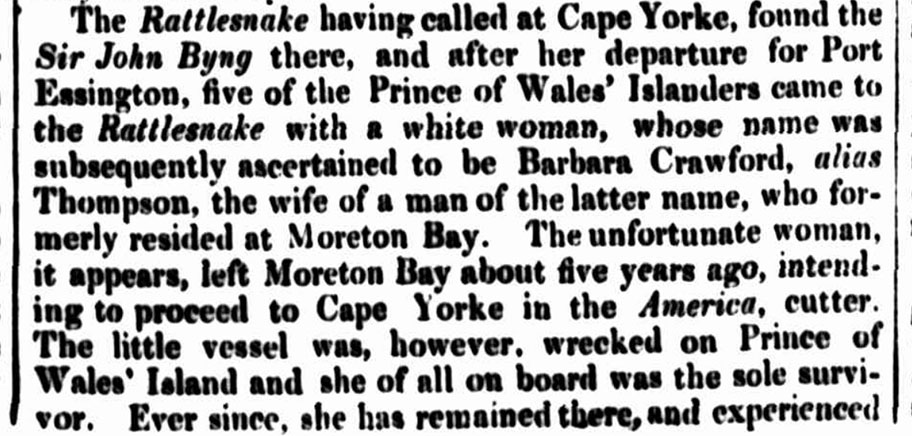
       The remaining 22 members of the Morning Star’s crew were thought to have perished as a result of the wreck or some calamity that befell them sometime afterwards. But four years later, another Morning Star survivor was found living with the Islanders on Murray Island on the Eastern entrance to Torres Strait.   

    The Claudine had anchored off Murray Island in September 1818 and sent a jolly boat ashore to meet with the islanders. To the astonishment of all, an Indian sailor was there to greet them in Hindustani. Fortunately, one of the sailors in the jolly boat spoke the language and was able to translate for the others. He told the sailors from the Claudine that he had been on the Morning Star when it ran aground and that since then he had been living with the Murray Islanders. He had learned their language and been accepted into their community, but the circumstances of his arrival on the island and the fate of his shipmates were not recorded. When the Claudine set sail, the Indian castaway was with them.

       The Morning Star is just one of many hundreds of vessels, large and small, that came to grief in Queensland’s northern waters from the late 18th and into the early part of the 20th Century.

    © Copyright C.J. Ison / Tales from the Quarterdeck, 2025.

    Please enter your email address below to be notified of future blogs.

  • Queensland’s Ten Worst Maritime Disasters

    The wreck of the Steamer Gothenburg. Source: Australasian Sketcher, 20 Mar 1875, p. 13.

    TEN: SOVEREIGN, 1847.

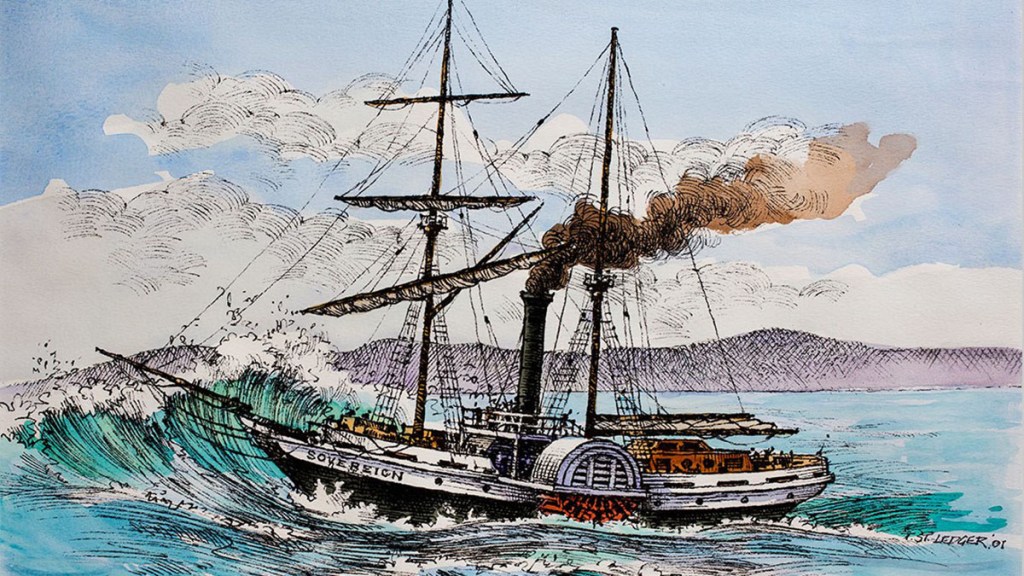
    The Sovereign. Image courtesy Stradbroke Island Heritage Museum.

    The paddle steamer Sovereign, with 54 persons on board, sailed from Moreton Bay via the southern channel on 11 March 1847.   As she ploughed through the large swells funnelled into the passage between Moreton and Stradbroke Islands, her engines failed at a critical moment.      The force of the breaking waves quickly drove her onto a sand spit projecting from the southern point of Moreton Island, where she broke up.    Forty-four people lost their lives.   The owners of the vessel would later claim the engines had been working fine and blamed the captain for the loss.     

    NINE: MERSEY, 1804.

    On 24 May 1804, the 350-ton merchant ship Mersey sailed from Sydney bound for Bengal, India, via Torres Strait.     In mid-June she was wrecked while trying to negotiate the dangerous waters of Torres Strait.   Neither the location or the circumstances of the tragedy are known, other than the captain and either 12 or 17 of the crew took to the longboat and made it safely to Timor Island to report the loss.   She reportedly sailed with 73 hands which means 56 or 61 people lost their lives.

    EIGHT: PERI, 1871.

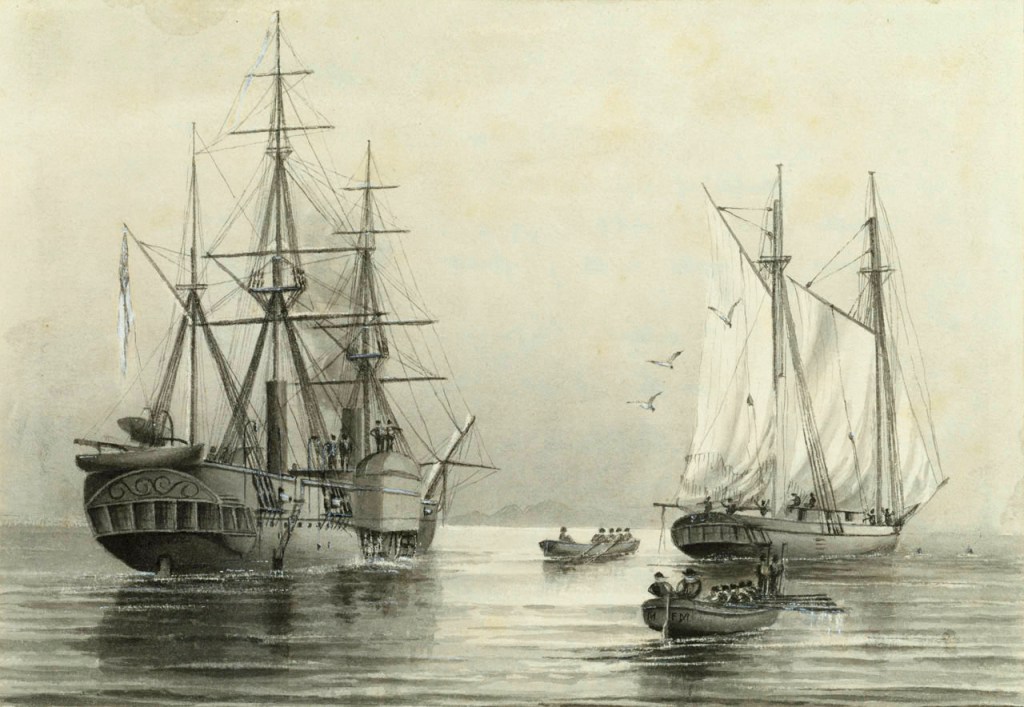
    HMS Basilisk and the Peri. Image Courtesy the British National Maritime Museum, Greenwich.

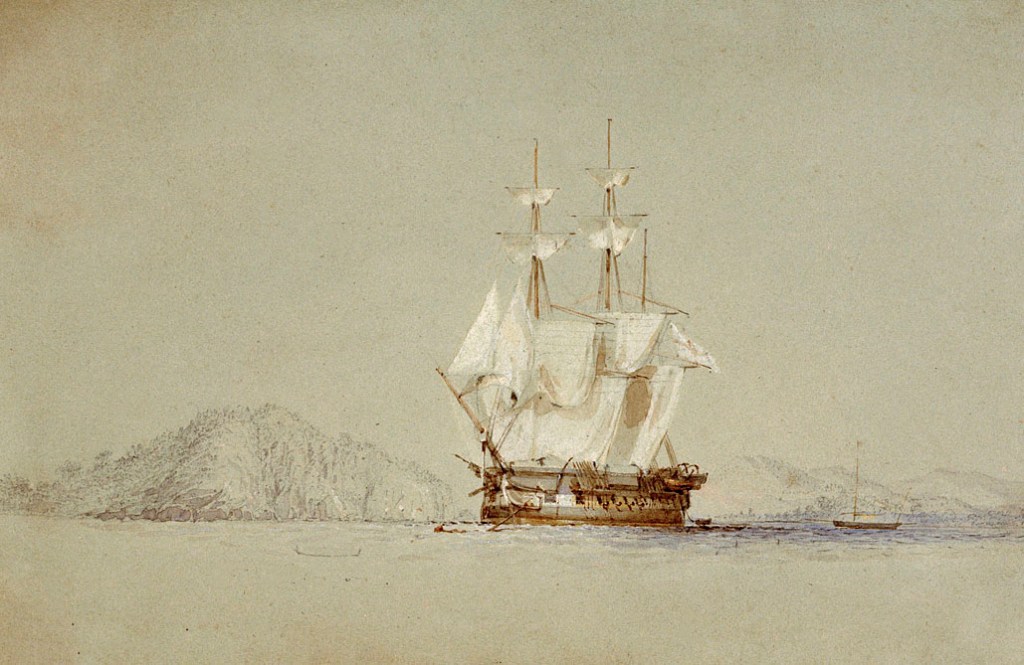
    In early February 1871 HMS Basilisk discovered a schooner, later identified as the Peri, adrift and seemingly abandoned a short distance off the Queensland near Cardwell.   When a boat was sent across to investigate, they discovered 14 emaciated Solomon Islanders, three corpses, no food or fresh water and five feet of putrid seawater in the hold. The Peri had last been seen about six weeks earlier in Fiji carrying around 80 or 90 blackbirded Islanders bound for Fijian cotton plantations.   It seems that the Islanders had overpowered their kidnappers and taken control of the schooner.   They then sailed or drifted west across almost 3,000 km of open ocean, withstood at least one severe tropical storm, and passed through a gap in the Great Barrier Reef before being found.      As many as 75 people likely died during the ordeal.

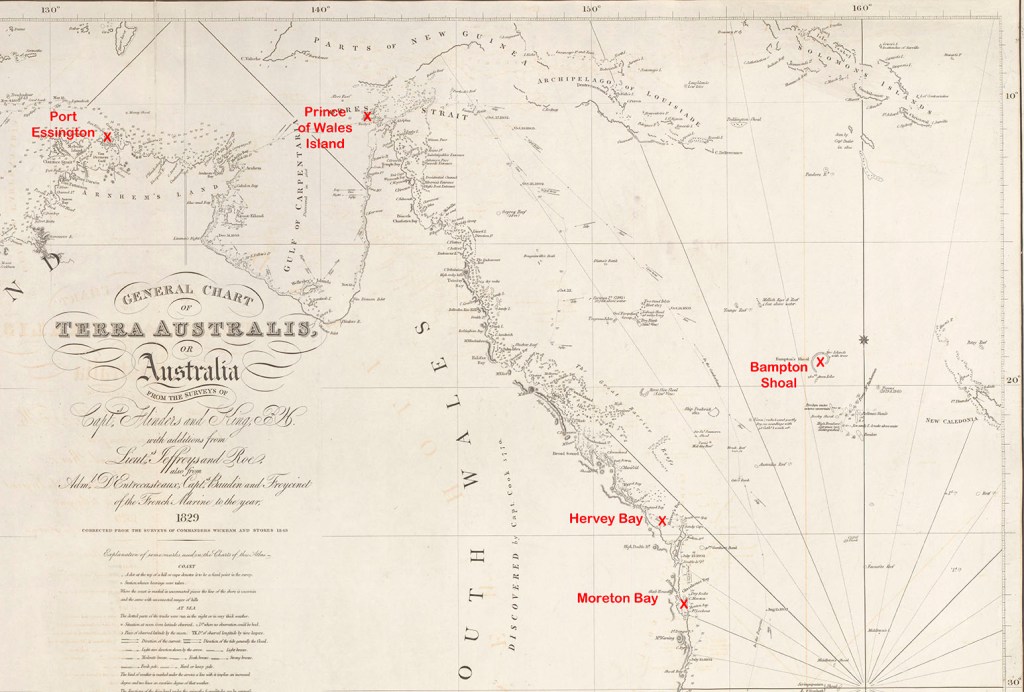
    Map showing 10 worst maritime disasters off Queensland. Courtesy Google Maps

    SEVEN: SYBIL, 1902.

    The labour schooner Sybil disappeared sometime after leaving the Solomon Islands on 19 April 1902 bound for Townsville with a fresh batch of South Seas labourers.    By August, grave fears were held for the Sybil, for the voyage should not have taken more than two or three weeks.    Searches were made of the islands along the outer Great Barrier Reef and in the Coral Sea but no trace of the vessel or any of those on board were found.   She had a crew of 12 and on the previous two voyages, she had carried 90 and 98 labour recruits, so it is thought no less than 100 lives were lost.

    SIX: GOTHENBURG, 1875

    Gothenburg. Photo Courtesy SLQ

    The steamer Gothenburg sailed from Darwin on 17 February 1875 bound for Adelaide via Australia’s east coast.   On 24 February the Gothenburg was steaming down the coast in the vicinity of Cape Bowling Green.   Bad weather meant they could not see the regular landmarks to aid their navigation. The captain was unaware strong currents were pushing the ship towards the Great Barrier Reef until it was too late. The Gothenburg ran aground on Old Reef.   The ship and all aboard her would likely have been saved but for a powerful cyclone bearing down on them.   As the storm worsened, the captain ordered the evacuation of the passengers, but as the women and children were being loaded into the lifeboats a succession of huge waves swept over the ship.    Only 22 people survived.  As many as 112 passengers and crew lost their lives.  

    FIVE: YONGALA, 1911

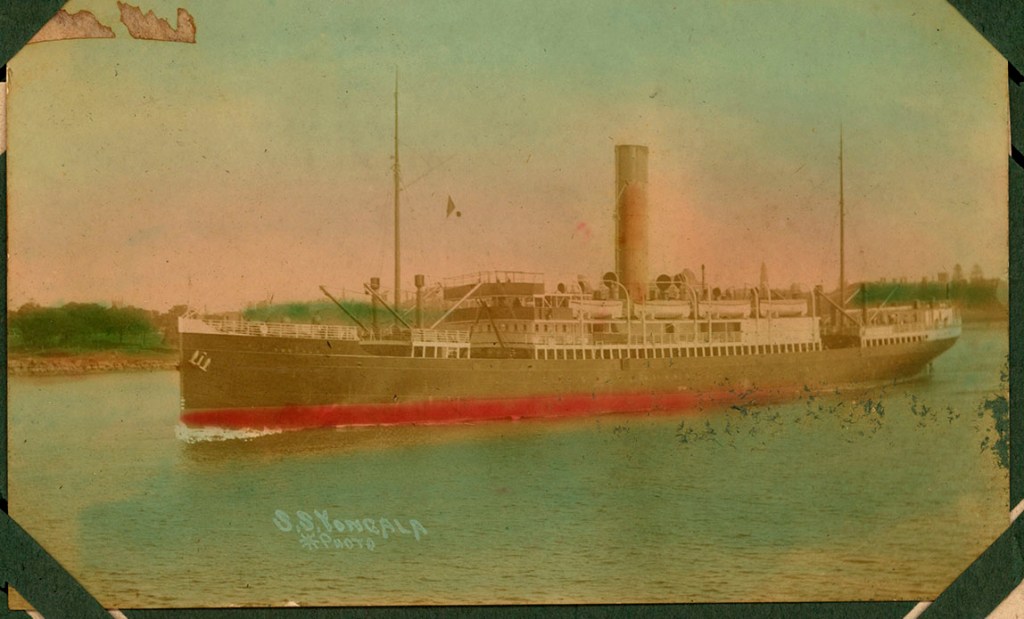
    S.S. Yongala. Photo Courtesy SLQ.

    The Yongala sank during a tropical cyclone near Cape Bowling Green on 11 March 1911 with the loss of all 122 people on board.    When the ship failed to arrive in Townsville as scheduled, concerns were raised.   Then, wreckage began washing ashore along the coast as far away as Hinchinbrook Island.   However, there was no sign of the ship or any hint as to where she might have sunk.   Nearly half a century would pass before the final resting place of the Yongala was conclusively located. 

    FOUR: QUETTA, 1890

    RMS Quetta. Photo courtesy SLQ

    While the Mail Steamer Quetta was steaming through Torres Strait on the night of 28 February 1890, it struck an uncharted rock pinnacle as it passed Adolphus Island.   The Quetta had departed from Brisbane bound for London carrying nearly 300 people comprising the passengers and crew when disaster struck.   The collision tore a gaping hole in the hull from bow to amidship, and the ship sank in just three minutes.    One hundred people made it safely to Little Adolphus Island where they were later rescued.   Dozens more were pulled from the water the following day.    133 people lost their lives in the tragedy.

    THREE: AHS CENTAUR, 1943

    AHS Centaur. Photo Courtesy State Library of Queensland

    At 4 am on 14 May 1943, the Australian Hospital Ship (AHS) Centaur was torpedoed and sunk by a Japanese submarine.    The Centaur was about 35km off Moreton Island having departed Sydney with medical staff from the Army’s 2/12 Field Ambulance bound for Port Moresby.   In all, there were 332 people on board.   268 lost their lives.   64 survived by clinging to debris and two damaged lifeboats until they were rescued 36 hours later.

    TWO: CYCLONE MAHINA, 1899

    Cyclone tracks for Cyclone Mahina.

    On the night of 4/5 March 1899, a powerful cyclone crossed the coast at Bathurst Bay on Cape York Peninsula. Lying directly in its path was the North Queensland pearling fleet which had sought shelter there.     Nearly 60 vessels – from large schooners to pearling luggers – were sunk or driven ashore with horrendous loss of life.    Between 300-400 people died in what is no doubt Queensland’s worst natural disaster.    The loss was most keenly felt on Thursday Island where the pearling fleet was based.

    ONE: GRIMENEZA, 1854

    Artists impression of the Grimeneza . Image Courtesy SLQ

    The worst shipwreck off the Queensland coast occurred on 3 July 1854.   The Peruvian ship Grimeneza was sailing from China with some 600 Chinese labourers bound for the Callao guano mines in Peru.   When they struck a reef at Bampton Shoals in the Coral Sea, the captain and six others immediately abandoned the ship leaving the rest of the crew and the passengers to their fate.  The rest of the crew tried to back the ship off, but when that failed, they too took to the lifeboats and were picked up 12 days later.   Miraculously, the Grimeneza floated off with the next high tide.   The labourers sailed the damaged ship west towards the Queensland coast with the pumps being worked around the clock.   But after three days of exhausting work, she foundered.   Six men were found clinging to a piece of wreckage 300 km off the coast a few days later.   The rest had all drowned or been taken by sharks.

    © Copyright, C.J. Ison / Tales from the Quarterdeck, 2024.

    If you would like to be notified of future blog posts, please enter your email address below.

  • William Swallow and the 1829 Cyprus mutiny

    Detail reputedly showing the brig Cyprus (centre) from a panorama of Hobart 1828 – watercolour drawings by Augustus Earle, Courtesy State Library of NSW.

       In August 1829, the brig Cyprus sailed from Hobart bound for Macquarie Harbour with provisions and 31 convicts sentenced to serve hard labour at that infamous penal settlement. However, while windbound at Recherche Bay in Tasmania’s south, the prisoners rose up, overpowered their guards and seized control of the ship. Thus began one of the most extraordinary escapes of Australia’s convict era.

       Their leader was a 37-year-old convict named William Swallow. He was likely the only man among the prisoners who had any seagoing experience, so in true pirate tradition, the men voted for him to be their captain. Swallow had once earned a living as a seaman on colliers plying England’s coastal waters. That was until he tired of the seagoing life and found it was more lucrative to break into portside houses or ships moored in harbour. He finally came undone when the police suspected him of being involved in several recent burglaries and raided his house. A large haul of stolen property was found in the house, and Swallow was whisked off to gaol. This took place in 1821 when Swallow was going by the name William Walker. He was found guilty of housebreaking and sentenced to be transported to Van Diemen’s Land (Tasmania) for seven years.

       William Swallow, however, had no intention of going quietly, leaving his wife and three children to fend for themselves. His first attempt to escape took place even before he had left England. He and a fellow prisoner jumped from the ship carrying them to the prison hulks to await the next Australia-bound convict transport.  His mate drowned in the attempt, but Swallow survived and returned to his hometown. However, he was quickly recaptured and charged with returning from transportation. This time, he was loaded on a ship and sent to Van Diemen’s Land.  

    Swallow made a second attempt to escape eight months after arriving in Hobart. He and three other convicts seized a small schooner, crossed Bass Strait and made it to within 80 kilometres of Sydney before they ran aground and were taken back into custody. Swallow received 150 lashes and was sentenced to serve hard labour at Macquarie Harbour Penal Settlement. But he escaped again before ever setting foot in that much-feared hellhole. This time, he escaped from gaol and stowed away on a merchant ship bound for England. There, he lived free until being discovered in 1828. This time, he was sent to Van Diemen’s Land for life. But Swallow was still not ready to give up and accept his fate. Shortly after arriving back in Hobart, he stowed away on the very ship that had so recently brought him from England. By now, guards were masters at finding stowaways, and Swallow was taken off before it left port. He was flogged again and was on his way to Macquarie Harbour on the Cyprus when, in 1829, he and the other convicts seized the ship.

    A tranquil Recherche Bay in southern Tasmania in 2019. Photo CJ Ison.

       On 13 August, while the Cyprus was windbound in Recherche Bay, the convicts pounced, catching their guards by surprise and wresting control of the ship. They put the soldiers, captain and crew ashore and the following morning, hauled up the anchor, unfurled the sails and gave three hearty cheers as they got underway. The castaways would remain stranded in that remote and inhospitable corner of Tasmania for two weeks before they were discovered. That gave Swallow and his men ample time to get far away from Van Diemen’s Land before the alarm was raised.

       It was supposed by the authorities that the runaways would try to make their way across the Pacific, where they would scuttle the Cyprus and pass themselves off as shipwrecked sailors at some unsuspecting South American port. But Swallow and the others had another idea in mind as Van Diemen’s Land disappeared over the horizon behind them.

       The Cyprus was well stocked with food, for it carried sufficient supplies to see the Macquarie Harbour Penal Settlement through the coming winter months when it was all but cut off from the outside world. Swallow set a course to take them to New Zealand, where the men painted the vessel’s hull black and renamed her the Friends of Boston. Passing themselves off as an American-flagged ship, they then sailed north towards the Friendly Islands, known today as Tonga.

       However, this leg of their voyage was far from smooth sailing. One man was lost overboard during a powerful storm, and the common purpose that had seen the convicts unite to capture the brig had begun to dissipate. After they reached the island of Tongatapu, present-day Nukualofa, seven men chose to remain there when the Cyprus set sail. Swallow continued north across the equator and eventually reached southern Japan after an impressive voyage of nearly 12,500 km. They pulled into a sheltered bay on the island of Shikoku in January 1830, hoping to resupply with firewood and fresh water. However, at the time, Japan was unwelcoming of foreigners. Despite the language barriers, the Japanese made it clear that the Cyprus had to be gone by sunset; otherwise, it would be fired upon.

    A watercolour of what is beieved to be the Cyprus by low-ranking Samurai artist Makita Hamaguchi in documents from the Tokushima prefectural archive. CC BY-SA 4.0, https://commons.wikimedia.org/w/index.php?curid=59397258

       Swallow heeded the warning, hoping to resupply somewhere more friendly, but as the sun dipped towards the horizon, the wind dropped and the ship was becalmed. The Japanese coastal battery opened fire as they warned they would, and one of the cannonballs struck the vessel on the waterline. But before any more damage could be inflicted, a breeze sprang up, and Swallow wasted no time getting the ship underway. They followed the Ryukyu Island chain south before crossing the East China Sea, all the time taking on water.   

    In February 1830, the Cyprus was off the coast of China, near the estuary of the Pearl River (Zhu Jiang River). By now, the leak had worsened, and the pumps had to be manned constantly to keep the ship afloat. Several of the runaways had had enough and wanted to abandon the ship. However, Swallow wasn’t ready to give up on the Cyprus just yet, despite the risk of being discovered by British naval vessels in the area. He hoped they might repair the ship and soon be on their way. However, those wishing to go ashore went below and punched a hole in the hull. They then boarded a lifeboat and left the Cyprus to sink. Swallow and his few remaining loyalists could not stem the steady inflow of water and were forced to abandon the ship a few hours later in the remaining lifeboat and make their way to Canton (Guangzhou).

    View of the Canton factories by William Daniell, circa early 1800s. Courtesy British National Maritime Museum via Wikipedia.

       The unexpected arrival of British subjects in the trading enclave raised the interest of the local East India Company officials. William Swallow was asked to visit their offices, where he was questioned at length.

       As news of the seizure of Cyprus had yet to reach that port, Swallow passed himself off as Captain William Waldon and late master of the 200-ton English brig Edward. His story was a mixture of fact and fiction. He said that they had left London on 14 December 1828, bound for Rio de Janeiro and had then rounded Cape Horn and crossed the Pacific to Japan, where they were fired upon. The Edward, he said, had steadily taken on water as he tried to make for Manila, but his ship had finally foundered near Formosa (Taiwan).

       He told the East India Company officials that he and his crew had boarded two lifeboats and headed for the Chinese mainland, but on the way, he lost contact with the second boat. On the strength that Swallow, AKA Waldon, had a sextant engraved with the ship’s name in his possession, and he had arrived in a longboat bearing the name “Edward of London,” his story was accepted. The East India Company officials gave Swallow and his men free passage to London on a merchant ship about to depart from Canton. The escaped convicts might just have got away with the subterfuge but for a stroke of bad luck.

       A second boat arrived at the docks just days after they left. The men on that boat also claimed to be survivors from the Edward. But their version of the story was at odds with the one provided by Swallow. One of the new arrivals was immediately detained, but the rest fled Canton on an outbound ship one step ahead of the law. Then, two more men from the Cyprus turned up in Canton. They had been found on one of the Ryukyu islands and taken to Canton for questioning. When news of the seizure of the Cyprus finally reached the British enclave, the men in custody were questioned more closely, and they eventually confessed to who they were.

    A watercolour by samurai Makita Hamaguchi showing one of the mutineers. CC BY-SA 4.0, https://commons.wikimedia.org/w/index.php?curid=59845977

       A letter was dispatched to London on the next ship to leave, warning the police to be on the lookout for Swallow and the others. That ship arrived in London before Swallow, and the police were waiting. However, by pure luck, he had disembarked at Margate rather than travel up the River Thames to London.   The rest of Swallow’s travelling companions were arrested at the dock, and a couple of weeks later, Swallow was tracked down to a Lambeth boarding house, living under an assumed name.

       In October 1830, Swallow and four others stood trial for piracy. The jury found the others guilty as charged, but acquitted William Swallow after he convincingly pleaded that he had been forced to take part in the mutiny against his will. Although Swallow escaped punishment for piracy, there was still the matter of his returning to England illegally. He was once again sent to Van Diemen’s Land, where he died at Port Arthur Penal Settlement on 12 May 1834.

    © Copyright C.J. Ison / Tales from the Quarterdeck, 2024.

    Please enter your email address below to be notified of future blogs.