Sixty bite-sized stories from Australia’s maritime past
The melancholy loss of H.M.S Sirius off Norfolk Island by George. Raper. Source National Library of Australia 136507434-1
I have just launched a new book titled Tales from the Quarterdeck: Sixty bite-sized stories from Australia’s maritime past. Sixty of the most popular posts have been reedited. In some cases, I’ve rewritten a couple and updated a few where new information has come to light since first writing them.
For those who would value ready access to the stories in their bookcase, Tales from the Quarterdeck is available in Kindle ebook and paperback formats through Amazon.
The stories are organised in chronological order, starting with the Tryall shipwreck off the Western Australian coast in 1622, and finishing with the Second World War exploits of the Krait. See below for a full list of the stories covered in the book.
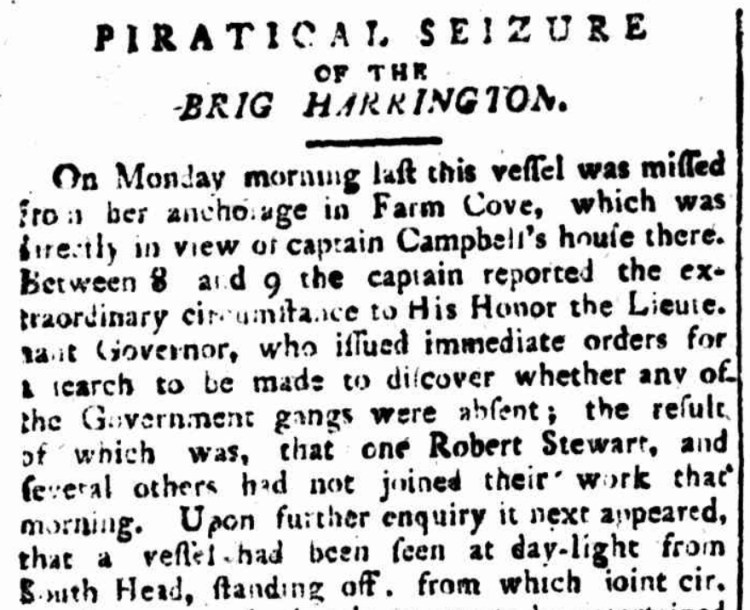
Sydney Gazette 22 May 1808, p. 2.
1622 – The Tryall: Australia’s earliest shipwreck
1629 – The Batavia Tragedy
1688 – William Dampier: Navigator, naturalist, writer, pirate
1770 – The Endeavour’s Crappy Repair
1788 – Loss of La Astrolabe and La Boussole, a 40-Year Mystery
1789 – Bligh’s Epic Voyage to Timor
1789 – HMS Guardian: All Hands to the Pumps
1790 – The Loss of HMS Sirius
1790 – Sydney’s First Desperate Escape
1791 – HMS Pandora: Queensland’s earliest recorded Shipwreck
1791 – William Bryant’s Great Escape
1797 – The Loss of the Sydney Cove
1803 – Loss of HMS Porpoise
1808 – Robert Stewart and the Seizure of the Harrington
1814 – Wreck of the Morning Star
1816 – The Life and Loss of HMSC Mermaid
1824 – The Brig Amity’s Amazing Career
1829 – The Cyprus mutiny
1831 – The Caledonia’s perilous last voyage
1833 – The Badger’s Textbook Escape
1835 – The Loss of the Convict Ship Neva
1835 – The Post Office in the middle of nowhere
1835 – The Tragic Loss of George III
1845 – The Cataraqui: Australia’s worst shipwreck
1846 – The Peruvian’s Lone Survivor
1847 – The Foundering of the Sovereign
1850 – The Loss of the Enchantress: A first-hand account
1851 – The Countess of Minto’s brush with Disaster
1852 – The Bourneuf’s Tragic Last Voyage
1852 – The Nelson Gold Heist
Woodbury, Walter B. (Walter Bentley), 1834-1885. Hamlet’s Ghost, Sourabaya [Surabaya], Java [Boat with Passengers and Crew], ca. 1865. Walter B. Woodbury Photograph Collection (PH 003). Special Collections and University Archives, University of Massachusetts Amherst Libraries
1854 – Bato to the Rescue
1854 – HMS Torch and the rescue of the Ningpo
1856 – The Loss of the Duroc and the Rise of La Deliverance
1858 – The Loss of the Saint Paul and its Horrific Aftermath
1858 – Narcisse Pelletier, An Extraordinary Tale of Survival
1859 – The Indian Queen’s Icy Encounter
1859 – The Sapphire and Marina
1863 – The loss of the Grafton: Marooned for twenty months
1864 – The Invercauld shipwreck
1865 – The CSS Shenandoah: Victoria’s link to the American Civil War
1866 – The Loss of the SS Cawarra: Bad luck or an avoidable tragedy?
The burning of the Cospatrick at sea. Penny Illustrated Paper, 09 January 1875, p. 1. (Detail)
On 27 November 1874, a lookout on the British ship Spectre spotted something floating in the water deep in the Indian Ocean. As they drew near, they realised it was a small boat holding six men. When they came alongside, they found one man was already dead. The other five were barely clinging to life and two of those would soon die. They were the only survivors from the emigrant ship Cospatrick, which had caught fire and sank with the loss of nearly 470 people.
The 1200-ton Cospatrick had sailed from London bound for Auckland with 433 passengers, most of whom were assisted migrants looking forward to starting life afresh in New Zealand. But, just after midnight on 17/18 November, when they were about 750 km southwest of the Cape of Good Hope, smoke was seen coming from the forehatch.
The alarm was immediately raised, and Captain Elmslie rushed on deck. The whole crew were turned out to tackle the blaze thought to have started in the Boatswain’s Locker, where many flammables were stored. Pumps poured water down the forescuttle, hoping to extinguish the fire before it spread. Meanwhile, the captain was trying to turn the ship before the wind in a vain attempt to keep the fire contained to the fore part of the vessel.
Cospatrick, source: London Illustrated News, 9 Jan 1875.
As the crew battled the fire, almost all the passengers rushed on deck, fearing for their lives, and screaming for help. Then the Cospatrick swung head to the wind, “which drove the flames and a thick body of smoke aft, setting fire to the forward boats,”* 2nd mate Henry McDonald recalled. He and the sailors fighting the fire with pumps and buckets were forced to retreat aft with the flames licking at their heels. With half the ships’ lifeboats lost Macdonald asked Captain Elmslie if he should lower the remaining two. Elmslie told him “no” but instead to continue fighting the fire.
But, by then, terrified passengers had taken matters into their own hands. As many as 80 people, many of them women, climbed into the starboard boat meant only to carry 30 while it was still suspended in its davits. They buckled under the weight, and when the boat dipped into the sea, it capsized, spilling everyone out. Under the circumstances, no crew could go to their assistance, and they all drowned.
A guard was placed on the port lifeboat, but it was also swarmed by panicked passengers. Flames burnt through the ship’s rigging, and the foremast collapsed and fell over the side. By now, the captain realised his ship was lost. Standing by the helm with his wife and son beside him, he told the few men assembled around him to do what they could to save their own lives.
The Rush to the Boats. The Australasian Sketcher, 20 Mar 1875, p. 9.
Macdonald and a couple of the seamen tried launching the pinnace which was stored upside down on the deck. But before they could get it over the side, its bow caught fire, and they abandoned it. Macdonald then ordered the port-side lifeboat to be lowered, and as it descended, he jumped on board. Moments later, he was joined by the Chief Mate, who leapt from the Cospatrick as it was fully ablaze. Captain Elmslie was last seen jumping into the sea with his wife. The ship’s doctor followed, carrying Elmslie’s young son.
The boat, carrying 34 people, remained by the Cospatrick throughout the night as it continued to blaze. The main and mizzen masts fell, and then an explosion deep in the hold blew out the stern under the poop deck. This was probably caused by the large quantities of alcoholic spirits, and other volatile liquids stored in the hold.
The next morning, Macdonald found that some of his shipmates had managed to right the starboard boat, and it, too, was full of survivors. They found a few other people clinging to wreckage and hauled them onto the two boats. They remained with the Cospatrick until it finally burned to the waterline and sank on the evening of 19 November. Then, Macdonald took command of the starboard boat while the Chief Mate remained in the portside boat.
They divided the surviving people between the two boats and shared out the available oars. The Chief Mat’s boat carried around 35 people while Macdonald’s carried 30. Neither boat had a mast or sail, but Macdonald got a petticoat from a female passenger, which he used as a makeshift sail fastened to an upright plank. Neither boat had any freshwater or any other provisions. Nor does it seem they had so much as a compass to steer by.
Sail Oh! Rescue of the Survivors. The Australasian Sketcher, 20 Mar 1875, p. 9.
They set a course for where they thought the southern tip of Africa lay some 750 kilometres away. The boats remained together for the next two days, but on Sunday night, 22 November, a gale blew up, and they became separated. The Chief Mate’s boat was never heard of again.
Henry Macdonald kept a daily log of their voyage as any good office would. “Sunday 22, … thirst began to tell severely on us all. … three men died, having first become made in consequence of drinking salt water.”* Four more men died the following day, but before their bodies were dispatched over the side, Macdonald wrote that “we were that hungry and thirsty that we drank the blood and ate the liver of two of them.”* Over the next several days, they would continue to live off the dead.
The weather raged around them, and deaths were a daily occurrence. Early in the morning of Thursday, 26 November, a barque sailed past but failed to spot them among the white caps. They continued drinking the blood of the dead, but they were getting weaker by the day.
On Friday, 27, two more men died, but they had only the strength to throw one of them overboard. “We are all fearfully bad, and had drunk sea water,” Macdonald entered in his log.*
There were now just five men still alive, but only barely. They were all dozing when Macdonald was woken by a passenger, who had gone made with delirium, biting his feet. When Macdonald looked up, he saw that an end to their suffering was at hand. The Spectre, returning home to Scotland from Calcutta, was bearing down on them. The five men were taken aboard, but two of them died soon after being rescued. The three survivors, including Henry Macdonald, were put ashore at St Helena when the barque stopped there for supplies.
The Survivors, L-R Cotter, Macdonald, Lewis. The Illustrated London News, 16 January 1875, p. 61.
An inquiry held in London into the loss was not convinced the fire had started in the boatswain’s locker. It concluded that the blaze was likely caused by a careless match or candle carried by someone breaking into the hold in search of liquor the ship was known to be carrying in large quantities. It recommended that a more robust bulkhead be installed in ships but did not consider whether highly flammable cargo should be carried on the same vessel as so many passengers.
Nor did the inquiry make any firm recommendations regarding the number of lifeboats carried by passenger ships. Even had the crew been able to launch all the Cospatrick’s boats, fewer than half the people on board could have been saved. It simply advised that ship owners should consider some increase in lifeboat carrying capacity. It would take another 40 years and the loss of the Titanic before laws mandated that all ships have enough lifeboats to evacuate everyone in an emergency.
(*) Henry Macdonald’s log was published in the Sydney Morning Herald on 26 Feb 1875, p. 3.
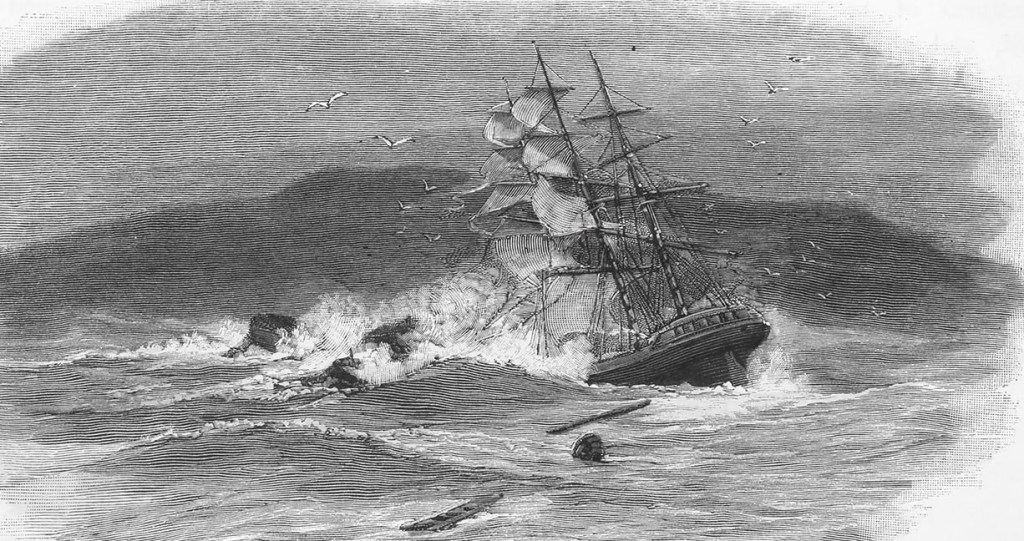
Cataraqui wrecked off King Island in Bass Strait. Image courtesy State Library of Victoria.
Australia’s worst shipwreck occurred off King Island on 4 August 1845. The 803-ton barque Cataraqui, carrying 409 people, slammed into rocks during foul weather. Only nine people made it ashore alive.
The Cataraqui sailed from Liverpool on 20 April, carrying 366 assisted migrants who were escaping poverty in England, and hoping to make a better life for themselves in Australia. Many of the passengers were women and children accompanying their menfolk, who had been guaranteed employment in the labour-strapped colonies.
The voyage had largely been uneventful until they were passing to the south of St Paul’s Island about halfway between the Cape of Good Hope and Australia’s west coast. On 15 July, the ship was struck by powerful winds and mountainous seas. For the next fortnight, there was no respite from the atrocious weather, as they steadily pushed east along the 40th parallel. They are not called the “Roaring Forties” for nothing.
By Sunday, 3 August, the Cataraqui was only one or two days’ sailing away from Melbourne and still the strong winds and high seas had not abated. At 7 p.m., Captain Charles Finlay estimated their position at 39° 17’S 141° 22’E or about 100 kilometres south of Cape Nelson on the Victorian coast. By 3 o’clock the next morning, the wind had begun to ease, and Captain Finlay bore northeast, expecting the distinctive profile of Cape Otway to come into view off his port bow. That would have given Finlay his first accurate position since passing St Paul.
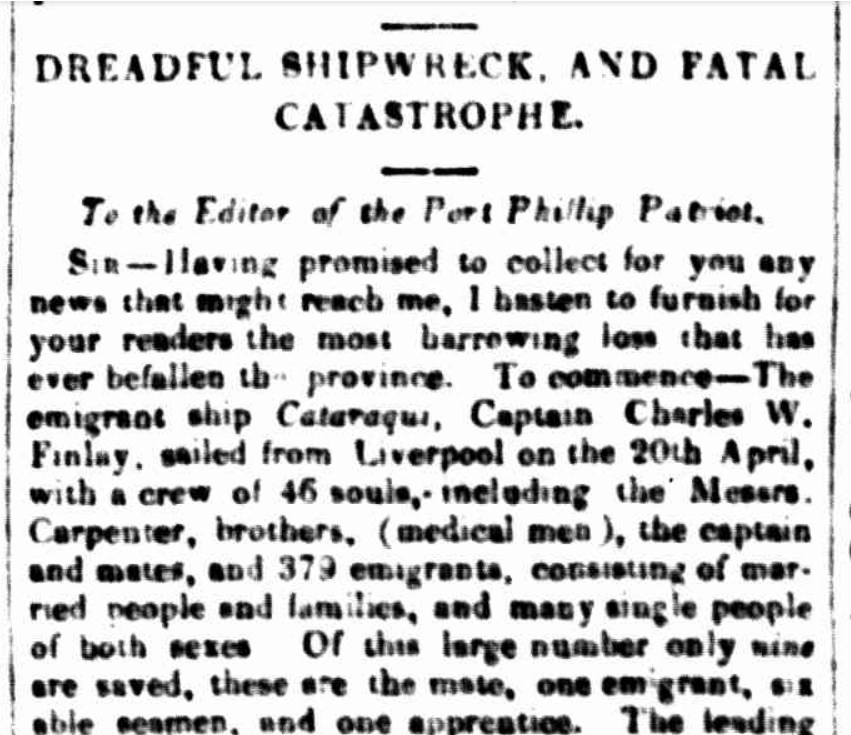
Report of the loss of the Cataraqui. Source: Port Phillip Patriot, 14 Sept 1845, p. 5.
Unfortunately, the strong winds had pushed the Cataraqui along faster than he had calculated. Unbeknown to him, his ship was further east and further south than he realised. So, rather than making towards Cape Otway with deep water ahead, the ship was heading towards the rugged west coast of King Island, hidden behind a blanket of thick weather and inky darkness.
At 4.30 a.m., the ship struck rocks near Fitzmaurice Bay. First Mate Thomas Guthrie provides a harrowing account of those first few hours, which was published in the Port Phillip Patriot on 14 September 1845.
“Imagine 425 [actually 409] souls,” he began, “of which the greater part were women and children, being suddenly awakened from a sound sleep by the crashing of the timbers of the ship against the rocks. The scene was dreadful, the sea pouring over the vessel—the planks and timbers crashing and breaking—the waters rushing in from below, and pouring down from above—the raging of the wind in the rigging and the boiling and hissing of the sea—joined to the dreadful shrieks of the females and children, who were drowning between decks.”
“The attempts of so many at once to get up the hatchways blocked them up, so that few got on deck uninjured, and when there, the roaring noise, and sweeping force of the sea was most appalling. Death stared them in the face in many forms— for it was not simply drowning, but violent dashing against the rocks which studded the waves between the vessel and the shore.”
“When day broke, they trusted to find a way to the shore, but no, the raging waves and pointed rocks rendered every attempt useless. The sea broke over the vessel very heavily, and soon swept away the long boat and almost everything on deck.”
Cataraqui wreck site. Courtesy Google Maps
In those few desperate hours, it was estimated that some 200 people lost their lives. Another 200 were faced with the stark reality that, even though the land was tantalisingly close, there was no safe way to reach it. The ship had struck a rocky reef running parallel with and a short distance from the coast. Captain Finlay ordered the masts cut away. He hoped the powerful waves might then carry the lightened ship over the rocks and closer to shore, where the survivors might stand some chance of reaching land. Unfortunately, it had no effect. The ship remained firmly stuck on the jagged rocks. Finlay then tried floating a buoy ashore, but the rope became entangled in kelp long before it could be used as a lifeline.
Around mid-morning, Captain Finlay ordered their only surviving boat over the side. He, the boatswain, the ship’s surgeon and four seamen set off in her in a desperate attempt to get a line ashore. However, the boat overturned in the tumultuous seas. Finlay was the only one to make it back to the ship alive.
At midday, the Cataraqui broke amidships and the aft sank, taking about 100 terrified people with it. By now, there were only 90 people still clinging to the wreckage. By midnight, 12 hours later, they were down to 50. Overcome by fatigue and the freezing cold, one survivor after another dropped from the wreck into the raging sea.
Thomas Guthrie clung on for as long as he could. But then he was finally swept from the last vestige of the wreck as it sank below the surface. Somehow, he avoided being dashed against the rocks, and the surf deposited him on the beach to join eight other survivors. One was Solomon Brown, a 30-year-old labourer who had joined the ship with his wife and four daughters. He was the only passenger to make it off the ship alive. The other seven, like Guthrie, were members of the crew.
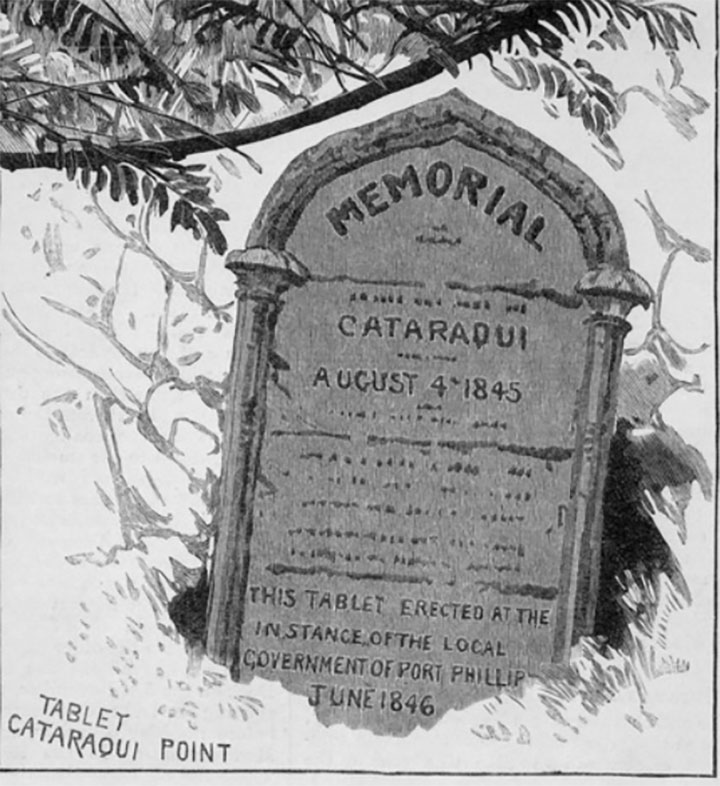
Memorial to the Cataraqui shipwreck on King Island. Source: Australasian Sketcher, 29 Dec 1887, p. 197.
The next day, on 6 August, the survivors were discovered by a party of sealers. Likely alerted by the debris being washed ashore near their camp, they had gone to investigate. Finding the nine survivors in a desperate state, the sealers built a shelter for them, started a fire, and fed them with provisions brought over from their own camp. Guthrie and the other Cataraqui survivors stayed with the sealers for four weeks. On 7 September, the cutter Midge arrived with fresh provisions. When she returned to Melbourne with a cargo of seal and wallaby skins, the survivors went with her.
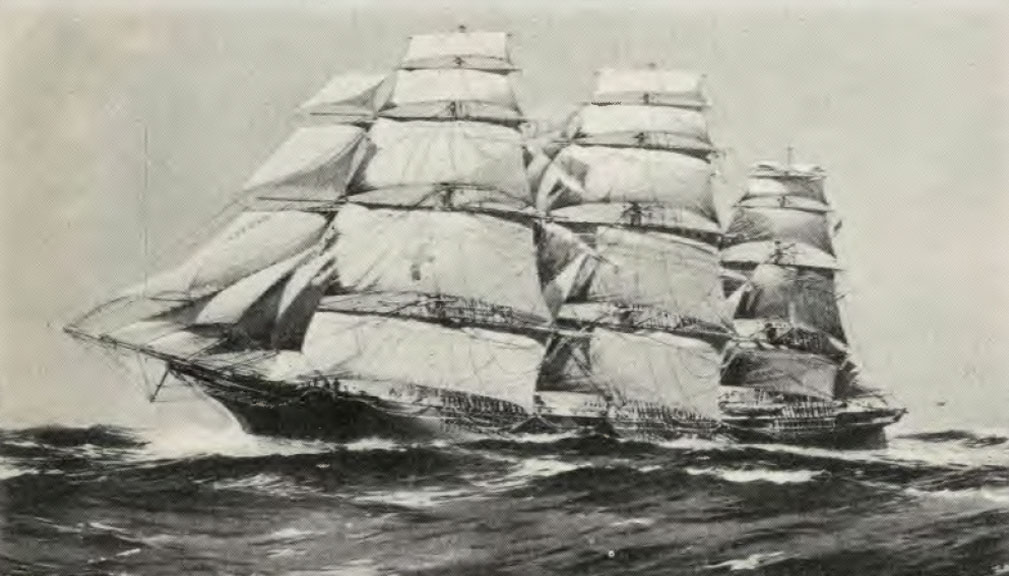
Example of an American Clipper similar to the Ticonderoga.
In November 1852 a migrant ship dropped anchor in Port Phillip Bay with some 700 passengers, many of them gravely ill. The 1,200-ton American Clipper Ticonderoga had been chartered to bring immigrants out to start a new life in Australia, but the three-month journey to their new home proved a nightmare for many of the mostly Scottish passengers.
Victoria was experiencing a labour shortage and had started offering assisted passage for workers to come and settle in the colony. Most of the passengers comprised of farmhands and their young families. But, not surprisingly, there was an incentive to get the most people out at the lowest cost to the Government.
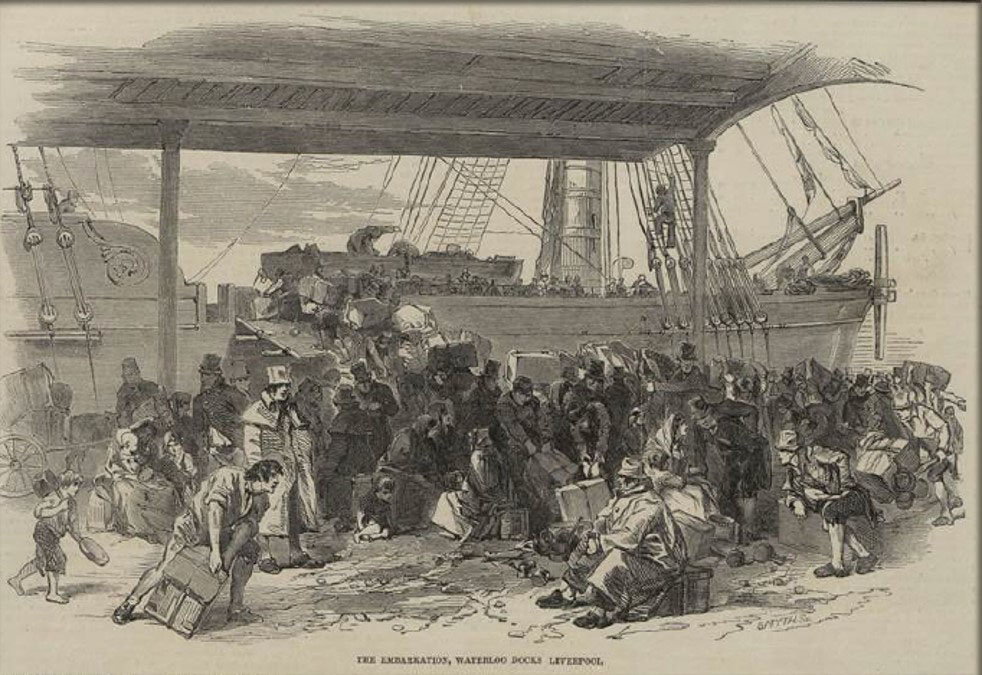
When the Ticonderoga left Liverpool she was overcrowded, even by the standards of Victorian England. Not long into the voyage passengers, many of them young children, started developing a red rash, high fever and sore throat. At the time the disease was sometimes called scarlet fever or Scarlatina, but it is generally thought today that it was Typhus that wreaked so much havoc on the passengers. Easily treated with antibiotics today, it had a devastating effect on those trapped onboard the ship.
The Embarkation, Waterloo Docks. Illustrated London News, 6 July 1850.
It was impossible to separate the sick from the healthy passengers in the overcrowded, poorly ventilated and unsanitary passenger accommodation spread across two decks. Consequently, the disease spread unchecked.
Passengers died in such numbers that as many as ten would be bundled together into a sheet of canvas for burial at sea. By the time they reached the port city of Melbourne more than 100 people had lost their lives. Another 150 were sick and in desperate need of medical attention, for they had long run out of medical comforts and the ship’s surgeon had been felled by the disease while attending to his patients. Many of those, 82 to be precise, died in the days and weeks that followed.
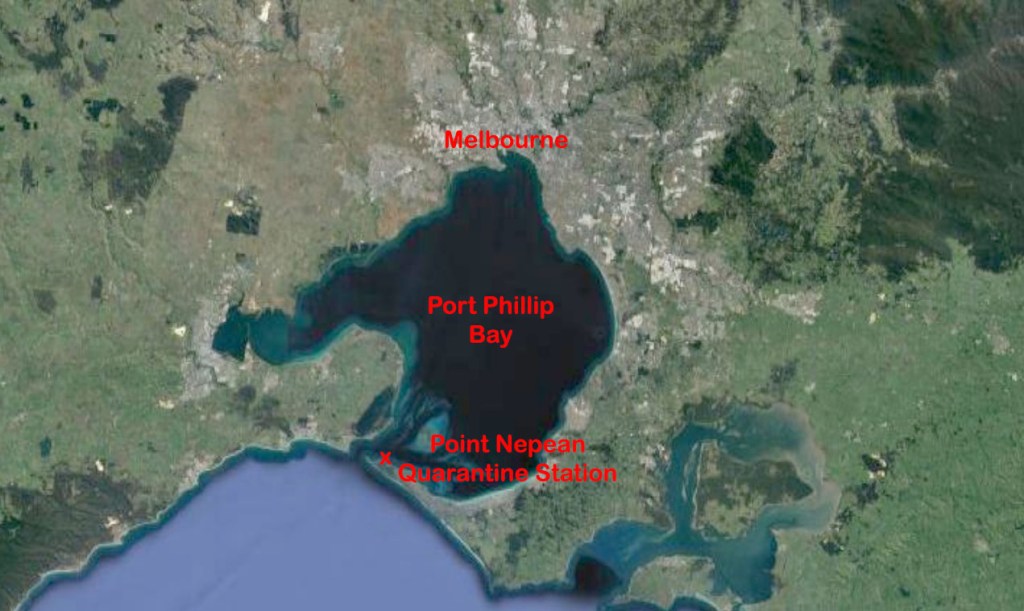
Port Phillip Bay. Source: Google Maps.
The passengers and crew were quarantined at Point Nepean just inside the Port Phillip Bay heads for the newly formed Victorian Government had already earmarked a parcel of land there to build a quarantine station. Tents were hastily erected using spars and ship’s sails and two nearby houses owned by lime burners were used as makeshift hospitals and staffed with medical men brought out from Melbourne. A ship was also dispatched to the Quarantine Station to serve as a hospital for the more serious cases.
The quick response contained the highly infectious disease and kept it from spreading to the general population. By January 1853 the epidemic had run its course. The surviving passengers were taken to Melbourne and the Ticonderoga was released to go on its way but not before being thoroughly fumigated.
Empire, 15 Nov 1852 Page 2.
The Emigration Commissioners who had chartered the ship in the first place were roundly condemned for allowing so many migrants, especially families with young children, to be sent out in such unhealthy conditions. The Ticonderoga was just the last and worst of several recent migrant ships coming to Australia to suffer such an appalling loss of life.
Between the Bourneuf, the Wanota, Marco Polo, and Ticonderoga, 279 passengers had died at sea as a result of infectious diseases on the passage out to Melbourne. The lesson was learned and future migrant ships were reduced to carrying no more than 350 passengers.
Cross section of emigrant ship Bourneuf. From Illustrated London News 10 July 1852.
On 3 August 1853, the 1500-ton Bourneuf sank in Torres Strait as she was returning to England. It was ironic that her return was cut short, for her voyage out to Melbourne, Victoria, had been no less tragic. She had left Liverpool in mid-July the year before carrying some 800 impoverished emigrants keen to start new lives in Australia. But one in ten would never make it.
Convict transportation to New South Wales had ceased two years earlier, and the recently constituted Victorian Government had introduced an assisted migration program to try to solve a chronic labour shortage. The colony had long been short of domestic servants, farm labourers, and other workers, but the recent discovery of gold had only exacerbated the problem. Meanwhile, England was still grappling with the social dislocation brought about by the Industrial Revolution. There were more people than there was jobs. On the surface, the migration program appeared to solve both intractable problems; however, transporting the migrants halfway around the world proved costly. Not surprisingly, there was an incentive to transport the largest number of people at the lowest cost to the Government.
Emigration Depot at Birkenhead, Liverpool. A ship, possibly the Bourneuf, about to depart for Australia in 1852.
The emigrants, many of them families with young children, were crammed into the Bourneuf’s two tiers of tiny cabins. Passengers were required to prepare their own meals in tightly packed communal kitchens. Bathing and toilet arrangements were rudimentary at best and maintaining good hygiene was impossible from the outset in the overcrowded confines of the ship. The close, fetid conditions were the ideal environment for the spread of communicable diseases. And, it was not long before people started coming down with dysentery. By mid-voyage, measles and scarlet fever were sweeping unchecked through the ship, taking a terrible toll.
Isolating the sick proved impossible, and for much of the passage, ten or more people, mostly children, died every week. By the time the Bourneuf dropped anchor off Geelong on 20 September, disease had claimed the lives of 83 passengers. The ship was immediately placed in quarantine while 20 desperately ill passengers recovered.
It would be nice to think that this had been an incident, but that was not the case. Four ships packed with assisted migrants made the long passage out to Victoria in 1852; the Wanota, the Marco Polo, the Ticonderoga and, of course, the Bourneuf. All were grossly overcrowded, even by the standards of the day. Disease outbreaks raged on all four ships with terrible consequences. No fewer than 279 passengers died on the four voyages. Many more passengers had to be hospitalised and quarantined on arrival. However, the lesson was eventually learned, and the Emigration Commissioners limited future migrant ships to carrying no more than 350 passengers.
Example of immigrant accommodation on the 1874 James Craig barque at the Maritime Museum in Sydney, New South Wales, Australia. Photo C.J. Ison.
The Bourneuf remained in Port Phillip Bay for ten months, eventually setting sail on 18 July 1853 divested of her passengers. She sailed from Melbourne bound for Bombay before continuing back to England.
Captain Bibby made his way up Australia’s east coast, pushed along by a south-easterly trade wind. After first passing through the Tasman Sea, he continued north into the warm tropical waters of the Coral Sea. The Bourneuf remained several hundred kilometres off the coast and well outside the Great Barrier Reef. This had become known as the “outer passage” and was considered by mariners to be safer than navigating close to land inside the reef. Captain Biddy intended to cross through the Great Barrier Reef at the Raine Island entrance so he could carefully pick his way through the labyrinth of shoals that lay in Torres Strait.
Unfortunately, it appears that Captain Biddy had miscalculated his run towards the entrance. At 1 a.m. on 3 August 1853, a lookout spotted a thin white line of breaking surf looming out of the darkness. By the time the danger had been seen, it was too late to take evasive action. The ship slammed into the Great Detached Reef about 15 kilometres south of the Raine Island entrance. Unrelenting swells from the Pacific Ocean pounded the stranded vessel. Captain Bibby gave the order to abandon ship. Thirty-nine people took to three lifeboats that night.
Two of the boats managed to get clear of the stricken vessel, and the survivors were later rescued by the Dutch ship Everdina Elizabeth. Captain Biddy, his wife, sister-in-law, and five crew drowned when huge waves capsized their lifeboat while they were still alongside the Bourneuf.
The Bourneuf is just one of 37 ships known to have been lost in or near the Raine Island Entrance during the 19th Century.







 Tales from the Quarterdeck