Category: #Maritime History

  • Cyclone Mahina & the loss of the North Queensland Pearling Fleet, 1899.

    Pearling luggers at Thursday Island. Courtesy State Library of Queensland.

       On 2 March 1899, Cyclone Mahina formed near the Solomon Islands and began tracking south-west towards the Queensland coast. On the same day, a second weather system formed in the Arafura Sea northwest of Darwin. This “monsoonal disturbance” was named Nachon and began moving towards the southwest. Unbeknown to the Thursday Island pearling fleet anchored in Bathurst Bay, 400 kilometres down the Queensland coast, both of these powerful weather systems were bearing down on them. Mahina and Nachon would collide over Bathurst Bay, wreaking havoc on the fleet, resulting in the loss of as many as 400 lives.

    Cyclone tracks for Cyclone Mahina which devastated the Thursday Island Pearling fleet at Cape Melville on 5 March 1899

       The pearling fleet was based at Thursday Island in Torres Strait, but the pearlers regularly ventured across Queensland’s warm tropical waters in search of shells. Pearling schooners served as floating processing stations for their fleet of ten to 15 luggers and diving boats. It was those smaller vessels that ranged out over nearby reefs, collecting the lucrative shells from the sea floor.

       March 4 was a Saturday and, for the pearlers, the much-anticipated start to the weekend. After they had delivered their pearl shells to their respective station schooner, tending to any repairs and restocking with provisions for the next week, it was time to relax and catch up with friends and family whom they had not seen all week.

       The schooners Sagitta, Silvery Wave, and Crest of the Wave were anchored near Cape Melville just inside Bathurst Bay. As the prevailing winds had been blowing from the southeast for the previous three weeks, everyone was anchored close to shore where the mountains extending inland protected them from the worst of the wind.
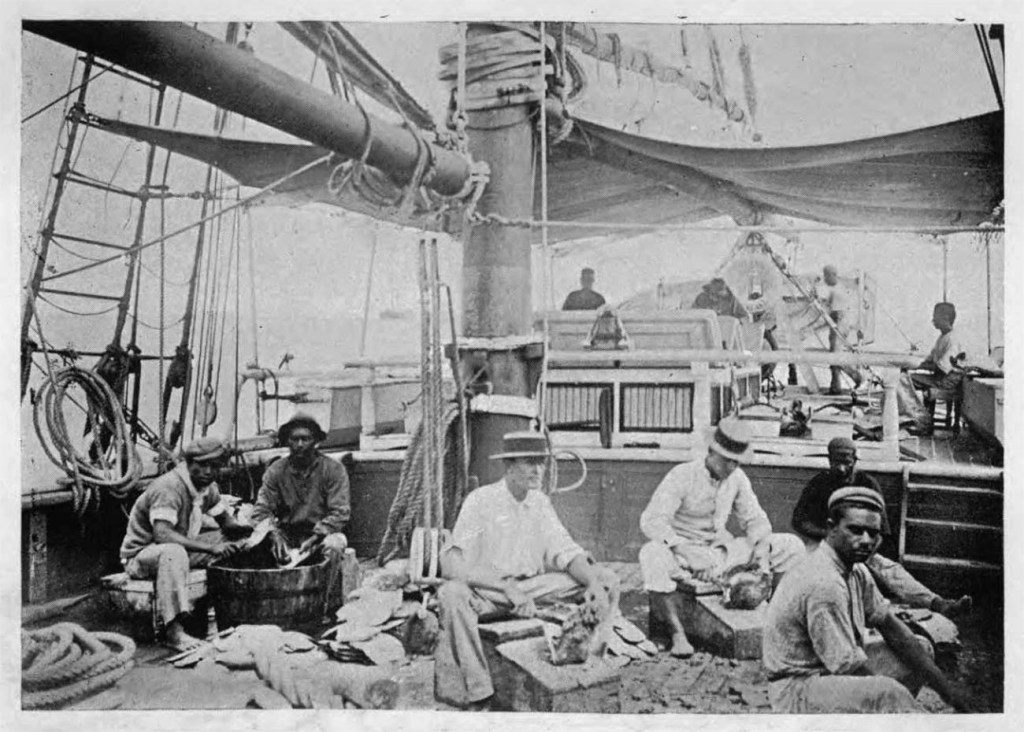
    Opening and cleaning shell on the schooner Olive. Source: The Pearling Disaster, 1899.

       The schooners Tarawa, Meg Merrilees, Olive and Aladin were anchored about 75 kilometres away near Pelican Island on the northwestern end of Princess Charlotte Bay. The manned Channel Rock lightship and several other pearling vessels were scattered along the Great Barrier Reef in the path of the approaching storm. No one, including the local Aboriginal people, could imagine the violent mayhem about to be unleashed upon them.

       At 7 o’clock on Saturday evening, only a moderate breeze was blowing from the southeast. However, just four hours later, the wind had increased to hurricane strength. It had also begun shifting direction from the southeast to the southwest. As Cyclone Mahina tore towards Bathurst Bay, the wind continued shifting further to the west, and eventually it blew from the northwest. For much of the early hours of Sunday, 5 March, the pearling fleet was exposed to the cyclone’s full fury. Torrential rain lashed the vessels. Streaks of angry lightning arced across the night sky while peals of thunder, howling wind and crashing waves competed to drown each other out. The hundreds of men and women trapped on their boats could do nothing but pray that they survived the ordeal.   

    Then, around 4 a.m., a massive storm surge swept through the bay. By 10 o’clock on Sunday morning, the tempest had moved inland, and some sanity returned to the world. It was only then that the few survivors would learn the full devastating impact of the storm.
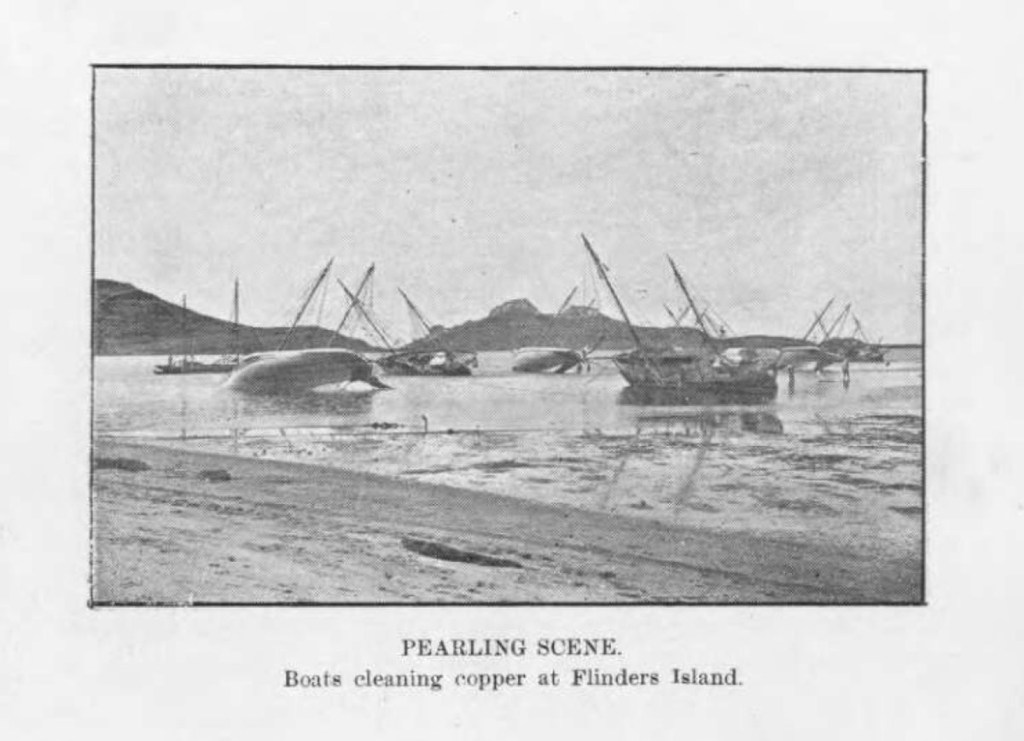
    Boats cleaning copper at Flinders Island. Source: The Pearling Disaster 1899.

       The Tarawa’s anchor cables had parted around 3 a.m., and she was swept onto Pelican Island. However, she was lucky for the damage would be easily patched, and she would limp back to Thursday Island. The Meg Merrilees dragged her anchors and ran onto a coral reef. All hands survived the wild night, but attempts to refloat the schooner were unsuccessful. The tender Weiwera was also lost. Of the 30 or so luggers anchored nearby, one-third sank with the loss of nine lives. The schooners Olive and the Aladin were more fortunate. Their anchors held, and they survived the night.

       The vessels lying off Cape Melville fared far worse. The 25-ton tender Admiral had only arrived in Bathurst Bay on the morning of the cyclone. She foundered at the storm’s height with the loss of her five crew and an unknown number of passengers brought down from Thursday Island to join the fleet. The Silvery Wave likewise was lost. Only a Japanese crew member named Sugimoto survived. The Sagitta was thought to have collided with the Silvery Wave and went to the bottom of Bathurst Bay with nearly 20 hands.   

    Captain W. Field Porter survived to give a harrowing account of that terrible night.  He recounted that his schooner, Crest of the Wave, was anchored near the other vessels off Cape Melville while about 40 luggers were in shallower water close to the beach. As the storm intensified, his anchors began dragging. Fortunately, the wind and current pushed the schooner into deeper water. “The intense darkness and driving rain prevented anything [from] being seen of the other boats or the land. The sea by this time was very rough, and enormous waves broke time after time on board,” Porter later wrote of his experience.

    “Mr Outridge, preparing for deep sea diving and assisted by Captain Porter of the Crest of the Wave.” Source: The Pearling disaster of 1899.

       The eye of the cyclone passed over his ship around 4.30 in the morning. After ten or fifteen minutes of dead calm, Captain Porter recalled, the wind suddenly came from the north-west, “with such terrific force that the schooner was thrown on her beam ends and [was] almost buried in the raging sea.” With much difficulty, the masts were cut away, and the ship righted itself. But by then, she had taken on a lot of water. The bilge pump was manned, and every spare hand bailed with buckets to keep the ship from sinking. Eventually, it was discovered that the water was entering through the rudder trunk. The leak was plugged with blankets and bags of flour, and the ship was saved. However, for 12 long and terrifying hours, the crew battled the elements, not knowing if each moment would be their last. Finally, the wind and seas started to ease, and Captain Porter and his men began to think they might just survive. As for the luggers, they either foundered at their anchorage or were driven ashore, where most were smashed to pieces. Some wreckage was found almost half a kilometre from the beach, taken there by the massive storm surge which swept several kilometres inland in places. Only a handful of the luggers were able to be refloated.

       The Channel Rock Lightship, moored between Cape Melville and Pipon Island, was nowhere to be seen after the storm passed and was believed to have sunk at her moorings with the loss of four lives. The bodies of Captain Gustaf Fuhrman and the mate Douglass Lee were later found near Cape Melville amongst debris from the lightship.

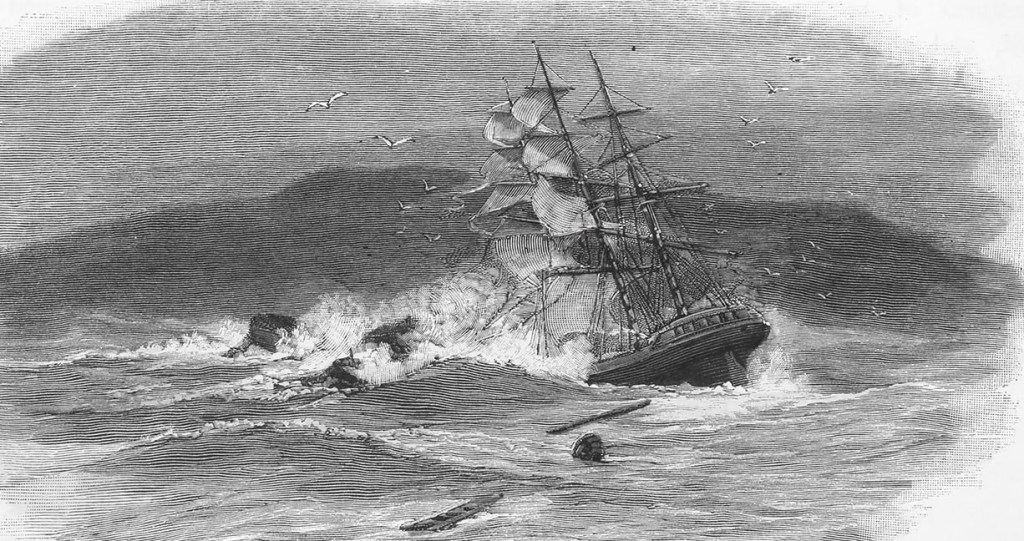
    Wreck of the Zanoni at Cape Melville, Source: The Pearling Disaster, 1899.

       It is estimated that some 300 pearlers lost their lives that night in Queensland’s most deadly natural disaster. While a dozen Europeans perished, most of the casualties were men and women from Torres Strait, the South Pacific, Japan and Malaya. Most were buried where their bodies were found with simple timber markers noting their final resting place. It was thought that as many as 100 local Aborigines were also killed during the storm and its massive tidal surge.

       On Flinders Island, several dolphins were found washed up on rocks almost five metres above the high tide mark. One witness painted a vivid picture of the destruction at Bathurst Bay. “There is quite a forest of mastheads and floating wreckage, the boats having evidently sunk at the anchorage. There are tons of dead fish, fowl, and reptiles of all descriptions, and the place presents the appearance of a large cemetery. All the trees have been stripped of their leaves.”

       Four schooners and 54 luggers were wrecked beyond repair, which devastated Thursday Island’s pearling industry. The human cost was even higher. With so many casualties, barely a family on Thursday Island escaped losing a loved one.
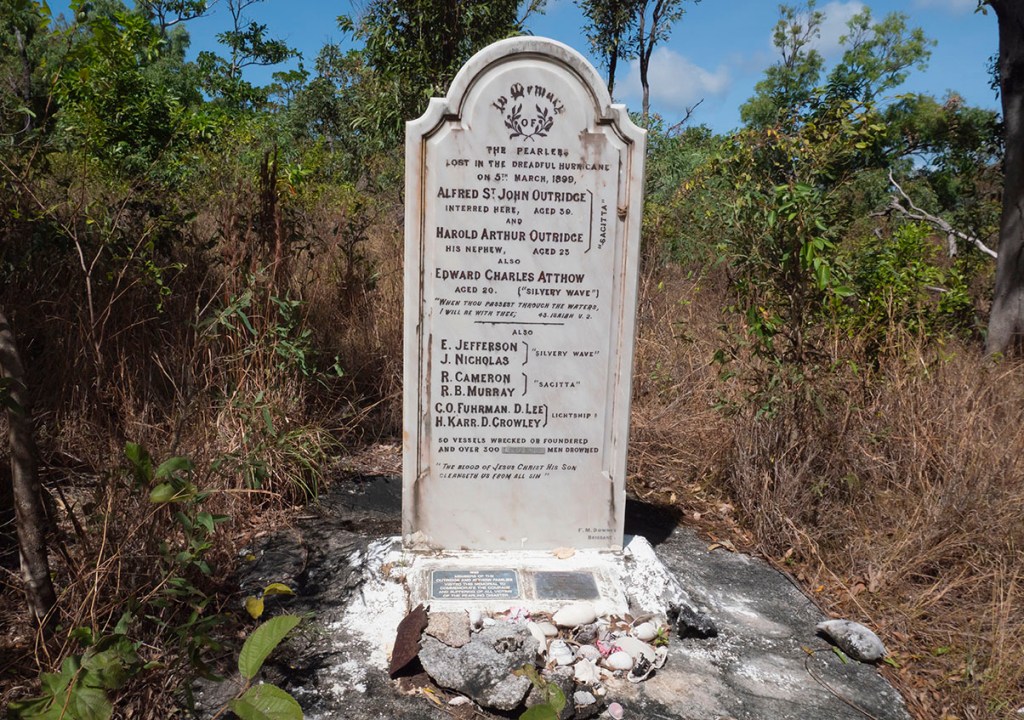
    Cyclone Mahina memorial at Cape Melville which marks the loss of 300 people during the storm. Photo: CJ Ison.

    © Copyright C.J. Ison / Tales from the Quarterdeck, 2024.

    Please enter your email address below to be notified of future blogs.

  • Shipping Cleopatra’s Needle

    Cleopatra’s needle being brought to England, 1877. Courtesy, National Maritime Museum, Greenwich, London

    In September 1877, a most unusual-looking vessel left the Egyptian port of Alexandria bound for England.   She was the brainchild of engineer John Dixon and had been purpose-built to carry a 200-ton stone obelisk to London.   “Cleopatra’s Needle”, as it became known, had been gifted to Great Britain almost sixty years earlier, but until Dixon came along, no one had found a cost-effective way of transporting the massive monolith to its destination on the banks of the Thames River.    

    The obelisk had originally been erected at Heliopolis near present-day Cairo in 1450 BCE on the orders of Thutmose III.    Two hundred years later, Ramses II added inscriptions commemorating his victorious battles.  Then, in 12 BCE, Cleopatra had it, and a second obelisk carried down the Nile to Alexandria and installed outside a temple to Julius Ceasar and Mark Antony, where they were eventually lost to time.

    While visiting his brother in Egypt in 1875, Dixon devised a plan to get the needle to London.   There had been a couple of schemes suggested in the past.   One proposed dragging the heavy monolith through the narrow streets of Alexandria to the port where it could be loaded onto a ship.  Another was to dredge a channel from the waterfront to get a ship alongside the monolith where it lay.   Neither was particularly economical or practical.   But, after taking a look at the obelisk in situ, Dixon thought he had the solution.

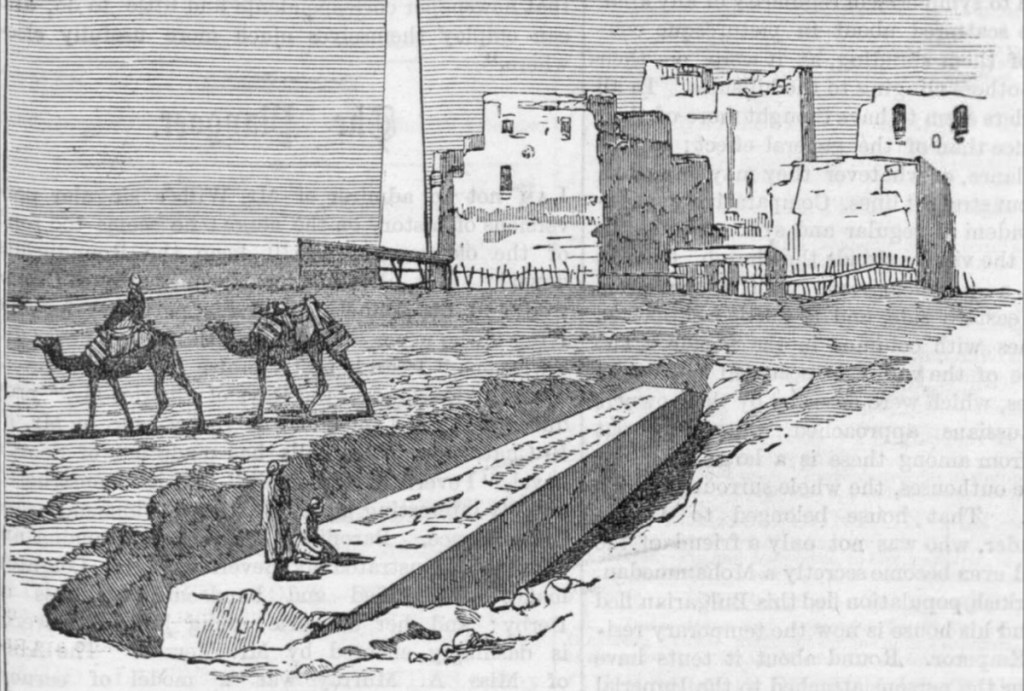
    “Cleopatra’s Needle as it lay.” Penny Illustrated Paper, 29 Sept 1877, p. 13.

    The obelisk was lying on its side, covered in sand behind an old quay wall about 4 metres above sea level.   On the seaward side of the wall, the sand sloped down gently to the water’s edge, eventually reaching deep water a few hundred metres away.   Rather than move the obelisk to a ship, Dixon proposed building a cylindrical vessel around Cleopatra’s Needle and, after removing a portion of the quay wall, rolling it down the slope and into the sea.   He estimated the venture would cost no more than £5,000 to get it to London and another £5,000 to have it installed on the Thames Embankment.   The cost was a far cry from the £80,000 the French had apparently paid to have one delivered to Paris in the 1830s.  

    With the government showing no interest in wearing the cost, it was up to private enterprise to come to the fore.    Dixon even offered to contribute 500 guineas of his own money to get things started.   But after two years of stagnation, a benefactor in the form of the noted surgeon and philanthropist Professor Erasmus Wilson stepped forward and donated the full amount.

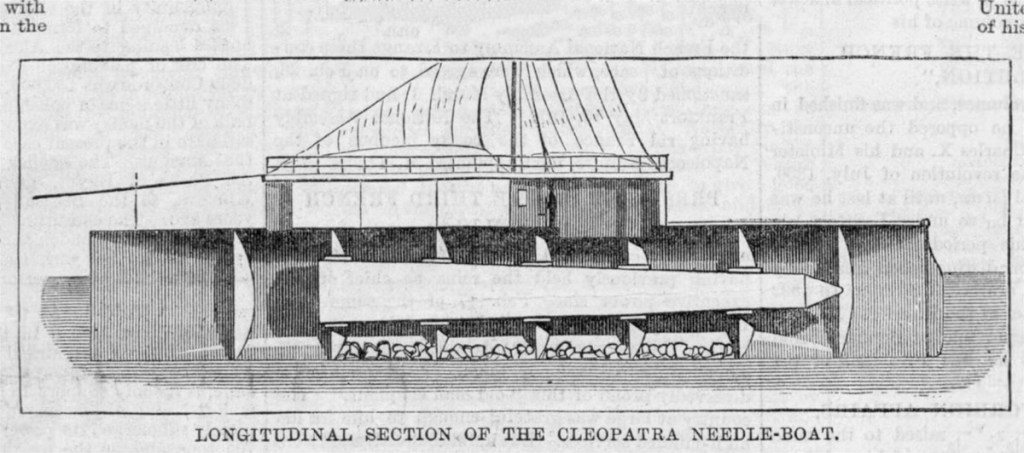
    Logitudinal section of the Cleopatra Needle-Boat, Penny Illustrated Paper, 8 Sept 1877, p. 9.

    By May 1877, Dixon was back in Alexandria and had begun work excavating around the buried obelisk.   It measured nearly 21 metres long and was slightly over 2 metres wide at the base.   He began encasing it in an iron cylinder 28 metres in length and 4.5 metres in width.   To prevent the stone and hieroglyphs from being damaged, Cleopatra’s Needle was cradled by several iron interior bulkheads lined with timber.

    The vessel resembled a giant cigar tube and was now ready to be floated.   A path was cleared and it was rolled towards the sea.   However, when tugs took the tube in tow, they discovered she had filled with water.    A stone had punctured a plate while the tube was being rolled down the beach.   The damaged plate was repaired, and the tube pumped dry.     Ballast was added, and the odd vessel was towed to a waiting dry dock where the rest of the work would be completed.

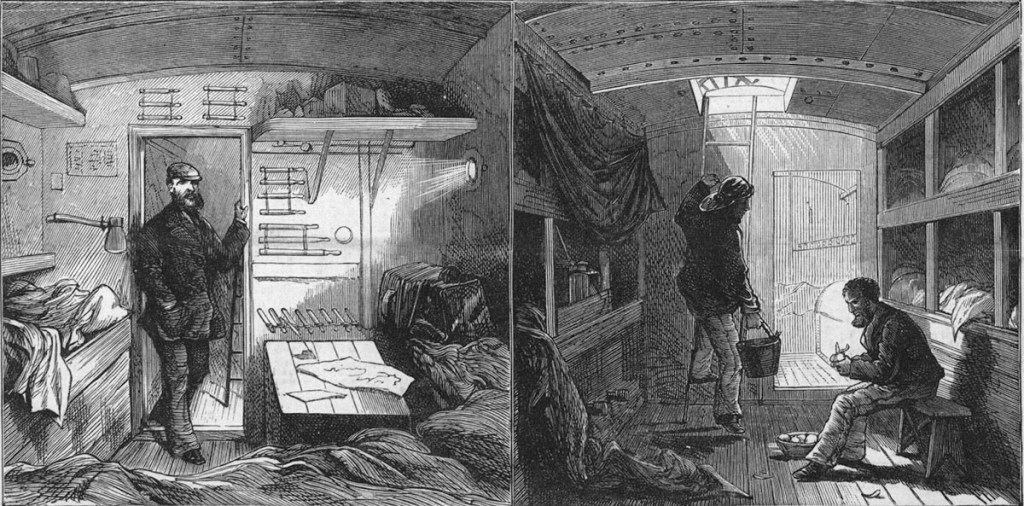
    Captain’s Cabin (left), Main cabin (right), Illustrated London News, 26 Jan 1878, p. 96.

    A cabin large enough to accommodate four men was mounted on the top of the tube and a keel below.   A stumpy mast and rigging were installed, along with a rudder, wheel and associated running gear.   The Cleopatra, as she was named, was ready to make the 6000-kilometre voyage to London.   Not having the means to propel herself, she was to be towed to England by the steamer Olga.   The sail and steering gear were only fitted to ease the strain on the steamer.

    On Friday morning, 21 September, Captain Booth gave the order for the Olga to get underway.   As she cleared Alexandria Harbour, the Cleopatra followed in her wake, tethered by a pair of tow cables.  They chugged along at a steady six knots, which was about as fast as the Olga could go towing her cumbersome load.    It cannot have been a pleasant cruise for Captain Campbell and his men on the Cleopatra.   At first, she yawed terribly, pulling one moment to port and the next to starboard.   However, once the Cleopatra’s steering chains were tightened and the towing cables lengthened, she finally ran true behind the steamer.   However, that did not stop her tendency to porpoise.   Dixon, who was travelling on the Olga, wrote, “I have counted as many as 17 times a minute that her nose has been underwater, and then ten or twelve feet above.” 

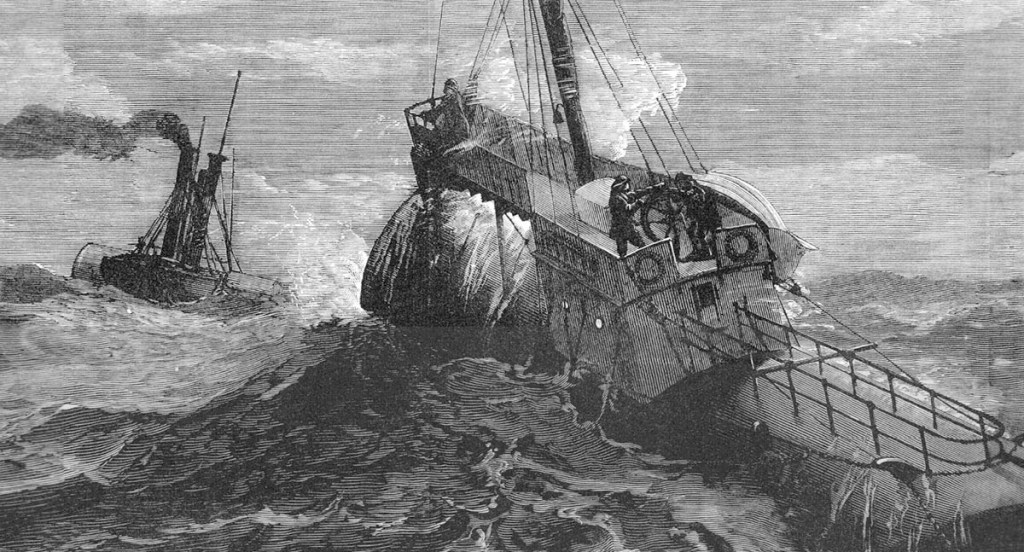
    First night out in the Bay of Biscay. From a sketch by our special artist on board the tug Anglia. Illusgtrated London New, 26 Jan 1878, p. 92.

    Apart from a few minor leaks, which were quickly plugged with cement, the voyage was uneventful until they were about to cross the Bay of Biscay.    On Sunday, 14 October the Olga and the Cleopatra were off Cape Finisterre when they were caught in a violent storm.  They were lashed by huge seas and a Force 7 to 8 gale blowing from the southwest.   That night, the Cleopatra’s ballast shifted and she was thrown onto her beam ends.   Captain Campbell cut away the mast, but the vessel did not right herself.   With the Cleopatra floundering around at the mercy of the wind and the waves, Campbell fired off his distress flares.  Captain Booth sent six men across to help in any way they could, but they were lost in the maelstrom before they reached the heavily listing vessel.   Eventually, Campbell and his men climbed into a boat and were hauled across to the Olga with the aid of a rope.  

    Captain Booth had no choice but to cut away the Cleopatra as he went in search of his six missing crew.   After spending some time searching the seas, the effort was abandoned, and the Olga headed for Falmouth to report the tragedy.   However, a couple of days later, the Cleopatra was found adrift about 170 kilometres off the Spanish coast by the crew of the Scottish steamer Fitzmaurice. They had been en route from Glasgow to Valencia when they happened upon the strange vessel bobbing in the water. They took it in tow and delivered it to the Spanish port of Ferrol and reported their find to the British Vice-Consul.  

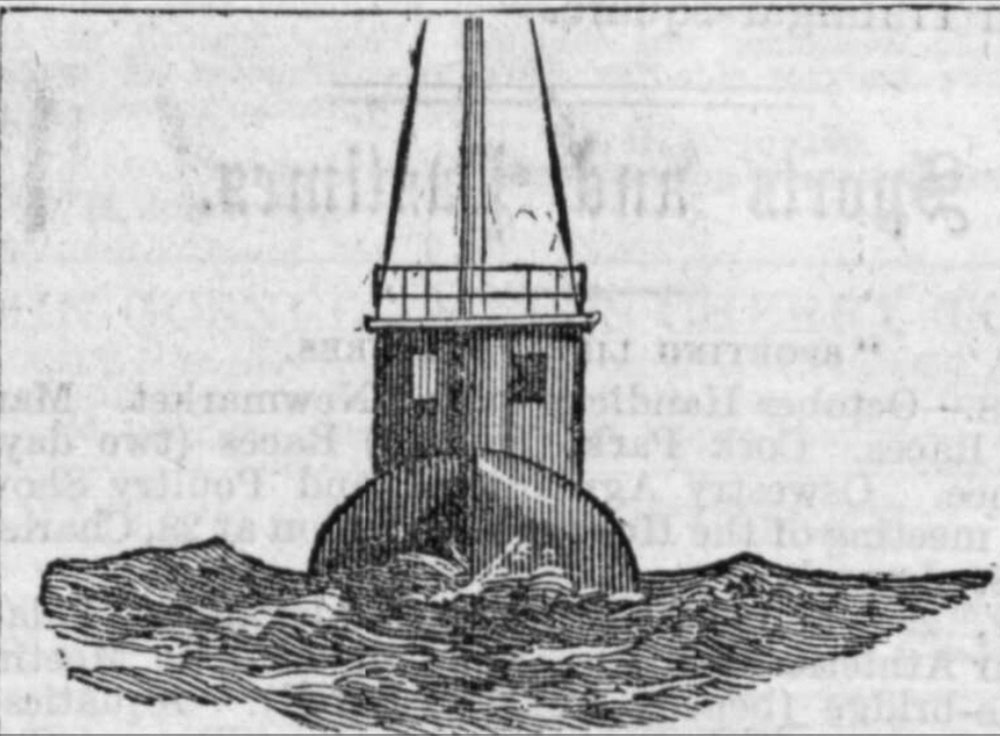
    “End view of the pontoon.” Penny Illustrated Paper, 29 Sept 1877, p. 13.

    Dixon offered the salvors £500 for finding the Cleopatra and its priceless cargo and taking her to port.    However, the Fitzmaurice’s owners claimed salvage rights ten times that amount.   The case eventually headed to the Admiralty Court, where the sum of £2000 was decided upon.   Meanwhile, the Cleopatra was towed the rest of the way to England, and up the Thames River to London, where it was to be installed on The Embankment.   There, the Cleopatra’s hull was opened up, and the obelisk removed none the worse for its long sea voyage.   Cleopatra’s Needle was erected on a new plinth where it still stands to this day.   A plaque commemorates the six men who lost their lives trying to save the Cleopatra and her crew.

    © Copyright C.J. Ison / Tales from the Quarterdeck, 2024.

    Please enter your email address below to be notified of future blogs.
  • The 1878 Loch Ard Tragedy

    “The Wreck of the Loch Ard near Sherbrook River.” Source: Illustrated Australian News, 8 July 1878, p. 20.

       In early June 1878, the Scottish merchant ship Loch Ard was expected to arrive in Port Phillip Bay at any time. But that was not to be. News soon reached Melbourne that the ship had been wrecked near the Sherbrook River, some 50 kilometres west of Cape Otway, with a fearsome loss of life.

       The Loch Ard was a 1623-ton fully rigged sailing ship belonging to the Glasgow General Shipping Company. But she proved to be an unlucky vessel. On her maiden voyage, she was twice dismasted. The first time it happened was shortly after she departed Glasgow on a voyage to Melbourne in December 1873. She was struck by a powerful storm and had to return to port to undergo a refit. She then set sail again in January the following year. This time, as she was crossing the Southern Ocean, she lost all three masts and nearly foundered during a ferocious storm. The resourceful captain was able to set jury-rigged masts from spare spars and limp the rest of the way to Melbourne.

       On this most recent voyage, the Loch Ard sailed from London on 27 February 1878 under the command of Captain George Gibbs with around 25 to 30 crew, 17 passengers and over 3,000 tons of cargo. But as she neared the end of her voyage, the weather closed in on that most dangerous stretch of Victoria’s coastline.

    The Loch Ard. By Allan C. Green – State Library of Victoria.

       The weather became squally, and the sky remained overcast for several days, preventing Captain Gibbs from making any observations as his ship ran before the wind under close-reefed topsails. Sailing instructions warned mariners to remain far out to sea until they had passed Cape Otway before making the final approach to the entrance to Port Phillip Bay. Unfortunately, Captain Gibbs was sailing blind and was unaware of how much danger he and his ship were in until it was too late.

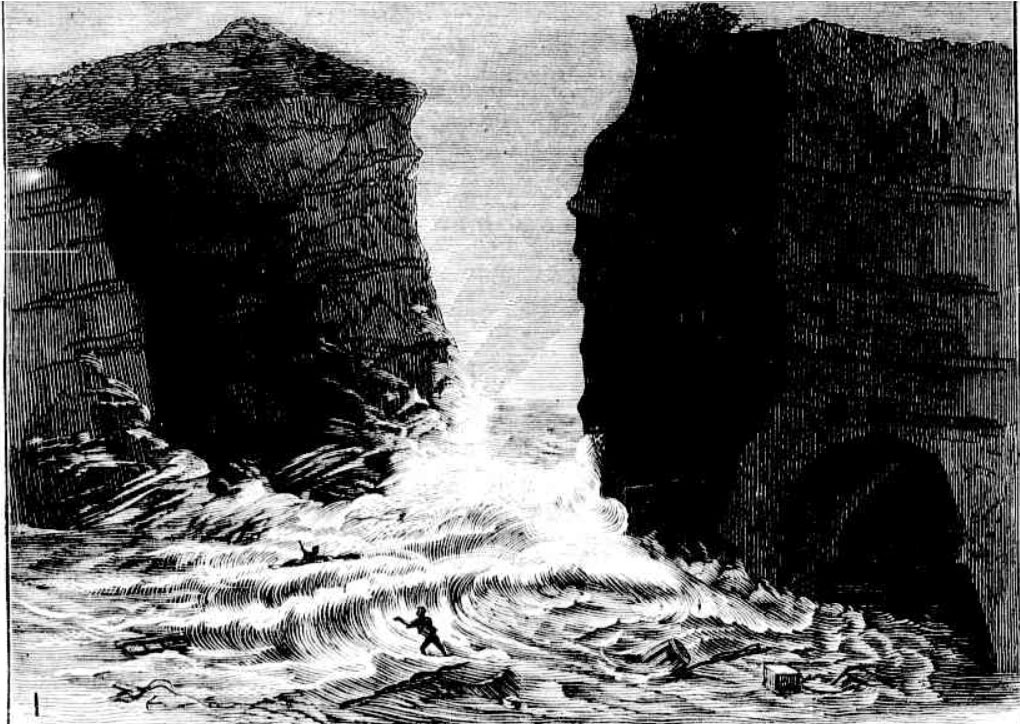
       Around 4 a.m. on 1 June, the lookout spotted white-capped waves breaking over a reef half a nautical mile (one kilometre) ahead. Gibbs ordered the ship to be put about, but the wind continued to push them towards danger. He then ordered both anchors to be let go, but they did not hold, and the ship continued towards the jagged fangs of the reef and the towering cliffs beyond.

       When they were just 150 metres from the rocks, Captain Gibbs ordered the anchors to be slipped, and he tried to put on more sail, hoping he might veer the ship back out to sea. But it was far too late. The crew had only managed to set the mainsail when the Loch Ard crashed into the rocks on her starboard quarter. The topmast went over the side, taking two seamen with it. Meanwhile, Gibbs ordered the lifeboats to be readied for the evacuation of the women. But by now, successive waves were crashing onto the deck and sweeping it clean.

    “The rescue of Miss Carmichael” Source: Illustrated Adelaide News, 1 Aug 1878, p. 13.

       Midshipman Thomas Pearce and several other seamen had tried getting one of the lifeboats over the side to begin taking on passengers when it was washed into the swirling seas. Meanwhile, the captain and several sailors were struggling to free another boat from a tangle of fallen rigging. Then, a massive wave lifted the Loch Ard off the reef, and she sank in deep water, spilling everyone into the turbulent seas.

       Pearce managed to cling to his upturned boat, but he never saw any of his shipmates again. By now, it was daylight, and he saw he was drifting towards a small bay. Once in the bay, he left the boat and began swimming towards shore. Then he found an upturned table and climbed onto it. He washed up onto a small sandy beach with all manner of crates, driftwood, and other debris from the wreck. After taking some time to recover his strength, Pearce searched the small bay to see if anyone else had survived. Just then, he heard a cry for help coming from the water. He then spotted a woman clinging to a spar bout 50 metres out in the bay.    He swam out, dragged her ashore, and the pair took shelter in a shallow cave. The young lady was 19-year-old Eva, the eldest daughter of the ship’s surgeon, Dr Carmichael. His wife and three children had accompanied him on the voyage, for they had intended to settle in Victoria.

    Miss Carmichael and Thomas Pearce. Source: The Illustrated Adelaide News, 1 Aug 1878, p. 13.

       After rescuing Eva, Pearce collapsed beside her from sheer exhaustion and slept. He felt somewhat recovered when he woke and turned his mind to scaling the high cliffs surrounding the bay so he could go and find help. He eventually found a route up and then a well-trodden path and began following it. After walking several kilometres, he came upon a shepherd tending to a flock of sheep. Pearce asked him to send for help while he returned to the bay to let Eva know assistance was on the way.

       However, when he returned to the cave, he found Eva was gone. Pearce searched the area but was unable to see her. When help arrived, the search continued. And then, just as night was falling, a faint cry was heard coming from behind a bush. There, they found Eva, barely conscious. She was hauled up the cliff face with the aid of a rope, where a carriage was waiting to whisk her away.

    The cave and wreckage strewn on the beach. Source: Australasian Sketcher, 6 July 1878, p. 11.

       Eva Carmichael and Thomas Pearce were the only survivors from the Loch Ard. The young midshipman had the unenviable task of identifying the remains of several bruised and battered bodies that washed up in the next few days.   

    Among the tons of debris washed ashore was one particularly well-constructed crate that contained a large porcelain peacock. It had been manufactured by Minton and had been sent out on the ship to be displayed at the upcoming 1880 Melbourne International Exhibition. It had survived the wreck without so much as a chip of damage. It and other relics from the Loch Ard are now on display at Warrnambool’s Flagstaff Hill Maritime Museum. The small bay where Thomas Pearce and Eva Carmichael made it ashore is now named Loch Ard Gorge.

    © Copyright C.J. Ison / Tales from the Quarterdeck, 2023.

    Please enter your email address below to be notified of future blogs.
  • The Loss of the SS Cawarra: Bad luck or an avoidable tragedy?

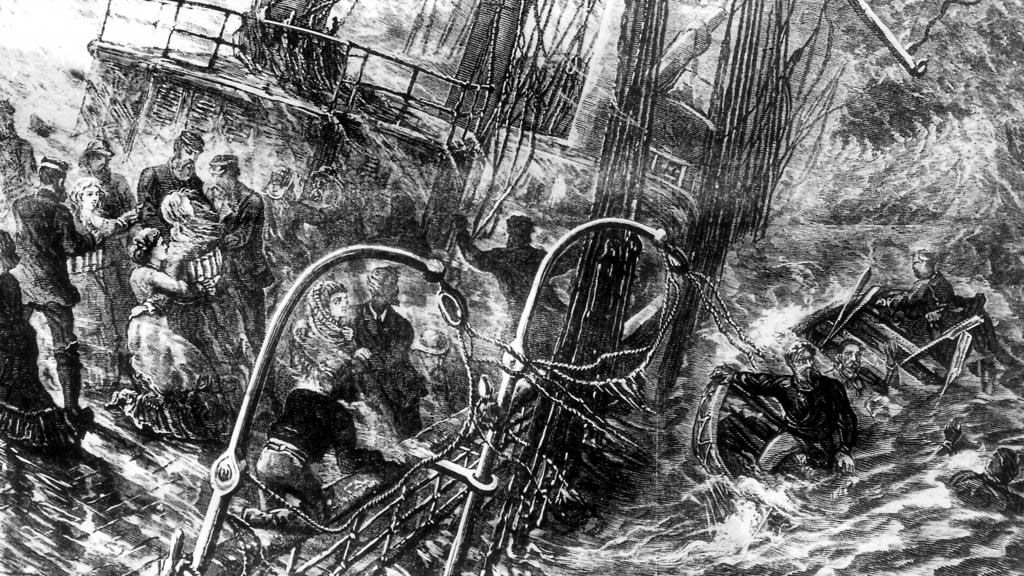
    “Foundering of the S.S. Cawarra off Newcastle.’ Source: Australian News for Home Readers, 27 Aug 1866, p. 4.

       When, in 1866, the Board of Inquiry into the Loss of the Steam Ship Cawarra handed down its report, it was met with much incredulity. After poring over the evidence for six weeks, the commissioners could only conclude that the catastrophe was simply the result of bad luck. That was despite evidence presented to them that the steamer had been grossly overloaded when she had left port.

       The SS Cawarra was a 439-ton side paddle steamer owned and operated by the Australian Steam Navigation Company, and regularly made the passage between Sydney and Brisbane. On what would be her last voyage, she had a crew of 36 and 25 passengers. In all, there were 61 souls on board. Around 6 p.m. on Wednesday, 11 July 1866, she passed through Sydney Heads on her way to Rockhampton via Brisbane. The northern settlement of Rockhampton had not been visited for some time, and basic provisions had run low. So, when the Cawarra’s hold was packed to capacity and no more would fit below, the remaining cargo was stowed on deck.

       As soon as the steamer was heading north through open seas, she was assisted on her way by a strong south-easterly breeze. But during that first night, the weather steadily worsened. By morning, the winds were shrieking at gale force, the seas were mountainous, and the ship was being lashed by torrential rain. In the face of such foul weather, Captain Henry Chatfield decided to take shelter at Newcastle until it was safe to resume his journey.

       Chatfield sighted the distinctive outline of Nobby Head at 2 o’clock in the afternoon, and shortly after that, the steamer rounded the headland to enter the port. However, as the Cawarra was approaching the mouth of the Hunter River, she was struck by a series of large waves that swept over her deck and pushed her around so she was now facing back out towards Nobby Head.

    “Position of Cawarra previous to foundering …” Source: Illustrated Sydney News, 16 Aug 1866, p. 5.

       It is thought that when Captain Chatfield realised his ship was in grave peril, he ordered the foresail to be set and tried to steam back out to sea. However, before he could do so, the Cawarra was hit by several more huge waves. They would spell her end. Water poured through the hatchways snuffing out the steamers’ fires. Now she was dead in the water at the mercy of the large seas. The ship then began to sink by the bow. Chatfield ordered the lifeboats to be made ready, but the treacherous seas swirling around the steamer made abandoning the ship impossible.

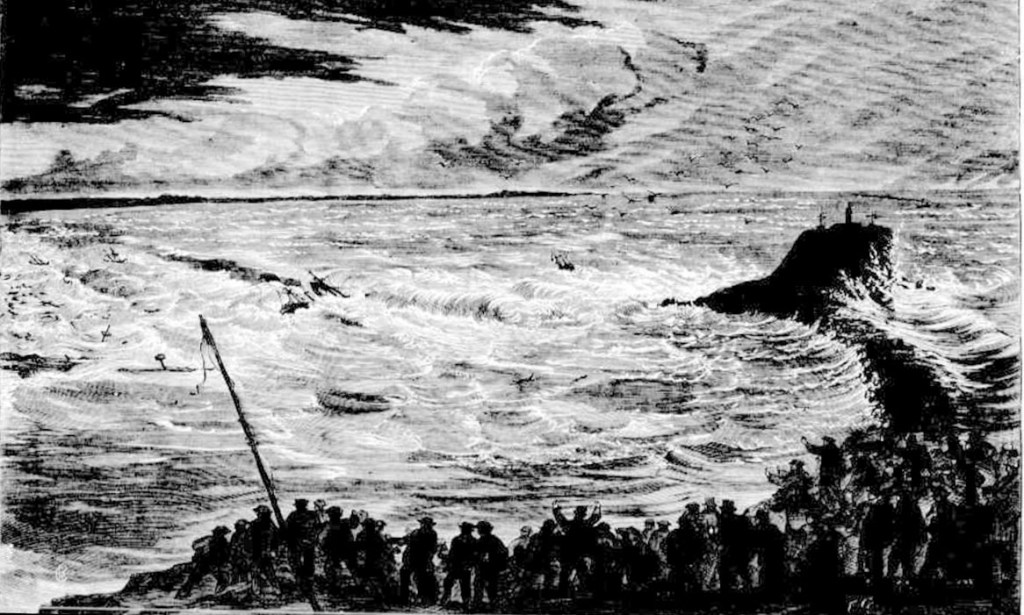
       Around 3 o’clock, the Cawarra was driven onto Oyster Bank. The foredeck soon disappeared below the waves, and everyone had gathered on the poop deck or had climbed into the rigging to escape the rising water. Fifteen minutes later, the mainmast and funnel toppled into the sea, taking with them all those sheltering on the poop. The foremast went a few minutes later, tossing the remaining three or four men into the water, and the Cawarra quickly sank from sight. It was as if she had never been there to observers watching the horror unfold from Nobby Head. Only a few pieces of wreckage and cargo washed ashore to testify that a ship had been lost.

       Sixty people died, while one man somehow managed to survive. Frederick Valliant Hedges had only joined the Cawarra eight months earlier. As the steamer began sinking by the bow, he had climbed high into the mainmast rigging only to be flung into the sea when the mast came crashing down. Hedges was later found clinging to a red buoy by a boat sent out from the lighthouse. Ironically, one of the rescuers was a man named John Johnson, who had himself been the sole survivor of the Dunbar when it sank off Sydney nine years earlier.

    The Rescue of F.V. Hedges, the only survivor from the Cawarra. Source: Illustrated Sydney News, 16 Aug 1866, p. 4.

        The violent storm wreaked havoc on shipping up and down the coast between Sydney and Port Stephens. Four more vessels foundered or were driven ashore at Newcastle, and another was wrecked near Port Stephens, further north. Several more were lost around Sydney. In all, 15 vessels were wrecked or driven ashore, adding another 17 fatalities to the grim final tally.

       It is perhaps easy to blame the weather for the Cawarra’s loss. In fact, the commission established to investigate the circumstances found just that. Its report concluded: “We are of the opinion that the catastrophe was one of those lamentable occurrences which befall at times the best ships and the most experienced commanders, and which human efforts are powerless to avert.”

       However, that explanation did not sit well with many folk. It had the whiff of a cover-up. Accusations that the Cawarra had been overladen when she left Sydney flew around maritime circles. She was reportedly carrying 450 tons of coal and cargo, which was 50 tons more than recommended by the ship’s builders. An engineer and surveyor from the Steam Navigation Board testified at the inquiry that when he had seen the Cawarra shortly before her departure, he thought she was sitting lower in the water than usual and believed she had been overloaded. But when he had raised his concerns with his superior and the ship’s owners, they both dismissed his concerns, telling him the Cawarra was a strong ship.    The possibility that overloading could have contributed to the loss was even raised in the New South Wales parliament. The outspoken former clergyman and politician, Dr J.D. Lang, called for the Commission’s findings to be rejected, pointing out the contradictory evidence presented at the inquest. But it was all to no avail. The findings stood, and the loss was attributed to bad luck.

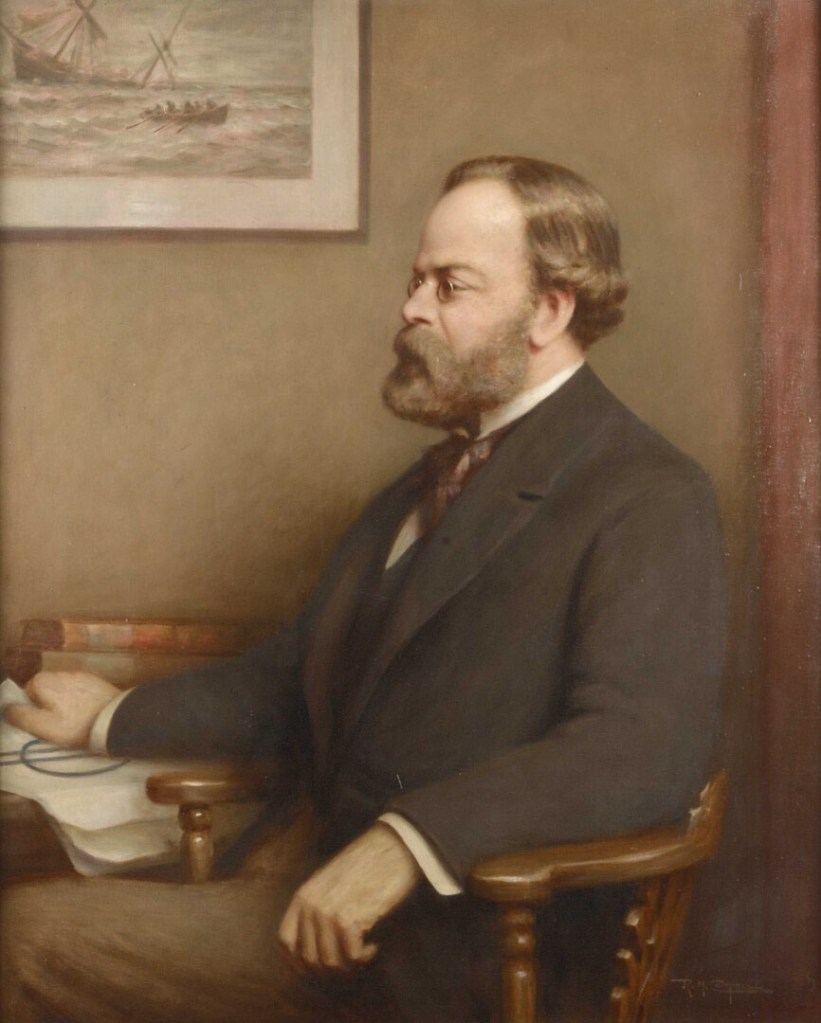
    Samuel Plimsoll. Wikimedia/creative commons.

       However, there were calls for a line to be marked on the hull of cargo ships to show when they were fully loaded. It would take another ten years before British parliamentarian Samuel Plimsoll was able to persuade his colleagues to take action. He was appalled by the number of ships and lives lost due to overloading. In 1876, the British Parliament passed legislation requiring markings on the sides of cargo ships, which would be submerged below the surface if the vessel was overloaded. This became known as the Plimsoll Line and is still in use today.

    © Copyright C.J. Ison / Tales from the Quarterdeck, 2023.

    To be notified of future blogs, please enter your email address below.

  • The Cataraqui: Australia’s deadliest shipwreck – 1845.

    Cataraqui wrecked off King Island in Bass Strait. Image courtesy State Library of Victoria.

        Australia’s worst shipwreck occurred off King Island on 4 August 1845. The 803-ton barque Cataraqui, carrying 409 people, slammed into rocks during foul weather. Only nine people made it ashore alive.

       The Cataraqui sailed from Liverpool on 20 April, carrying 366 assisted migrants who were escaping poverty in England, and hoping to make a better life for themselves in Australia. Many of the passengers were women and children accompanying their menfolk, who had been guaranteed employment in the labour-strapped colonies.

       The voyage had largely been uneventful until they were passing to the south of St Paul’s Island about halfway between the Cape of Good Hope and Australia’s west coast. On 15 July, the ship was struck by powerful winds and mountainous seas. For the next fortnight, there was no respite from the atrocious weather, as they steadily pushed east along the 40th parallel. They are not called the “Roaring Forties” for nothing.   

    By Sunday, 3 August, the Cataraqui was only one or two days’ sailing away from Melbourne and still the strong winds and high seas had not abated. At 7 p.m., Captain Charles Finlay estimated their position at 39° 17’S 141° 22’E or about 100 kilometres south of Cape Nelson on the Victorian coast. By 3 o’clock the next morning, the wind had begun to ease, and Captain Finlay bore northeast, expecting the distinctive profile of Cape Otway to come into view off his port bow. That would have given Finlay his first accurate position since passing St Paul.

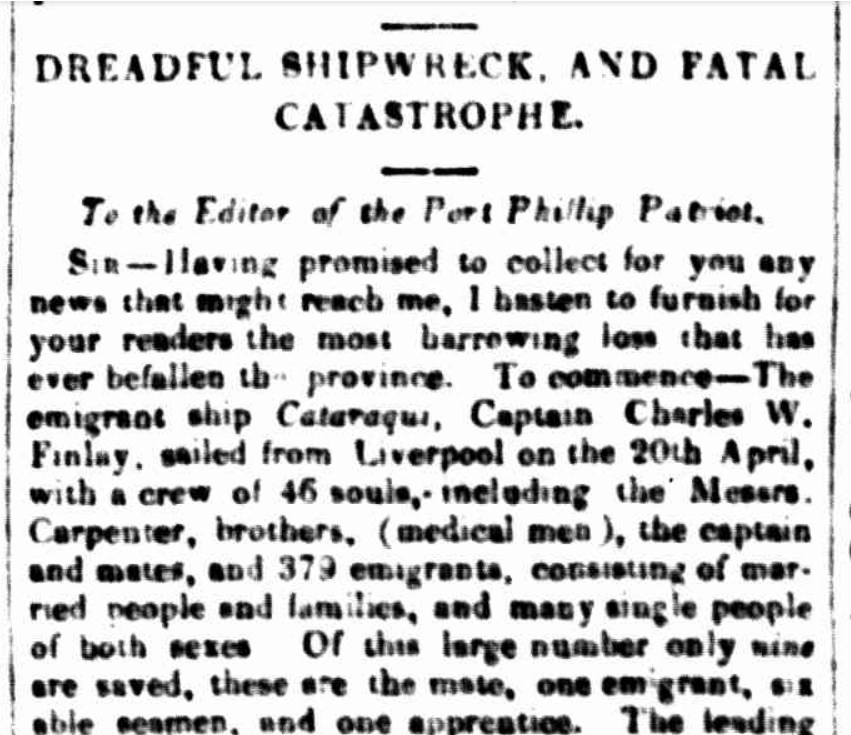
    Report of the loss of the Cataraqui. Source: Port Phillip Patriot, 14 Sept 1845, p. 5.

       Unfortunately, the strong winds had pushed the Cataraqui along faster than he had calculated. Unbeknown to him, his ship was further east and further south than he realised. So, rather than making towards Cape Otway with deep water ahead, the ship was heading towards the rugged west coast of King Island, hidden behind a blanket of thick weather and inky darkness.

       At 4.30 a.m., the ship struck rocks near Fitzmaurice Bay. First Mate Thomas Guthrie provides a harrowing account of those first few hours, which was published in the Port Phillip Patriot on 14 September 1845.

       “Imagine 425 [actually 409] souls,” he began, “of which the greater part were women and children, being suddenly awakened from a sound sleep by the crashing of the timbers of the ship against the rocks. The scene was dreadful, the sea pouring over the vessel—the planks and timbers crashing and breaking—the waters rushing in from below, and pouring down from above—the raging of the wind in the rigging and the boiling and hissing of the sea—joined to the dreadful shrieks of the females and children, who were drowning between decks.”

       “The attempts of so many at once to get up the hatchways blocked them up, so that few got on deck uninjured, and when there, the roaring noise, and sweeping force of the sea was most appalling. Death stared them in the face in many forms— for it was not simply drowning, but violent dashing against the rocks which studded the waves between the vessel and the shore.”   

    “When day broke, they trusted to find a way to the shore, but no, the raging waves and pointed rocks rendered every attempt useless. The sea broke over the vessel very heavily, and soon swept away the long boat and almost everything on deck.”

    Cataraqui wreck site. Courtesy Google Maps

       In those few desperate hours, it was estimated that some 200 people lost their lives. Another 200 were faced with the stark reality that, even though the land was tantalisingly close, there was no safe way to reach it. The ship had struck a rocky reef running parallel with and a short distance from the coast. Captain Finlay ordered the masts cut away. He hoped the powerful waves might then carry the lightened ship over the rocks and closer to shore, where the survivors might stand some chance of reaching land. Unfortunately, it had no effect. The ship remained firmly stuck on the jagged rocks. Finlay then tried floating a buoy ashore, but the rope became entangled in kelp long before it could be used as a lifeline.

       Around mid-morning, Captain Finlay ordered their only surviving boat over the side. He, the boatswain, the ship’s surgeon and four seamen set off in her in a desperate attempt to get a line ashore. However, the boat overturned in the tumultuous seas. Finlay was the only one to make it back to the ship alive.

       At midday, the Cataraqui broke amidships and the aft sank, taking about 100 terrified people with it. By now, there were only 90 people still clinging to the wreckage. By midnight, 12 hours later, they were down to 50. Overcome by fatigue and the freezing cold, one survivor after another dropped from the wreck into the raging sea.

       Thomas Guthrie clung on for as long as he could. But then he was finally swept from the last vestige of the wreck as it sank below the surface. Somehow, he avoided being dashed against the rocks, and the surf deposited him on the beach to join eight other survivors. One was Solomon Brown, a 30-year-old labourer who had joined the ship with his wife and four daughters. He was the only passenger to make it off the ship alive. The other seven, like Guthrie, were members of the crew.

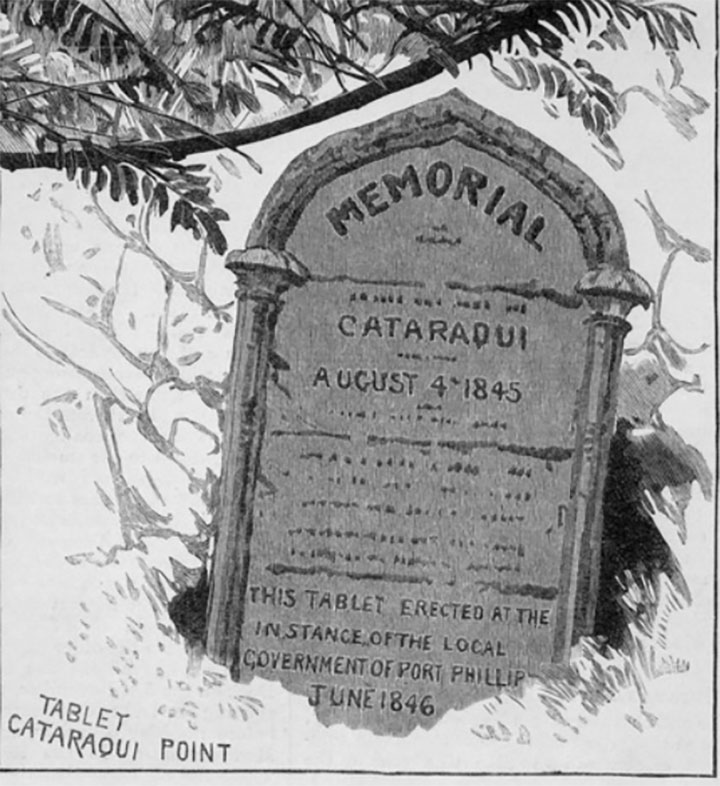
    Memorial to the Cataraqui shipwreck on King Island. Source: Australasian Sketcher, 29 Dec 1887, p. 197.

       The next day, on 6 August, the survivors were discovered by a party of sealers. Likely alerted by the debris being washed ashore near their camp, they had gone to investigate. Finding the nine survivors in a desperate state, the sealers built a shelter for them, started a fire, and fed them with provisions brought over from their own camp. Guthrie and the other Cataraqui survivors stayed with the sealers for four weeks. On 7 September, the cutter Midge arrived with fresh provisions. When she returned to Melbourne with a cargo of seal and wallaby skins, the survivors went with her.

    © Copyright C.J. Ison / Tales from the Quarterdeck, 2023.

    To be notified of future blogs, please enter your email address below.