
The 1750-ton steel-hulled fully-rigged ship Grace Harwar was launched in Glasgow in 1889, and for the next 46 years, she crossed the world’s oceans carrying all manner of bulk cargoes. She became well-known to Australian mariners and dockworkers alike, regularly taking on coal, grain, and other goods bound for distant ports.
Despite her fast lines and majestic presence, she gained a name for herself as a cursed ship among the more superstitious of sailors. On her 1889 maiden voyage, the bosun was lost when an upper yard was carried away during a gale while rounding Cape Horn. That might have been ignored, for Cape Horn was a notoriously dangerous stretch of water. But that was only the first of a string of deaths associated with the Grace Harwar.
In December 1901, while on a passage from Cape Town to New Zealand, she was slammed by a powerful storm as she neared her destination. Heavy seas broke across her deck, sweeping away the lifeboats. The ballast shifted, and the Grace Harwar took on a dangerous list, which saw the lee rail submerged three feet underwater. The captain was washed overboard, but fortunately, another wave swept him back on deck, where he scrambled to safety. However, one of the seamen was not so lucky and drowned. The Grace Harwar survived the maelstrom to limp into Gisborne Harbour for repairs, but her reputation as a Jonah ship was growing.
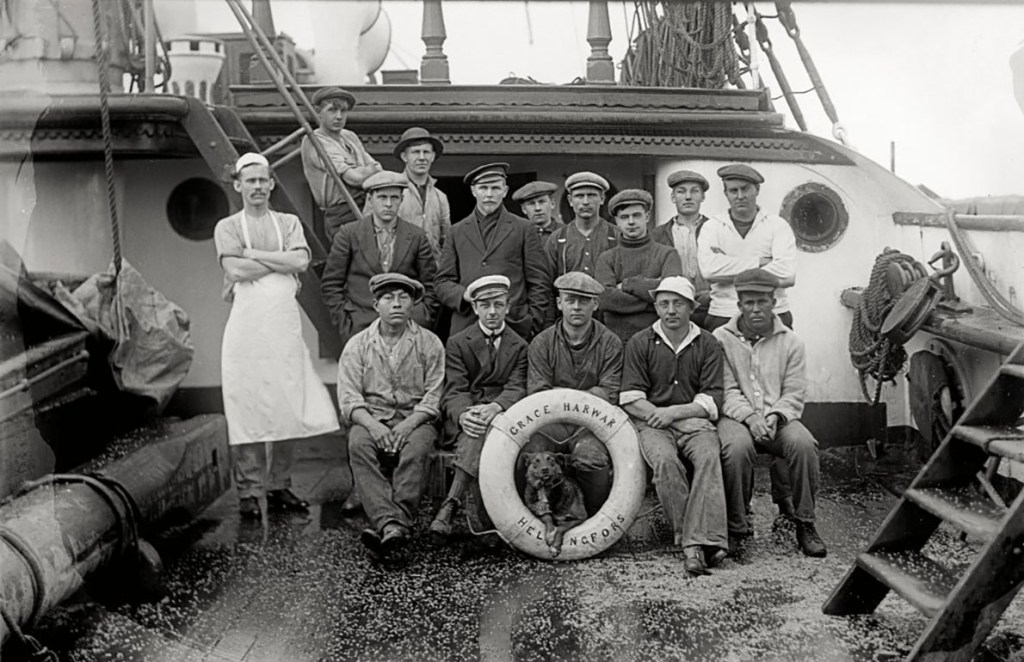
In 1907, while she was sailing from Australia to the Chilean port of Tocopilla, the captain’s young wife died from tuberculosis. Captain Hudson returned his wife’s body to Sydney in the hold and then shipped off the Grace Harwar, vowing he would never go to sea in her again. Three years later, in July 1910, a seaman was killed when the royal yard came crashing down on deck just as the men were congratulating themselves on making it around Cape Horn unscathed.
The following year, 1911, she was anchored at Coquimbo, Chile, when a freak storm blew out of nowhere, causing havoc among the ships anchored in the bay. The Grace Harwar lost her figurehead and bowsprit when she collided with another vessel as they both swung uncontrollably on the end of their anchor chains. Then her anchors began to drag, and she ran up against a German barque, causing yet more damage. During the same year, one of the mates was injured and later died during an operation to recover a lost anchor at the Chilean port of Iquique. But the bad luck did not end there.

While she was anchored off Mobile, Alabama, in the Gulf of Mexico during a ferocious hurricane, one of her sailors was knocked overboard by a loose spar. He drowned before anyone could go to his aid. That was in 1916.
By the late 1920s, the number of fully-rigged sailing ships plying the world’s oceans was in rapid decline. They were increasingly replaced by steam and even newer marine diesel-powered vessels that were no longer dependent on the wind. Two young Australian journalists set out to record the passing of the sailing era. In 1929, they joined the Grace Harwar’s crew in South Australia and filmed the old windjammer’s voyage across the South Pacific, around Cape Horn and up through the Atlantic to deliver her cargo of wheat to England. She lived up to her deadly reputation, claiming the life of one of the reporters, Ronald Walker. He was struck by a falling yard while aloft during foul weather and died. However, the extraordinary footage he and his partner, Allan Villiers, captured using the large boxy cameras of the day was edited together to make the 1930 feature-length film “Windjammer.” Clips from the movie can still be viewed on YouTube.

During the first half of the 1930s, the Grace Harwar was a regular at the annual “Great Grain Race,” carrying wheat from ports in the Spencer Gulf, South Australia, to England. Strictly speaking, it was not an official race, but the captains of the windjammers that carried the annual harvest were known to wager bets on who would deliver their cargo in the fastest time. And of course, there were bragging rights at stake.
In 1935 the Grace Harwar’s 46-year sailing career finally came to an end. She made one last 40 km voyage from Falmouth around to Charlestown, where she was broken up for scrap.


© Copyright C.J. Ison / Tales from the Quarterdeck, 2022.
To be notified of future blogs, please enter your email address below.







 Tales from the Quarterdeck