Category: Convict History

  • The Caledonia’s perilous last voyage

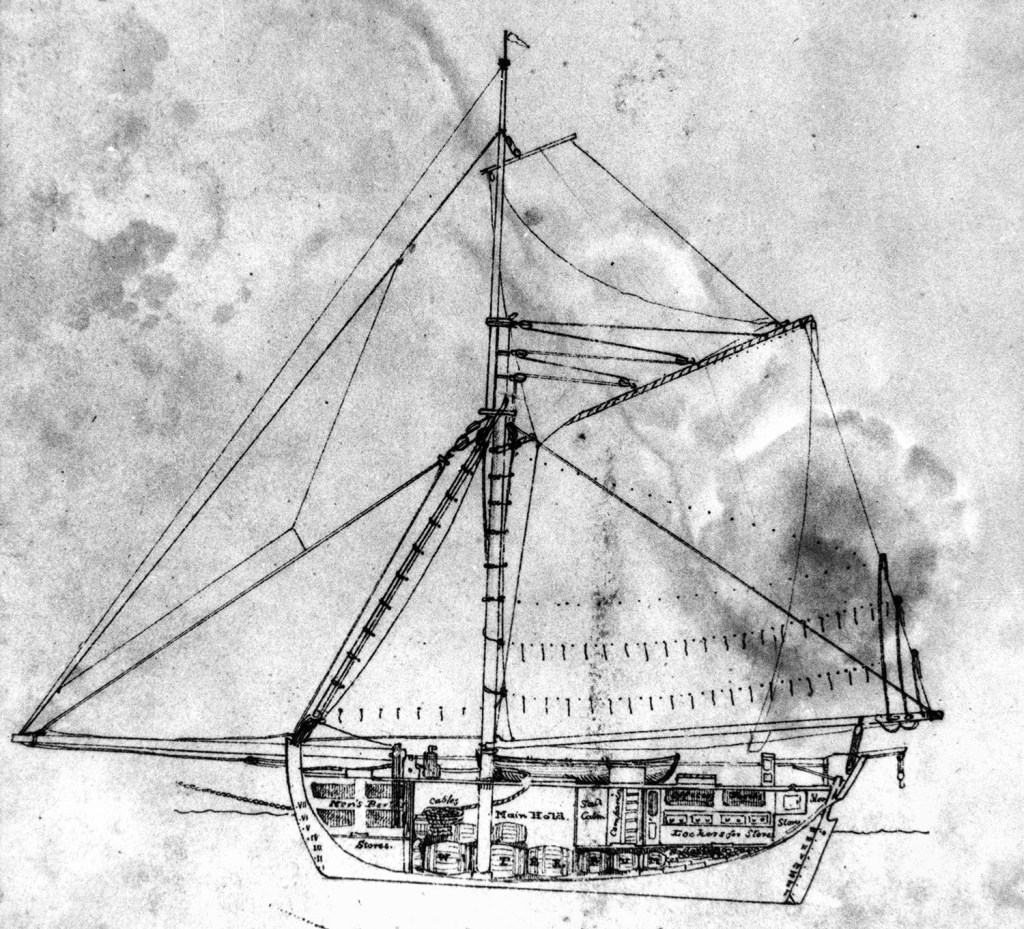
    A schooner of the early 1800s. Courtesy State Library of Queensland.

    On a hot December night in 1831, a storm rolled across Moreton Bay as they often do at that time of year. Outside the Amity Point pilot house, nearly a dozen convicts huddled under a sheet of canvas as they bided their time. There was a small schooner anchored a short distance offshore, and the storm would provide the soaking prisoners with a rare opportunity to escape.

       But what the hapless runaways did not know as they seized the Caledonia and sailed her out of Moreton Bay, their self-appointed leader was a dangerous psychopath, and they would be swapping one reign of terror for another far worse. Three of them would soon be murdered. A fourth would be abandoned on an inhospitable island, and the rest would flee for their lives at the earliest opportunity.

       The Caledonia had pulled into Moreton Bay the previous day to collect a whaleboat, which belonged to the sailing ship America. The crew had used it to reach Moreton Bay after their ship was wrecked further north. Two Sydney businessmen had purchased the salvage rights to the wrecked ship and sent Captain George Browning north to retrieve the boat and strip the America of everything of value. Browning had reported to the Amity Point pilot station and explained their unexpected visit. He was now waiting for the boat to be brought down the Brisbane River before he continued on his way to the wreck site.
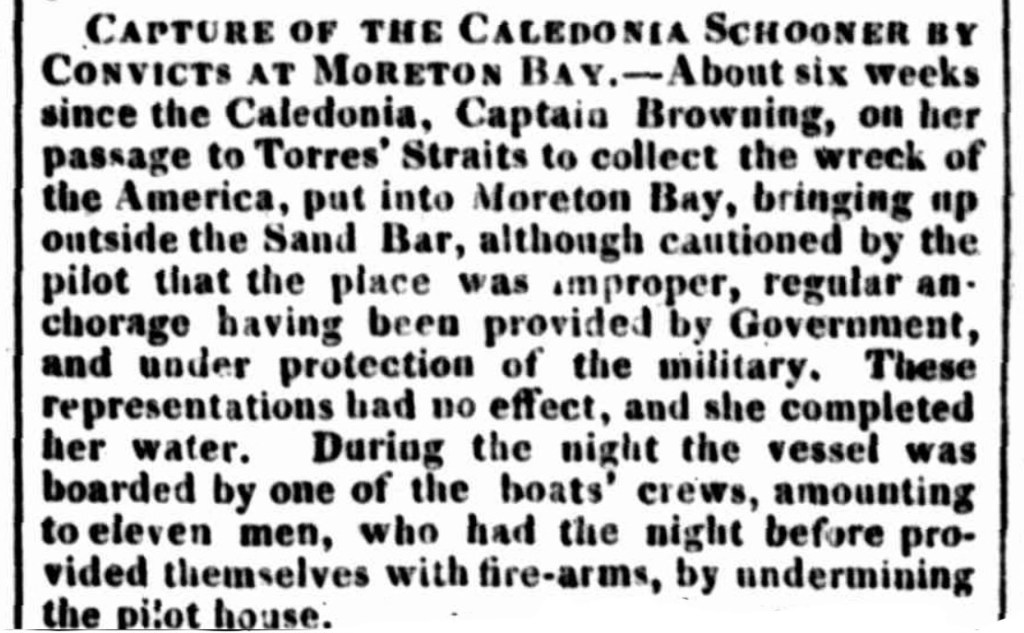
    Sydney Herald, 20 Feb 1832, p. 3.

    That night, as lightning streaked across the sky and deafening claps of thunder boomed around them, the convicts got to work. The guard had taken shelter and the raging storm muffled any noise they made. They easily dug down through the sand and tunnelled under the pilothouse wall. A couple of them crawled inside, stole the keys to the boat shed and armed themselves with muskets and pistols while the pilot and a guard slept. Then they jumped into the pilot boat and rowed out to the Caledonia. No guard had been posted on deck, and the crew were easily overwhelmed before they had fully awoken. The Caledonia’s crew were ordered into the pilot boat to make their way back to Amity Point using only one oar. However, the convicts held on to Captain Browning. He was needed to navigate the schooner to the tiny island of Rotuma, 3000 km away. By dawn, the Caledonia was heading out to sea, as the crew drifted back to shore to raise the alarm.

       The leader of the runaways was a former sailor named William Evans. He was unusual, for he had come to New South Wales as part of the crew of a merchant ship. One night while moored in Sydney Harbour, Evans had broken into the captain’s cabin and stolen a purse full of money. He was spotted leaving the ship in a small dinghy and was soon caught. Evans was found guilty and sentenced to seven years’ hard labour at Moreton Bay. Now, in the closing days of 1831, Evans still had three more years of back-breaking toil, poor rations and loathsome living conditions to endure. When he realised there was a chance he could make his escape on the schooner, he pounced, convincing the rest of the prisoners to join him.
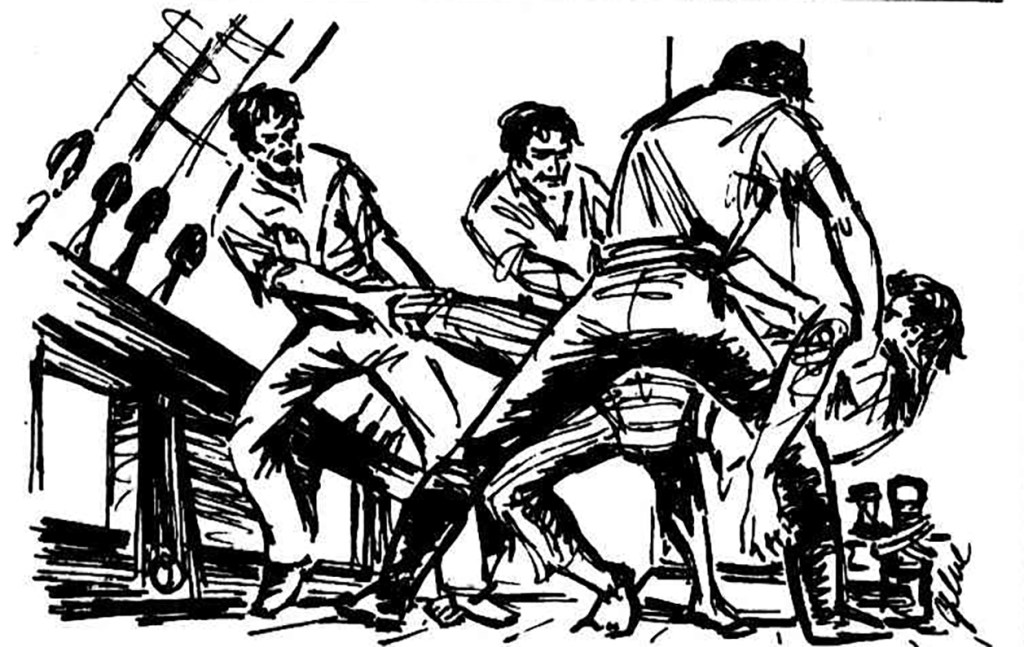
    Newspaper illustration of Evans and others throwing convict over the side of the Caledonia. The Argus, circa 1950s

       After they had been at sea for a week, tensions came to a head among the convicts. The common purpose that had seen them work together to seize the ship and escape had been replaced by bitterness and division. After hearing a rumour that a mutiny was looming, Evans struck first. He stood outside the entrance to the crew’s cabin, backed up by two mates, and ordered one of the mutineers to come on deck. As he emerged, Evans shot him point-blank in the head. Evans then ordered two others to come out, and they were killed on the spot. That ended any thought of challenging his leadership.

       About a week later, the schoonerstopped at New Caledonia for water. Evans’ right-hand man, Hugh Hastings, and a couple of others took a boat out to fill the water barrels. But, while they were gone, a party of Islanders came out to the schooner, indicating that they wanted to trade. As the Islanders outnumbered those on the schooner, they were barred from boarding. Only a volley of shots fired over their heads saw them leave. Fearing they might return under the cover of darkness, Evans had the Caledonia taken out to sea. But, when Hastings returned to find the schooner missing, he thought the worst and swore he would kill Evans for his treachery.

       Hastings and the others spent an uncomfortable night in the boat, but in the morning the Caledonia returned to pick them up. When Evans heard that Hastings had threatened him, he gave his mate two choices. Either stay on the island and take his chances with the hostile natives, or be shot. Hastings remained on the island when the Caledonia sailed away.

    Likely route taken by the Caledonia from Moreton Bay to Savai’i Island

       The Caledonia continued back out to sea and headed for the tiny island of Rotuma, still 1000 km away. Evans had heard rumours that whaling ships regularly stopped there for water and fresh supplies. He planned to join the next American whaler to visit Rotuma and work his way to the United States.

       The Caledonia dropped anchor off Rotuma a week or so later, however, their stay was cut short. One of the convicts bragged that they had just escaped from Moreton Bay. When Evans found out, he was furious and vowed to kill the man, but he fled into the bush before the threat could be carried out. Evans felt it was no longer safe to stay on Rotuma, so he ordered Captain Browning to set sail.

       The Caledonia eventually pulled up off Savai’i Island in Samoa. As soon as they dropped anchor, three more of the convicts jumped ship and fled inland, taking with them three women Evans had kidnapped off Rotuma. Of the ten convicts who escaped with Evans, only three were left.

       Evans went ashore and learned that whaling ships regularly called in there for supplies, so he scuttled the Caledonia and awaited the next ship. Browning, whose life had hung in the balance since leaving Moreton Bay, was finally able to escape Evans’s clutches. A local chief had taken a liking to Browning and gave him protection as Evans and his mates kept their distance. When, a fortnight later, the whaler Oldham dropped anchor, Browning raced out to meet the captain. Browning told him that Evans was an escaped convict and had murdered three men since fleeing Moreton Bay. The Oldham’s captain and crew went ashore and brought Evans back to their ship in chains. Evans’ mates, by then, had taken off into the bush. However, Evans would never front court for his crimes. On the way back to Sydney, he jumped over the side of the ship, preferring to drown rather than face the hangman.

       Several months after the Caledonia sailed out of Moreton Bay, Captain Browning arrived back in Sydney, long after he had been given up for dead.

    The full story is told in A Treacherous Coast: Ten Tales of Shipwreck and Survival from Queensland Waters available through Amazon.

    © Copyright C.J. Ison / Tales from the Quarterdeck, 2022.

    To be notified of future blog posts, please enter your email address below.

  • HMS Guardian: All Hands to the Pumps

       In September 1789, HMS Guardian sailed from Portsmouth, England, with much-needed supplies for the newly established penal settlement in New South Wales. But its voyage was cut short when it struck an iceberg in the Southern Ocean and began filling with water.

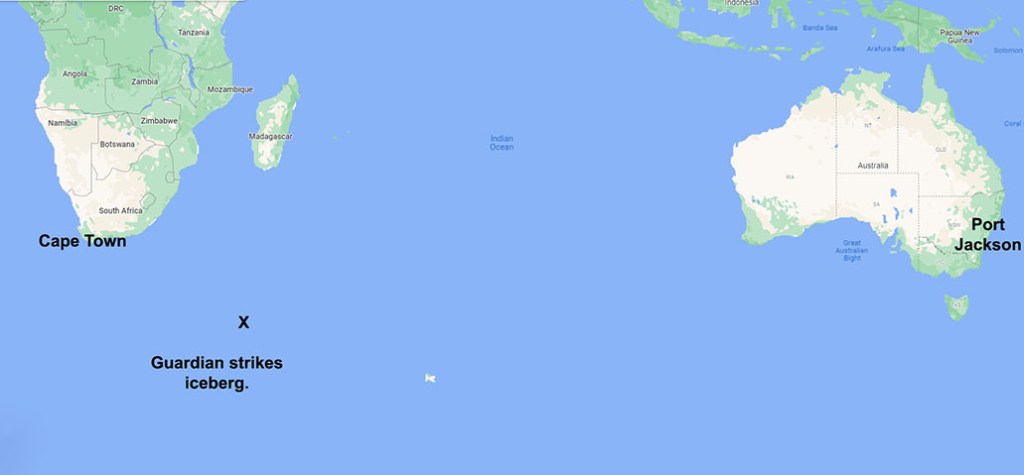
       After an uneventful passage south, the Guardian had stopped at Table Bay (present-day Cape Town) for a fortnight in early December. There, they took on board plants and livestock destined for the colony before setting off across the Southern Ocean for Australia.

       The sea conditions were almost ideal, except for a dense fog. There was little swell, and a gentle breeze filled the sails, pushing them east. Late on the afternoon of 24 December, when they were about 2,000 km away from the nearest land, the fog lifted, revealing an iceberg about six kilometres away.

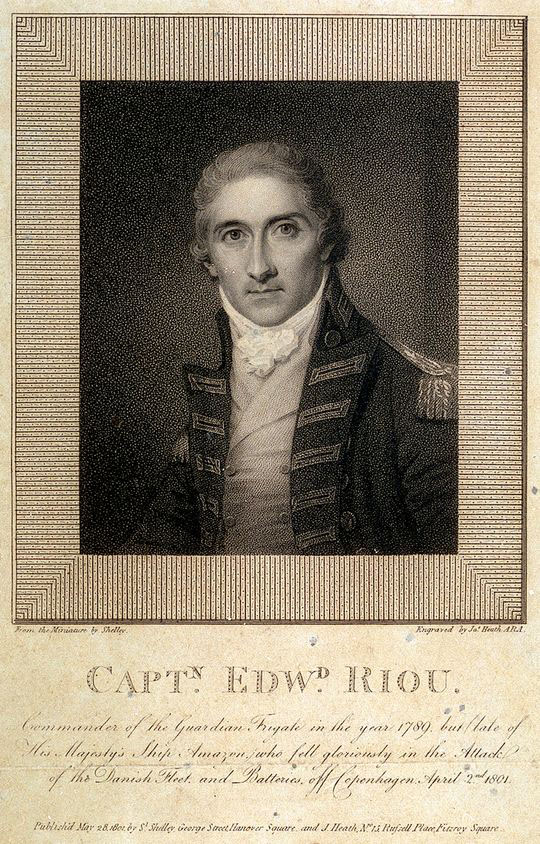
       After two weeks at sea, the ship’s water supply had been depleted by the additional animals and plants they were carrying. The captain, Lt. Edward Riou, seized the opportunity to resupply. He brought the Guardian to within 500 metres of the towering white mountain and sent two boats out to gather blocks of ice that were floating in the sea. 

    Captain Edward Riou, commander of the Guardian.

    By the time the heavily laden boats returned it was about 7 p.m. and the fog had once again enveloped the Guardian. By quarter to eight, Riou could barely see the length of his ship.

       Then, without warning, the Guardian crashed stern-first onto a submerged ice shelf projecting out from the berg. The force of the collision violently shook the vessel, causing the rudder to snap off. Riou was able to use the wind and the sails to back his ship off the ice, and for a brief moment, it seemed that disaster had been averted.

       However, upon sounding the wells, the carpenter reported that they were taking on a lot of water. The ship had sustained serious damage below the waterline. Riou ordered the pumps manned and the ship lightened. The crew started by throwing the livestock penned on deck over the side. They then began bringing stores up from the hold, and they were also tossed into the sea.

       By 10 p.m., it was clear that all the hard work was not going to save the ship. The water continued to gain on the pumps as the ship began to sit lower in the water. Soon she was so low that waves swept over the deck, threatening to pour into the hold through the open hatchways.

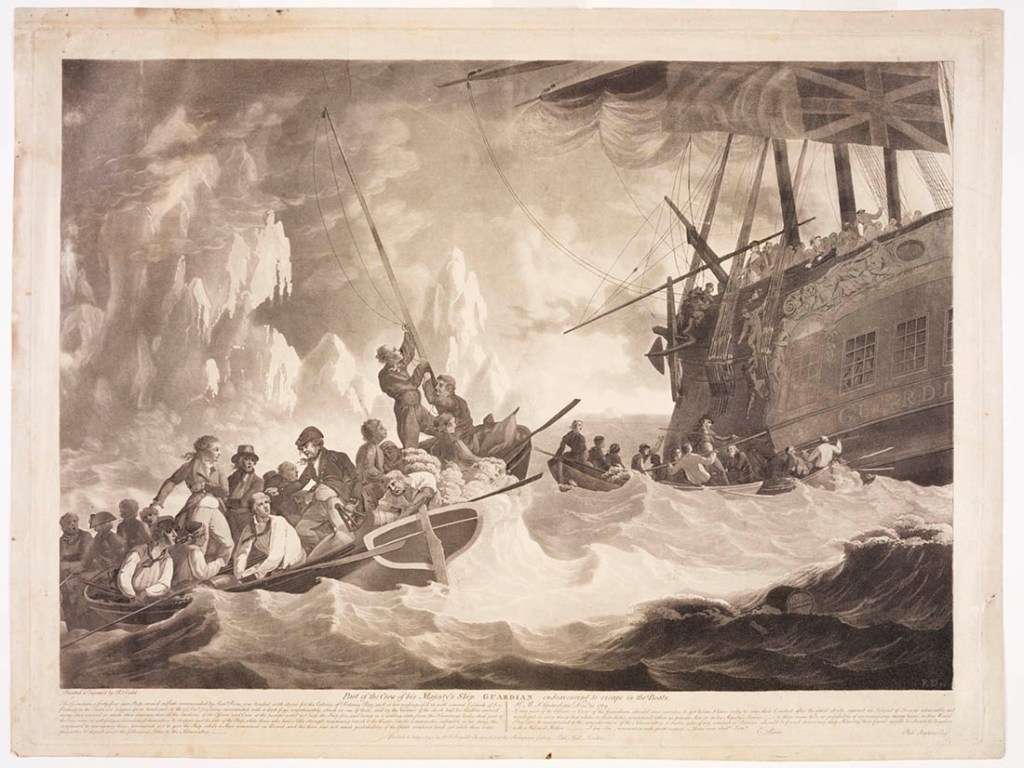
    Efforts to save the ship continued through the night and the next day. By now, the weather had deteriorated. The wind was raging around them, and mountainous seas rose, crashing into the stricken ship. By now, the crew were exhausted from their continuous exertions at the pumps and jettisoning cargo. Lt Riou finally accepted the inevitable and gave the order to abandon ship.

       There were 123 souls on board the ship, but the five lifeboats would only carry half that number. Riou, a maritime man to his core, had already decided he would remain with his ship to the end. But he encouraged anyone who wished to do so to take to the boats where they might stand some chance of surviving.   

    One lifeboat was lost immediately when it was lowered into the sea, but the other four got away and were soon out of sight. Sixty-two people chose to remain with the ship, including 21 of the 25 convicts being transported.

    Illustration titled “Part of the crew of his Majesty’s Ship Guardian endeavouring to escape in the boats.” Courtesy: State Library of NSW.

    To Riou’s and everyone else’s great surprise, the Guardian did not sink. Though she sat very low, her deck awash with frigid water, she remained afloat, barely. They would later learn that the cargo of barrels still trapped in the hold provided just enough buoyancy to keep the stricken vessel from sinking. Riou would also later discover that most of the ballast had been lost through a rent in the hull.

       A sail was draped under the ship to stem the inflow of water. The pumps were manned around the clock, and they slowly limped back to Table Bay. The relentless cold and wet conditions and sheer physical effort made the passage brutal. However, nine weeks later, they made it to False Bay, where the Guardian would soon break up on the beach.

       Of the 60 passengers and crew who had taken to the boats, only 15 survived. They were rescued by a passing ship after being adrift for nine days. The three other lifeboats that got away from the Guardian were never heard of again.

    Map courtesy Google Maps.

       Lt Riou was cleared of blame for the loss of his ship and was later promoted to the rank of Captain. He praised the performance of his officers and men and sought pardons for the convicts who had worked so resolutely to save the ship. But by the time the recommendation reached Port Jackson, one of the convicts had already been hanged for stealing, and six others had gone on to commit additional crimes and their pardons were revoked. But 14 men had their sentences overturned.

    (C) Copyright Tales from the Quarterdeck / C.J. Ison, 2022.

    To receive notifications of future blog posts enter your email address below.
  • Thomas Pamphlett and the Remarkable Castaways of Moreton Bay

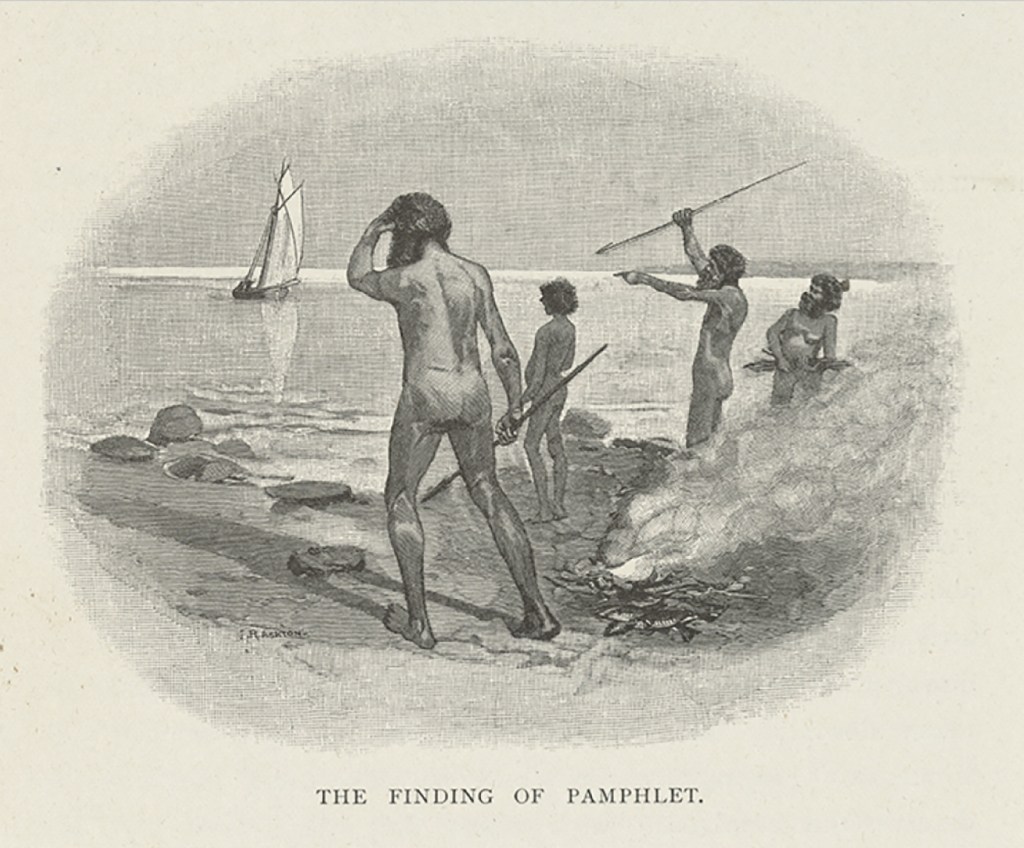
    Source: ‘The Finding of Pamphlet’, Picturesque Atlas of Australasia, vol. II, 1886, nla.cat-vn1654251.

    Most Queensland school children are taught that the first non-Aboriginal people to settle in their state were convicts and their gaolers who arrived in September 1824.   But actually the first white-skinned people to live in what would become Queensland were three castaway ex-convicts who came ashore 18 months earlier.

    In 1823 Governor Brisbane sent the NSW Surveyor General, John Oxley, to determine if Moreton Bay, 800 kilometres north of Sydney, would make a suitable penal settlement to house the colony’s worst and most incorrigible convicts.

    On 29 November the small government cutter Mermaid, carrying Oxley and his party, dropped anchor in Pumicestone Passage separating Bribie Island from the mainland.   To their astonishment, among the Aborigines they could see on shore stood a taller, lighter-skinned man excitedly haling them.    His name was Thomas Pamphlett and he and two mates had been living with the local Aboriginal peoples for the past seven months.

    This is their story.     On 21 March 1823 four ticket-of-leave men, Thomas Pamphlett, John Finnegan, Richard Parsons and John Thompson, sailed from Sydney in a 10-metre-long open boat bound south to the Illawarra to gather cedar logs for sale in Sydney.

    However, they were caught in a ferocious storm which battered the craft mercilessly for five days.   They were driven far from the coast under a bare mast and when the storm finally cleared five days later they had no idea where they were.     They thought they had been blown south towards Van Diemen’s Land but in fact they had been taken north.    So, when they could finally hoist a sail they bore north in search of Sydney.  

    Their water had run out days earlier and they only had rum to quench their thirst.    All four were in a bad way but John Thompson became delirious and died from thirst.   They kept him in the boat for several days until the smell drove them to bury him at sea.  

    They finally sighted land about three weeks after setting off from Sydney.   This turned out to be Moreton Island though that was not known to them at the time.   They could see a freshwater stream flowing across the beach so Pamphlett swam ashore with the water keg in tow.   He drank his fill but was too weak to swim back to the boat.    The others, crazed with thirst, brought the boat closer to shore but it got caught in the surf and was smashed to pieces.

    The three men were alive but stranded.   They salvaged some flour, a bucket, an axe, a pair of scissors, the water keg but little else.    They soon came across an Aboriginal camp in the sand dunes and were befriended by the people.    The three castaways lived with their hosts for a couple of months then they decided to set off north thinking they would eventually reach Sydney.

    First they went south to cross over to Stradbroke Island then onto the mainland where they ventured north around Moreton Bay   All the time they were accompanied by different bands of Yuggera.   Pamphlett and Finnegan decided to stop at Bribie Island on the northern edge of the bay and lived with the Joondoobarrie people until they were found by Oxley and his party.     Parsons, still determined to return to Sydney kept heading north and may have gone as far as Harvey Bay before it was made clear to him his presence among the Butchella people was not welcomed.  

    The cutter Mermaid. Photo State Library of Queensland

    He returned to Bribie Island many months later only to find his comrades had been taken away on the Mermaid.   However, the party of explorers left a message in a bottle for Parson should he ever pass that way again.   Unfortunately, he was illiterate and could not read the message that had been left for him, but he remained in that area in the hope that another ship might pass that way.    He was in luck.   The brig Amity sailed into Moreton Bay in September the following year with 30 convicts and their guards to establish the first settlement at Redcliffe.   When they came ashore Parsons was standing on the beach waiting for them.  

    Richard Parsons was returned to Sydney and found work as a bullock driver. John Finnegan later returned to Moreton Bay and took up a post piloting ships in and out of the bay. Thomas Pamphlett also returned to Moreton Bay, but it was not of his own choosing. He stole two bags of flour in 1826 and was sentenced to spend seven years toiling at Moreton Bay penal settlement.

    For more interesting stories from Australia’s maritime past check out  A Treacherous Coast: Ten Tales of Shipwreck and Survival from Queensland Waters, available now as a Kindle eBook or paperback through Amazon.

    (c) C. J. Ison / Tales from the Quarterdeck, 2021.

    To be notified of future blog posts, please enter your email address below.