Category: Convict History

  • The Loss of the Sydney Cove – 1797

    A barque caught in heavy weather. Source: Tales of Shipwrecks and Adventures at Sea, 1856.

       In May 1797, a fishing party returned to Sydney with more than their daily catch. They had found three shipwreck survivors south of Botany Bay who told them that the merchant ship Sydney Cove had been wrecked somewhere far to the south. The survivors had trekked over 600 km along New South Wales’s rugged southern coast seeking help for their captain and shipmates who were still stranded with the ship.

       On 10 November 1796, the 250-ton Sydney Cove had sailed from Calcutta with her hold full of Indian goods and produce the owners hoped to sell in Sydney. The crew, numbering close to fifty men, was a mix of Indian and European seamen under the command of Captain Guy Hamilton. About a month out, as she cleaved her way south through the Indian Ocean, the Sydney Cove was caught in a terrible storm and began taking on water. Initially, the leak was easily managed with the pumps, so Hamilton continued on his course to round Van Diemen’s Land (Tasmania) before heading north again and on up the New South Wales coast to Sydney.

       By January, as they sailed into the latitudes south of Tasmania, the ship was caught in the grip of another powerful storm. The leak began to worsen, and soon the pumps had to operate continuously to prevent the ship from sinking.

       As they headed up Tasmania’s east coast, they encountered yet more wild weather and heavy seas. By now, water was pouring into the hold faster than the men at the pumps could clear it. The barque was slowly filling with water. Captain Hamilton ordered all non-essential gear to be jettisoned to lighten the load, but that only put off the inevitable.   

    By 9 February, the water in the hold was lapping at the lower-deck hatches. Captain Hamilton realised he had no choice but to beach his ship to save her from foundering in deep water. If that were to happen, he would not only lose his ship and its precious cargo but also much of his crew, for they would not all fit on the Sydney Cove’s two boats. He found a sandy beach on what is today called Preservation Island in the Furneaux group and ran her ashore. Although Hamilton had saved the ship from sinking, his troubles were far from over.
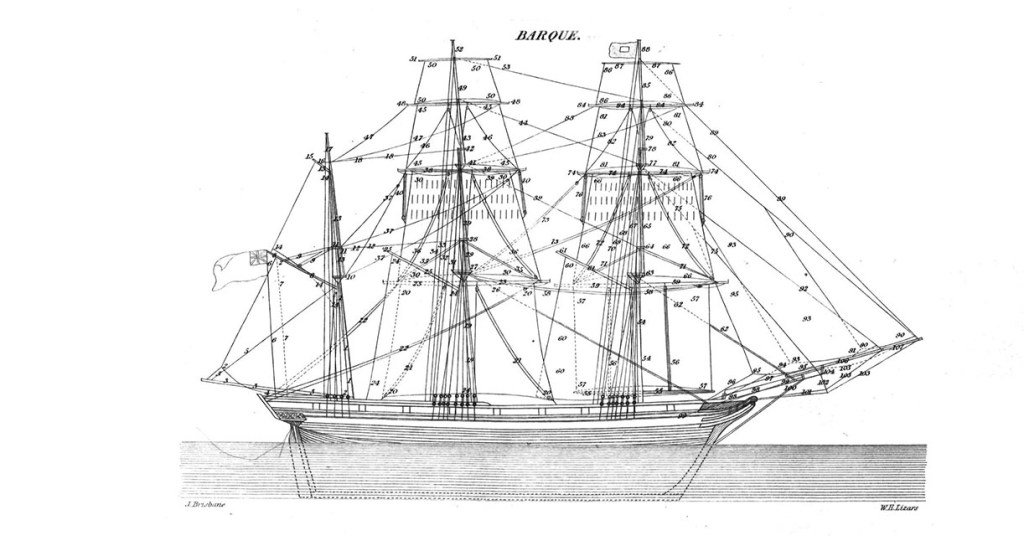
    No illustration of the Sydney Cove exists but it likely looked similar to this example. Source: Nautical Dictionary by Arthur Young, published in 1863.

       Exhausted from constant bailing and battling through rough seas, Hamilton got the crew unloading much of the ship’s stores and cargo onto Preservation Island. But then the weary men discovered the casks of rum stacked among the cargo. Hamilton had to have the liquor taken to a neighbouring island to prevent his men from pillaging it. Captain Hamilton then organised his crew for a prolonged stay, for they had come ashore at a very remote part of the world. The crew erected shelters using sails and spars to give them refuge from the elements. Hamilton rationed everyone to one cup of rice per day, and though they sank a well and found water, it proved so brackish it was barely drinkable. However, their immediate needs were met. Then he turned his mind to their rescue.

       If they were ever to leave Preservation Island, they would have to send for help. It was agreed that the First Mate, Hugh Thomson, with 17 men, would sail north, keeping close to the New South Wales coast until they reached Sydney. Captain Hamilton and the remaining crew, numbering about 30, would remain with the ship.

       Several days after setting off, the longboat was driven ashore on Ninety-Mile Beach and smashed to pieces. Thomson and his men escaped with their lives, but they had little else. With no way to return to the Sydney Cove, their only chance of survival lay in continuing to Sydney, 600 km away, on foot.

       Thomson hugged the coast, knowing that as long as they kept the sea on their right, they would eventually arrive at the young settlement. However, that meant crossing many wide river mouths and scrambling over numerous rocky promontories along the way. The journey was gruelling and took a heavy toll on the men. Encounters with the indigenous peoples varied in nature. Some provided the castaways with food and water, while others were less sympathetic but allowed them to pass unhindered. Yet others set upon the interlopers on their land. Their numbers dwindled as some drowned crossing rivers or otherwise fell victim to the harsh and unforgiving terrain.

    The Sydney Cove party as depicted by Smiths’ Weekly in 1939. Smith’s Weekly 30 Sep 1939 p. 8.

       By late April, there were only three men left. However, they had managed to reach within 20 km of Botany Bay when fishermen finally discovered them. The fishermen took the survivors the rest of the way to Sydney in their boat. On learning of the loss of the Sydney Cove, Governor Hunter ordered vessels to be sent to rescue the remaining sailors and salvage the ship’s cargo.

       After being marooned for some four months, Captain Hamilton and the rest of the crew were in dire straits. Winter was fast approaching. Successive storms had mercilessly battered their shelters, and now they had gaping tears, offering the men little protection from the bitter weather. While they had been able to supplement their rice ration with seabirds nesting on the island, their diet still barely sustained life. To add to their sense of abandonment, they had seen several ships pass in the distance but had been unable to alert any of them to their presence.

       Then, on 10 June 1798, salvation arrived when the sloop Eliza sailed into view and dropped anchor a short distance off the beach. It was later joined by the schooner Francis, under the command of Lt Matthew Flinders. Both ships had left Sydney 10 days earlier under Governor Hunter’s orders. The crews loaded as much of the salvaged cargo as they dared, leaving five volunteers behind to watch over the remaining goods until it could be collected at a later date. Captain Hamilton and his men boarded the Francis and Eliza, and they headed for Sydney.   

    The weather was no less kind as the two small ships battled their way home. It took 15 days of hard sailing through storms and high seas for the Francis to reach Port Jackson. The Eliza never made it back to Sydney and was presumed to have sunk in the terrible weather with the loss of her own crew, plus eight shipwreck survivors. In total, about half of the crew of the Sydney Cove lost their lives.

       The shipwreck is historically significant for the trek undertaken by Thomson and the others. They were the first Europeans to note an outcrop of coal in the Illawarra, which has defined the region to this day. Also, Captain Hamilton recorded strong south-westerly currents during his time on Preservation Island, suggesting there was a large body of water separating Van Diemen’s Land and the Australian mainland. The existence of the strait would later be confirmed by Matthew Flinders and George Bass and named after the latter.

    © Copyright C.J. Ison / Tales from the Quarterdeck, 2023.

    To be notified of future blogs, please enter your email address below.

  • The Loss of HMS Sirius – 1790

    “The melancholy loss of H.M.S Sirius off Norfolk Island” by George. Raper. Courtesy: National Library of Australia 136507434-1

    When HMS Sirius was wrecked off Norfolk Island in 1790, the loss was keenly felt back in Sydney. She was one of only two ships available to Governor Phillip, and he desperately needed both of them. Sydney had so far been unable to grow sufficient food to feed itself and was now facing starvation. The loss of the Sirius only compounded the colony’s problems. 

       HMS Sirius had sailed from Portsmouth on 13 March 1787 as part of the First Fleet, a social experiment to rid England of its most troublesome and unwanted folk. They arrived in New South Wales in January 1788. A month later HMS Supply sailed for Norfolk Island with a small number of convicts and a detachment of guards to establish a penal settlement there. By October of the same year, Governor Phillip realised that Sydney would soon be facing starvation unless something was urgently done. He ordered Captain John Hunter to sail HMS Sirius to the Cape of Good Hope and purchase livestock, grain and other provisions for the fledgling colony.   

    Some months after her return, the Sirius, in company with HMS Supply, was ordered to sail for Norfolk Island with desperately needed provisions along with additional convicts and guards.

    First Fleet entering Sydney Heads January 1788. By E. Le Bihan, Courtesy State Library of NSW.

       They reached Norfolk Island on 13 March 1790, and over the next few days, they disembarked their passengers; however, the sea conditions were such that neither ship was able to land its stores. On 15 March, the unrelenting gale-force southerly forced them to leave the island. By the 19th, the wind had moderated and shifted around to the southeast, so Captain Hunter made landfall again, hoping to begin unloading.

       As Sirius neared the island, Captain Hunter saw the Supply already anchored in Sydney Bay, and there were signals flying on shore that longboats could land without danger from the surf. Hunter took his ship in as close as he dared, loaded the boats and sent them away, but then the wind freshened.

    “Part of the Reef in Sydney Bay, Norfolk Island, on which the Sirius was wreck’d. 19 March 1790.’ by William Bradley.

         Hunter ordered his men to haul up the anchor and make for open water, but before he could do so, the Sirius was driven onto the rocks. Powerful surf crashed around the stricken ship. Soon after they struck, the carpenter reported that water was pouring into the hold. The masts were cut away in the hope that the lightened vessel might be driven higher onto the reef, where the crew would have a better chance of saving their lives.

       By now, it was about 11 a.m. The provisions were brought up from the hold and stacked on deck so they might be floated ashore if the opportunity arose. However, the sea conditions continued to deteriorate. Towards evening, Hunter received word from shore urging him to abandon ship as it would be too dangerous to remain overnight. A rope was tied to an empty barrel and floated through the surf to waiting hands ashore. Then a seven-inch-thick hawser was sent across the narrow stretch of reef and surging seas and tied to a tree. Now the crew could be hauled ashore three or four at a time. Most sported cuts or bruises by the time the reached land from being bashed against the rocks on the perilous passage. The operation stopped only when it became too dark to continue safely, and the remaining men were taken off the following day.

       A couple of days later, two convicts volunteered to go aboard the Sirius to get the livestock ashore. They got a number of pigs and some poultry over the side and the current did the rest. However, as evening turned to night, the two convicts refused to leave the ship. They had found a cask of rum sometime during the day, and by evening, they were drunk as lords. Probably in an effort to keep themselves warm, they lit two fires, but they soon got out of hand and did significant damage to the ship. The following day, guards were sent out to the ship to forcibly return them to shore, where they were clapped in irons for their troubles.

       When the weather finally eased, Hunter sent some of his men across to begin ferrying the remaining provisions ashore using the hawser. Other stores, sealed in timber casks, were thrown into the water with the hope that they would wash ashore through the surf. Some made it. Some sank to the bottom.

       While the Supply had managed to unload its provisions on the sheltered side of the island, with so many additional mouths to feed, rations for everyone on Norfolk were cut in half.

    The Settlement on Norfolk Island, May 16th 1790 / George Raper. Courtesy State Library of NSW, FL541331.

    Captain Hunter and his crew would be stranded on Norfolk Island for several months before they could return to Sydney. Meanwhile, Governor Phillip was stunned to learn of the Sirius’ loss. He had been relying on her to go on another resupply mission to keep the struggling colony fed.

       His problems just kept mounting. The second fleet had recently arrived, delivering 800 extra mouths to feed, many were already in a terrible physical state when they came ashore. They were too ill to help cultivate crops or contribute in any other meaningful way. One of the fleet’s two supply ships, HMS Guardian, had been wrecked in the Southern Ocean, placing a greater strain on the settlement’s already meagre provisions. Food was tightly rationed and no distinction was made between the lowest convict and the Governor himself. Everyone received the same ration, one and a half pounds (700 g) of flour, two pounds (900 g) of salt pork, one pound (450 g) of rice and one pint (500ml) of peas per week.   

    The few privately owned boats in Sydney were requisitioned and sent out to catch fish. Hunting parties roamed the outskirts in search of game, and guards had to be stationed around the public vegetable gardens to prevent theft. HMS Supply was sent to Batavia for supplies, leaving Sydney without a single ship at its disposal. One hundred forty-three people died of sickness or malnutrition in Sydney that year. There was probably no other time when the existence of the settlement looked so tenuous. 

    © Copyright C.J. Ison / Tales from the Quarterdeck, 2023.

    To be notified of future blogs, please enter your email address below.

  • The Tragic Loss of George III – 1835

    The Wreck of George III, by Knud Bull, wikimedia commons.

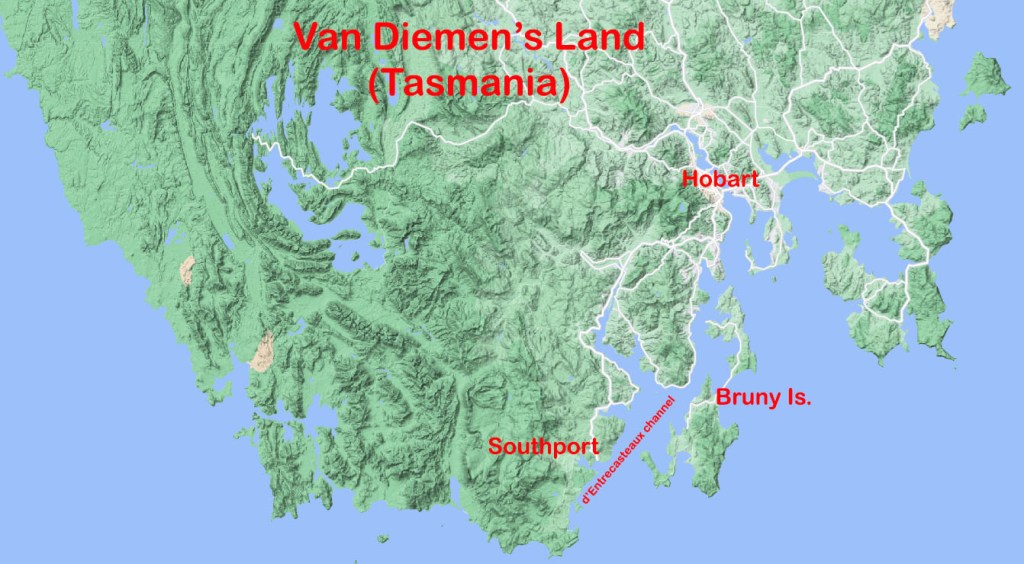
       The 400-ton ship George III sailed from England on 12 December 1834, bound for Van Diemen’s Land (Tasmania). She was carrying nearly 300 people, of whom 220 were convicts. When they were less than 80 km from Hobart, tragedy struck with a terrible loss of life.

       Around 11 a.m. on Sunday, 12 April 1835, the George III made land at South Cape, the southernmost point of Tasmania. By early evening, they had entered the D’entrecasteaux Channel to make the final run up the coast to the mouth of the Derwent River. From there, it would have been a short cruise up the river to Hobart Town. She put the dangerous Actaeon Islands behind her around 8.30 that night. The moon was out, the weather mild, and they were being pushed along at a modest 1 ½ to 2 knots (3 – 4 km/h) by a light breeze blowing off the land.   

    Captain William Moxey had a man in the chains sounding the passage as they made their way north. Repeated soundings showed they were in 20 fathoms (36m) of water, which was more than deep enough for safe passage. Then, shortly before nine o’clock, Moxey was stunned to hear the man call out “quarter less four,” meaning they were in less than four fathoms (7m) of water. He ordered the helm put hard to port. But before the ship could respond, she struck ground and came to a stop where the chart said there was clear passage.

    Southern Tasmania. Google Maps.

       The captain had soundings taken around the ship and found they were stranded on an uncharted rock with between three and five metres of water surrounding them. The initial collision was not particularly violent, but now that the ship was stuck fast, the ocean swells began lifting her up and dropping her back down on her rocky perch. Within minutes, the repeated pounding brought the main mast crashing down. The mizzen mast came down with it, littering the deck with a tangle of rope, canvas and timber spars.

       The crash brought everyone on deck, except for the prisoners. Seamen not on watch, passengers and the complement of soldiers hastily dressed and came up to see what had happened. Captain Moxey gave the order to abandon ship and oversaw the evacuation in the ship’s boats. However, efforts were severely hampered by the continued pounding and the mess of debris strewn across the deck and floating in the water.

       Moxley ordered one of his boats with a crew of seven to make for Hobart as quickly as possible to get help. Then he got the evacuation of the passengers and the rest of the crew underway. Meanwhile, the convicts were still locked below deck with armed guards stationed over the hatchway.

       The situation was becoming dire for the convicts trapped in their prison. They were already standing waist-deep in freezing water, and despite their pleas to the guards to be let out, the hatch covers remained locked. In genuine fear for their lives, several rushed forward and tried to force the hatch cover open with their bare hands. According to one of the surviving convicts, the guards opened fire to force them back, and at least one prisoner was struck by a bullet and killed. In a later inquiry, Moxey would dispute the claim, saying that the guards had only been stationed over the hatchways to keep the panicking prisoners contained below deck until the women and children had safely been evacuated. In fact, the inquiry reads like the minutes of a mutual appreciation society meeting, each officer praising the efforts of the others in saving so many lives.

    The Colonist, 7 May 1835, p. 5.

       Fifteen minutes after striking the rock, the deck was awash with water, and the last of the boats carrying 40 people had left the stranded vessel. Captain Moxley was among them, having been pulled from the water after he became trapped between floating timbers.

       By this time, the guards watching over the hatchways had left in the last boat. The trapped convicts were now able to force their way on deck to find it deserted.  But some 50 or so prisoners had been too ill to save themselves. Most had been suffering from scurvy and had drowned where they lay unable to escape the rising water.

       After putting the survivors ashore, Moxley returned to the ship and began taking off the convicts. By the time he had reached the George III for the third time, a schooner sent from Hobart had arrived and was taking off the last of the survivors.

       One hundred and thirty-four people lost their lives. Three of them were passengers – a woman and two children – and two were members of the ship’s crew. Convicts made up the remaining 128 fatalities. Most never had a chance, trapped in the hold as the water rose around them.

    The next morning, a convict named John Roberts was found dead, lashed to a ringbolt in the surgeon’s cabin. It seems he could not swim, so he had tied himself off, hoping to be washed ashore as the ship broke up.    Despite the heavy loss of life, 160 people were saved. They were all taken to Hobart, cold, wet, and thoroughly exhausted from the ordeal.

    View of Hobart Town by Samuel Davenport, circa 1835.

         The inquiry into the loss of the ship found no one was to blame. It concluded that the George III had struck a rock not recorded on the chart. Then it came time for the inquiry to consider the treatment of the convicts. No officer admitted to ordering the prisoners to be confined below deck as the hold flooded with water. The Corporal of the guard testified that the muskets were only used to “intimidate” the prisoners, and only one shot was fired, and that into the air. No one was held accountable for the loss of so many prisoners.

     © Copyright C.J. Ison / Tales from the Quarterdeck, 2022.

    To be notified of future blogs, please enter your email address below.

  • William Bryant’s Great Escape – 1791

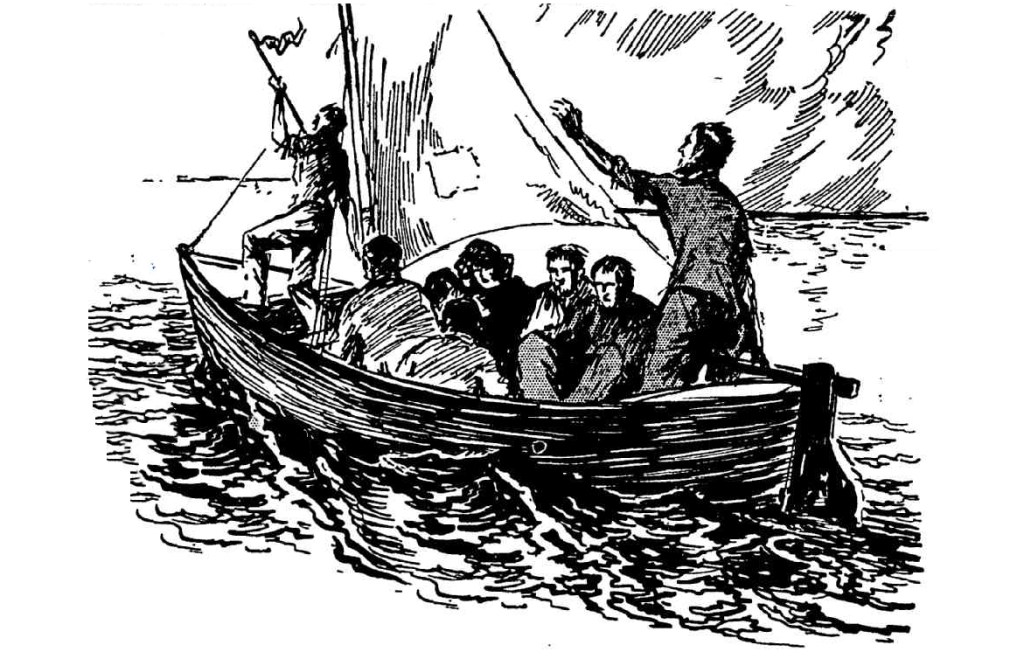
    1930s era illustration of the 1791 convict escape led by William Bryant. Source: The World’s News 9 Sep 1931 Page 9.

       It is an odd piece of Australian history that some of the first people to repeat Captain Cook’s voyage up Australia’s east coast were not other intrepid navigators or explorers, but a motley band of prisoners bent on escape.

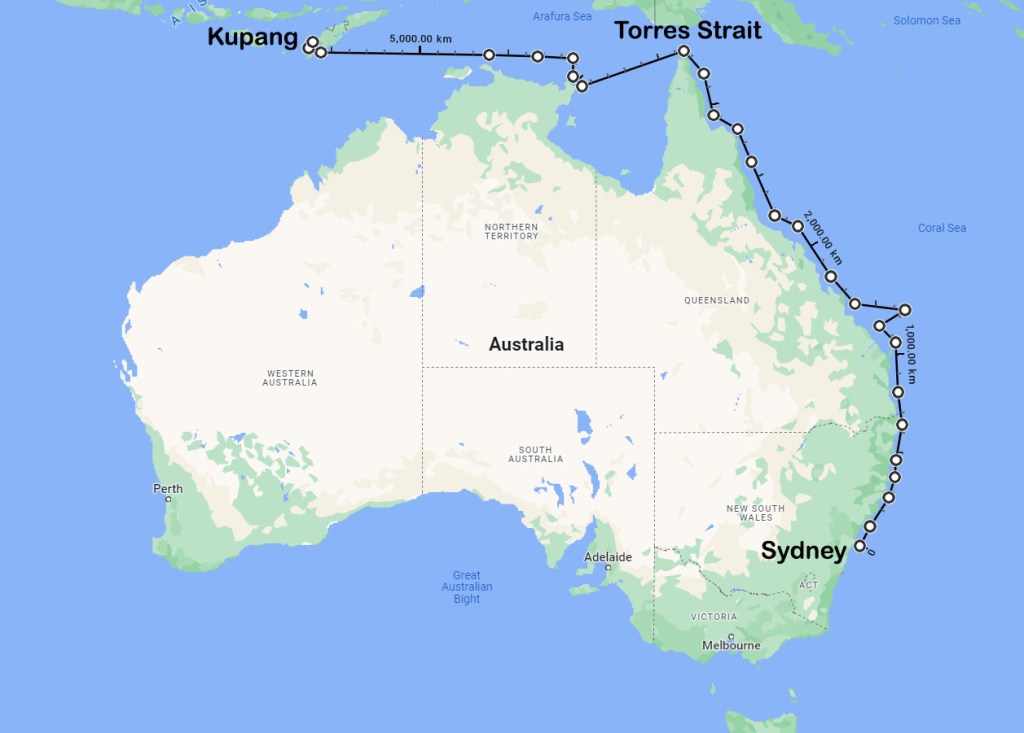
       In March 1791, nine convicts stole Governor Phillips’ six-oared whaleboat and made their way out through Sydney Heads. That was the start of a 5000 km voyage that would take them up Australia’s east coast, around the tip of Cape York and across the Arafura Sea. On 5 June, after 69 days at sea, they sailed into the Dutch settlement of Kupang on Timor Island. It was a remarkable achievement then, and remains so to this day.   

    Their leader was a 34-year-old fisherman from Cornwall called William Bryant. He had been sent to New South Wales for impersonating Royal Navy sailors so as to collect their wages. That was back in December 1783. Bryant had been sentenced to transportation for seven years, and by the end of 1790, he had technically completed his sentence and should have been released. However, no one had thought to send the appropriate documentation out with the convicts on the First Fleet, so he had no way to prove his claim. What’s more, the colony was still struggling to feed itself, and Bryant was a valuable man to Governor Phillip and his administration. Bryant kept the colony supplied with fish, even when other sources of sustenance failed.

    Map showing their approximate route from Sydney to Timor. Source: Google Maps.

       It seems likely that Bryant had started planning his escape shortly after the seven-year anniversary of his sentence. Even had he been allowed to leave, he probably could not have done so. His wife, Mary, still had a couple of years to serve, and there were two young children to consider. He shared his plans with seven trusted mates, and they began preparations to escape. Those seven were all members of the colony’s fishing fleet, and all had years of maritime experience to draw on.

       In the weeks and months leading to their departure, they began stashing away provisions for the long journey. That must have been no easy task, for flour, rice, salted pork, and other staples were all in limited supply. Sydney was starving, and all food was closely monitored and carefully rationed out. However, Bryant was known to have skimmed fish from the catch before handing it over to the Government store. Perhaps he used some of that to trade for the supplies he needed. He also purchased a couple of muskets, a compass, a quadrant and a chart from the captain of a Dutch ship which had recently delivered supplies to Sydney. He likely also paid for these by selling or trading fish on the black market.

    William Bryant and the convicts in the six oar Governor’s cutter which they sailed from Sydney to Kupang. Source: Smith’s Weekly 23 Oct 1937 Page 18

    On the night of 28 March, they were ready to leave. The Bryants, their two children and the rest of the runaways gathered together everything they had amassed for the voyage and carried it down to Sydney Cove. There, they loaded it into Governor Phillips’ cutter, which happened to be the largest and the sturdiest of the boats in the colony’s small fishing fleet. They then headed across Sydney Harbour and out to sea.

       It is hard to imagine what was passing through their minds as they put Sydney behind them. They must have known that the voyage they were embarking on would be fraught with danger. None of them would have been naïve enough to think it would be smooth sailing. They could only rely on their own resourcefulness and a bit of luck to make it to Kupang. On the one hand, remaining in Sydney was hardly a safe alternative. Conditions had grown dire in the struggling colony. Starvation and disease were constant companions. In the previous year alone, 143 people had perished; all but a handful had been convicts.

       The first place they pulled in to replenish water and look for fresh supplies was the Hunter River. There, they were visited by the local inhabitants, the Awabakal people, and after being given a few gifts, the convicts were left unmolested. However, that would be the only time they received a friendly reception. The next time they pulled in to make repairs to the cutter, they were run off by the local Aborigines. A little while later, they were blown far out to sea, and by the time they had returned to the coast, they found few opportunities to put ashore due to the dangerous surf conditions.

       One month after leaving Sydney, they had travelled about 540 nm (1000 km) or only one-fifth of the way to Kupang. This would have placed them somewhere between the Sunshine Coast and Fraser Island (K’gari), where they were forced to land to make urgent repairs to the cutter. It had been taking on water and needed to be recaulked before they continued on their journey north. They were soon heading into Australia’s tropical waters, where they were caught in an unseasonal storm that lashed them for several days without mercy.  They were kept bailing continuously to keep afloat, but they survived. They were blown far out into the Coral Sea, and it would take them more than one full day’s sailing west until they found a small deserted island. This was likely Lady Elliot or one of the islands in the Bunker Group a little further north.   After weeks of struggle and misfortune, they seized the opportunity to recuperate and escape the cramped conditions on the boat.

       The sailing conditions finally improved, and they made steady progress up the Queensland coast, pushed along by the prevailing southerlies. Shortly after rounding Cape York, they replenished their water and then headed out across the Gulf of Carpentaria. It would take them four and a half days to reach East Arnhem Land. Bryant then followed the coastline for several days, looking for a place to refill their water casks. The search proved fruitless, so he decided to head out to sea and make a direct course for Timor. Thirty-six hours later, they made it to Timor Island. It was now 5 June. They had completed their 5000 km voyage in 69 days with no loss of life. That was no mean feat of seamanship and tenacity. Unfortunately, things would soon turn against the runaways.

       Bryant and the others passed themselves off as shipwrecked sailors to the Dutch authorities, and for a while, they were treated as such. But then it seems someone blabbed about who they really were, and the Governor locked them in gaol. Shortly after Captain Edwards and his crew arrived in the settlement, genuine survivors of HMS Pandora wrecked on the Great Barrier Reef. When Edwards left for England, Bryant and the rest of the bolters went with him.

       William Bryant and his son would die in a Batavia gaol. Three other convicts, plus the Bryants’ daughter, perished on the voyage back to England. Mary Bryant and the four remaining prisoners were put on trial, charged with returning from transportation. They could have been sentenced to death or returned to New South Wales for the rest of their lives. Instead, news of the atrocious conditions in Sydney and their ordeal trying to escape them touched a nerve. They were allowed to serve out their original sentences in England, and by November 1793, Mary Bryant and the four other convicts had all been pardoned and allowed to walk free.    A detailed account of the voyage from Sydney to Kupang can be found in “Memorandums” written by James Martin, one of the convicts who made it back to England. 

    The long and perilous voyage remains one of the great feats of seamanship in an open boat. It is told in more detail in Bolters: An Unruly Bunch of Malcontents.

    © Copyright C.J. Ison / Tales from the Quarterdeck, 2022.

    To be notified of future blogs, please enter your email address below.

  • No Charts, No Worries

    A schooner of the early 1800s. Courtesy State Library of Queensland.

    When Captain George Browning sailed the small schooner Caledonia from Sydney in December 1831, he intended to follow the coast north as far as the Tropic of Capricorn.   There he was to collect salvage from a ship that had been wrecked in the Bunker Islands and return it to Sydney to be sold.   But on the way, he was to call in at the Moreton Bay Penal Settlement to collect a whaleboat the crew had used to escape the wreck.   That was where things began to go wrong for the young master mariner.

    While anchored in Moreton Bay his ship was seized by a band of convicts who sent the crew ashore and ordered Browning to take them to the tiny South Pacific Island of Rotuma some 1,500 nautical miles or 3,000 kilometres away over open ocean.   See my blog “The Caledonia’s perilous last voyage,” for a more detailed account.

    Among the many challenges he faced, he had no charts covering the South Pacific.  Yet, Browning had to find a way to deliver his unwanted passengers to their destination if he was to have any chance of saving his ship and preserving his own life.   He consulted his “Epitome of Practical Navigation,” a book all master mariners kept close at hand.   The regularly updated volume was considered the standard text on maritime navigation and was packed with charts and tables to help mariners navigate the world’s oceans.   

    Example from The American Practical Navigator, 1837. There were several such books used by master mariners.

    Browning referred to a table of South Pacific Islands with their corresponding geographic coordinates.  With this information, he flipped over one of his coastal charts and drew a grid labelling the key lines of longitudes and latitudes for the waters he would be sailing and marked the various known islands and features identified in the table, albeit with many reefs, shoals and other hazards left unrecorded.   Notwithstanding its limitations, he could now take observations and plot his whereabouts and relate that to his destination – Rotuma – and any other islands in the course of his travels.   

    Using his makeshift chart, Browning navigated from Moreton Bay to New Caledonia where they stopped to collect fresh drinking water.   From there he charted a course to Rotuma and when he was directed to leave that island at a moment’s notice and make for Wallis Island he did that too.  

    Perhaps the chart’s greatest value came as they sailed towards Wallis Island.   A couple of the convicts warned Browning that their leader intended to scuttle the Caledonia and do away with its captain once they had arrived.   He knew Wallis Island lay a short distance over the horizon and they would likely arrive late that afternoon.  

    He shaped the sails to slow the ship’s progress until nightfall.   Then, during the hours of darkness, he picked up speed again and was able to slip by Wallis thereby prolonging his life a little longer.   A couple of days later they pulled in at the Samoan island of Savai’i.   There the Caledonia was scuttled but Browning was befriended by a local chief and escaped the convicts’ clutches.  He eventually returned to Australia to tell his amazing story.

    The full story is told in A Treacherous Coast: Ten Tales of Shipwreck and Survival from Queensland Waters available through Amazon.

    © Copyright C.J. Ison / Tales from the Quarterdeck, 2022.

    To be notified of future blog posts, please enter your email address below.