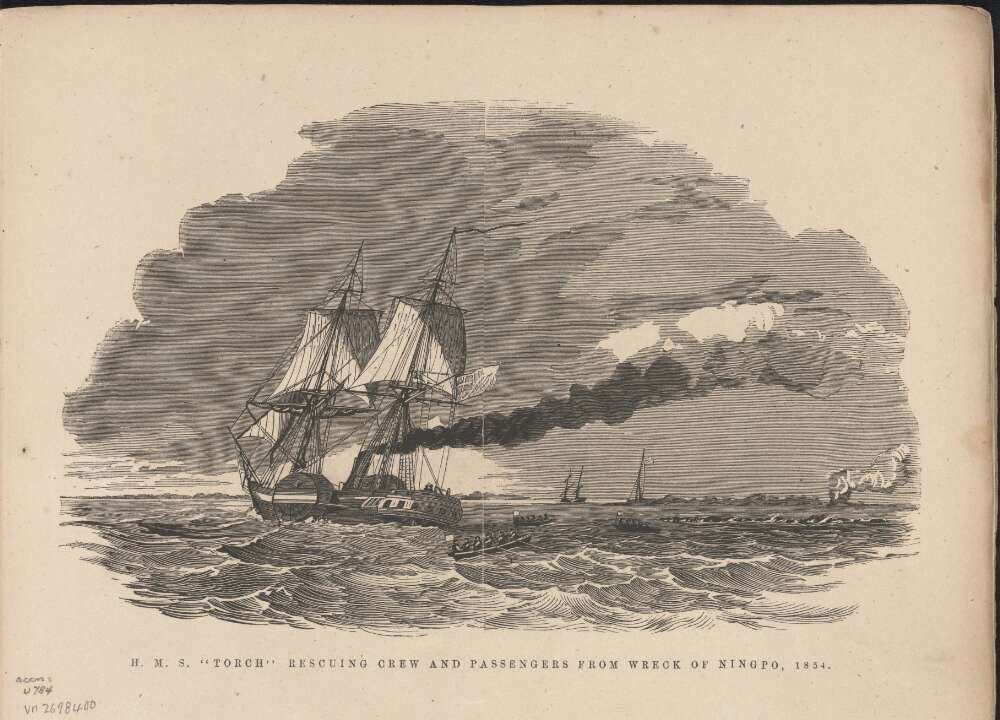
As Lieutenant William Chimmo was making HMS Torch ready for a return to sea, he was unexpectedly tasked with an urgent mission. Word had just reached Sydney that nearly 20 people had been marooned for two months on a remote island far out in the Coral Sea. By chance, his paddle steamer had just completed repairs and was eminently suited to the task at hand.
Second Mate William Tough of the 150-ton junk-rigged schooner Ningpo had arrived in Sydney on 2 October 1854. He had staggered in to Moreton Bay with a tale of personal heroism and a plea for help to save his stranded shipmates, but there was no vessel there that could go to the Ningpo’s rescue. Tough was patched up and sent to Sydney on the next ship heading south.
The Ningpo had departed Hong Kong on 15 April 1854, bound for Melbourne to take up new duties as a lighter in Hobson’s Bay. The voyage south had been a difficult one, plagued by storms, rough seas and a nagging leak which just kept getting worse. To add to Captain Billings’ woes, his chronometer stopped working. Unable to determine his longitude, accurate navigation had been reduced to nothing more than an aspirational stab in the dark. Billings decided they should pull into the French settlement at the Isle of Pines for repairs the Ningpo’s hull. But while still north of New Caledonia, he inexplicably changed his mind, opting to head for Moreton Bay instead.
This meant sailing dangerously close to the D’Entrecasteaux Reef, a two-thousand-square-kilometre maze of submerged coral reefs, small islets, and sandbars. Its discoverer, French Admiral Antoine Bruni D’Entrecasteaux, called it “the most dangerous reef he ever saw.”

By 8 p.m. on 28 July, Billings estimated that he was clear of those dangerous waters, but he was wrong. Minutes later, the Ningpo ran onto a submerged coral outcrop and began filling with water.
Unable to get the Ningpo off, Captain Billings made the decision to abandon ship. He, his crew and two passengers made for a small sand island a few kilometres away. They set up camp using timber spars and canvas sails. They fabricated a still to distil fresh water from the sea. Food proved plentiful, as the waters surrounding the island teemed with fish, and the island itself was a nesting ground for turtles and was also home to thousands of seabirds.
With their immediate necessities well catered for, thoughts turned to how they might escape. Their only means of leaving the island was a four-metre (13 ft) dinghy, the only lifeboat the Ningpo carried. Billings wanted to try to make the Isle of Pines about 600 km away, but his crew refused, fearing they would be killed by the inhabitants of New Caledonia long before they reached their destination. They wanted to send a small party to Moreton Bay, despite it being twice as far away. The captain and his crew were at an impasse.
Even after they had been stranded for more than a month, they sill could not agree where they should go to seek help. Frustrated with the inaction, Tough and two others set off in the dinghy to make the perilous voyage to Moreton Bay without first seeking the captain’s permission. Billings was furious when he discovered that his boat, compass, and nautical chart were all missing. He was convinced that they would fail, and in so doing, Tough’s recklessness had condemned the rest of them to an endless stay on the island. However, most of the crew held on to the belief that they would soon be found by a passing ship. Billings was not so optimistic, for he knew he had taken his ship far from regular shipping routes and that no sailing ship would intentionally venture into these treacherous waters.
But, despite Billings’ doubts, Tough and his companions reached Wide Bay on the Australian mainland 14 days later. As they beached their dinghy, a party of Aborigines attacked them, stole the boat and left them for dead. Ten days after that, however, the seriously injured Tough staggered into Brisbane, assisted by a couple of more hospitable Aborigines. Unfortunately, his companions were not so lucky, having died along the way. With no vessel available in Moreton Bay that could go to the rescue, Tough was sent to Sydney with a letter addressed to the Colonial Secretary, seeking assistance. After being stranded for more than 10 weeks, there was no guarantee that the Ningpo castaways would be found alive, but the authorities believed they were duty-bound to try.
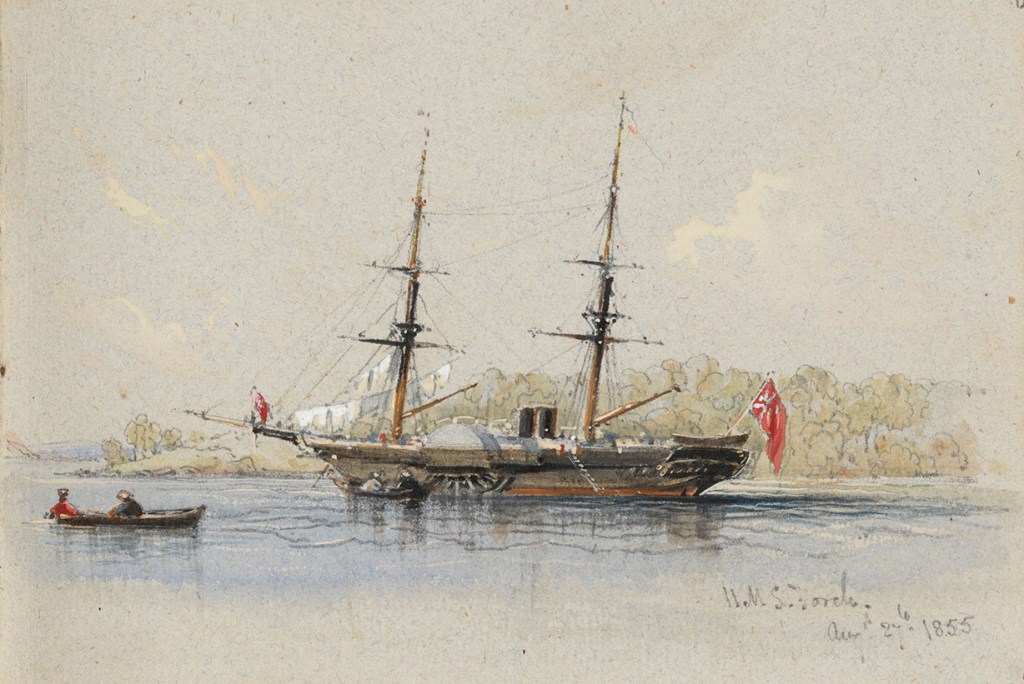
Lt. Chimmo was ordered to steam out of port as soon as possible. Fortunately, his preparations to return to Fijian waters to continue his survey work were well advanced, so he was able to clear Sydney Heads the following night. He stopped in Newcastle only long enough to fill his coal bunkers before continuing north.
Chimmo only knew that the Ningpo had run aground near a small island in the vicinity of latitude 18° 36’ South, the coordinate supplied by Tough and presumably recorded by Billings. The only charts available in Sydney that covered that stretch of ocean showed that the Ningpo was probably stranded somewhere near the Huon Islands. But the scale of the map offered little detail. HMS Torch would have to carefully pick its way through the reefs and shoals to find the castaways.
The Torch battled unseasonal north-westerly winds for the first 11 days. Then the south-easterly trades finally resumed, and they made much faster progress. By mid-October, they had arrived at the search area, but then another delay beset them. Storm clouds began gathering, and Chimmo had no choice but to make for deeper waters until the weather cleared or risk the destruction of his ship.
Meanwhile, Billings had finally convinced his men that they should wait no longer for help to arrive. After three months, it was clear that if they were ever to get off the island, it would be by their own means. He proposed building a boat from the remains of the Ningpo, and had already manufactured some rudimentary shipwright’s tools from cutlasses, knives and other metal objects they had salvaged from the schooner. Finally, his men realised they had a chance of success and embraced the idea. Unfortunately, the same storm that chased the Torch away also lashed their island, and Billings was forced to put their plans on hold for the time being.
When the storm finally cleared, Chimmo began his search of the Huon Islands. He sent search parties out in small boats to inspect each sandbar and islet they came across, but none showed any sign of recent habitation. Frequent rain squalls and strong winds hampered the search, and on one occasion, a boat capsized in the choppy seas, but no lives were lost. Then on the morning of 26 October, he spotted two islands in the distance.

After the storm had passed, Billings and his men began preparing to go out to the Ningpo in a dugout canoe found in the bushy interior of the island. How it got there was a mystery, but it had been a godsend to the stranded sailors. But before they headed off to the wreck, a lookout spotted a ship in the distance, the first such sighting since they had landed. Signal fires were lit, and everyone lined the beach in anticipation of being rescued.
As Lt Chimmo drew near to one of the islands, he saw two columns of smoke. Then, he spotted the stranded ship further off in the distance. Finally, he could make out people clustered on the beach. He fired a cannon to let them know they had been seen and gingerly made his way through the reef-strewn lagoon.
Fearing the weather could deteriorate at any moment, boats were sent across the last couple of kilometres to collect the castaways. One of the first to step ashore was the Ningpo’s second mate, William Tough, who had volunteered to accompany the rescue. He had brought help, as promised, to the utter amazement of Captain Billings.
The whole boarding operation was completed that day. The Torch then sailed for Sydney, arriving on 10 December 1854, having completed a round trip of more than 4000 km.

© Copyright C.J. Ison / Tales from the Quarterdeck, 2022.
To be notified of future blogs, please enter your email address below.











 Tales from the Quarterdeck