Category: Australian history

  • The Sapphire and Marina: Three Months in a Leaky Boat

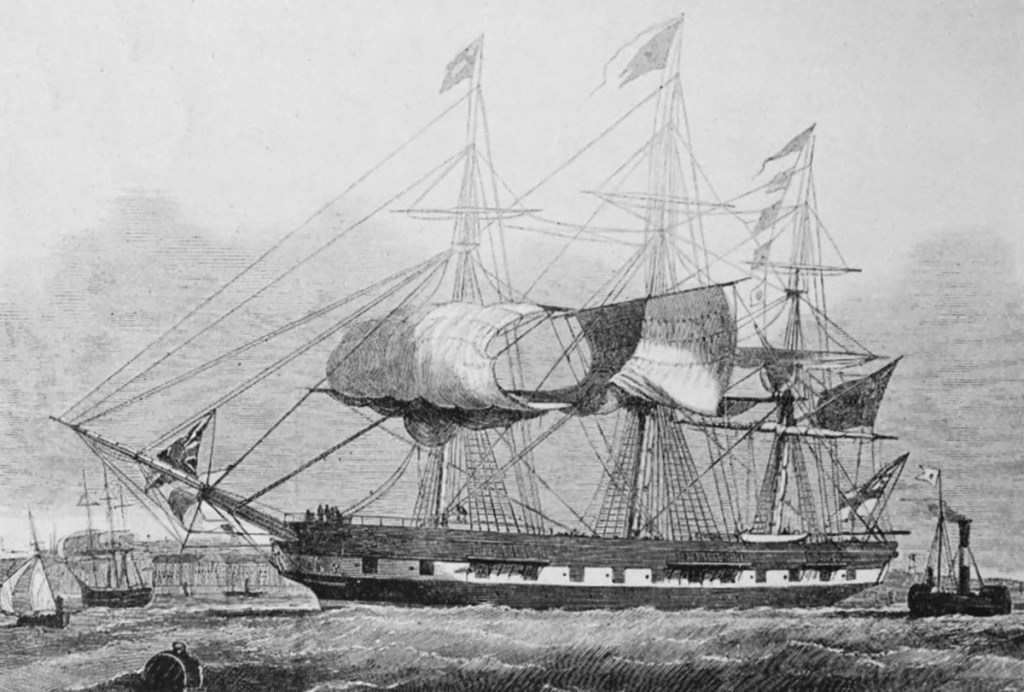
       At midday on 8 September 1859, the 749-ton merchant shipSapphire weighed anchor and began slowly making her way out of Port Curtis (present-day Gladstone, Queensland). She was ultimately bound for India via Torres Strait, with a consignment of 60 Australian horses purchased by the British Indian Army. But before the ship could clear the natural harbour, she ran aground on a sandbar and had to wait for the rising tide to lift her off.  So began a voyage that would cost 18 men their lives and last five gruelling months, only for the few survivors to wind up back where they had started. Their story is a remarkable one of perseverance in the face of unimaginable hardship, served with a healthy measure of good luck.   

    The Sapphire bore out into the Coral Sea and then headed north outside the Great Barrier Reef. On 23 September, Captain Bowden calculated he was somewhere off Raine Island. That afternoon, the lookout sighted a line of breaking surf heralding the outer edge of the reef. Bowden had the ship put about, and they tacked back and forth through the late afternoon. Captain Bowden intended to hold his position in deep water overnight and make his way through the reef first thing in the morning.

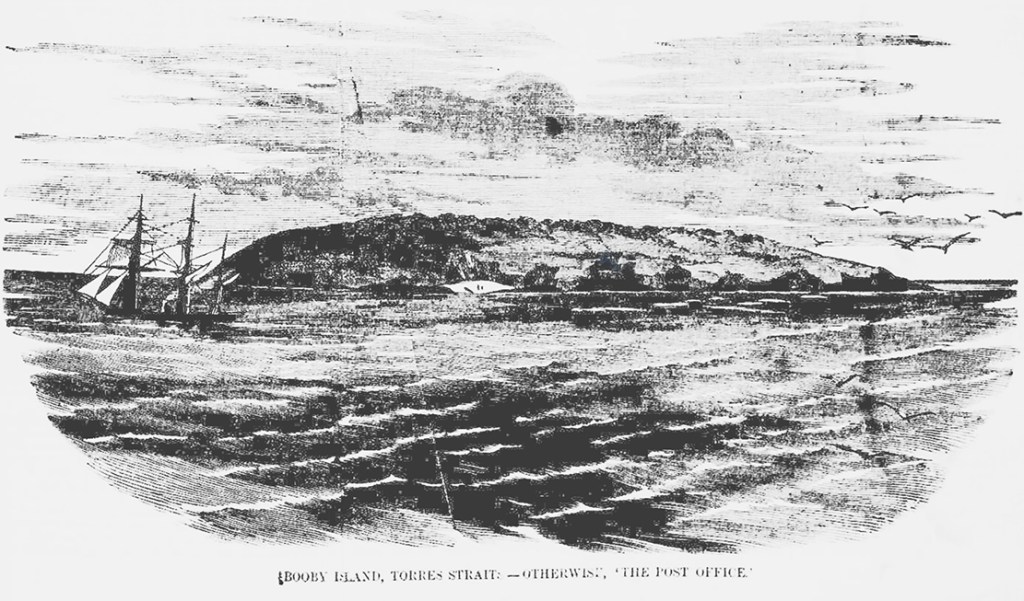
    Illustration of Booby Island, Torres Strait – Otherwise, Post Office. From the Illustrated Sydney News, Fri 16 Dec 1864, Page 9.

        But shortly after sunset, the alarm was raised. A lookout sighted a long, uninterrupted curve of white water directly in their path. By the time the ship responded to the call to pull hard about, the breakers were just 500 metres off the leeward bow. There was now insufficient sea room to turn the ship around and point her back out to sea.  The Sapphire struck the coral reef broadside. Huge waves swept her deck. The force of the collision brought down the fore-top-gallant mast, and one of their lifeboats was swept from its davits. The ship heeled over, and all seemed lost. Captain Bowden ordered the main mast cut away, hoping the vessel might right itself. When the mast came down, it landed on the deck, smashing the longboat to pieces. It also brought down the mizzen mast, which in turn crashed onto the lifeboat, damaging it. Within minutes, three of the Sapphire’s five boats were lost. Everyone spent a harrowing night sheltering as best they could while the terrified horses remained trapped in the hold.

       Breaking with maritime convention, by leaving his ship, Captain Bowden set off in the morning to search for somewhere to land. First Mate William Beveridge was left in charge of the stranded vessel. Beveridge began preparations to abandon the ship and also had the carpenters try to repair the two badly damaged boats, only half expecting that Bowden might return. It seems that Beveridge and Bowden did not see eye to eye, and the first mate may even have blamed his captain for running aground. However, Bowden did return to the Sapphire, having found a suitable refuge on Sir Charles Hardy Island about 85 km away.

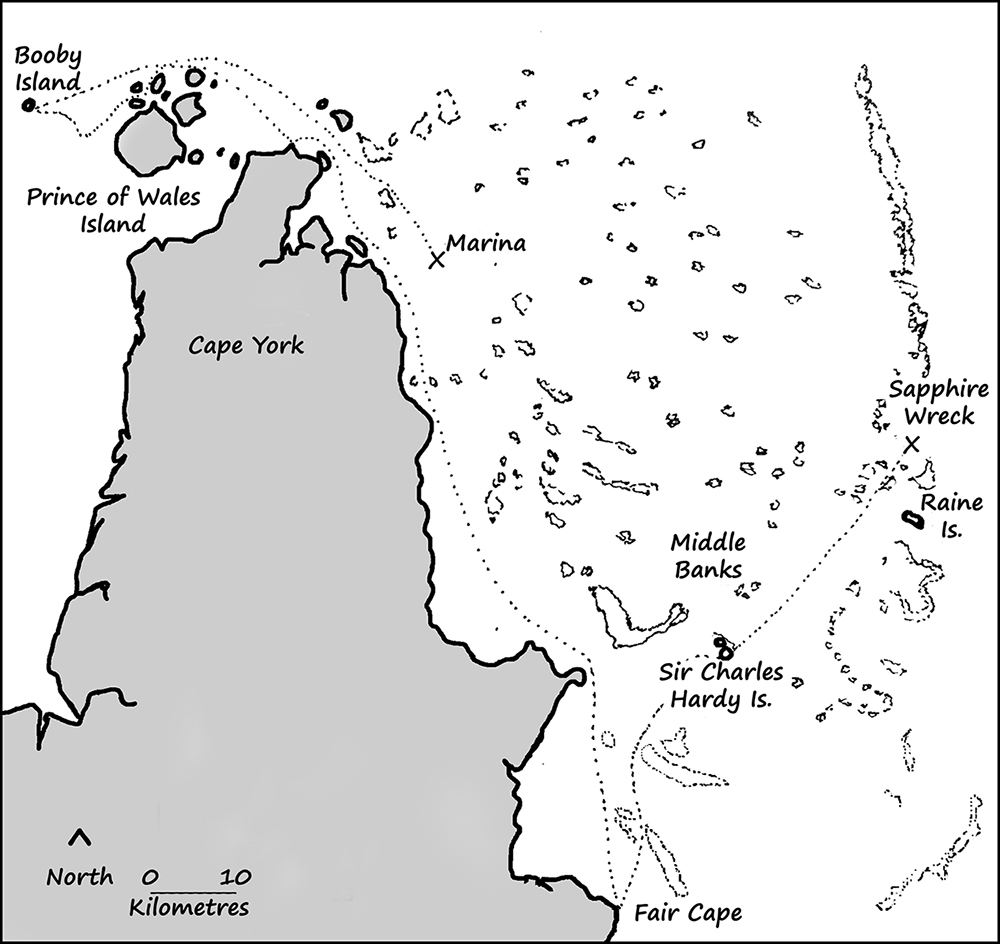
       The Sapphire’s crew of 28 men took to the two surviving boats and headed to the island, abandoning the ship and the 60 horses still trapped below. Captain Bowden decided they should return to Port Curtis, 1,500 kilometres to the south, and they left messages in a bottle hung from a tree telling of their intentions. They set off south on October 6 but immediately encountered strong headwinds. Bowden soon gave up on heading south, turning his boat around to head north, through Torres Strait, intending to make for Booby Island. In another unusual turn of events, Beveridge did not follow suit. He continued trying to push south for another day or two before he also gave up and turned around.

    Sapphire survivors route through Torres Strait from leaving the Sapphire and finding the Marina.

       Beveridge reached Booby Island in mid-October to find Bowden and the rest of the men already there. By now, they had been roaming the seas around Torres Strait for almost a month. The provisions they found there were a godsend for the hungry sailors, but they would not last indefinitely. Bowden and Beveridge agreed that they would have to leave there sooner or later. It was approaching cyclone season, and they had not seen another vessel since becoming marooned. They would likely not see another ship pass by Booby Island until April or even May the next year.

       Bowden and Beveridge put their differences aside and decided to make another attempt to return to Port Curtis, despite their recent failure. But as soon as they got clear of the island, they were struck by the same contrary winds that had plagued them earlier.

       While Beveridge and his boat were off Friday Island, they were set upon by Torres Strait Islanders and one of the men was speared to death. Meanwhile, Captain Bowden’s boat was off Hammond Island. They had stopped to trade with a party of Islanders, but in what seemed like an unprovoked attack, a volley of spears and arrows was launched into their overcrowded boat. Only one man was able to jump clear and swim away. He would later be rescued by Beveridge, who had gone in search of Bowden’s boat.

       Beveridge and his men continued pushing back east and eventually made it around the tip of Cape York. They then picked their way through the maze of coral reefs, and their luck finally changed for the better.

       They spotted a ship in the distance, the first they had seen since abandoning their own vessel some six weeks earlier. But, as they drew closer, they found it was deserted. The ship proved to be the barque Marina, which had run aground around the same time the Sapphire had been wrecked. It too had been abandoned by its crew, and they had also made it to Sir Charles Hardy, reaching it only hours after the Sapphire castaways had left. Miraculously, the Marina had floated off the reef on a spring tide only to drift around Torres Strait for the next several weeks.

    Marina’s course down the Queensland Coast. Source Google Maps.

       The Marina’s crew had then set off south for Port Curtis, and after 43 days of arduous sailing, they made it safely to port and notified the authorities of the loss of their own ship and also of the Sapphire. HMS Cordelia was dispatched north to search for the Sapphire’s missing men. However, she only steamed as far as Cape Upstart, thinking the lost sailors could not still be any further north. But they were wrong. By now, it was late January 1860, and the Sapphire’s crew was anchored off Lizard Island in the Marina, 500 km further north.

       Back in late November, Beveridge had decided they should sail the Marina to Port Curtis rather than try to do so in their small pinnace. Setting off on the 26th, they battled the same contrary winds and currents that had previously frustrated them. For the next two months, they made painfully slow progress. They anchored for days and weeks at a time, waiting for the south-easterlies to fall off. In the first month, they travelled just 180 km.

       They spent tiring Christmas Day kedging the stranded barque off a sandbar, and they would run aground twice more in the weeks that followed. The Marina’s hull was so damaged that water flowed freely in and out of the hold. The only thing keeping the ship afloat was her cargo of tightly packed Kauri logs.

       On 9 February, they were anchored off Palm Island.   In the past two and a half months, they had covered a little more than half the distance to Port Curtis. They still had another 800 km or more to go.   All seemed lost.   Their food had all but run out, and they were slowly starving to death.    

    Finally, their luck turned around. The wind started blowing from the north. They put to sea and made steady progress south. Three days later, Beveridge sighted Cape Upstart off the port bow. The next day, they were cruising through the Whitsundays. They were now only 400 km from Port Curtis. A couple of days after that, they crossed Keppel Bay, and the next day, 17 February, they anchored off Facing Island just outside Port Curtis. No one had the strength to manoeuvre the crippled vessel into port. They took to the Sapphire’s pinnace again and surprised everyone with their return, for they had long been given up for dead.

    The Sapphire’s full story is told in A Treacherous Coast: Ten Tales of Shipwreck and Survival from Queensland Waters, available as an eBook or paperback through Amazon.

    © Copyright C.J. Ison, Tales from the Quarterdeck, 2021.

    Enter your email address in the form below to be notified of new posts.

  • The Spanish Silver of Torres Strait

    Example of a mechant brig, similar to the Sun. Source: “L’Album De Marine Du Duc D’Orleans,” 1827.

       Sometime around 1891, a group of beche-de-mer fishermen stumbled upon a huge hoard of Spanish silver coins. The men had been fishing in the shallow waters of the Eastern Fields at the eastern approach to Torres Strait when they made the surprise discovery.

       At low tide, when much of the reef was exposed, they spotted an old, coral-encrusted anchor fluke jutting from the reef’s surface. The shoals of Torres Strait had claimed many a ship during the 19th Century, and the fishermen were keen to see what else they might find.

       They began chipping away at the decades of accumulated growth until the anchor finally broke free from the surrounding coral. When it was rolled clear, a mass of silver coins, all fused together by time and saltwater, was revealed. Buoyed by the find, the fishermen forgot about the beche-de-mer and extended their excavations. Each day, as soon as the falling tide exposed the reef, they got to work chipping away at the coral. In the end, they uncovered a staggering 410 kgs (900 pounds) of silver. It took them two trips to carry it all back to Somerset, the fishing and cattle station near the tip of Cape York owned by the early pioneering family of Frank Jardine.

    Spanish silver coins as circulated in the early days of New South Wales.

       At the time, it was supposed that the coins might have been carried on a Spanish ship on her way to Manila to pay the wages of the civil and military staff. Either that, or it was to be used to purchase spices from traders in the Indonesian Archipelago, further to the west. Regardless, the ship that had been carrying the fortune in silver had ended its voyage on that remote coral outcrop many decades earlier. They knew it was an old wreck, for by 1891, the timbers had long since rotted away.

       The mystery was only solved years later. It turned out not to have been a Spanish galleon at all. Instead, the fishermen had stumbled upon the remains of the English brig, Sun, which had been lost in Torres Strait in May 1826. Earlier that same year, the Sun had delivered a cargo of tea from China to merchants in Hobart and Sydney. In Sydney, a local businessman had entrusted the ship and her captain with a new cargo of between 30,000 and 40,000 Spanish silver dollars. At the time, one Spanish dollar was worth 4 shillings and 4 pence, which would have valued the somewhere between £7,000 and £10,000. In today’s money, the silver content alone would be worth well over one million Australian dollars.

       The Sun sailed from Sydney on 7 May, bound for Singapore by way of Torres Strait. But it never arrived. The voyage was cut short three weeks later when the Sun struck a submerged reef as it attempted to navigate the dangerous waters separating Cape York from New Guinea.

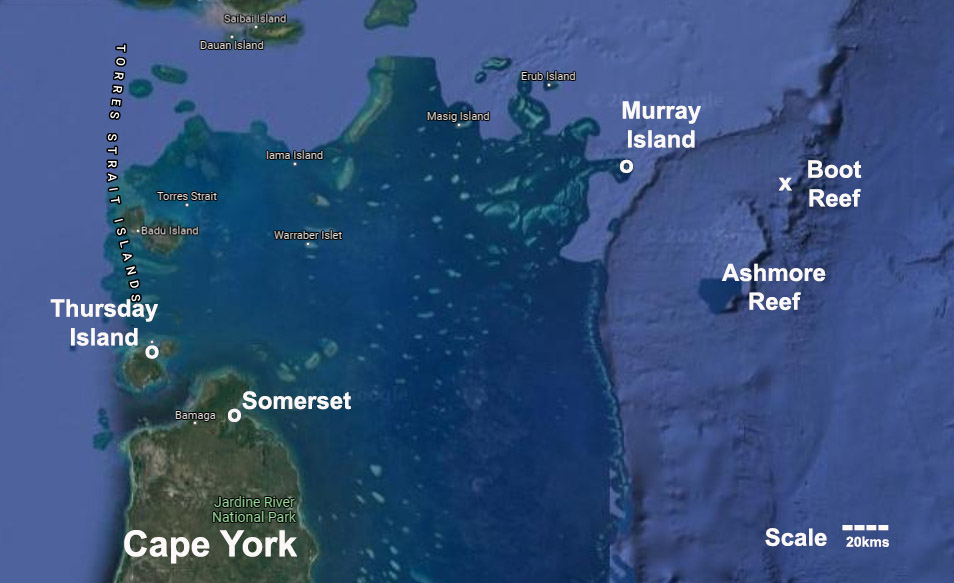
    Torres Strait. Source: Google Maps.

       The ship broke up almost immediately. Captain Gillet and his crew took to the longboat and jolly boat and made for Murray Island, about 30 nm (60 km) away. Such was the haste with which they were forced to abandon the ship that there was certainly no time to save the silver. The crew didn’t even have time to provision the boats with food or water before they pushed away from the wreck. Fortunately, they would only be at sea for two days before sighting land.

       As fate would have it, just as their safety seemed assured, the longboat struck a reef and capsized, spilling all the occupants into the water. The first and second mates, plus 22 lascar sailors, drowned. Only the jolly boat with the ship’s captain and 11 remaining seamen reached Murray Island, where they were looked after by the Islanders. Three days later, Captain Gillet and his men were rescued by a passing ship and eventually delivered to Calcutta, where he reported the loss of his ship.   

    So, there the Spanish silver dollars remained undisturbed for the next 65 years as the Sun slowly disintegrated around them. As the employer of the fishermen, Frank Jardine claimed the lion’s share of the haul. He reportedly had at least some of the coins melted down and made into silver tableware and cutlery for the Jardine Homestead.

    © Copyright C.J. Ison, Tales from the Quarterdeck, 2021.

    Enter your email address below to be notified of new posts.

  • The Post Office in the middle of nowhere

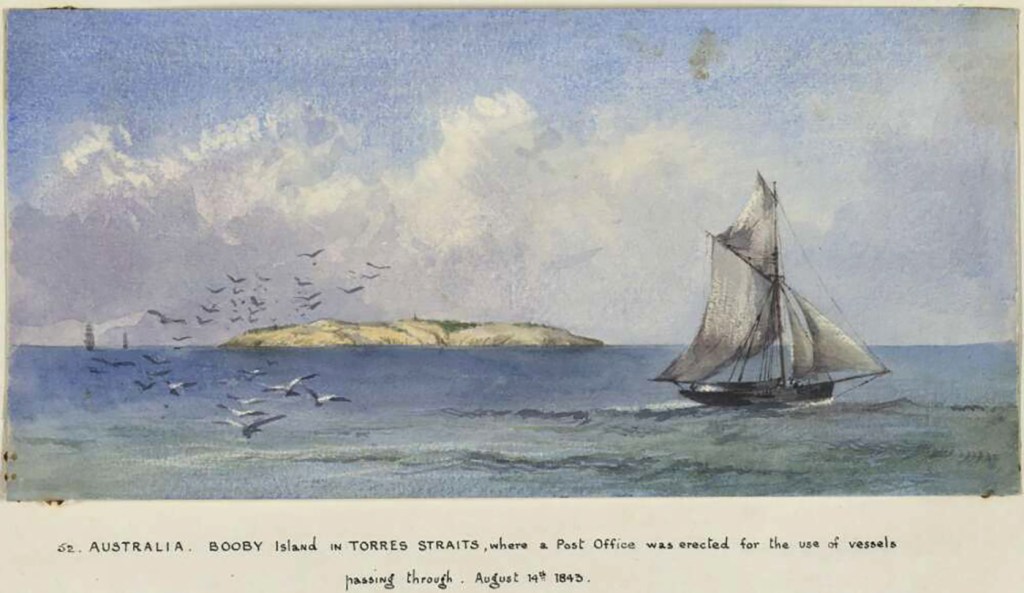
    Booby Island. Image courtesy National Library of Australia

       It might seem strange that one of Australia’s earliest post offices was also one of its most remote. It was set up on Booby Island in Torres Strait in 1835. However, the practice of passing mariners leaving correspondence on the island was already well established.

       Booby Island (Ngiangu to the Torres Strait Islanders) lies west of the tip of Cape York, about 1,800 nm or 3200 km by sea from Sydney. The nearest European settlement was the Dutch outpost of Kupang on Timor Island, 2000 km west across the Arafura Sea.

       Cook named the small outcrop Booby Island after the birds he saw nesting on its rocky slopes. The island would go on to serve as a crucial navigation landmark, especially for those mariners who had sailed up Australia’s east coast and were bound for Timor and beyond. Reaching Booby Island meant they had made it safely through the labyrinth of dangerous coral shoals plaguing the Torres Strait.  

       The earliest record of shipwrecked sailors finding refuge on Booby Island dates to 1814. The merchant vessel Morning Star, sailing from Sydney to Batavia, struck a reef and sank in Torres Strait. The crew abandoned the ship and made for nearby Booby Island. They were stranded there for five months, living in one of the island’s caves and surviving on rainwater and the seabirds that resided there. Then a sharp-eyed observer on a passing ship noticed a white flag being vigorously waved by one of the survivors. Five men were rescued. Twenty-two of their shipmates, including the captain, lost their lives.

       By the 1820s, ships were regularly passing through Torres Strait on their way from Sydney and Hobart bound for ports in India, China and England. Too many ran aground or sank in those remote and treacherous waters.

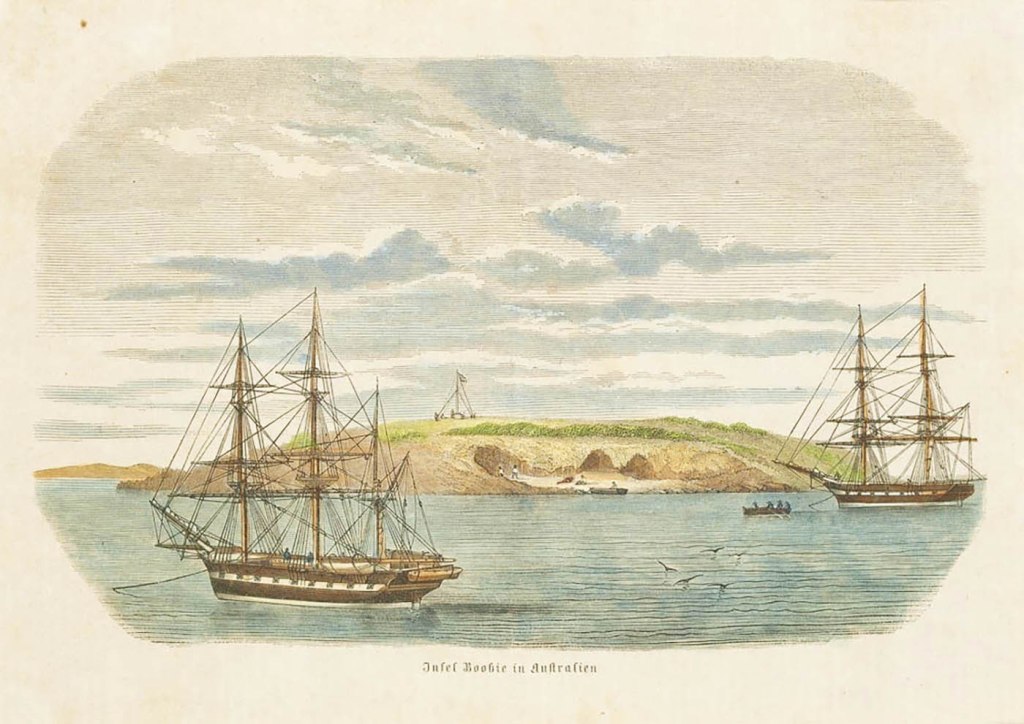
       In 1822, a flagstaff was erected on Booby Island’s summit, and a logbook was placed in one of the island’s caves so ships’ captains could register their safe passage through the Great Barrier Reef and Torres Strait. Those same mariners also began leaving sailing reports in the ledger to aid their fellow seafarers. The location of uncharted reefs or the strength and direction of hazardous currents were all recorded, sometimes at the cost of the vessel. Much of this information would be used to update later naval charts of the region.

    From an unidentified illustrated newspaper depicting Booby Island in the Torres Strait. Illustration Courtesy State Library of Queensland.

       Shortly after taking up duties as the Governor of New South Wales in 1824, William Bligh had the island stocked with barrels of fresh water, preserved meat and sea biscuits. Bligh knew stocking the island with provisions would go a long way towards saving the lives of sailors unfortunate enough to come to grief in those remote northern waters. He had first-hand knowledge of just how dangerous they could be. As a young Lieutenant, Bligh had sailed a small open cutter through Torres Strait after he had been unceremoniously relieved of his ship, HMS Bounty, by its mutinous crew.

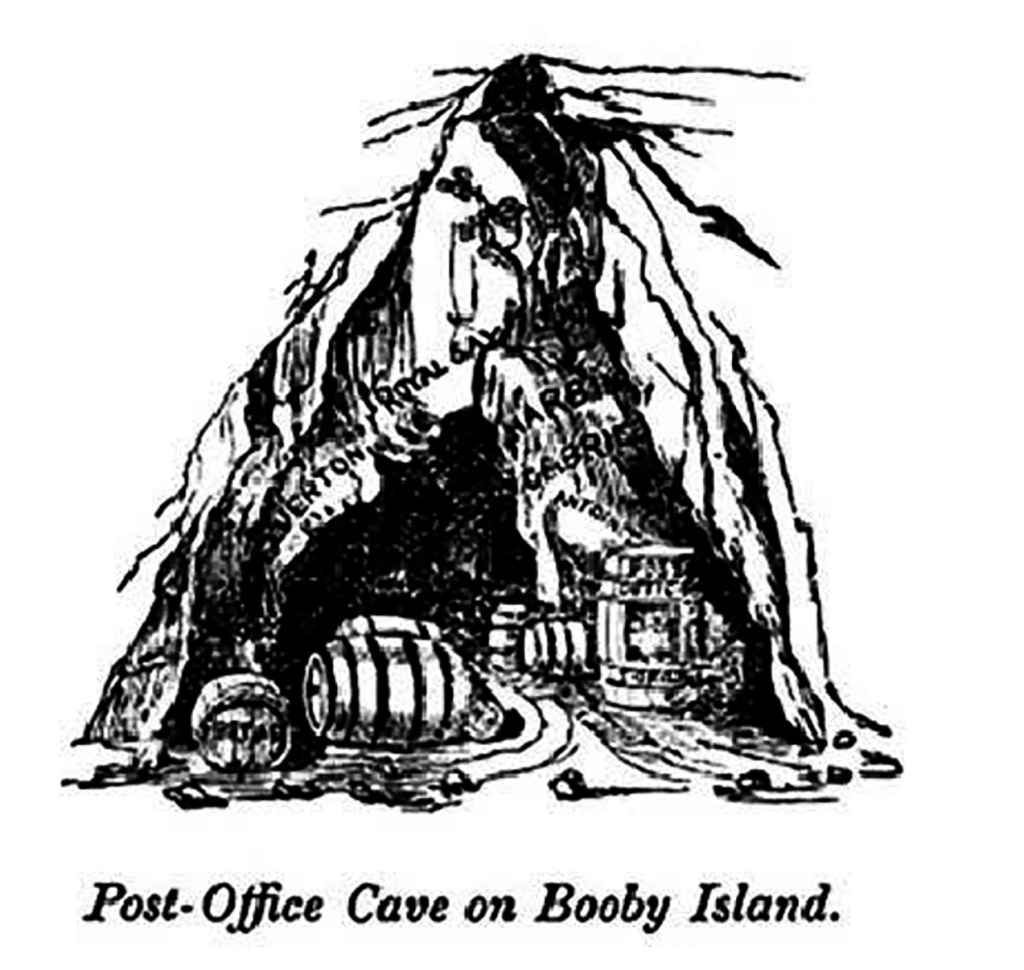
       Then, 11 years later, in 1835, Captain Hobson of HMS Rattlesnake established the unmanned “post office” in one of the island’s small caves. The practice of leaving details of sailing hazards continued. But mariners also began leaving letters in the box in the hope they might be taken on to various destinations by other passing ships. For example, someone on a ship bound for India might leave a letter addressed to a recipient in Canton, China. The next ship bound for that port would take it on to its destination.   

    When the Upton Castle stopped briefly at Booby Island in 1838, one of its passengers visited the post box and described it thus,“[it is] covered with canvas and well secured, and supplied with a quantity of pens, paper, and ink, and pencils in excellent order.”

    Early illustration of the Booby Island Post Office.

    It is worth remembering that the only other post office in Australia at the time was in Sydney.    Melbourne would not get a post office for another couple of years and it would be seven years before another post office appeared in what would become Queensland.

    In the span of just 15 years castaways from at least ten ships owed their lives to Booby Island.   The Coringa Packet, and Hydrabad (1845) Ceres (1849), Victoria (1853), Elizabeth, Frances Walk   It is worth noting that, at the time, the only other post offices in Australia were located in Sydney and Hobart. Melbourne would not get a post office for another couple of years, and it would be seven years before Brisbane got one.

       In the span of just 15 years, castaways from at least ten ships owed their lives to supplies left at Booby Island. Survivors from the Coringa Packet, and Hydrabad (1845), Ceres (1849), Victoria (1853), Elizabeth, Frances Walker and Sultana (1854), Chesterholme (1858), Equateur, and Sapphire (1859) and many more before and since made for the island after their ships were lost.

       Booby Island remained a vital refuge for shipwrecked mariners and a place to exchange information until the 1870s, when a government outpost was established on nearby Thursday Island.er and Sultana (1854), Chesterholme (1858), Equateur, and Sapphire (1859) and many more before and since made for the island after their ships were lost.

    Booby Island remained an important refuge for shipwrecked mariners and a place to exchange information until the 1870s when it was supplanted by a government outpost on Thursday Island.

    Copyright © C.J. Ison, Tales from the Quarterdeck, 2021.

    To be notified of future blog posts, please enter your email address below.

  • Thomas Pamphlett and the Remarkable Castaways of Moreton Bay

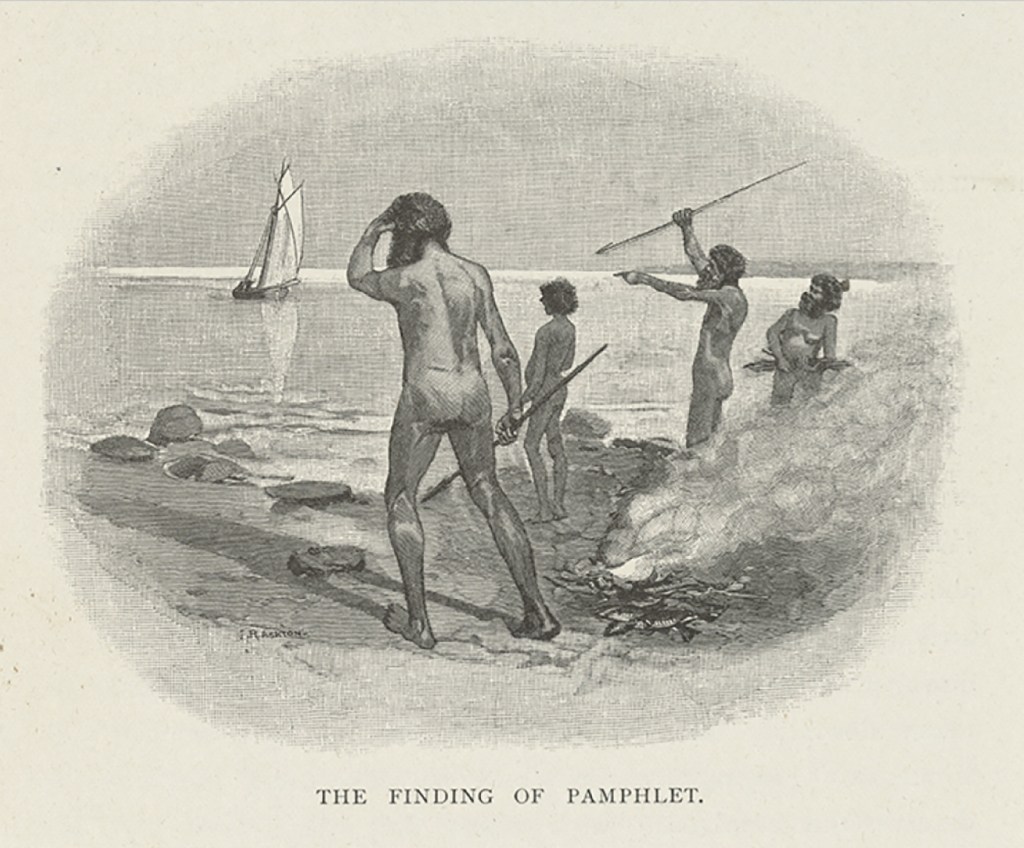
    Source: ‘The Finding of Pamphlet’, Picturesque Atlas of Australasia, vol. II, 1886, nla.cat-vn1654251.

    Most Queensland school children are taught that the first non-Aboriginal people to settle in their state were convicts and their gaolers who arrived in September 1824.   But actually the first white-skinned people to live in what would become Queensland were three castaway ex-convicts who came ashore 18 months earlier.

    In 1823 Governor Brisbane sent the NSW Surveyor General, John Oxley, to determine if Moreton Bay, 800 kilometres north of Sydney, would make a suitable penal settlement to house the colony’s worst and most incorrigible convicts.

    On 29 November the small government cutter Mermaid, carrying Oxley and his party, dropped anchor in Pumicestone Passage separating Bribie Island from the mainland.   To their astonishment, among the Aborigines they could see on shore stood a taller, lighter-skinned man excitedly haling them.    His name was Thomas Pamphlett and he and two mates had been living with the local Aboriginal peoples for the past seven months.

    This is their story.     On 21 March 1823 four ticket-of-leave men, Thomas Pamphlett, John Finnegan, Richard Parsons and John Thompson, sailed from Sydney in a 10-metre-long open boat bound south to the Illawarra to gather cedar logs for sale in Sydney.

    However, they were caught in a ferocious storm which battered the craft mercilessly for five days.   They were driven far from the coast under a bare mast and when the storm finally cleared five days later they had no idea where they were.     They thought they had been blown south towards Van Diemen’s Land but in fact they had been taken north.    So, when they could finally hoist a sail they bore north in search of Sydney.  

    Their water had run out days earlier and they only had rum to quench their thirst.    All four were in a bad way but John Thompson became delirious and died from thirst.   They kept him in the boat for several days until the smell drove them to bury him at sea.  

    They finally sighted land about three weeks after setting off from Sydney.   This turned out to be Moreton Island though that was not known to them at the time.   They could see a freshwater stream flowing across the beach so Pamphlett swam ashore with the water keg in tow.   He drank his fill but was too weak to swim back to the boat.    The others, crazed with thirst, brought the boat closer to shore but it got caught in the surf and was smashed to pieces.

    The three men were alive but stranded.   They salvaged some flour, a bucket, an axe, a pair of scissors, the water keg but little else.    They soon came across an Aboriginal camp in the sand dunes and were befriended by the people.    The three castaways lived with their hosts for a couple of months then they decided to set off north thinking they would eventually reach Sydney.

    First they went south to cross over to Stradbroke Island then onto the mainland where they ventured north around Moreton Bay   All the time they were accompanied by different bands of Yuggera.   Pamphlett and Finnegan decided to stop at Bribie Island on the northern edge of the bay and lived with the Joondoobarrie people until they were found by Oxley and his party.     Parsons, still determined to return to Sydney kept heading north and may have gone as far as Harvey Bay before it was made clear to him his presence among the Butchella people was not welcomed.  

    The cutter Mermaid. Photo State Library of Queensland

    He returned to Bribie Island many months later only to find his comrades had been taken away on the Mermaid.   However, the party of explorers left a message in a bottle for Parson should he ever pass that way again.   Unfortunately, he was illiterate and could not read the message that had been left for him, but he remained in that area in the hope that another ship might pass that way.    He was in luck.   The brig Amity sailed into Moreton Bay in September the following year with 30 convicts and their guards to establish the first settlement at Redcliffe.   When they came ashore Parsons was standing on the beach waiting for them.  

    Richard Parsons was returned to Sydney and found work as a bullock driver. John Finnegan later returned to Moreton Bay and took up a post piloting ships in and out of the bay. Thomas Pamphlett also returned to Moreton Bay, but it was not of his own choosing. He stole two bags of flour in 1826 and was sentenced to spend seven years toiling at Moreton Bay penal settlement.

    For more interesting stories from Australia’s maritime past check out  A Treacherous Coast: Ten Tales of Shipwreck and Survival from Queensland Waters, available now as a Kindle eBook or paperback through Amazon.

    (c) C. J. Ison / Tales from the Quarterdeck, 2021.

    To be notified of future blog posts, please enter your email address below.