Category: Australian history

  • HMS Guardian: All Hands to the Pumps

       In September 1789, HMS Guardian sailed from Portsmouth, England, with much-needed supplies for the newly established penal settlement in New South Wales. But its voyage was cut short when it struck an iceberg in the Southern Ocean and began filling with water.

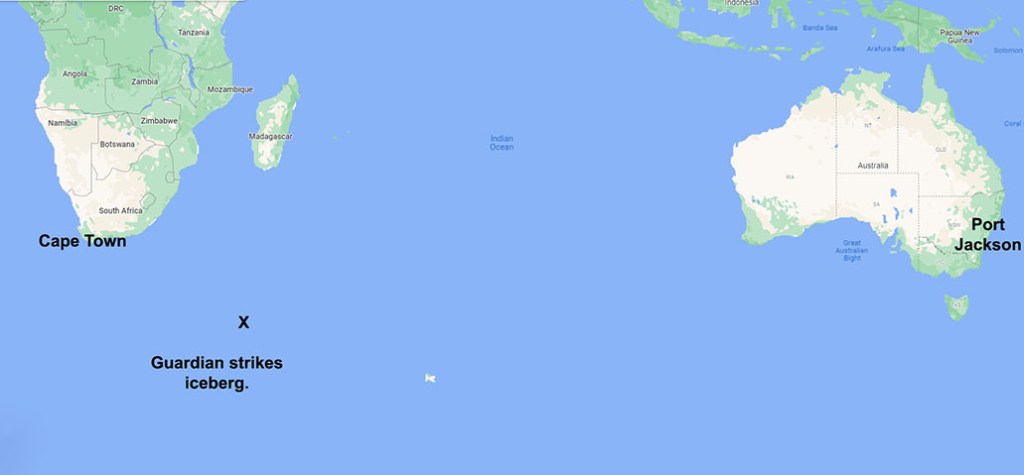
       After an uneventful passage south, the Guardian had stopped at Table Bay (present-day Cape Town) for a fortnight in early December. There, they took on board plants and livestock destined for the colony before setting off across the Southern Ocean for Australia.

       The sea conditions were almost ideal, except for a dense fog. There was little swell, and a gentle breeze filled the sails, pushing them east. Late on the afternoon of 24 December, when they were about 2,000 km away from the nearest land, the fog lifted, revealing an iceberg about six kilometres away.

       After two weeks at sea, the ship’s water supply had been depleted by the additional animals and plants they were carrying. The captain, Lt. Edward Riou, seized the opportunity to resupply. He brought the Guardian to within 500 metres of the towering white mountain and sent two boats out to gather blocks of ice that were floating in the sea. 

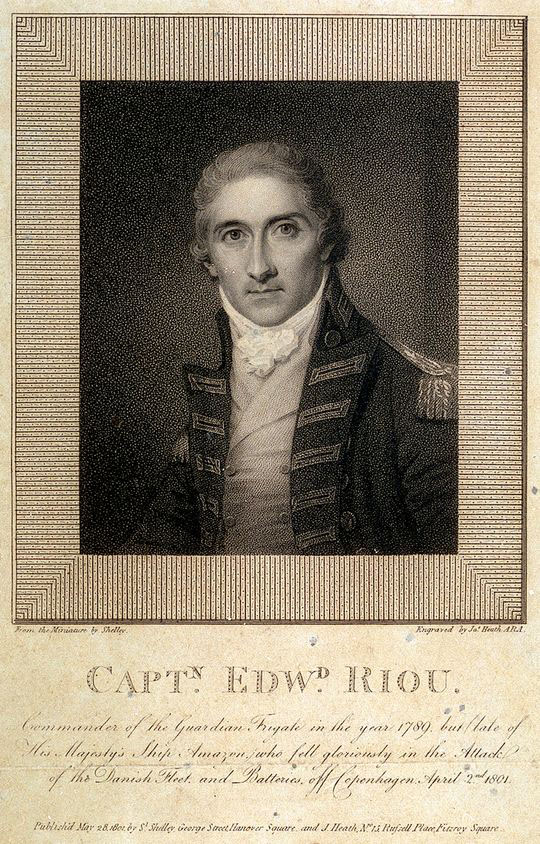
    Captain Edward Riou, commander of the Guardian.

    By the time the heavily laden boats returned it was about 7 p.m. and the fog had once again enveloped the Guardian. By quarter to eight, Riou could barely see the length of his ship.

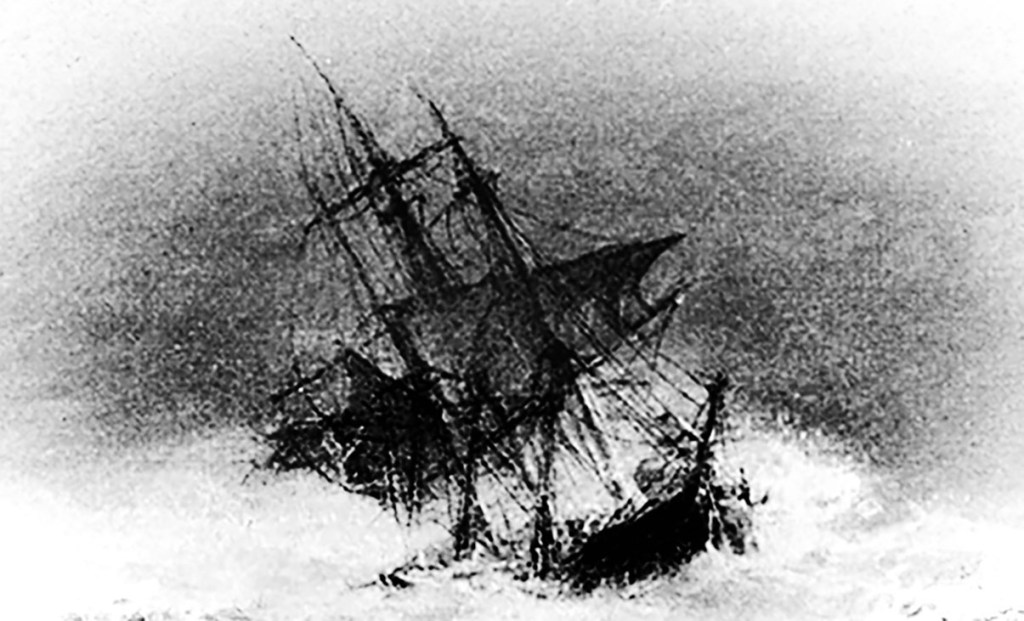
       Then, without warning, the Guardian crashed stern-first onto a submerged ice shelf projecting out from the berg. The force of the collision violently shook the vessel, causing the rudder to snap off. Riou was able to use the wind and the sails to back his ship off the ice, and for a brief moment, it seemed that disaster had been averted.

       However, upon sounding the wells, the carpenter reported that they were taking on a lot of water. The ship had sustained serious damage below the waterline. Riou ordered the pumps manned and the ship lightened. The crew started by throwing the livestock penned on deck over the side. They then began bringing stores up from the hold, and they were also tossed into the sea.

       By 10 p.m., it was clear that all the hard work was not going to save the ship. The water continued to gain on the pumps as the ship began to sit lower in the water. Soon she was so low that waves swept over the deck, threatening to pour into the hold through the open hatchways.

    Efforts to save the ship continued through the night and the next day. By now, the weather had deteriorated. The wind was raging around them, and mountainous seas rose, crashing into the stricken ship. By now, the crew were exhausted from their continuous exertions at the pumps and jettisoning cargo. Lt Riou finally accepted the inevitable and gave the order to abandon ship.

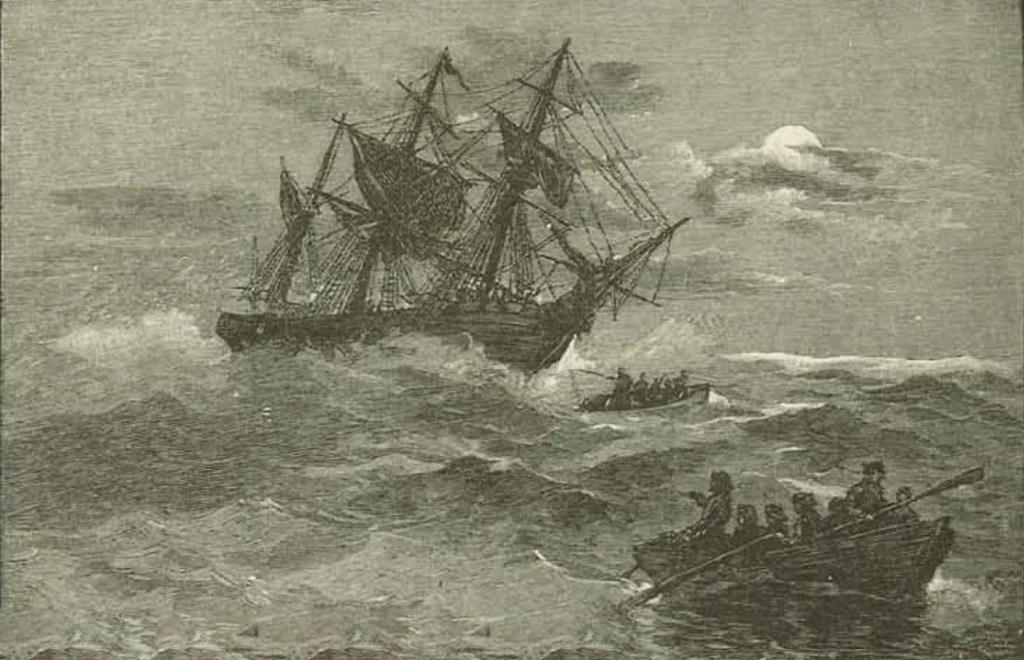
       There were 123 souls on board the ship, but the five lifeboats would only carry half that number. Riou, a maritime man to his core, had already decided he would remain with his ship to the end. But he encouraged anyone who wished to do so to take to the boats where they might stand some chance of surviving.   

    One lifeboat was lost immediately when it was lowered into the sea, but the other four got away and were soon out of sight. Sixty-two people chose to remain with the ship, including 21 of the 25 convicts being transported.

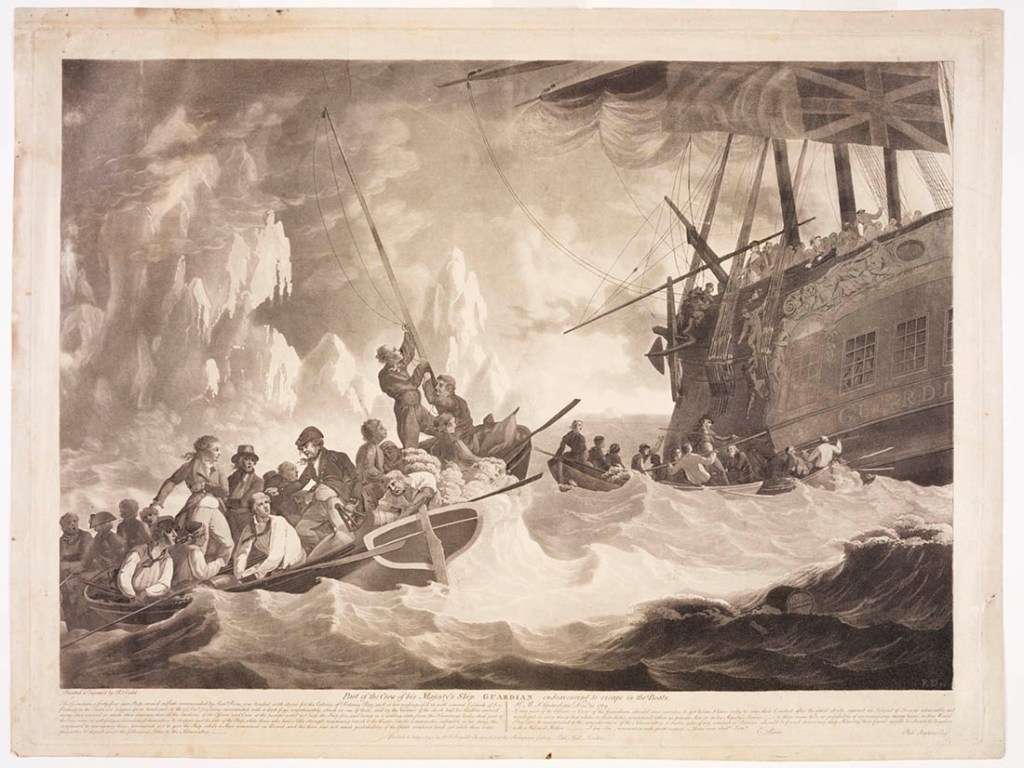
    Illustration titled “Part of the crew of his Majesty’s Ship Guardian endeavouring to escape in the boats.” Courtesy: State Library of NSW.

    To Riou’s and everyone else’s great surprise, the Guardian did not sink. Though she sat very low, her deck awash with frigid water, she remained afloat, barely. They would later learn that the cargo of barrels still trapped in the hold provided just enough buoyancy to keep the stricken vessel from sinking. Riou would also later discover that most of the ballast had been lost through a rent in the hull.

       A sail was draped under the ship to stem the inflow of water. The pumps were manned around the clock, and they slowly limped back to Table Bay. The relentless cold and wet conditions and sheer physical effort made the passage brutal. However, nine weeks later, they made it to False Bay, where the Guardian would soon break up on the beach.

       Of the 60 passengers and crew who had taken to the boats, only 15 survived. They were rescued by a passing ship after being adrift for nine days. The three other lifeboats that got away from the Guardian were never heard of again.

    Map courtesy Google Maps.

       Lt Riou was cleared of blame for the loss of his ship and was later promoted to the rank of Captain. He praised the performance of his officers and men and sought pardons for the convicts who had worked so resolutely to save the ship. But by the time the recommendation reached Port Jackson, one of the convicts had already been hanged for stealing, and six others had gone on to commit additional crimes and their pardons were revoked. But 14 men had their sentences overturned.

    (C) Copyright Tales from the Quarterdeck / C.J. Ison, 2022.

    To receive notifications of future blog posts enter your email address below.

  • The Peruvian’s Lone Survivor

    James Morrill. Source National Library of Australia 136099157-1.

       In July 1846, word reached Sydney that a ship, the Peruvian, had been discovered abandoned on the remote Bellona Shoals far out in the Coral Sea.   No one knew what had happened to those who had been on board. As the months passed with no word of any survivors, it was presumed they had all been lost at sea when the ship was wrecked or in a desperate attempt to reach land. Then, 17 years later, a naked lone survivor walked out of the bush with a remarkable story of survival.  

       His name was James Morrill, and he had been 22 years old in late February 1846 when the Peruvian sailed out of Sydney Harbour on her way to China. Morrill had only joined the crew a couple of days before they sailed. Captain Pitkethly and his crew, including Morrill, numbered 14. Pitkethly’s wife, Elizabeth, six passengers and two stowaways sailed with them. In total, there were 23 people on board.

       The Peruvian had fine weather for the first three days and made an easy time of it sailing north under full sails.   But during the third night at sea, the weather started to turn. The next morning, the ship was in the grip of a powerful storm.   For the next several days, the Peruvian was blown north under bare poles.  Then, after nearly a week, the weather began to ease again. Sail was heaped back on, and they started making up for lost time. Then, in the early hours of 8 March, an ominous line of white caps materialised out of the pitch black night directly in their path.

       The Peruvian slammed into the reef before there was any chance to change course. The waves lifted the damaged ship onto the reef, where she stuck fast. Seawater swept the deck, washing away the lifeboat and the unsuspecting second mate who had just emerged from below deck.

       The morning revealed an unbroken reef awash with turbulent white foaming water as far as the eye could see. No islet, sandbar or refuge of any sort lay in sight. Only jagged rocks jutted from the sea’s surface. Captain Pitkethly made the difficult decision to abandon his ship. When the crew lowered the jolly boat over the side, it was immediately smashed to pieces. They now only had one boat left. It was loaded with supplies and lowered away. Then the ropes got tangled and the boat filled with water. The first mate jumped in the boat to try to save it, but before he could bail it out, the stern broke away. The damaged boat plummeted into the water, and a strong current swept it away from the side of the ship. Resigning himself to his fate, the man bid the captain and crew farewell and was soon lost from sight.

       Their situation had become dire with the loss of all three lifeboats. The ship could break apart at any time, and they were stranded over 1000 km off Australia’s east coast. But Pitkethley was not about to give up. The Peruvian’s masts were brought down, and cross planks were lashed and nailed in place, forming a platform. Then the remaining 21 castaways boarded the raft for a very uncertain future.

       The raft drifted with the north-westerly current towards the Australian mainland. The days passed slowly under the blazing tropical sun. Water and food were carefully rationed, making thirst and hunger constant companions. Morrill would recall that one day blurred into the next. Had the captain not recorded the passing of each day by carving a notch into a piece of timber, no one could have said how long they had been adrift in that empty sea.

       Morrill would later recall that after they had been adrift for a little over three weeks, they had their first casualty from the raft. Captain Pitkethly prayed over the man’s body, and it was lowered into the water. To everyone’s horror, as the body floated away, it was attacked by sharks and torn to shreds. The feeding frenzy, according to Morrill, only ended when the body was completely devoured.

       By now, they had probably left the open ocean and were among the shoals of the Great Barrier Reef. Fish could be seen in the crystal clear water, and they were able to catch some with a lure they fashioned from a fish hook, a piece of tin and a strip of canvas. Nature also answered their prayers for fresh water when the skies opened up. Rainwater was collected in a sail, and they could fill their water container for the first time since abandoning the ship. However, their good fortune did not last.

       Four weeks of starvation, thirst, and exposure to the elements had taken their toll on everyone. The castaways started dying in rapid succession.  “At this time they dropped off one after the other very rapidly, but I was so exhausted myself that I forget the order of their names,” Morrill would later recall.   

    James Morrill. Photo courtesy State Library of Queensland.

       By now, the raft was continuously circled by sharks drawn by the regular supply of corpses. Half-starved and desperate to fill their aching bellies, the survivors resolved to catch one of their tormentors.

       “The captain devised a plan to snare them with a running bowline knot, which we managed as follows,” Morrill would later claim, “We cut off the leg of one of the men who died, and lashed it at the end of the oar for a bait, and on the end of the other oar we put the snare, so that the fish must come through the snare to get at the bait.   Presently, one came, which we captured and killed with the carpenter’s axe.”

       And so Morrill and a few others clung to life. After being adrift for about five weeks, they sighted land for the first time. When Captain Pitkethly examined his chart, he took it to be Cape Upstart. But with no way to steer the raft, they could only watch and pray that they reached shore sometime soon.

       “Two or three days afterwards we saw the land once more, and were driven towards Cleveland Bay,” Morrill recalled, “but just as we were preparing to get ashore, in the hopes of getting water, a land breeze sprang up and drove us out to sea again.”

       Then, around midnight, the raft washed ashore, likely on the southern point of Cape Cleveland. After so long at sea, no one had the strength to do anything but drag themselves off the raft and collapse on the beach. In the early hours of the morning, it began to rain. Morrill and the other castaways quenched their thirst by drinking directly from shallow depressions in nearby rocks.   Cold and wet, they huddled together and waited for dawn.

       They had been adrift on the raft for 42 days according to the captain’s tally of nicks in the piece of wood. Only seven of the 21 people who had left the Peruvian were still alive, and two of those would die from exhaustion within hours of reaching land.

       For the next couple of weeks, the survivors sheltered in a cave and foraged for shellfish among the rocks. One of the castaways found a canoe pulled up on the beach one day. He would set off south in it alone after Morrill and everyone else refused to join him. Morrill would later learn that his emaciated body was found by Aborigines not far from where he had left.

    Memorial to James Morril, the last survivor of the Peruvian shipwreck who lived with Aborigines for 17 years. Bowen Cemetery.

       As their strength slowly returned, the castaways began ranging further afield in search of food. And their presence soon came to the attention of the local Aborigines, the Bindal and Juru peoples. One evening after Morrill and Captain Pitkethly had returned to the cave from a day’s foraging, they heard strange jabbering and whistling sounds. When they went to investigate, they found several naked black men staring at them with keen interest.

       “At first they were as afraid of us as we were of them,” Morrill later said. “Presently, we held up our hands in supplication to them to help us; some of them returned it. After a while, they came among us and felt us all over from head to foot. They satisfied themselves that we were human beings, and, hearing us talk, they asked us by signs where we had come from. We made signs and told them we had come across the sea, and, seeing how thin and emaciated we were, they took pity on us. …”

       By now, only Morrill, Captain Pitkethly, his wife Elizabeth and a young apprentice were left. They were taken in by the Aborigines and assigned to different groups. The captain and his wife never fully recovered and struggled to adapt to the arduous life among the Aborigines. They died within a few days of each other and were buried together. Morrill would also later learn that the apprentice had also died.

    .   Morrill would live among the Bindal people of the Burdekin region for the next 17 years. Every so often, his new friends told him that they had sighted a ship out on the ocean, but he was never close enough to try signalling for help. But the sightings served to remind him of his past life.

       By 1863, the frontier of European colonisation had reached the lower Burdekin River. By then, he was nearly 40 years old. One day, Morrill approached a hut, calling out to its occupants, “What cheer, shipmates?” The shepherds came out, one of whom was armed with a gun, to find a naked, dark-skinned man standing before them. “Do not shoot me, I am a British object, a shipwrecked sailor,” Morrill yelled.  He was invited inside and told the shepherds his story in broken English. He only then realised how much he wanted to return to his old life. Morrill made one final visit to his Bindal family and friends, begging them not to follow him. Aborigines were frequently shot on sight if they seemed to pose a threat, and Morrill did not want that fate to fall on his loved ones.

       Morrill would eventually be taken to Brisbane, where he met the Governor. He asked that the Aborigines be allowed to live on their land unmolested by settlers, but his plea went unheeded. He was given a job as an assistant storeman in Bowen, where he married, fathered a child and became a much-liked member of the local community. But the hardships he had endured over the years had taken a toll on his body. An old knee wound, which had never properly healed, became inflamed, and he died, probably of blood poisoning, just two years later.    A modest memorial to the last survivor of the Peruvian shipwreck can be found in the Bowen Cemetery.

    James Morrill’s full story is told in A Treacherous Coast: Ten Tales of Shipwreck and Survival from Queensland Waters.

    © Copyright C.J. Ison, Tales from the Quarterdeck, 2022.

    Enter your email address below to be notified of new posts.
  • The Endeavour’s Crappy Repair

    The Endeavour being towed off the reef into deep water by Samuel Atkins (1787-1808).

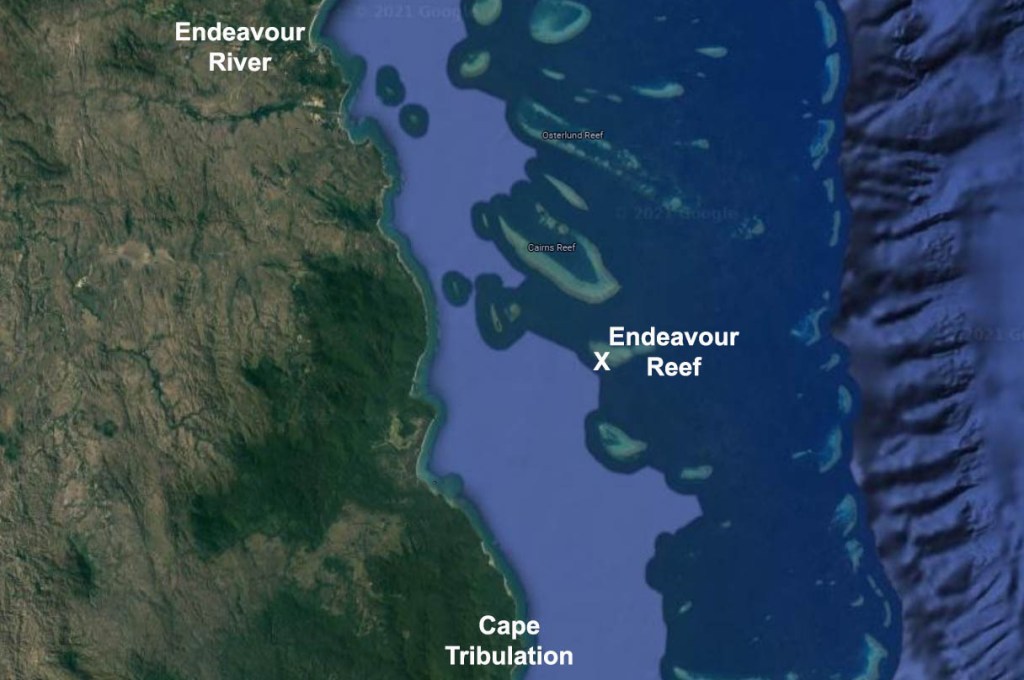
    As the Endeavour famously made its way up Australia’s east coast in 1770, there was a moment when the success of Cook’s voyage hinged on a pile of sticky animal dung, and some handfuls of wool and rope fibre. The incident occurred shortly after passing Cape Tribulation, so named by Cook because that was where his troubles began.

       All of Monday, 11 June, the Endeavour had been sailing about 15 kilometres off the coast, pushed along by an east-southeasterly breeze. At 6 in the evening, Cook ordered the sail to be shortened, and he instructed the helmsman to steer to the seaward of two small islands lying directly in their path. He also had a seaman in the bow constantly sounding the depth, for he was literally sailing into the unknown. Then, shortly after 9 o’clock, as he and his officers sat down to supper, the seabed suddenly rose to within 15 metres of the sea’s surface. Cook called the crew to their stations and was prepared to drop anchor or adjust sail, but as suddenly as the seabed had risen, it dropped away again. They had just passed over a coral reef.

       Then, an hour or so later, the Endeavour ran up on a coral reef and stuck fast. Cook was about to discover he had stumbled into a dangerous labyrinth of reefs and shoals where the Great Barrier Reef pinched in close to the Australian mainland.

    “The Endeavour on the Reef” Source: Picturesque atlas of Australasia, 1886.

    An anchor was taken out aft in the hope that they might be able to kedge the Endeavour back off the reef on the high tide. But when the time came for the men to heave, she would not budge. The next high tide would be at 11 a.m., so he ordered the crew to lighten the ship for the next attempt. Cannons, ballast, water casks, stores of all sorts were tossed over the side.  At high tide, they tried kedging off the reef a second time, but again she would not budge.  Yet more stores went over the side, and on the third attempt, the Endeavour floated free, but the hull had been breached, and water was pouring into the hold.

       All three working bilge pumps were manned non-stop to stop the Endeavour from sinking. Everyone, sailors, officers, civilian scientists, and even Cook himself, took fifteen-minute turns at the pumps. Cook knew their survival hinged on finding a suitable place to beach the stricken vessel so they could make repairs. But there was no guarantee he would find such a place before his ship foundered.

       Then, a young midshipman, Jonathan Monkhouse, suggested fothering as a means of plugging the leak and buying them some much-needed time. He had seen it done with great effect on a ship he had previously served on. With nothing to lose, Cook set him to work, aided by as many men as he could spare from pumping and sailing duties.

       Monkhouse took a spare canvas sail and spread it out on the deck. He gathered up a large quantity of rope fibre and wool and had his men chop it up finely. The short fibres were mixed with dung from the animal pens and formed fist-sized sticky balls of odorous matting. These were slopped onto the sail about six to eight centimetres apart until a sizeable portion of the canvas had been covered.

       The sail was then lowered over the side of the ship forward of the hole in the hull, and then drawn back along the side. As the fother – the particles of oakum and wool – were sucked in through the rents in the hull, they caught on the edges, and in no time at all, they plugged the holes and slowed the leaks to a trickle.

    Map showing Endeavour Reef when the ship went aground. Source: Google Maps.

       “In about half an hour, to our great surprise, the ship was pumped dry, and upon letting the pumps stand, she was found to make very little water, so much beyond our most sanguine expectations had this singular expedient succeeded,” Joseph Banks would later write in his journal.

       For the first time since striking the reef, the Endeavour was out of immediate danger.  She was now taking on less than half a metre of water each hour, and that could be easily managed using just a single bilge pump.

       The Endeavour sailed a bit further up the coast until they reached what is now named Endeavour River. There, Cook found a steeply sloping sandy beach ideally suited to careening his ship. And, after several days’ delay waiting for safe conditions to enter the river mouth, he ran the barque onto the beach to examine the damage.

    The Endeavour beached for repairs. Photo courtesy SLQ

    At 2 a.m. [on 23 June] the tide left her, which gave us an opportunity to examine the leak, … the rocks had made their way [through] 4 planks, quite to, and even into the timbers, and wounded 3 more. The manner these planks were damaged – or cut out, as I may say – is hardly credible; scarce a splinter was to be seen, but the whole was cut away as if it had been done by the hands of man with a blunt-edged tool,” Lieutenant James Cook later wrote.

       Cook also found a fist-sized lump of coral lodged in the hull, along with pieces of matted wool and oakum, which so successfully stemmed the leak.

       At low tide the next day, the ship’s carpenters began replacing the damaged planks and the armourers got the forge going to manufacture replacement bolts and nails to secure the new timbers in place. In all, Cook and his crew spent six weeks there making repairs and re-provisioning.

    HMB Endeavour. Photo Courtesy SLV.

       Once the hull was repaired, the Endeavour put back out to sea on 4 August and gingerly made her way north. But they were still trapped in the same dangerous stretch of water that had come so close to ending the voyage. It would take several days of careful and nerve-wracking sailing before they escaped the intricate maze of coral shoals.

    The full story of the Endeavour’s stranding on the Great Barrier Reef is told in A Treacherous Coast: Ten Tales of Shipwreck and Survival from Queensland Waters.

    © Copyright C.J. Ison, Tales from the Quarterdeck, 2022.

    Enter your email address below to be notified of new posts.

  • The Tragedy behind the Gothenburg Medals

    L-R Robert Brazil, John Cleland, and James Fitzgerald. Photo: Adelaide School of Photography, 1876.

       In September 1875, the South Australian Government honoured three men for the courage they displayed when the Gothenburg sank with fearsome loss of life. James Fitzgerald, John Cleland and Robert Brazil had risked their lives to save other survivors from the ill-fated steamer.

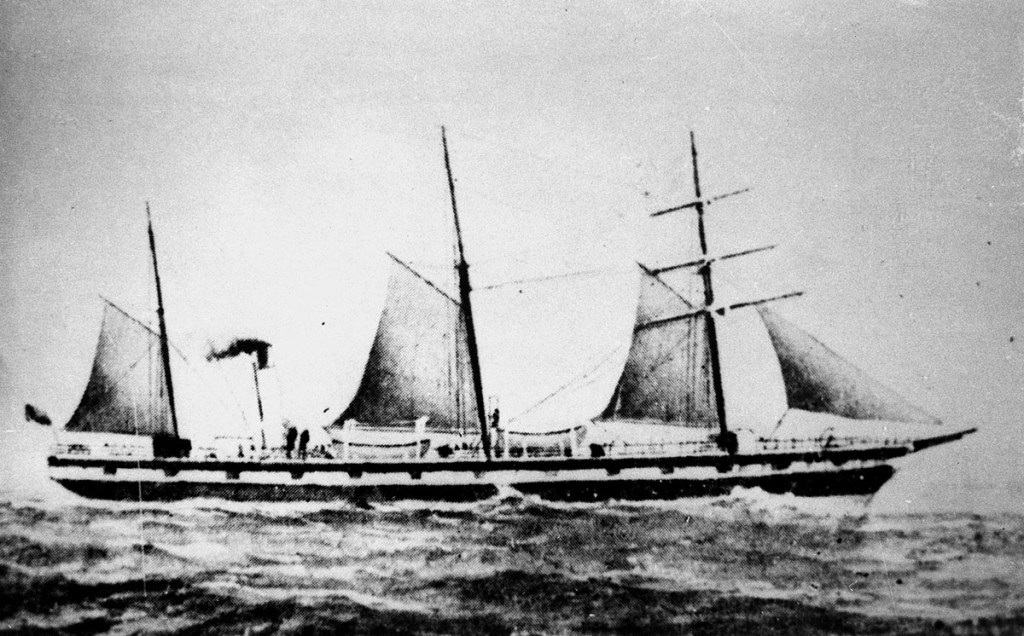
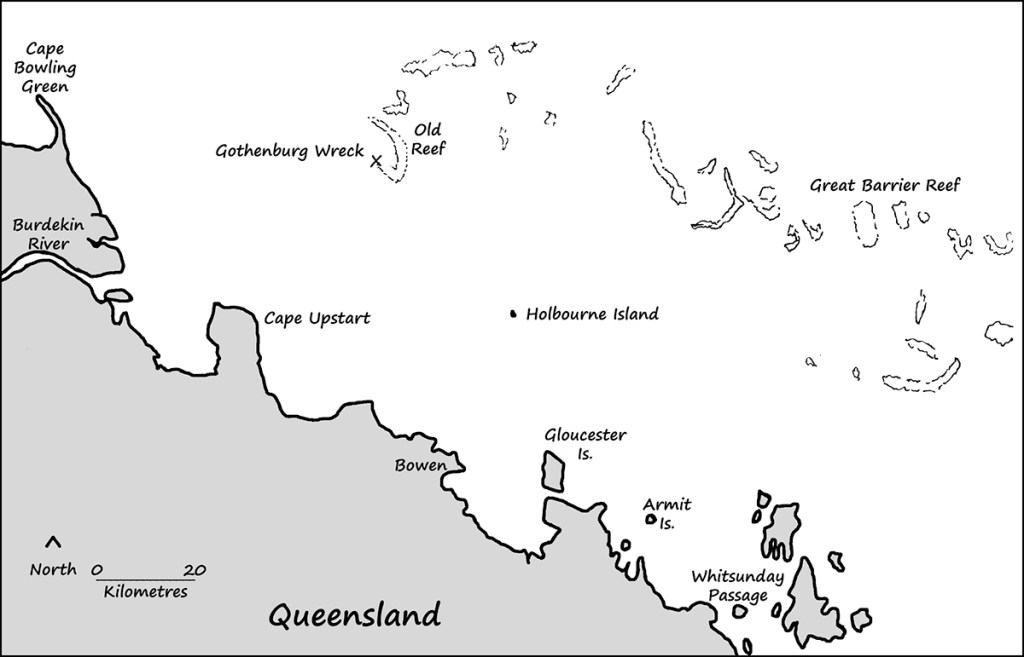
       The Gothenburg was a 501-ton steamer, and on this, her final voyage, she carried 37 crew and 88 passengers, 25 of whom were women or children. She departed Darwin on Tuesday, 16 February 1875, bound for Adelaide via Australia’s east coast. By the evening of the 24th, Cape Bowling Green just south of Townsville, would have been visible off the starboard side had it not been obscured by thick weather.

       The steamer had been followed by bad weather for most of the voyage down the Queensland coast. With usual landmarks hidden from view, the captain, James Pearce, was relying on his patent log to plot their progress. He thought he now had open seas ahead of him until they reached Flinders Passage, where he would pass through the Great Barrier Reef. It was early evening, and the Gothenburg was cutting through the water at 10 knots (19 km/h). Large swells made the ship roll uncomfortably, upsetting many of the passengers. But then the seas flattened.  It should have alerted the captain that they were in the lee of a large reef. But before any action could be taken, the Gothenburg ran onto a vast coral shoal hidden just under the sea’s surface.

    Illustration a the Human Society medal awarded to survivors of the Gothenburg shipwreck. Source: The Illustrated Adelaide News 1 Sep 1875, page 8.

       The impact was not particularly violent. The iron-hulled steamer had glided along the top of the reef, coming to a halt in less than her own length. By the time she stopped, her stern was still hanging out over deep water. It would transpire that the Gothenburg had drifted further east than Pearce had reckoned on, and they had struck Old Reef just north of Flinders Passage.

    Pearce was not particularly concerned at first; the hull had not been breached, and he thought he would be able to back the steamer off. However, when the engines were put in reverse, the ship didn’t budge. Pearce ordered the crew to move cargo from the fore hold and bring it aft. He also asked all the passengers to congregate on the stern. With the bow raised and the stern lowered, he hoped the ship would easily slide back off the reef. As the tide peaked, the engines were turning at maximum speed, but the vessel remained firmly stuck. The passengers and most of the crew retired for the night, expecting they would try again on the next high tide.

       Meanwhile, the weather continued to deteriorate. A powerful storm was fast approaching over the northern horizon. Through the rest of the night, the Gothenburg was lashed by high seas, torrential rain, and a gale-force wind.The steamer bumped and ground on the hard coral until the hull sprang leaks and she began taking on water, a lot of water.

       In just a few short hours, the situation became dire. Captain Pearce began preparations to abandon the ship, starting with the evacuation of women and children. It was now around 3 a.m., and pitch-black. Most of the passengers were already up on deck despite the atrocious weather. Few wished to remain in their cabins below.

       Pearce only had four lifeboats at his disposal, but two of them were swept away before he could get a single passenger off the ship. The third boat, only partly filled with passengers, capsized and broke apart as soon as it was lowered into the water. Then the ship heeled over, and a mountainous wave swept many of the passengers from the deck to drown in the turbulent sea.

    The wreck of the Steamer Gothenburg. Source: Australasian Sketcher, 20 Mar 1875, p. 13.

       A lucky few managed to swim back to the ship and were rescued by those who had climbed into the ship’s rigging before the wave struck. There they clung, hoping to ride out the storm. James Fitzgerald, John Cleland, both passengers, and one of the crew, Robert Brazil, were among the survivors.

       Fitzgerald would later recall, “We had seen illustrations of shipwrecks, but on this frightful morning … before daybreak, we saw the dreadful reality of its horrors. The ship was lying over on the port side, awfully listing, a hurricane was blowing, rain was coming down as it does in the tropics, and unmerciful breakers were rushing over the unfortunate vessel, seldom without taking some of the people with them.”

       John Cleland, a gold miner returning to Adelaide, spotted the fourth lifeboat floating upside down, still attached to its davits. He knew that if they were to have any chance of survival, they needed that boat. He climbed down from the rigging, tied a rope around his waist and swam through the breaking waves to better secure it.

    The Gothenburg. Photo Courtesy State Library of Queensland.

       Cleland’s first attempt failed, and he swam back through the surging seas to the relative safety of the main mast. James Fitzgerald then joined him, and together they repeatedly swam out to the boat, cut away at the tangled mess of ropes, and then swam back to the mast to rest. Finally, they cut through the last of the ropes securing the boat to the davits. They then tied it off again with a length of rope attached to the mast. But the boat still floated upside down. They had been unable to right the craft on their own.

       Seeing the pair struggling, Robert Brazil swam out and joined them, and with their combined weight, they were able to flip the lifeboat over. Cleland and the others were relieved to see that the oars were still securely locked in place.

       The trio then returned to the mast and tied themselves to the rigging high above the waves. They stayed there all that day and the following night, tied to rigging so they would not fall when they dozed off. Then, the following morning, the weather began to ease.

       The three men returned to the boat and bailed it out. Cleland, Fitzgerald, Brazil and eleven other men climbed into the lifeboat and eventually made it to the safety of Holbourne Island. They were rescued by boats sent out from Bowen to search for survivors the next day. Over one hundred people lost their lives in the disaster, Captain Pearce among them.

       A marine board enquiry found that the captain had not exercised sufficient care in the navigation of his ship. They felt that had he made the effort to sight Cape Bowling Green lighthouse or Cape Upstart as he steamed south, he might have more accurately fixed his position, and the disaster could have been averted.

    The full story of the Gothenburg shipwreck is told in A Treacherous Coast: Ten Tales of Shipwreck and Survival from Queensland Waters, available as a Kindle eBook or paperback through Amazon.

    © Copyright C.J. Ison, Tales from the Quarterdeck, 2021.

    Enter your email address below to be notified of new posts.
  • The Indian Queen’s Icy Encounter

    Striking of the Indian Queen on an iceberg in the South Pacific, on the morning of April 1. Source: London Illustrated News.

        The Indian Queen had a well-deserved reputation as a fast sailer on the England-Australia run. So much so, that in Melbourne, her captain had bet the master of the equally fast, and appropriately named, Greyhound, that he would reach port in England before him. But the wager would cost Captain Brewer far more than he bargained for.

       On 13 March 1859, the 1040-ton clipper left port bound for Liverpool, with a cargo of wool, gold and 40 passengers, a day ahead of the Greyhound. Once outside Port Phillip Heads, Captain Brewer bore south-east to pick up the strong westerly winds swirling uninterrupted around the Southern Ocean.

       So intent on beating the Greyhound was Captain Brewer that he threw caution to the wind. He took the Indian Queen into those frigid and rarely visited waters below 60° latitude, much further south than was prudent.

       The ship sliced its way through the sea at 12 knots (22 km/h) and made as much as 200-270 nautical miles (300-500 km) per day. After a fortnight of steady sailing, the Indian Queen was already halfway to Cape Horn. But the ship was also thousands of miles from any land except the barren shores of Antarctica. Then the weather turned foul.

    Black Ball clipper Marco Polo, sister ship to the Indian Queen.

        It was already bitterly cold that far south. But now the deck was lashed by freezing rain and sleet. Visibility was much reduced by the rain and a persistent fog, but Brewer kept all canvas out in his quest to reach Liverpool before the Greyhound. His only concession to the conditions was to post lookouts forward to warn of any impending dangers.

       Then, about 2 o’clock in the morning on 1 April, when they were about 58° S and 151° W, the Indian Queen crashed into a towering mountain of ice. It suddenly loomed out of the fog ahead of them, and the ship struck hard and came to rest broadside to the iceberg before anyone knew it was there. The impact tore away the bowsprit and a long section of the starboard bulwark. Tons of ice crashed down onto the deck, smashing the starboard lifeboat to pieces.

       The collision also sheared off the foremast just above the deck, felled the upper sections of the mainmast and strewed the deck with a tangle of ropes, timber spars and billowing clouds of canvas. More debris hung over the portside into the inky black water. Amid this scene of carnage, only the aft mast remained upright.   

    When the first passengers emerged on deck to see what had so violently awoken them, they found a scene of utter devastation. “So dark was it we could only see a spectral blueish white mass,” one passenger later recalled, “and the black waves washing up its sides.” 

    Approximate location of the collision. Google Maps.

       Perhaps more alarmingly, the poop deck was deserted.   The portside lifeboat was missing, as was the captain and most of the crew.

       No sooner had the ship slammed into the iceberg than Captain Brewer and most of his men had rushed to the only undamaged boat. They all knew that no one would live for long in those icy waters should the ship go to the bottom of the sea. Gone was any notion of getting women and children into the lifeboats first or that the captain would remain with his ship to the bitter end. Rather, fearing for their lives, it was every man for himself.

       Captain Brewer, the first mate, 13 sailors and two stowaways immediately put off in the undamaged lifeboat and pulled away from the stricken vessel, expecting it to sink below the surface at any moment. In his haste to save his own skin, Brewer had even abandoned his own 16-year-old son to fend for himself.

       When the ship’s carpenter, Thomas Howard, got on deck, he immediately sounded the pumps and found the vessel was not taking on any water. It looked as though the ship had struck the iceberg with a glancing blow, which had brought down the masts and rigging, but the impact had not breached the hull. Although the damage appeared severe, it had been largely superficial.

       Now that it was clear that the ship was not about to sink, the second mate, Philip Syratt, took charge of the few remaining sailors and got them to work cleaning up the mess. He and Howard then called out through the howling wind and murky mist for the captain and the rest of the crew to return to the ship.

       But, as the lifeboat materialised out of the fog and drew towards the Indian Queen, a large wave swept over its stern, filling it with icy seawater. Panic overtook the crowded boat, and they lost the oars in the confusion. Ropes and life buoys were tossed towards the semi-submerged boat, but it had already drifted out of range. The lifeboat with 17 souls sitting in waist-deep freezing water soon disappeared back into the mist, never to be seen again.   

    Syratt organised the crew and passengers into work parties, and they cut away much of the rigging and other debris dangling over the port side. They also cleared tons of ice from the deck and then jury-rigged sails, which allowed them to get underway. Syratt then bore north into warmer and safer latitudes. Forty days later, the Indian Queen limped into the Chilean port of Valparaiso with no further loss of life. Any thought of beating the Greyhound to Liverpool had been abandoned with the loss of the captain.

    © Copyright C.J. Ison, Tales from the Quarterdeck, 2021.

    Enter your email address below to be notified of new posts.