Author: cjisontftq

  • The Spanish Silver of Torres Strait

    Example of a mechant brig, similar to the Sun. Source: “L’Album De Marine Du Duc D’Orleans,” 1827.

       Sometime around 1891, a group of beche-de-mer fishermen stumbled upon a huge hoard of Spanish silver coins. The men had been fishing in the shallow waters of the Eastern Fields at the eastern approach to Torres Strait when they made the surprise discovery.

       At low tide, when much of the reef was exposed, they spotted an old, coral-encrusted anchor fluke jutting from the reef’s surface. The shoals of Torres Strait had claimed many a ship during the 19th Century, and the fishermen were keen to see what else they might find.

       They began chipping away at the decades of accumulated growth until the anchor finally broke free from the surrounding coral. When it was rolled clear, a mass of silver coins, all fused together by time and saltwater, was revealed. Buoyed by the find, the fishermen forgot about the beche-de-mer and extended their excavations. Each day, as soon as the falling tide exposed the reef, they got to work chipping away at the coral. In the end, they uncovered a staggering 410 kgs (900 pounds) of silver. It took them two trips to carry it all back to Somerset, the fishing and cattle station near the tip of Cape York owned by the early pioneering family of Frank Jardine.

    Spanish silver coins as circulated in the early days of New South Wales.

       At the time, it was supposed that the coins might have been carried on a Spanish ship on her way to Manila to pay the wages of the civil and military staff. Either that, or it was to be used to purchase spices from traders in the Indonesian Archipelago, further to the west. Regardless, the ship that had been carrying the fortune in silver had ended its voyage on that remote coral outcrop many decades earlier. They knew it was an old wreck, for by 1891, the timbers had long since rotted away.

       The mystery was only solved years later. It turned out not to have been a Spanish galleon at all. Instead, the fishermen had stumbled upon the remains of the English brig, Sun, which had been lost in Torres Strait in May 1826. Earlier that same year, the Sun had delivered a cargo of tea from China to merchants in Hobart and Sydney. In Sydney, a local businessman had entrusted the ship and her captain with a new cargo of between 30,000 and 40,000 Spanish silver dollars. At the time, one Spanish dollar was worth 4 shillings and 4 pence, which would have valued the somewhere between £7,000 and £10,000. In today’s money, the silver content alone would be worth well over one million Australian dollars.

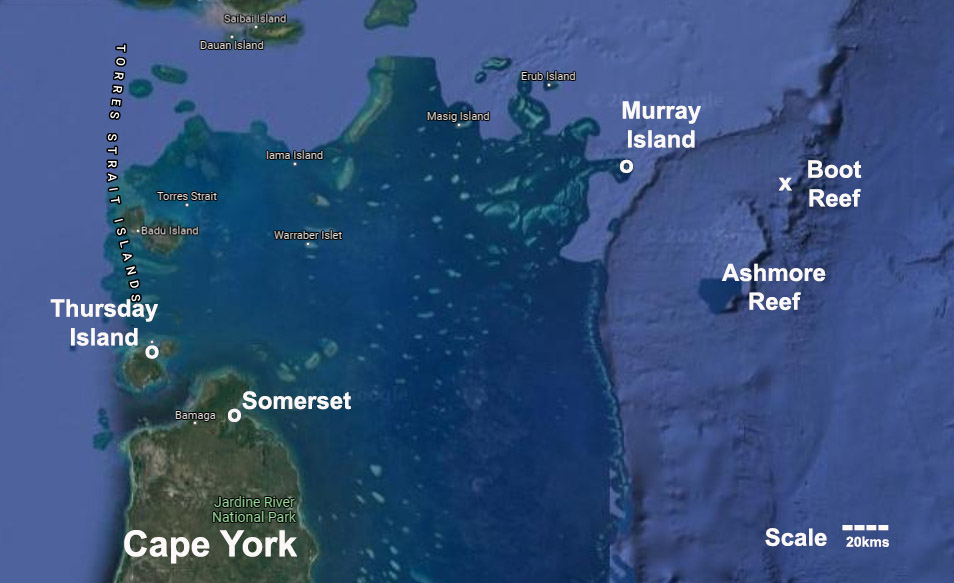
       The Sun sailed from Sydney on 7 May, bound for Singapore by way of Torres Strait. But it never arrived. The voyage was cut short three weeks later when the Sun struck a submerged reef as it attempted to navigate the dangerous waters separating Cape York from New Guinea.

    Torres Strait. Source: Google Maps.

       The ship broke up almost immediately. Captain Gillet and his crew took to the longboat and jolly boat and made for Murray Island, about 30 nm (60 km) away. Such was the haste with which they were forced to abandon the ship that there was certainly no time to save the silver. The crew didn’t even have time to provision the boats with food or water before they pushed away from the wreck. Fortunately, they would only be at sea for two days before sighting land.

       As fate would have it, just as their safety seemed assured, the longboat struck a reef and capsized, spilling all the occupants into the water. The first and second mates, plus 22 lascar sailors, drowned. Only the jolly boat with the ship’s captain and 11 remaining seamen reached Murray Island, where they were looked after by the Islanders. Three days later, Captain Gillet and his men were rescued by a passing ship and eventually delivered to Calcutta, where he reported the loss of his ship.   

    So, there the Spanish silver dollars remained undisturbed for the next 65 years as the Sun slowly disintegrated around them. As the employer of the fishermen, Frank Jardine claimed the lion’s share of the haul. He reportedly had at least some of the coins melted down and made into silver tableware and cutlery for the Jardine Homestead.

    © Copyright C.J. Ison, Tales from the Quarterdeck, 2021.

    Enter your email address below to be notified of new posts.

  • The Macabre case of the Mignonette

    Illustration of the yacht Mignonette.

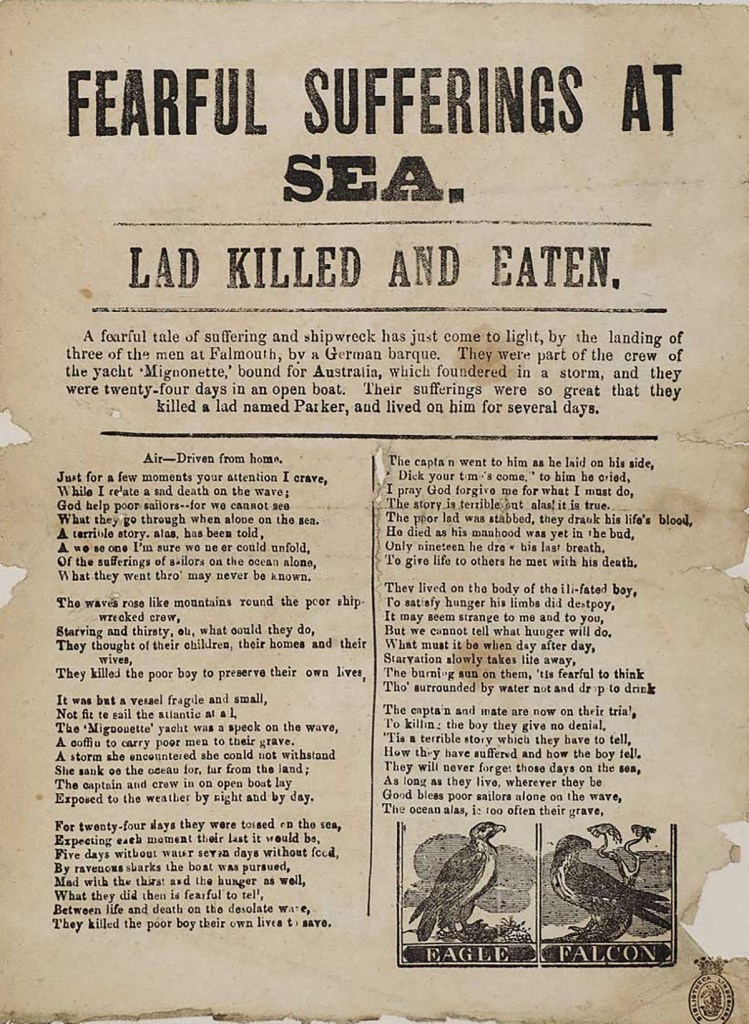
       Genuine verifiable instances of cannibalism among shipwreck survivors are remarkably rare. But when they have occurred, those involved have often been met with revulsion and sympathy in equal measure. Such was the case with the survivors of the small yacht Mignonette, which foundered in the Atlantic Ocean on its way to Australia in 1884.

       The Mignonette was a small yacht of about 33 tons. It had been purchased in England by Sydney barrister and Commodore of the Sydney Yacht Club, John Want. He hired a respected master mariner named Thomas Dudley and a crew of three to sail the vessel to Australia while he returned home by a regular steamer service in more salubrious surroundings.

       The Mignonette sailed from Southampton on 19 May 1884 and briefly stopped at Madeira off the Moroccan coast around the middle of June. Then, nothing further was heard of her until 6 September, when Dudley and two of his crew returned to England after being rescued at sea by the German barque Montezuma.    The world then learned the horrifying truth of their ordeal. Six weeks after leaving England, they were far from land, some 3000 kilometres south of the equator and 2500 kilometres off the Namibian coast. By now, the weather had turned foul. The seas ran high, and Captain Dudley was running before a strong wind, taking them further south. On the afternoon of 5 July, the Mignonette was struck by a gigantic rogue wave that had risen from nowhere and crashed into her side. The yacht’s hull was stoved in.

    As the Mignonette went down, The Illustrated London News, 20 Sept 1884, p. 268.

       The mate, Edwin Stevens, was at the wheel and barely had time to call out a warning before the monster wave struck. Fortunately, Dudley grabbed hold of the boom and held on as a wall of water swept across the deck.

       The Mignonette immediately started filling with water. Dudley ordered the men to prepare to abandon ship. They got the lifeboat over the side while he went below to gather provisions. By then, seawater was already swirling around the cabin interior. He only had time to grab a couple of tins of what he thought was preserved meat, before he raced back on deck and leapt into the dinghy as the Mignonette sank below the waves.

       Dudley, Stevens, Edward Brooks, and seventeen-year-old Richard Parker spent a frightening night in the tiny four-metre dinghy as the storm raged around them. When Dudley opened the tinned provisions, he discovered they contained not meat but preserved turnips. Even worse, they had no fresh water.   

    For the next five days, they subsisted on morsels of turnip and tiny quantities of rainwater, but it was never enough. Then their luck improved, at least for a short while. They captured and killed a turtle that had been basking on the sea’s surface.

    “Sailing Before the Wind.” The Illustrated London News, 29 Sept 1884.

       By day 19, the last of the turnips and the turtle meat had long gone, and the young cabin boy, Parker, had started drinking seawater to quench his burning thirst. He was now lying in the bottom of the boat in a delirious state.

      Wracked with hunger and despair, that night, Thomas Dudley suggested drawing lots to see who should be killed to provide sustenance so the rest might live. Brooks wanted no part of it and told the others he believed they should all live or die together.

       Dudley and Stevens discussed their options and felt that, as they were both married men with families to support, it should be Parker they butchered, as he was already close to death. The matter was settled.

       Dudley prayed for forgiveness for what they were about to do, then, as Stephens held Parker down, Dudley pulled out his knife and slit the boy’s throat. Brooks turned away, covering his eyes with his hands, but he could not block out Parker’s feeble pleas for mercy.    As Parker’s blood drained from his body, they caught it in an empty turnip tin and drank it. Brooks, despite his horror, was unable to resist taking a share. The three men fed on Parker until they were rescued by the passing barque Montezuma, five days later.

    Newspaper illustration showing the “terrible tale of the sea. and the horrible sufferings,” of the shipwrecked sailors.

       When Captain Dudley returned to England, he reported the loss of his vessel and the hardships they had endured afterwards, including the death of the delirious Parker. As abhorrent as his actions were, he believed he had committed no crime. In his mind, he had sacrificed one life to save three. But the police saw it otherwise. He and Stephens were remanded in custody to stand trial for the capital crime of murder.

       There was widespread interest in the tragic story in both Britain and Australia. Many people were sympathetic towards the captain and his first mate. But there were also those who felt the pair had acted prematurely in killing the dying Parker.

       At their trial, Dudley and Stephens pleaded not guilty, their barrister arguing they had acted in self-defence. He used the analogy that if two shipwrecked men were on a plank that would only support one, one or the other could be excused for pushing away the other man to drown. For, he argued, were both men to remain on the plank, both would perish.

    FEARFUL SUFFERINGS AT SEA. LAD KILLED AND EATEN. Courtesy State Library of Scotland.

         The judge didn’t see things that way. In summing up the case, he told the jury:

       “It was impossible to say that the act of Dudley and Stephens was an act of self-defence. Parker at the bottom of the boat was not endangering their lives by any act of his. The boat could hold them all, and the motive for killing him was not for the purpose of lightening the boat, but for the purpose of eating him, which they could do when dead, but not while living. What really imperilled their lives was not the presence of Parker, but the absence of food and drink.”

       The jury found the pair guilty, and the judge sentenced them to death, but it appears there was little likelihood that the death sentence would ever be carried out. Even Parker’s family had forgiven the two men on trial. After waiting on death row for six months, both sentences were commuted to time served, and they were released from custody.   

    It was generally agreed that they had acted as they did under the extreme duress of being lost at sea for so long without food or water. No one felt that justice would be served by punishing the two men any more than they had already suffered.

    Copyright © C.J. Ison, Tales from the Quarterdeck, 2021.

    To be notified of future blog posts please enter your email address below.

  • The Bogus Count and Hamlet’s Ghost

    Hamlet’s Ghost at Surabaya, Indonesia, 1868. Photo Courtesy: Walter B Woodbury Photograph Collection, Robert S. Cox Special Collections and University Archives Research Center, UMass Amherst Libraries.

       Some things you can’t make up. This is the improbable story of how a young man impersonating an Austrian aristocrat came to cruise up the Queensland coast on a resurrected vessel named Hamlet’s Ghost.

       In May 1868, a dashing young man stepped ashore in Sydney claiming to be Count Ignaz Von Attems, a blood relative of Archduke Albert of Austria. The Von Attems family traced its aristocratic lineage back to the 12th Century. To Australia’s class-conscious and pretentious squattocracy, the young count gracing their presence was a man to be feted.

       Von Attems knew how the game was played, for he was a master far beyond his 25 years might suggest. He dressed extravagantly, splashed money around with abandon, hinted at a lavish monthly stipend and generally loved to court attention. He was a man to be seen and, more importantly, to many in colonial society, a man to be seen with. No social gathering of the day would be complete without the aristocratic Count attending. He would often dress in the full uniform of an Austrian cavalry officer, complete with sword, even when wandering about town.

       But, after spending just four weeks in Sydney being wined and dined by the city’s social elite, he up and left for Brisbane, promising he would return after doing a spot of hunting in the recently separated colony to the north.


    “The Gallant Count Von Attems” newspaper article from the 1940s. Source: Trove.

       Count Ignaz’s reception in Brisbane was no less exuberant than it had been in Sydney. The Premier of Queensland, Robert Mackenzie, hosted a champagne lunch in Von Attems’s honour, attended by the colony’s leading citizens, for no other reason than he had deigned to visit their humble domain.

       As in Sydney, he borrowed heavily on lines of credit with the colonial banks and convinced local merchants and new acquaintances alike to temporarily cover his expenses. His usual excuse, and one rarely questioned, was that he was waiting for his monthly allowance to catch up with him.

       By now, Count Von Attems, or Curt Oswald Schmulz as he was better known to his family back in Austria, had perfected his – far from petty – grift. Schmulz was charismatic, urbane, and exceedingly generous with “his” money. He was everything one would expect from a well-bred Austrian gentleman. Born into a middle-class family in Saxony, the young Schmulz attended a Commercial Academy and worked in a counting house (an accounting firm) while completing his studies. He also began mixing with friends from wealthier families who enjoyed a far more lavish lifestyle than he could afford. That did not deter the young man from living life to the full. Unfortunately, by the time young Curt Schmulz celebrated his 20th birthday, he had amassed debts neither he nor his father could repay.

    The man dressed in white is likely Curt Schmulz AKA Count von Attems on board Hamlet’s Ghost at Surabaya 1868. Walter B Woodbury Photograph Collection, Robert S. Cox Special Collections and University Archives Research Center, UMass Amherst Libraries.

       He quietly boarded an American-bound ship, leaving Europe and his financial troubles behind. However, the United States was embroiled in its own problems. The Civil War was raging, and Schmulz joined the Union Army, where he apparently served with some distinction. By the time he was mustered out at the end of hostilities, he had risen to the rank of Captain.

       For the next two years or so, he travelled through South America, Africa, and the Middle East before returning to Europe. He supported himself by using forged letters of introduction and drawing on fictitious lines of credit with banks far from where he happened to be at the time. No doubt his earlier employment at the counting house stood him in good stead, for he would have known how the financial system worked and how he could exploit it in those early days. He never stayed anywhere for long and assumed the personas of many different people, real and imagined. He also became adept at assuming the airs of a European aristocrat.

       When he left Sydney, he had no intention of ever returning. To do so would have courted disaster, for it would only be a matter of time before the trail of crumbs he had left behind him caught up. When it was time for him to leave Brisbane, he intended to keep heading north and make for Batavia in the Dutch East Indies (present-day Indonesia) to start anew.   

    And, one day, he found the ideal vessel to take him there. He purchased a luxurious pleasure craft enigmatically named Hamlet’s Ghost. It had a story just as interesting as the bogus Counts. A clue to its origin, for students of Shakespeare, can be found in the yacht’s name. Hamlet’s Ghost had been born from the carcass of the whaling schooner, Prince of Denmark.

    Example of an 1860s whaling Schooner.

       The Prince of Denmark had run aground on one of the Chesterfield Islands far out in the Coral Sea during a heavy storm in 1863. The prospect that they might be rescued by a passing ship was extremely remote. So, the captain got his men to work on building a new boat from the remains of his wrecked ship. Captain Bennett and his crew of Solomon Islanders then sailed her to Moreton Bay, where he sold the vessel. He and his men then boarded the next ship bound for Sydney.

       Hamlet’s Ghost first saw service as a lighter in Moreton Bay, transferring cargo from ships to shore. Then, three years later, a well-heeled merchant named George Harris purchased the craft. He had seen her hidden potential. After the shipwrights had finished with her, Hamelt’s Ghost had been transformed from a utilitarian workboat into a fine pleasure yacht. She was now a schooner-rigged vessel of about 8-10 tons with an elliptical stern and an overhanging bow. The hull had been sheathed in cedar and copper-plated to ward off seaworms. She had been fitted with a spacious cabin amidships, featuring a large central skylight that protruded above the deck, providing full headroom and an abundance of light.    “The vessel’s cabin is splendidly fitted up,” wrote one reporter. “The panelling is of grained maple mounted with gold mouldings, and a large pier glass fills up one end of the cabin.”

    Hamlet’s Ghost at Surabaya, 1868. Photo courtesy: Walter B Woodbury Photograph Collection, Robert S. Cox Special Collections and University Archives Research Center, UMass Amherst Libraries.

       She was also armed with three brass swivel guns to ward off any threats when cruising in remote or dangerous waters. But for the most part, Harris was content to sail her down the Brisbane River and around Moreton Bay.

       When the bogus count saw Hamlet’s Ghost, he knew it was the perfect vessel for what he had in mind. Von Attems told everyone that he intended to explore the warm waters along the Queensland coast, perhaps as far as Cleveland Bay (present-day Townsville), before returning to Brisbane. Harris was too canny a businessman to relinquish his vessel without first receiving full payment, no matter how esteemed the purchaser was. So, the count purchased the yacht with borrowed money to the sum of £500.  Von Attems crewed it with a captain, chief officer, three seamen, a cook/steward and, of course, a manservant.

       Three weeks after his sensational arrival, Count Ignaz Von Attems bid Brisbane “Auf Wiedersehen,” leaving another mountain of debt in his wake. He even had the audacity to direct creditors to the Prussian Consulate for payment shortly before he set sail.

       Curt Schmulz did not leave Brisbane too soon, for a month later, a warrant for his arrest issued in Sydney had reached the stunned city. By then, the bogus count was rounding Cape York Peninsula, but it had been anything but fair sailing up the Queensland coast.

       Hamlet’s Ghost had pulled in at Maryborough, Rockhampton and Cleveland Bay, where the leaving citizens, thrilled to be in such august company, entertained the dashing and gracious young man. But, for the crew, Count Von Attems had proved to be a particularly obnoxious creature to work for. By the time Hamlet’s Ghost had reached the government outpost of Somerset near the top of Cape York, the captain had had enough of the arrogant Count. Their latest argument escalated to the point where both men brandished their pistols, threatening to shoot each other. Cooler heads stepped in before either was hurt, and order was restored. However, the captain and the steward left the yacht at Somerset. Von Attems was only able to convince the rest of the crew to stay by promising them more money. They then left Queensland behind, passed through Torres Strait and on towards the Dutch East Indies.

       Count Von Attems, AKA Curt Schmulz, finally ran out of luck at Surabaya. There, he was arrested after passing several fraudulent bank bills. While waiting his day in court, Von Attems escaped the prison hospital and almost managed to flee the East Indies before being recaptured.

       He was finally tried, found guilty and served 10 years in Batavia’s notorious Glodok Prison. Hamlet’s Ghost was never returned to Queensland. The Dutch colonial government reportedly sold her off for £100, and her final years are unknown.

    (C) Copyright Tales from the quarterdeck / C.J. Ison 2021.

    To be notified of future blog posts please enter your email address below.

  • The Post Office in the middle of nowhere

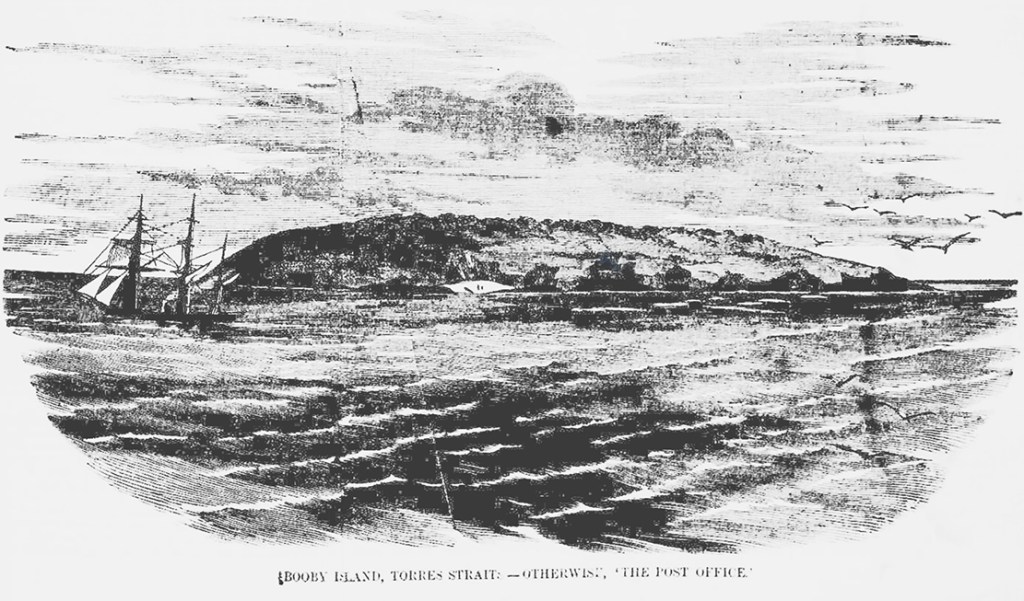
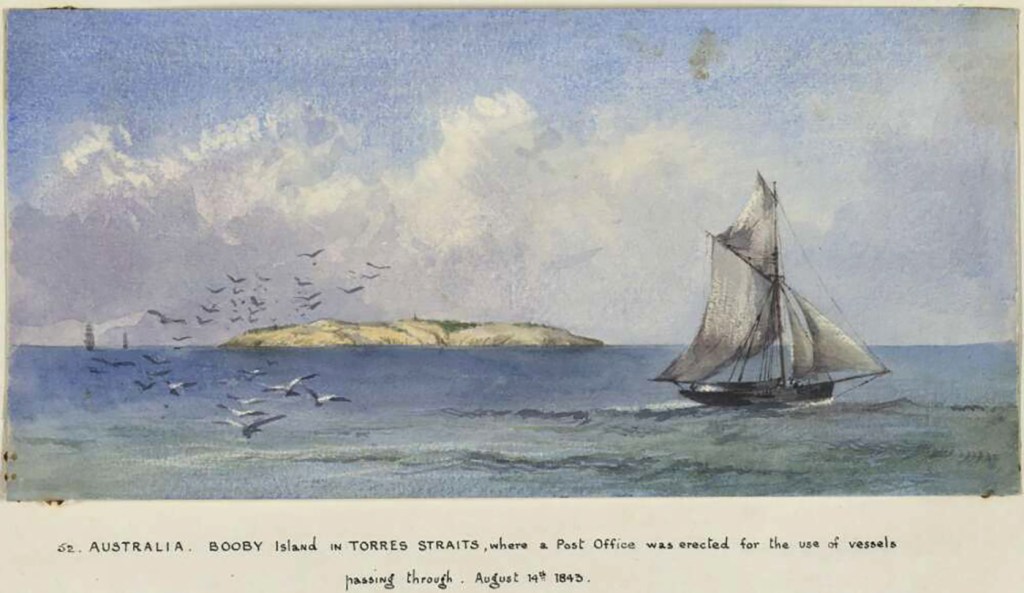
    Booby Island. Image courtesy National Library of Australia

       It might seem strange that one of Australia’s earliest post offices was also one of its most remote. It was set up on Booby Island in Torres Strait in 1835. However, the practice of passing mariners leaving correspondence on the island was already well established.

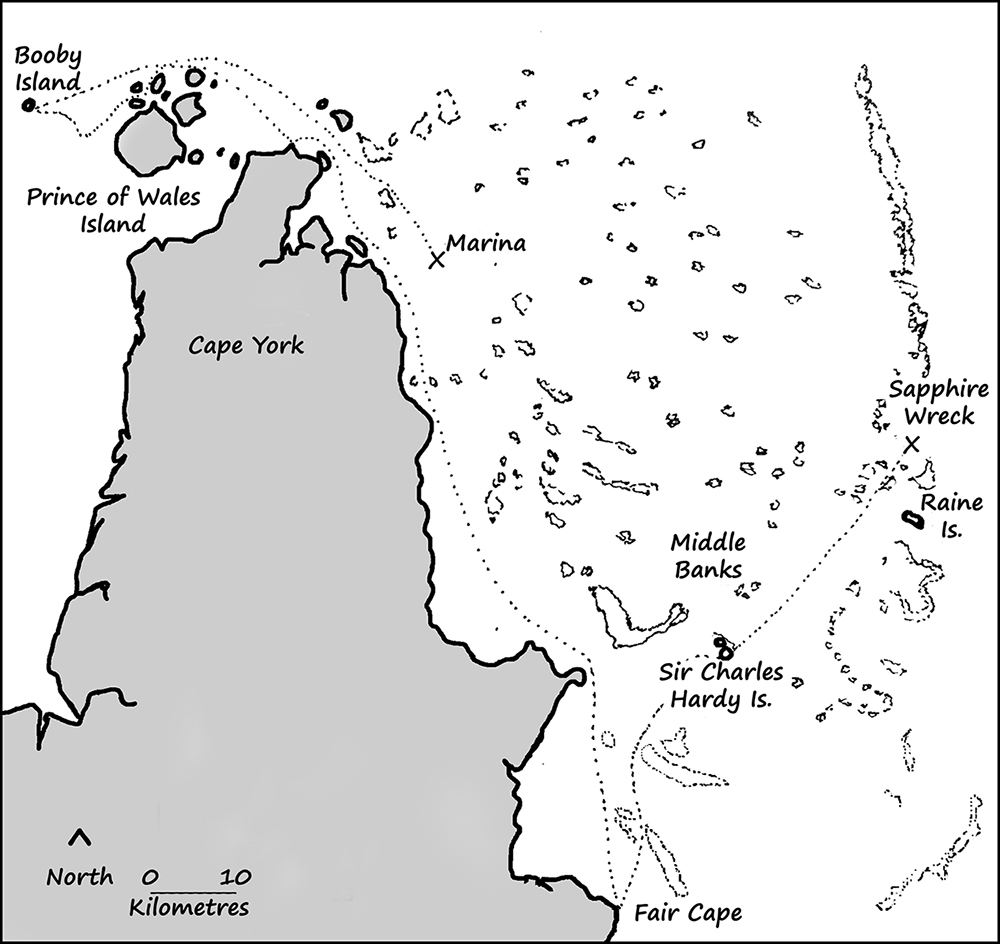
       Booby Island (Ngiangu to the Torres Strait Islanders) lies west of the tip of Cape York, about 1,800 nm or 3200 km by sea from Sydney. The nearest European settlement was the Dutch outpost of Kupang on Timor Island, 2000 km west across the Arafura Sea.

       Cook named the small outcrop Booby Island after the birds he saw nesting on its rocky slopes. The island would go on to serve as a crucial navigation landmark, especially for those mariners who had sailed up Australia’s east coast and were bound for Timor and beyond. Reaching Booby Island meant they had made it safely through the labyrinth of dangerous coral shoals plaguing the Torres Strait.  

       The earliest record of shipwrecked sailors finding refuge on Booby Island dates to 1814. The merchant vessel Morning Star, sailing from Sydney to Batavia, struck a reef and sank in Torres Strait. The crew abandoned the ship and made for nearby Booby Island. They were stranded there for five months, living in one of the island’s caves and surviving on rainwater and the seabirds that resided there. Then a sharp-eyed observer on a passing ship noticed a white flag being vigorously waved by one of the survivors. Five men were rescued. Twenty-two of their shipmates, including the captain, lost their lives.

       By the 1820s, ships were regularly passing through Torres Strait on their way from Sydney and Hobart bound for ports in India, China and England. Too many ran aground or sank in those remote and treacherous waters.

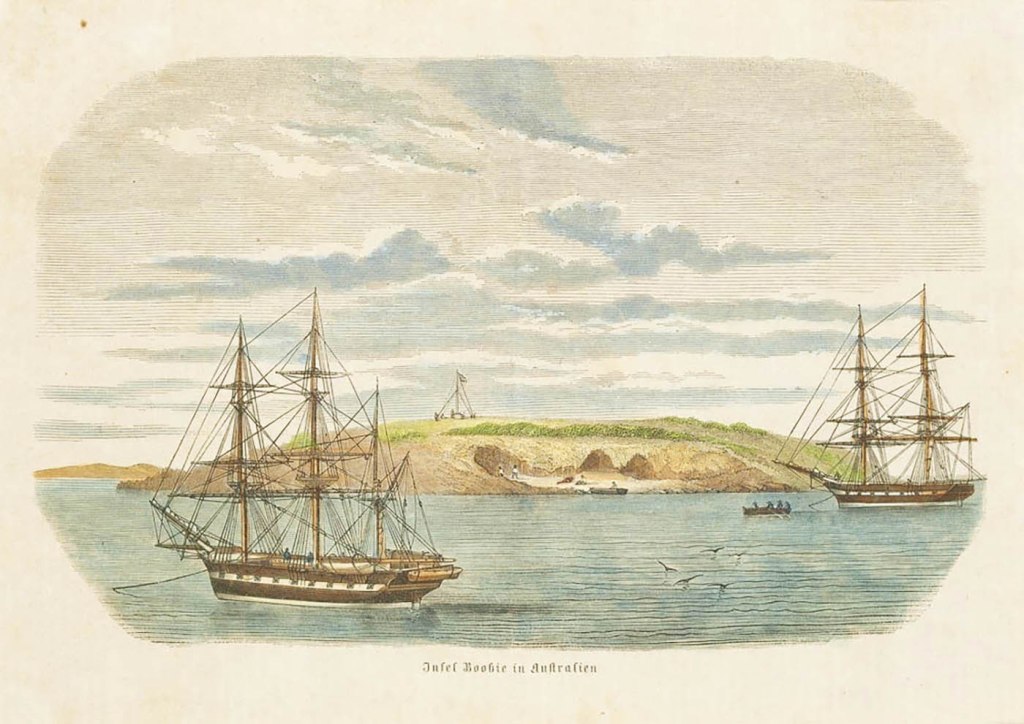
       In 1822, a flagstaff was erected on Booby Island’s summit, and a logbook was placed in one of the island’s caves so ships’ captains could register their safe passage through the Great Barrier Reef and Torres Strait. Those same mariners also began leaving sailing reports in the ledger to aid their fellow seafarers. The location of uncharted reefs or the strength and direction of hazardous currents were all recorded, sometimes at the cost of the vessel. Much of this information would be used to update later naval charts of the region.

    From an unidentified illustrated newspaper depicting Booby Island in the Torres Strait. Illustration Courtesy State Library of Queensland.

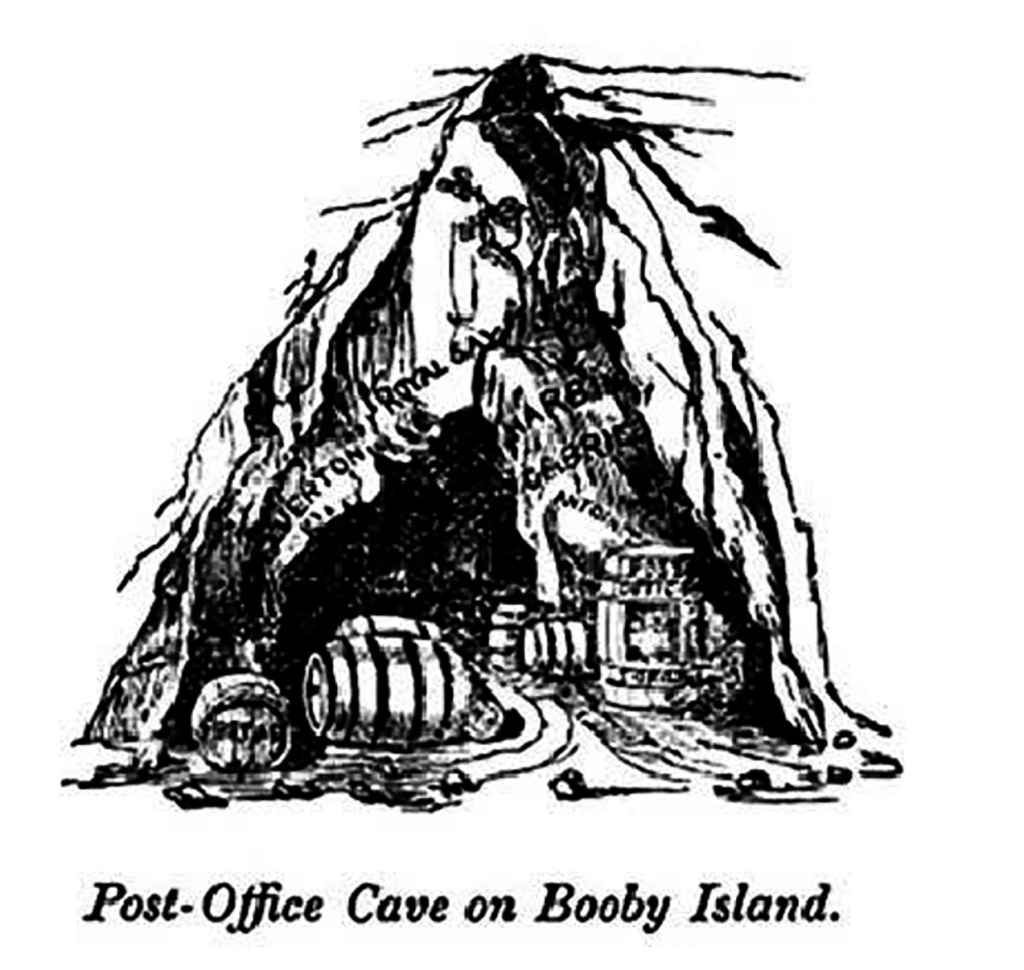
       Shortly after taking up duties as the Governor of New South Wales in 1824, William Bligh had the island stocked with barrels of fresh water, preserved meat and sea biscuits. Bligh knew stocking the island with provisions would go a long way towards saving the lives of sailors unfortunate enough to come to grief in those remote northern waters. He had first-hand knowledge of just how dangerous they could be. As a young Lieutenant, Bligh had sailed a small open cutter through Torres Strait after he had been unceremoniously relieved of his ship, HMS Bounty, by its mutinous crew.

       Then, 11 years later, in 1835, Captain Hobson of HMS Rattlesnake established the unmanned “post office” in one of the island’s small caves. The practice of leaving details of sailing hazards continued. But mariners also began leaving letters in the box in the hope they might be taken on to various destinations by other passing ships. For example, someone on a ship bound for India might leave a letter addressed to a recipient in Canton, China. The next ship bound for that port would take it on to its destination.   

    When the Upton Castle stopped briefly at Booby Island in 1838, one of its passengers visited the post box and described it thus,“[it is] covered with canvas and well secured, and supplied with a quantity of pens, paper, and ink, and pencils in excellent order.”

    Early illustration of the Booby Island Post Office.

    It is worth remembering that the only other post office in Australia at the time was in Sydney.    Melbourne would not get a post office for another couple of years and it would be seven years before another post office appeared in what would become Queensland.

    In the span of just 15 years castaways from at least ten ships owed their lives to Booby Island.   The Coringa Packet, and Hydrabad (1845) Ceres (1849), Victoria (1853), Elizabeth, Frances Walk   It is worth noting that, at the time, the only other post offices in Australia were located in Sydney and Hobart. Melbourne would not get a post office for another couple of years, and it would be seven years before Brisbane got one.

       In the span of just 15 years, castaways from at least ten ships owed their lives to supplies left at Booby Island. Survivors from the Coringa Packet, and Hydrabad (1845), Ceres (1849), Victoria (1853), Elizabeth, Frances Walker and Sultana (1854), Chesterholme (1858), Equateur, and Sapphire (1859) and many more before and since made for the island after their ships were lost.

       Booby Island remained a vital refuge for shipwrecked mariners and a place to exchange information until the 1870s, when a government outpost was established on nearby Thursday Island.er and Sultana (1854), Chesterholme (1858), Equateur, and Sapphire (1859) and many more before and since made for the island after their ships were lost.

    Booby Island remained an important refuge for shipwrecked mariners and a place to exchange information until the 1870s when it was supplanted by a government outpost on Thursday Island.

    Copyright © C.J. Ison, Tales from the Quarterdeck, 2021.

    To be notified of future blog posts, please enter your email address below.

  • Thomas Pamphlett and the Remarkable Castaways of Moreton Bay

    Source: ‘The Finding of Pamphlet’, Picturesque Atlas of Australasia, vol. II, 1886, nla.cat-vn1654251.

    Most Queensland school children are taught that the first non-Aboriginal people to settle in their state were convicts and their gaolers who arrived in September 1824.   But actually the first white-skinned people to live in what would become Queensland were three castaway ex-convicts who came ashore 18 months earlier.

    In 1823 Governor Brisbane sent the NSW Surveyor General, John Oxley, to determine if Moreton Bay, 800 kilometres north of Sydney, would make a suitable penal settlement to house the colony’s worst and most incorrigible convicts.

    On 29 November the small government cutter Mermaid, carrying Oxley and his party, dropped anchor in Pumicestone Passage separating Bribie Island from the mainland.   To their astonishment, among the Aborigines they could see on shore stood a taller, lighter-skinned man excitedly haling them.    His name was Thomas Pamphlett and he and two mates had been living with the local Aboriginal peoples for the past seven months.

    This is their story.     On 21 March 1823 four ticket-of-leave men, Thomas Pamphlett, John Finnegan, Richard Parsons and John Thompson, sailed from Sydney in a 10-metre-long open boat bound south to the Illawarra to gather cedar logs for sale in Sydney.

    However, they were caught in a ferocious storm which battered the craft mercilessly for five days.   They were driven far from the coast under a bare mast and when the storm finally cleared five days later they had no idea where they were.     They thought they had been blown south towards Van Diemen’s Land but in fact they had been taken north.    So, when they could finally hoist a sail they bore north in search of Sydney.  

    Their water had run out days earlier and they only had rum to quench their thirst.    All four were in a bad way but John Thompson became delirious and died from thirst.   They kept him in the boat for several days until the smell drove them to bury him at sea.  

    They finally sighted land about three weeks after setting off from Sydney.   This turned out to be Moreton Island though that was not known to them at the time.   They could see a freshwater stream flowing across the beach so Pamphlett swam ashore with the water keg in tow.   He drank his fill but was too weak to swim back to the boat.    The others, crazed with thirst, brought the boat closer to shore but it got caught in the surf and was smashed to pieces.

    The three men were alive but stranded.   They salvaged some flour, a bucket, an axe, a pair of scissors, the water keg but little else.    They soon came across an Aboriginal camp in the sand dunes and were befriended by the people.    The three castaways lived with their hosts for a couple of months then they decided to set off north thinking they would eventually reach Sydney.

    First they went south to cross over to Stradbroke Island then onto the mainland where they ventured north around Moreton Bay   All the time they were accompanied by different bands of Yuggera.   Pamphlett and Finnegan decided to stop at Bribie Island on the northern edge of the bay and lived with the Joondoobarrie people until they were found by Oxley and his party.     Parsons, still determined to return to Sydney kept heading north and may have gone as far as Harvey Bay before it was made clear to him his presence among the Butchella people was not welcomed.  

    The cutter Mermaid. Photo State Library of Queensland

    He returned to Bribie Island many months later only to find his comrades had been taken away on the Mermaid.   However, the party of explorers left a message in a bottle for Parson should he ever pass that way again.   Unfortunately, he was illiterate and could not read the message that had been left for him, but he remained in that area in the hope that another ship might pass that way.    He was in luck.   The brig Amity sailed into Moreton Bay in September the following year with 30 convicts and their guards to establish the first settlement at Redcliffe.   When they came ashore Parsons was standing on the beach waiting for them.  

    Richard Parsons was returned to Sydney and found work as a bullock driver. John Finnegan later returned to Moreton Bay and took up a post piloting ships in and out of the bay. Thomas Pamphlett also returned to Moreton Bay, but it was not of his own choosing. He stole two bags of flour in 1826 and was sentenced to spend seven years toiling at Moreton Bay penal settlement.

    For more interesting stories from Australia’s maritime past check out  A Treacherous Coast: Ten Tales of Shipwreck and Survival from Queensland Waters, available now as a Kindle eBook or paperback through Amazon.

    (c) C. J. Ison / Tales from the Quarterdeck, 2021.

    To be notified of future blog posts, please enter your email address below.